
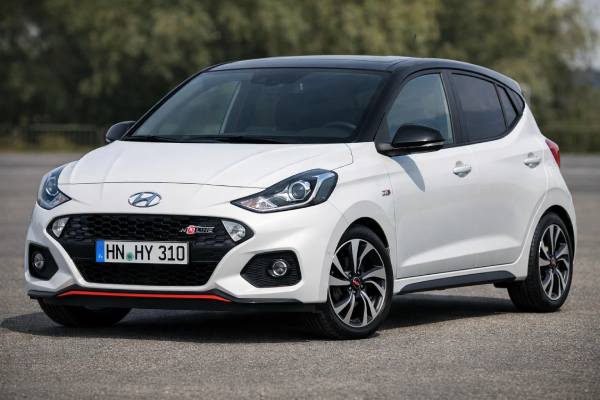
The 2020–2023 Hyundai i10 N Line (AC3) 1.2 MPi is a niche version of Hyundai’s city car, but it fills an interesting gap in the market. It combines the sharper styling and cabin details of the N Line trim with the simpler, naturally aspirated 1.2-litre four-cylinder petrol engine rather than the more performance-focused turbo option. That matters for owners. You get the visual appeal of the sportier model, a smoother and less stressed engine than the small turbo in some situations, and lower mechanical complexity over the long term. It is still a city hatchback first, not a hot hatch, but it feels more mature and better equipped than many small rivals. Because N Line engine availability varied by country, this guide focuses on the 1.2 MPi 84 hp version where offered and uses representative official figures while noting where market, seating layout, or transmission choice can change details.
Quick Specs and Notes
- The 1.2 MPi engine is smooth, simple, and well matched to urban and suburban use.
- N Line trim adds stronger visual character, sportier cabin details, and usually larger wheels.
- Cabin packaging and boot space are excellent for a car in this class.
- Some N Line hardware and equipment differ by market, so VIN-level checking matters.
- A sensible oil and filter interval is every 10,000–15,000 km or 12 months.
Start here
- Hyundai i10 AC3 N Line traits
- Hyundai i10 AC3 N Line data
- Hyundai i10 AC3 N Line equipment
- Known faults and service actions
- Maintenance map and buyer checks
- Road feel and real economy
- Hyundai i10 N Line rivals
Hyundai i10 AC3 N Line traits
The AC3-generation i10 is one of the more convincing modern city cars because it does not feel like a stripped-down compromise. It has a short body, a tight footprint, and easy manners in traffic, but it also offers a cabin that feels properly developed, with useful rear-seat space, decent shoulder room for the class, and an upright driving position that makes daily driving simple. In N Line form, Hyundai gave the i10 a more assertive look with unique bumpers, red exterior accents, specific wheels, and sportier interior detailing. That immediately changes the tone of the car. It still does the same practical job as the standard i10, but it looks less anonymous and more deliberate.
The 1.2 MPi version is important because it gives the N Line a different personality from the 1.0 T-GDi model. Instead of chasing outright punch, the 1.2 uses a naturally aspirated four-cylinder engine with multi-point fuel injection. That brings a calmer power delivery, smoother idle quality, and simpler long-term ownership. In day-to-day use, it often feels more linear and less busy than a tiny turbo engine driven gently around town. Drivers who care more about predictability than drama usually appreciate that. It also means there is less heat and pressure in the system, and fewer expensive turbo-related worries once the car moves into older used-car territory.
The AC3 platform itself is a step forward from the earlier IA car. The body is stiffer, the design is more mature, and Hyundai put more effort into active safety and connectivity. That helps the i10 feel like a small modern hatchback rather than a bargain-bin city runabout. The boot is useful, visibility is good, and the low-stress control weights suit new drivers, commuters, and people who spend a lot of time in tight urban streets. For many buyers, this is the core advantage: the i10 N Line 1.2 looks sportier than its mission, but its mission remains practical.
That balance is also why expectations matter. The 1.2 MPi N Line is not a junior hot hatch. It gets the visual attitude and some trim-level upgrades, but not the full performance shift that many buyers imagine when they hear the N Line badge. The real appeal is subtler. It is a stylish, compact, relatively light hatchback with a simple four-cylinder petrol engine and a well-packaged interior. That combination is actually rare now. For city and suburban owners who want something sharper-looking than the average base hatchback without taking on turbo complexity, the AC3 i10 N Line 1.2 makes more sense than its modest output figure suggests.
Hyundai i10 AC3 N Line data
The figures below describe the 2020–2023 Hyundai i10 N Line (AC3) with the 1.2 MPi 84 hp engine where that engine was offered with N Line trim. Hyundai published slightly different figures depending on market, seat count, wheel package, and whether the car used the five-speed manual or five-speed AMT. Treat the table as a representative baseline and confirm any critical number by VIN, local brochure, or service data.
| Item | Hyundai i10 N Line (AC3) 1.2 MPi |
|---|---|
| Code | 1.2 MPi |
| Engine layout and cylinders | Inline-4, DOHC, 16-valve |
| Valves per cylinder | 4 |
| Displacement | 1.2 L (1197 cc) |
| Bore × stroke | 71.0 × 75.6 mm (2.80 × 2.98 in) |
| Induction | Naturally aspirated |
| Fuel system | MPi |
| Compression ratio | 11.0:1 |
| Max power | 84 hp (62 kW) @ 6,000 rpm |
| Max torque | 118 Nm (87 lb-ft) @ about 4,200 rpm |
| Timing drive | Chain |
| Rated efficiency | about 5.1–5.8 L/100 km (46.1–41.0 mpg US / 55.4–48.7 mpg UK), market and transmission dependent |
| Real-world highway @ 120 km/h | about 6.1–6.9 L/100 km |
| Transmission and driveline | Value |
|---|---|
| Transmission | 5-speed manual; some markets also offered 5-speed AMT |
| Drive type | FWD |
| Differential | Open |
| Chassis and dimensions | Value |
|---|---|
| Suspension, front / rear | MacPherson strut / coupled torsion beam axle |
| Steering | Motor-driven power steering |
| Steering ratio | about 14:1 |
| Lock-to-lock turns | about 2.7 |
| Brakes | Front discs; rear hardware varies by market and trim, verify by VIN |
| Most popular tyre sizes | 195/45 R16 on many N Line cars |
| Ground clearance | about 149–152 mm (5.9–6.0 in), market dependent |
| Length | about 3,670–3,675 mm (144.5–144.7 in) |
| Width | 1,680 mm (66.1 in) |
| Height | about 1,480–1,483 mm (58.3–58.4 in) |
| Wheelbase | 2,425 mm (95.5 in) |
| Turning circle | about 9.7 m (31.8 ft) |
| Kerb weight | about 930–1,000 kg (2,050–2,205 lb), depending on version |
| GVWR | about 1,350–1,430 kg (2,976–3,153 lb) |
| Fuel tank | 36 L (9.5 US gal / 7.9 UK gal) |
| Cargo volume | 252 L / 1,050 L (8.9 / 37.1 ft³), VDA |
| Performance and capability | Value |
|---|---|
| 0–100 km/h (0–62 mph) | about 12.8–13.8 s depending on gearbox and market |
| Top speed | about 171 km/h (106 mph) |
| 100–0 km/h braking | not consistently published in official open material |
| Towing capacity | market-specific and often limited; verify locally |
| Payload | about 420–500 kg (926–1,102 lb) |
| Fluids and service capacities | Value |
|---|---|
| Engine oil | SAE 5W-30 is a common Hyundai-approved grade in Europe; about 3.3 L (3.5 US qt) with filter |
| Coolant | Hyundai long-life ethylene-glycol coolant; verify mix ratio and capacity by VIN |
| Manual transmission oil | Hyundai-specified manual transaxle fluid; capacity varies by gearbox version |
| Differential / transfer case | Not separate on this FWD transaxle layout |
| A/C refrigerant | Check vehicle label; market-specific |
| A/C compressor oil | Check service label; market-specific |
| Key torque specs | Wheel nuts typically 88–107 Nm (65–79 lb-ft) |
| Safety and driver assistance | Value |
|---|---|
| Euro NCAP | 3 stars in 2020 protocol for the i10 line tested |
| IIHS | Not applicable |
| ADAS suite | AEB, lane support, driver attention warning, speed-limit support, eCall; exact mix varies by market and package |
The table shows why this version is appealing. It is light, space-efficient, and mechanically straightforward. The numbers are modest, but the overall ownership picture is strong.
Hyundai i10 AC3 N Line equipment
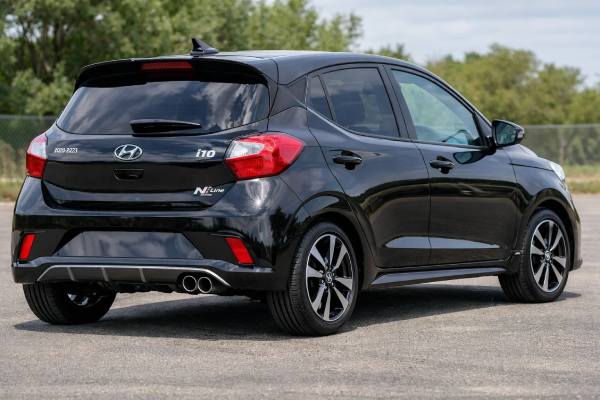
The N Line trim matters more to this car than the engine alone. On the outside, Hyundai used specific bumpers, a unique grille treatment, red accents, model-specific alloy wheels, and N Line badging to give the AC3 i10 a more athletic stance. The car still has the same basic proportions as the standard i10, but the visual effect is noticeably different. It looks lower, wider, and more purposeful, especially in darker colours or two-tone combinations. That matters in a segment where many cars still look built to a price.
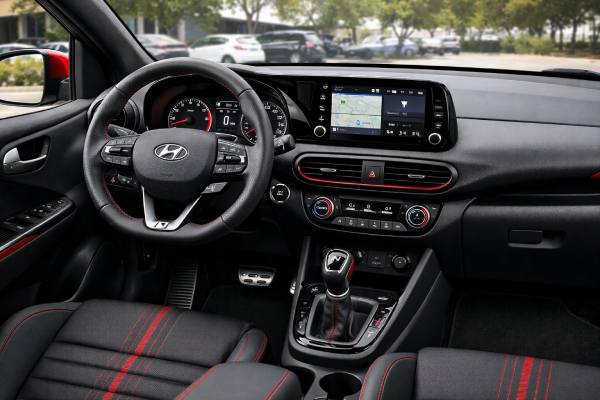
Inside, the N Line treatment is more than just a badge. The steering wheel, gear selector, seat trim, stitching, red air-vent highlights, and metal pedal details help it feel like a deliberate trim level rather than a sticker package. This is one of the strongest reasons to seek the N Line over a standard mid-grade i10. The basic dashboard design is already one of the better layouts in the city-car class, and the N Line extras give it a more focused feel without hurting practicality. Higher-spec cars also benefit from the stronger infotainment package, smartphone integration, a reversing camera, and in some markets navigation, wireless charging, and connected services.
Because equipment differs by country, buyers should think in groups rather than one universal trim list. Some 2020–2023 N Line cars came with the 1.0 T-GDi as the headline powertrain, while other markets also paired the N Line look with the 1.2 MPi. Some received five seats, some had four-seat efficiency variants elsewhere in the range, and some had manual-only drivetrains while others offered AMT. That is why the VIN, brochure, and equipment list matter more than the badge alone. A 1.2 MPi N Line with the right features can be a smarter long-term buy than a more powerful turbo car if your priority is low-stress ownership.
Safety equipment on the AC3 i10 was a real generational step forward. Depending on market and package, the i10 offered Forward Collision-Avoidance Assist with vehicle, pedestrian, and cyclist recognition, Lane Following Assist, Driver Attention Warning, Intelligent Speed Limit Assist, High Beam Assist, and eCall. That is a strong list for a small hatchback, though not every market made every item standard. Standard passive safety equipment usually included multiple airbags, ISOFIX anchorages, ABS, ESC, tyre-pressure monitoring, and hill-start assist. Euro NCAP’s 2020 result for the i10 line was more demanding than older tests and gave the car a three-star rating, which should be read in context. It reflects a city car with useful active safety equipment but not class-leading crash performance by tougher modern protocols.
For used buyers, the key equipment question is simple: decide whether you want the N Line for appearance, features, or both. If it is mainly about the look, a clean 1.2 MPi N Line can be the sweet spot. If it is mainly about performance, the turbo model is the one that changes the driving verdict. That distinction is central to shopping this version well.
Known faults and service actions
The i10 N Line 1.2 MPi is not a high-risk car, and that is one of its main virtues. The naturally aspirated 1.2-litre engine avoids the turbocharger, intercooler plumbing, and higher thermal load of the 1.0 T-GDi version. It also uses a timing chain rather than a timing belt, which removes one large scheduled replacement item from the ownership story. That does not mean it is maintenance-free. It means that the problems it tends to develop are the usual small-car issues rather than dramatic engineering weaknesses.
The most important theme is oil quality and service discipline. Chain-driven petrol engines are simple, but they do not like neglected oil. If a 1.2 MPi car has gone too long between services, cold-start chain rattle, tensioner wear, and rougher idle quality can appear earlier than they should. The usual pattern is easy to recognise: noisy start-up, a slightly ragged idle, or timing-related fault codes on a car with weak service history. The likely root cause is extended oil intervals or running low on oil. The remedy is also straightforward: keep the correct oil in it, do not stretch service intervals, and avoid a used example with clear cold-start noise unless it is priced for repair.
Beyond the engine, the most common issues are small and familiar. Short-trip use can age batteries quickly, especially in cars with lots of stop-start cycles, heated equipment, and infotainment use. Weak batteries can trigger odd warnings, sluggish cranking, and flaky start-stop performance. Ignition-coil or spark-plug wear can cause occasional misfire symptoms. Brake hardware can corrode or bind if the car has lived a pure city life. Clutches wear in the normal way, and any AMT version deserves extra care on test drive to check shift quality, hesitation, and calibration feel. None of this is unusual, but it is what owners actually see.
Chassis wear is usually modest. Front drop links, bushes, tyres, and wheel alignment are the most likely weak spots on cars that have lived on poor urban roads. Larger N Line wheels look good but can make the car more vulnerable to tyre damage, kerb rash, and harsher impacts. That means suspension knocks, steering vibration, and uneven tyre wear should never be dismissed as “normal small-car stuff.” They are usually signs that the car has hit potholes hard or missed alignment checks.
Public recall and campaign detail varies by country, and this is not a model where one universal defect headline dominates the ownership story. The right approach is VIN-specific verification. Use Hyundai’s official recall and service-campaign tools, ask for dealer records, and treat proof of completed campaign work as part of a healthy service file. On a relatively recent car like this, software updates for infotainment and some driver-assistance functions may also matter, especially on better-equipped versions. The overall reliability outlook remains good, but good examples are defined by evidence, not assumption.
Maintenance map and buyer checks
The smartest way to own an i10 N Line 1.2 MPi is to service it slightly more carefully than the minimum and to buy condition rather than spec-sheet excitement. This is not an expensive car to keep right, but it can become an annoying one if a previous owner cut corners on fluids, tyres, or brakes. The good news is that the core maintenance plan is simple and realistic.
| Service item | Practical interval |
|---|---|
| Engine oil and filter | Every 10,000–15,000 km or 12 months |
| Engine air filter | Inspect yearly; replace around 20,000–30,000 km |
| Cabin air filter | 12–24 months depending on climate and use |
| Spark plugs | About 45,000–60,000 km |
| Coolant | First major replacement around 5 years, then by official schedule and condition |
| Brake fluid | Every 2 years |
| Manual transmission oil | Refresh around 60,000–90,000 km for smoother long-term operation |
| AMT fluid and calibration checks | Follow Hyundai schedule where applicable |
| Timing chain | Inspect for noise or timing faults; replace only if symptoms or wear appear |
| Auxiliary belt and hoses | Inspect at every annual service |
| Brake pads, discs, and rear hardware | Inspect at every service |
| Tyre rotation and alignment | About every 10,000–15,000 km or when wear suggests it |
| 12 V battery test | Annually after year 3 |
For decision-making, a few numbers are worth keeping in mind. Engine oil capacity is about 3.3 litres with filter, wheel nuts are typically tightened to around 88–107 Nm, and the tyre package on many N Line cars is more expensive than the base i10 setup. That matters because premium tyres make a real difference to how this car drives. On a light hatchback, tyre quality affects steering feel, braking confidence, road noise, and wet-weather stability more than many owners expect.
A buyer’s inspection should focus on evidence and feel, not just appearance:
- Start the engine fully cold and listen for chain noise, rough idle, or warning lights.
- Check the service record for annual oil changes, brake fluid, and plug replacement.
- Inspect all four tyres for brand consistency, age, and shoulder wear.
- Drive over rough surfaces to listen for front-end knocks or wheel-related vibration.
- Test the clutch for a clean bite point and the gearbox for warm-shift smoothness.
- Check every electrical feature, especially the screen, camera, USB ports, and climate controls.
- Confirm that every safety warning lamp behaves correctly at start-up.
- Inspect the wheels for impact damage and the underside for poor repairs or corrosion starting at seams.
The best examples are usually late cars with full dealer or specialist history, good tyres, and no cosmetic evidence of hard city abuse. The ones to avoid are neglected by small margins rather than dramatic ones: overdue oil changes, mismatched tyres, weak batteries, or AMT cars with jerky low-speed behaviour. Long-term durability is good because the car is simple. That simplicity only pays off if the basics were never ignored.
Road feel and real economy
The i10 N Line 1.2 MPi drives better than its modest output suggests, but that verdict depends on understanding what it is. This is not the N Line turbo car in disguise. It is a light city hatchback with a slightly sharper visual and equipment package, powered by a small naturally aspirated four-cylinder. In town, that works well. The engine is smooth, the throttle response is linear, and the compact body makes the car easy to place. You do not get a wave of torque, but you do get predictability, and that matters more in traffic than many buyers admit.
One of the 1.2 MPi’s quiet strengths is refinement at low and medium load. Compared with many three-cylinder rivals, it tends to idle more smoothly and sound less strained in ordinary use. Around town and on suburban roads, that helps the N Line feel more grown up than its size implies. Steering is very light at parking speeds and still tidy enough once moving. The chassis is stable rather than playful, and the suspension tune is still city-car firm rather than genuinely sporty. On 16-inch N Line wheels, impacts are more noticeable than on smaller-wheel standard i10s, but the car remains composed if the tyres are good.
On faster roads, the 1.2’s limits are clear. A 0–100 km/h time in the 13-second range is acceptable for a city hatch, and a top speed around 171 km/h is enough for occasional longer trips, but the car is happiest below that pace. Overtakes need planning, especially uphill or with a full cabin. At 120 km/h, the engine is working, wind noise is more obvious, and the difference between this car and a larger supermini becomes clear. That is not a fault. It is simply the boundary of the segment.
Real-world efficiency is good rather than miraculous. In mixed driving, a careful owner can expect roughly 5.4–6.2 L/100 km. Gentle extra-urban use can dip into the low 5s, while fast motorway work, winter traffic, or repeated short trips can pull the average into the mid-6s or slightly above. Highway driving at 120 km/h typically lands around 6.1–6.9 L/100 km depending on wind, terrain, tyre choice, and load. AMT versions may trade a little smoothness for reasonable fuel performance, while the manual is usually the better choice for driver confidence and consistency.
The N Line trim changes the emotional experience more than the performance result. The seats, steering wheel, wheels, and visual attitude make the car feel a little more special every day, but the 1.2 MPi keeps the ownership and driving character grounded. That makes the car easy to like. It is honest, simple, comfortable enough, and efficient without demanding that the owner adapt to a complicated powertrain.
Hyundai i10 N Line rivals
The i10 N Line 1.2 MPi occupies an unusual space because it mixes sporty trim with an ordinary but capable naturally aspirated engine. That makes its closest rivals less obvious than they first seem. Against a Kia Picanto GT-Line or similarly styled Picanto 1.2, the Hyundai makes a very direct case. Both offer tidy packaging, city-friendly size, and a dressed-up look without the cost of a full performance model. The Hyundai often feels slightly more grown-up in cabin design and rear-seat usefulness, while the Kia may feel just as compelling on value and warranty reputation. In practice, condition and equipment usually decide the winner.
Against the Toyota Aygo X or older Aygo/108/C1-style city cars, the Hyundai’s advantage is maturity. It feels roomier, more substantial, and more like a small hatchback than a minimalist urban tool. Those rivals can be charming and efficient, but they tend to feel narrower, noisier, and less polished once the road opens up. The i10’s blend of space, technology, and everyday ease gives it a broader skill set.
The Volkswagen up!, Skoda Citigo, and SEAT Mii family remain strong benchmark rivals in how they drive. They often feel slightly cleaner in steering response and body control, and some drivers will prefer their more mature road manners. The Hyundai answers with fresher technology, broader active-safety availability in later years, and the appeal of the N Line trim itself. If the comparison is about ownership ease and city usefulness rather than chassis purity, the Hyundai makes a strong argument.
The larger question is whether the i10 N Line 1.2 is worth choosing over its own turbo sibling. For many buyers, yes. The 1.0 T-GDi N Line is quicker and more distinct dynamically, but it also changes the car’s character and complexity. The 1.2 MPi version is easier to recommend to buyers who want style, simplicity, and low running risk rather than extra shove. It is the rational choice wearing a sportier jacket.
That is the real verdict. The i10 N Line 1.2 MPi is not the fastest or most refined small hatchback of its era. It is one of the most balanced. It gives you a strong design package, a practical cabin, useful modern safety equipment, and a simple four-cylinder petrol engine in a class where compromises are usually much harsher. For urban drivers and long-term private owners, that mix remains genuinely appealing.
References
- The all-new i10 N Line | Cars – Hyundai Worldwide 2026 (Model Page)
- Hyundai i10 may seem like a small car, but it makes a big statement 2023 (Press Kit)
- Official Hyundai i10 2020 safety rating 2020 (Safety Rating)
- Hyundai i10 | Downloads | Hyundai Motor UK 2026 (Brochure and Tech Spec Hub)
- Home | Hyundai Recalls & Service Campaigns 2026 (Recall Database)
Disclaimer
This article is for informational purposes only and is not a substitute for professional diagnosis or repair. Specifications, torque values, service intervals, procedures, and equipment can vary by VIN, market, model year, and trim, so always verify critical details against the official service documentation for the exact vehicle.
If this guide helped you, please consider sharing it on Facebook, X, or another platform to support our work.