
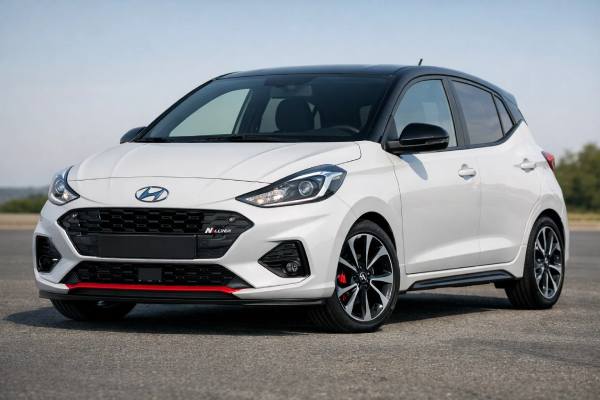
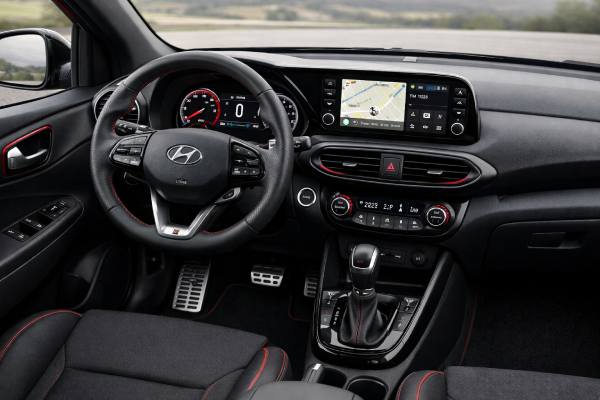
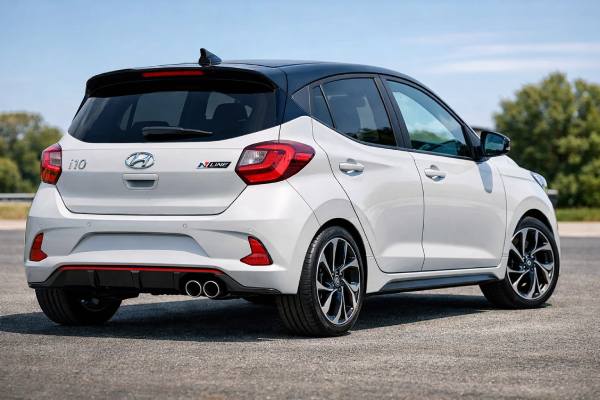
The 2023–2024 Hyundai i10 N Line AC3 is one of the few modern city cars that still tries to be useful and entertaining at the same time. It keeps the i10’s core strengths—compact size, clever packaging, easy visibility, and low running costs—but adds a turbocharged 1.0-litre three-cylinder engine, sharper steering and suspension tuning, and a much more distinctive look. For many buyers, that makes it the sweet spot of the facelifted range. It is not a true hot hatch, and Hyundai never pretended it was, but the N Line does feel noticeably more eager than the regular 1.0 MPi or 1.2 MPi versions. The trade-off is that this is a more tightly wound package, with a turbocharger, direct injection, lower-profile tyres, and a trim-specific parts list that deserves careful maintenance. Buy and service it with that in mind, and it offers a rare mix of city-car practicality and genuine character.
What to Know
- Strong low-rpm torque makes the i10 N Line feel much livelier than the regular i10 engines in daily driving.
- The N Line package adds real hardware value, including 16-inch wheels, sportier trim details, and a more focused chassis tune.
- Cabin space and boot capacity remain excellent for the class despite the sportier positioning.
- As a turbocharged direct-injection car, it benefits from shorter oil-change intervals than a minimum-cost owner might expect.
- A practical oil and filter interval is every 10,000 km or 12 months, and sooner in repeated short-trip use.
Explore the sections
- Hyundai i10 N Line AC3 focus
- Hyundai i10 N Line AC3 numbers
- Hyundai i10 N Line AC3 equipment and safety
- Common weak points and campaign checks
- Service plan and used buying advice
- Real-world performance and economy
- How the N Line compares with rivals
Hyundai i10 N Line AC3 focus
The facelifted AC3-generation Hyundai i10 N Line exists in a narrow but very useful space. It is not a stripped-out performance special, and it is not simply a styling pack either. Hyundai gave it visual changes, but also a turbocharged engine, trim-specific wheels, rear-disc-brake hardware in market material, and a more alert chassis setup. That combination matters, because most cars in this class lean either toward pure affordability or toward cosmetic sportiness. The i10 N Line tries to offer more than that.
The 2023 facelift sharpened the design and pushed equipment further. The updated i10 range brought revised lighting graphics, fresh wheel designs, new trim layouts, and broader safety equipment. In N Line form, the car also kept the details that separate it from the rest of the lineup: a specific grille and bumper treatment, red accents, 16-inch N Line wheels, sport-themed seat trim, and a cabin that feels more deliberate than playful. It still looks like a small hatchback, but it no longer looks anonymous.
The engine is the real reason enthusiasts notice it. This 1.0 T-GDi unit is a turbocharged 998 cc three-cylinder, commonly quoted at 100 PS in official European material and often rounded to 100 hp in used-car listings and search queries. More important than the headline number is the torque delivery. With 172 Nm available from low revs, the N Line feels much less strained than naturally aspirated city cars when pulling away, climbing a hill, or overtaking on a fast two-lane road. That gives the car a wider comfort zone. It is still primarily a city hatch, but it no longer feels trapped there.
Packaging is another major part of the appeal. Even as the sportiest version of the range, the N Line keeps the regular i10’s useful proportions. The boot remains 252 litres in VDA form with the rear seats up, and rear-seat space is still surprisingly decent for the segment. That matters because the N Line works best as a car you can enjoy every day, not one that asks you to trade all practicality for style.
Ownership, however, deserves realistic expectations. This is not a troublesome model by reputation, but it is a newer turbocharged direct-injection car, not an old-school basic runabout. That means oil quality, warm-up habits, tyre condition, and correct service procedures matter more than they do on the most basic small-car engines. If treated properly, the reward is one of the most characterful cars in the current city-car class. If neglected because it “is only a small Hyundai,” it can lose that edge quickly.
In short, the facelifted i10 N Line is attractive because it feels complete. It is small and easy to live with, but it also has enough powertrain and chassis personality to be memorable. That is rare, and it is why this version deserves closer attention than a simple trim badge might suggest.
Hyundai i10 N Line AC3 numbers
The facelifted i10 N Line shares much of its structure with the wider AC3 i10 family, but its powertrain and some chassis details are distinct enough to matter. European and UK factory material broadly agrees on the important numbers, though a few market sheets round dimensions differently and some early retail wording was less tidy than the technical data tables. For the 2023–2024 N Line 1.0 T-GDi manual, the following figures are the most useful.
| Powertrain and efficiency | Hyundai i10 N Line AC3 1.0 T-GDi |
|---|---|
| Code | 1.0 T-GDi three-cylinder turbo petrol, commonly associated with Hyundai’s Kappa family |
| Engine layout and cylinders | Inline-three, transverse, DOHC, 4 valves per cylinder |
| Bore × stroke | 71.0 × 84.0 mm (2.80 × 3.31 in) |
| Displacement | 1.0 L (998 cc) |
| Induction | Turbocharged |
| Fuel system | GDi / direct injection |
| Compression ratio | 10.5:1 |
| Max power | 100 hp (73.6 kW) @ 4,500 rpm |
| Max torque | 172 Nm (127 lb-ft) @ 1,500 rpm |
| Timing drive | Chain |
| Rated efficiency | 5.4 L/100 km (43.6 mpg US / 52.3 mpg UK) combined WLTP |
| Real-world highway at 120 km/h | Usually about 5.8–6.5 L/100 km depending on load, wind, tyres, and temperature |
| Transmission and driveline | |
|---|---|
| Transmission | 5-speed manual |
| Drive type | FWD |
| Differential | Open |
| Chassis and dimensions | |
|---|---|
| Suspension front/rear | MacPherson strut / coupled torsion beam axle |
| Steering | Motor-driven power steering |
| Steering ratio | 14.0:1 |
| Steering wheel lock to lock | 2.64 turns |
| Brakes | Front ventilated discs 252 mm (9.92 in), rear discs 203.2 mm (8.00 in) in published N Line material |
| Wheels and tyres | 16-inch alloy wheels; 195/45 R16 tyres common |
| Ground clearance | 152 mm (5.98 in) |
| Length / width / height | 3,675 / 1,680 / 1,483 mm (144.7 / 66.1 / 58.4 in) |
| Wheelbase | 2,425 mm (95.5 in) |
| Turning circle | About 9.8 m (32.2 ft) kerb to kerb |
| Kerb weight | Roughly 1,024–1,045 kg (2,258–2,304 lb), market and seating configuration dependent |
| GVWR | 1,470 kg (3,241 lb) |
| Fuel tank | 36 L (9.5 US gal / 7.9 UK gal) |
| Cargo volume | 252–1,050 L (8.9–37.1 ft³), VDA |
| Performance and capability | |
|---|---|
| 0–100 km/h | 10.5 s |
| Top speed | 185 km/h (115 mph) |
| Towing capacity | 300 kg braked / 300 kg unbraked in published UK spec material |
| Payload | About 425–446 kg (937–983 lb) depending on specification |
| Fluids and service capacities | |
|---|---|
| Engine oil | Market-approved 0W-30 or 5W-30 grade depending climate and service spec; about 3.6 L (3.8 US qt) |
| Coolant | Long-life ethylene-glycol coolant to Hyundai spec; verify final fill by VIN and market |
| Transmission oil | Manual gearbox fluid to gearbox-specific Hyundai spec; verify before service |
| Differential / transfer case | Not applicable |
| A/C refrigerant | Verify on under-bonnet label; exact charge varies by market build |
| A/C compressor oil | Verify by compressor label and service data |
| Key torque specs | Wheel fasteners are typically in the upper-80s to low-100s Nm range depending on wheel type and market; verify before tightening |
| Safety and driver assistance | |
|---|---|
| Crash ratings | Euro NCAP 3 stars for the current-generation i10 platform |
| Euro NCAP scores | 69% adult, 75% child, 52% vulnerable road users, 59% safety assist |
| IIHS | Not applicable |
| ADAS suite | AEB car/pedestrian/cyclist, lane keeping, lane follow, speed-assist functions, driver attention warning, eCall; availability and naming vary by trim and market |
What stands out is that the N Line is not just a styling variation. It has a meaningful torque advantage, a short-throw-feeling manual, large-for-class wheels, and a chassis spec that supports the engine. The downside is that those same features make tyre cost, ride quality, and service discipline more important than on the entry-level i10 models.
Hyundai i10 N Line AC3 equipment and safety
The facelifted i10 range was rationalised around a small number of trims in several markets, typically with Advance, Premium, and N Line sitting above one another. The N Line is the top enthusiast-facing version, but it is not simply “Premium plus body kit.” It has its own mechanical identity, appearance package, and cabin detailing, and that matters when comparing used or nearly new examples.
On the outside, the N Line gets the trim features buyers tend to look for first: 16-inch N Line design alloy wheels, a dedicated grille, gloss-black mirror treatment in some market specs, red detailing, privacy glass, and bumper changes that give the car a wider, more planted appearance. In practical terms, the wheel-and-tyre package also affects how the car rides and steers. This is one reason the N Line feels more immediate than the other i10s, but it is also why pothole damage and tyre quality matter more on this version.
Inside, Hyundai did more than add badges. The N Line receives a distinct interior design package with black and red seat trim, N logos, N Line floor mats, a leather-trimmed steering wheel and gear knob, sporty metal pedals, heated front seats, heated steering wheel, mood lighting, and in many published trim sheets an 8-inch touchscreen with smartphone integration. That creates a stronger sense of occasion than most A-segment cars manage, and it helps justify the price premium over the standard versions.
Equipment also moved forward with the facelift. Across many markets, Hyundai made the i10’s safety and convenience package much stronger than older city-car buyers might expect. Depending on market and trim, facelift material lists rear parking sensors, a rear-view camera, USB-C charging points, cruise control, keyless entry, navigation, and smartphone integration. The N Line often sits on the generous side of that equipment spread, which makes it easier to recommend as a small primary car rather than a second or third household vehicle.
Safety is a more nuanced story. The current-generation i10 platform holds a 3-star Euro NCAP result under the 2020 protocol, with 69% adult occupant protection, 75% child occupant protection, 52% vulnerable road-user protection, and 59% safety assist. Those are respectable but not class-leading numbers, and they need to be read in context. Euro NCAP’s modern tests are much tougher than older ones, and the i10’s score reflects both the strengths and limitations of a light city hatch. The structure did not collapse into irrelevance, but there were clear weaknesses in chest and abdomen protection in some scenarios, and the active-safety systems were only moderately effective in parts of the test programme.
That said, the facelifted i10 still offers a stronger active-safety story than many older city cars. Factory material lists Forward Collision-Avoidance Assist with car, pedestrian, and cyclist detection, Lane Follow Assist, Lane Keep Assist, Intelligent Speed Limit Assist, Driver Attention Warning, eCall, and other familiar Hyundai SmartSense elements. In real ownership, that means two things. First, the i10 N Line is better equipped than many rivals of similar size and price. Second, windscreen replacement, camera alignment, and sensor health now matter in a way they did not on previous generations.
For buyers, the sweet spot is usually a car with fully working safety tech, quality tyres, and no signs of careless repairs. The i10 N Line’s appeal is not only that it looks sportier, but that it offers a genuinely fuller package than the base trims.
Common weak points and campaign checks
Because the facelifted i10 N Line is still a relatively recent car, long-term failure data is not as deep as it is for an older generation. That means the reliability picture needs to be read honestly. There is not yet a broad, well-established list of endemic catastrophic failures specific to the 2023–2024 N Line. That is good news. It also means buyers should pay more attention to operating conditions, maintenance habits, and market-specific campaigns than to internet folklore.
The most likely low-to-medium severity issues are the familiar ones that affect many modern small turbo cars. Short-trip use is hard on oil, condensation control, batteries, and brakes. On an i10 N Line, that can show up as a tired 12 V battery, surface-corroded rear discs, or a car that feels less crisp than it should because it has spent most of its life warming up rather than driving properly. Symptoms are usually obvious: slow cranking, inconsistent stop-start behaviour where fitted, light brake drag, rusty rear discs, or a generally reluctant feel after standing.
Tyre and wheel condition are another important ownership point. The N Line’s 16-inch wheels and low-profile tyres sharpen the handling, but they are less forgiving than the basic i10 setup. Poor alignment, kerb damage, and cheap replacement tyres can quickly spoil the way the car steers and rides. This is not a defect, but it is a frequent used-car weakness. A supposedly sporty city car on mismatched budget tyres is rarely a good sign.
Powertrain-wise, the 1.0 T-GDi should be treated like a modern turbo direct-injection engine, not like an old naturally aspirated city-car unit. There is no widespread evidence that the facelifted N Line is uniquely fragile, but there are predictable risk areas if maintenance is stretched: oil dilution from repeated short trips, turbocharger stress from poor warm-up and shut-down habits, chain and tensioner wear on low-quality oil, and long-term intake carbon accumulation that is common to GDi engines over time. None of these should be assumed on a young car, but all of them are reasons to prefer strong history over low sticker price.
Software and calibrations matter more than on older i10 generations because the facelifted model uses camera-based driver-assistance systems and a more connected infotainment environment. Minor bugs, sensor faults after windscreen work, or warning messages caused by calibration issues are more plausible than on older budget hatchbacks. After any front-end repair or screen replacement, it is sensible to confirm that the lane and collision systems operate normally and that no warnings remain stored.
As for recalls and service campaigns, the only safe answer is a VIN-based one. Hyundai’s official recall portal is the right place to check, because campaign coverage can vary by country, production date, and equipment. This is especially true for a current model sold across multiple European and regional markets. A car can be perfectly healthy and still have an unfinished campaign that the next owner should complete promptly.
The practical pre-purchase checklist is therefore straightforward:
- Ask for full service history, not just invoice totals
- Verify official campaign status by VIN
- Inspect tyres, wheels, and rear brakes closely
- Cold-start the engine and listen for abnormal rattle or hesitation
- Confirm all driver-assistance features initialise cleanly
For a recent small turbo car, that is the right level of caution. You do not need to assume disaster, but you should not buy on styling alone.
Service plan and used buying advice
The best maintenance strategy for the i10 N Line is simple: treat it like a premium small turbo engine in a city-car body, not like a disposable commuter. The car is compact and relatively affordable, but the engine and trim package deserve better than the cheapest possible service pattern. That is what will separate a crisp, durable example from one that feels tired far too early.
A practical schedule for real-world ownership looks like this:
| Item | Practical interval |
|---|---|
| Engine oil and filter | Every 10,000 km or 12 months; every 7,500–8,000 km in very short-trip use |
| Engine air filter | Inspect every service; replace around 30,000 km or sooner in dusty conditions |
| Cabin air filter | Every 15,000–20,000 km or 12–24 months |
| Coolant | Check annually; replace by age and specification if history is unclear |
| Spark plugs | Inspect around 30,000 km; many turbo small engines benefit from replacement by 45,000–60,000 km |
| Fuel filter | Follow the official market schedule if separately serviceable |
| Timing chain | No routine replacement interval; inspect if there is rattle, timing error, or poor oil history |
| Auxiliary belt and hoses | Inspect yearly and replace on cracking, glazing, leakage, or noise |
| Manual gearbox oil | Inspect for leaks and shift quality; refresh around 90,000–100,000 km if the car will be kept long term |
| Brake fluid | Every 2 years |
| Brake pads and discs | Inspect at least annually; rear discs deserve special attention on lightly used cars |
| Tyre rotation | Every 10,000 km if wear pattern allows |
| Wheel alignment | Yearly, or after pothole impact or uneven tyre wear |
| 12 V battery test | Annually after year 3 or 4 |
For fluids, the exact approval code matters more than the marketing label. Use the viscosity and specification required for the car’s climate and market, and do not guess because “all small Hyundais use the same oil.” In practice, this engine is happiest on high-quality approved 0W-30 or 5W-30 oil changed regularly. That helps the turbocharger, chain system, and direct-injection hardware all at once. Coolant and gearbox fluid should also be chosen by VIN and transmission code, not by generic shelf logic.
Torque values are another area where owners should stay disciplined. Wheel fasteners are not exotic, but over-tightening or under-tightening on 16-inch alloys is still a common workshop mistake. The same applies to spark plugs on a direct-injection turbo engine, where thread damage and incorrect torque are needless own goals.
As a used or nearly new buy, the i10 N Line is mostly about condition rather than age. A one-owner car on quality tyres, with dealer or specialist history, clean brake operation, and no warning lights is usually a safer bet than a cheaper example with cosmetic add-ons and patchy service paperwork. Specific checks should include:
- Cold-start idle quality and any chain or top-end noise
- Smooth clutch take-up and clean shift into every gear
- Tyre brand, date code, and evenness of wear
- Rear brake condition after a normal drive
- Correct operation of camera and driver-assistance systems
- Evidence of careful wheel and suspension treatment
The best version to seek is usually a standard N Line with complete service records and no evidence of poor repairs. The worst is the car that has been driven hard, serviced casually, and dressed up with aftermarket parts. Long-term durability looks promising, but only if the car is maintained to match its specification.
Real-world performance and economy
The reason the i10 N Line works is that it feels different from a normal city car almost immediately, even before you push it. The three-cylinder engine has a slightly purposeful note, the torque comes in early, and the car reacts more eagerly to a throttle input than the naturally aspirated i10 models. That does not make it wild or demanding. It simply gives the driver more reserve, and in a small car that reserve changes the whole experience.
Around town, the N Line is still very much an i10. Visibility is good, the controls are light enough for traffic, and the short body makes parking easy. What changes is the step-off and mid-range. The 172 Nm torque figure is much more important here than the 100 hp headline. You need fewer revs, fewer frantic downshifts, and less patience when joining a roundabout or climbing a gradient with passengers onboard. The engine also feels more relaxed than a small naturally aspirated motor when the air conditioning is on and the car is fully loaded.
On faster roads, the N Line’s advantage becomes clearer. A 10.5-second 0–100 km/h time and 185 km/h top speed are not hot-hatch numbers, but in this segment they are enough to make the car feel genuinely capable. It will merge confidently, overtake with planning rather than panic, and sit at motorway speed without sounding hopelessly overextended. The short gearing and manual gearbox help, though the car is still more about usable punch than top-end excitement.
The chassis is tuned to support that character. Hyundai describes the N Line as having specially tuned suspension and steering components, and the real-world result is a sharper front end and more immediate response than in the softer trim levels. Turn-in is tidy, body control is better than many city-car buyers expect, and the car feels eager rather than merely obedient. The trade-off is ride firmness. On smooth roads that feels welcome. On broken urban surfaces, the 16-inch wheels and low-profile tyres can make the car busier and noisier than a standard i10 on smaller wheels.
NVH is respectable, but this remains a turbocharged city hatch. At idle and very low speeds, you notice the three-cylinder texture more than in the 1.2 MPi. At motorway speed, wind and road noise are still more obvious than in a larger supermini. The N Line is refined enough for regular longer trips, but not transformed into a mini grand tourer. Braking feel is typically firm and easy to judge, and the rear-disc setup helps maintain a more modern pedal feel than many class rivals with rear drums.
Real-world efficiency is one of the few places where restraint matters. Official combined WLTP fuel use is 5.4 L/100 km, but most owners should expect more in mixed driving. A realistic range is about 6.0–6.8 L/100 km mixed, around 5.7–6.3 L/100 km on a steady highway run near 120 km/h, and 7.0–8.0 L/100 km in cold, dense urban traffic. Push the car hard or run poor tyres, and the number rises further. That is still reasonable for a 100 hp turbo city car, but the N Line is not the economy king of the range.
In short, the N Line drives the way it looks: sharper, quicker to respond, and more mature than the base models. It does not chase ultimate performance, but it gives the i10 a level of personality many rivals simply do not match.
How the N Line compares with rivals
The i10 N Line’s strongest argument is that it does not have many direct rivals that balance the same ingredients so well. Plenty of small cars are cheaper. Some are roomier. A few feel softer and more comfort-led. But very few combine five-door practicality, modern safety equipment, a turbocharged engine, and a genuinely sporty presentation in such a compact footprint.
The Kia Picanto GT-Line and GT-Line S are the most obvious competitors. They sit close in size, philosophy, and corporate DNA. In many ways the comparison comes down to preference and condition rather than outright superiority. The Kia often feels just as clever in town and can be equally well equipped, but the Hyundai tends to feel slightly more grown-up in packaging and often a touch cleaner in cabin design. The i10 N Line also has a confident balance between usable pace and everyday practicality that makes it easy to recommend.
Against the Toyota Aygo X, the Hyundai wins on performance and cabin seriousness. The Toyota has crossover style, a strong reputation for low-cost reliability, and urban ease, but the i10 N Line feels more substantial, faster, and more versatile as an all-round car. Against the Fiat Panda mild hybrid, the Hyundai feels newer, safer in active-assist terms, and more polished, though the Panda can still charm with its upright visibility and forgiving ride.
The i10 N Line also benefits from arriving in a market where many traditional city cars have become weaker or more expensive. The Volkswagen up! GTI is gone, the Suzuki Ignis is more of a mini crossover with its own personality, and several brands have simply left the segment behind. That leaves the Hyundai in an unusually strong position. It is one of the few current cars that still speaks to buyers who want a small hatchback with a bit of mechanical character.
Where the N Line loses ground is refinement-per-pound and true performance ambition. A larger used supermini, or something like a well-kept older warm hatch, may offer a more planted motorway feel or a more genuinely engaging chassis for similar money. The i10 N Line is still a city car first. It has a short wheelbase, limited rear load flexibility compared with bigger hatches, and a ride quality that is firmer than the standard i10. For some buyers, that will be enough to push them toward a calmer trim or a bigger car.
But if the brief is a small car that still feels special, the Hyundai has a convincing answer. It gives you meaningful turbo torque, a useful manual gearbox, modern safety kit, standout styling, and one of the best packaging solutions in the segment. Just as importantly, it does that without becoming a fragile niche toy.
The final verdict is that the facelifted 2023–2024 Hyundai i10 N Line AC3 is one of the smartest performance-flavoured city cars on sale. Its strengths are clear: strong torque, clever packaging, generous equipment, and genuine day-to-day usability. Its cautions are equally clear: it needs proper maintenance, quality tyres, and realistic expectations about ride comfort and long-term turbo ownership. Buy it with those points in mind, and it is not just the fun i10. It is arguably the most complete i10.
References
- Hyundai i10 range | Technical, Specifications and Pricing | April 2023 2023 (Brochure)
- Hyundai i10 | Technical data | July 2023 2023 (Technical Data)
- EuroNCAP | Hyundai i10 2020 (Safety Rating)
- Hyundai Owners manuals | Hyundai Motor UK 2026 (Owner’s Manual)
- Home | Hyundai Recalls & Service Campaigns 2026 (Recall Database)
Disclaimer
This article is for informational purposes only and is not a substitute for professional diagnosis, repair, or official workshop guidance. Specifications, torque values, intervals, procedures, capacities, and fitted equipment can vary by VIN, market, trim, and production date, so always verify the exact data for your vehicle against official service documentation before carrying out maintenance or repairs.
If this guide was useful, please consider sharing it on Facebook, X, or another social platform to support our work.