
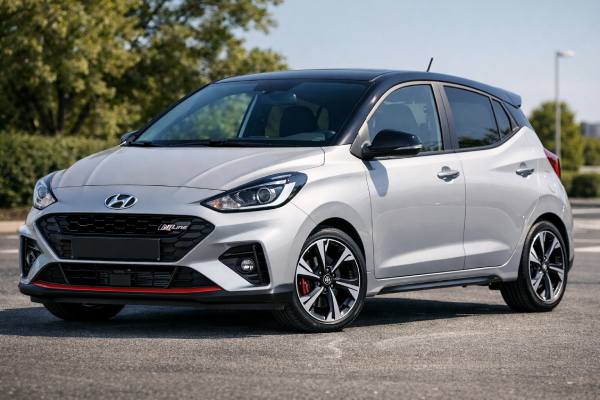
The facelifted Hyundai i10 N Line (AC3) 1.0 T-GDi is the version of the i10 range that adds real energy without losing the city-car logic that makes the model easy to recommend. It keeps the compact dimensions, useful boot, and low everyday running costs of the standard car, but pairs them with a 90 hp turbocharged three-cylinder engine, sharper steering and suspension tuning, and a more distinctive N Line interior and exterior. That makes a noticeable difference in daily use. The regular i10 is practical; the N Line is practical and genuinely lively. Even so, it remains a small front-wheel-drive hatchback, not a mini hot hatch with endless reserve. Buyers still need to balance pace, comfort, fuel use, and long-term simplicity. This guide focuses on the facelift 2024–present N Line with the 1.0 T-GDi engine and 5-speed manual transmission, covering the specs, equipment, safety, reliability outlook, maintenance needs, and real ownership advantages.
Top Highlights
- The 1.0 T-GDi engine gives the i10 real mid-range pull, with 172 Nm from low revs.
- N Line trim adds specially tuned suspension and steering, 16-inch wheels, and sportier seats.
- Standard safety equipment is strong for the class in many European-market versions.
- As a direct-injection turbo petrol, it needs correct oil, good fuel, and consistent servicing.
- Plan on an engine-oil and filter change every 15,000 km or 12 months.
Explore the sections
- Hyundai i10 N Line Turbo Life
- Hyundai i10 N Line Data Pack
- Hyundai i10 N Line Kit and Safety
- Typical Faults and Recall Checks
- Service Routine and Buyer Advice
- Turbo Driving and Consumption
- Rivals and Buying Context
Hyundai i10 N Line Turbo Life
The facelift 2024–present Hyundai i10 N Line sits in a useful niche. It is still a true city car, with the dimensions, visibility, and easy parking manners that define the segment, but it adds enough engine and chassis character to feel different from the regular i10. That matters because many small hatchbacks promise sportiness through trim details alone. The N Line does more than that. It pairs the compact AC3 body with Hyundai’s 1.0-litre turbocharged three-cylinder petrol engine, rated at 90 PS, and adds model-specific steering and suspension tuning. In everyday terms, that means the car feels more eager, more responsive, and less stretched once speeds rise beyond town traffic.
This version suits drivers who spend a lot of time in urban and suburban use but do not want a car that feels flat when the road opens up. The standard 1.0 MPi and 1.2 MPi i10 models are rational. The N Line adds a little attitude without pushing ownership into something complicated or expensive to justify. You still get the compact body, the easy seating position, the five-door practicality, and the useful 252-litre boot. What changes is the way the car reacts when you use the throttle. With 172 Nm available from low revs, the N Line feels far stronger in the middle of the rev range than the naturally aspirated engines.
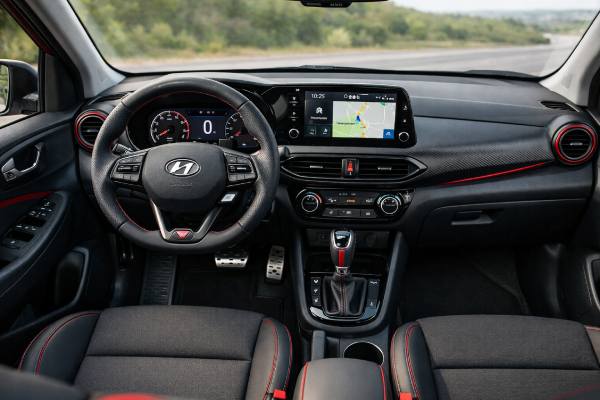
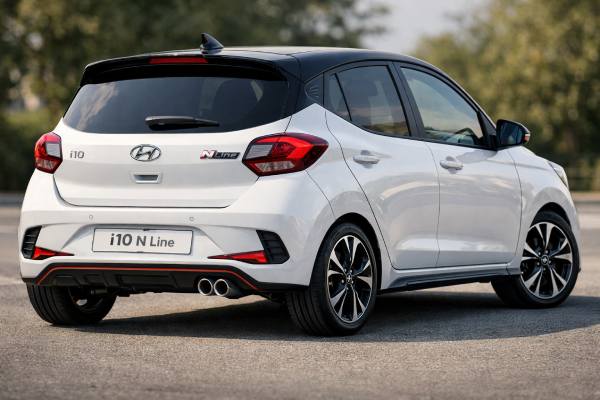
The facelift sharpened that impression by tightening the design. The N Line gets its own front bumper treatment, grille, alloy wheels, red accents, sportier seats, and a more distinctive light signature. Inside, the changes are modest but effective. The steering wheel, gearshift, red contrast details, and trim pieces create a cabin that feels more purposeful than the standard car without becoming gimmicky. Importantly, the i10 still keeps the straightforward controls and good outward visibility that make it easy to drive every day.
There are clear advantages to this version. It is more engaging than the base engines, yet it is still smaller and cheaper to run than stepping into a larger supermini. It is also more honest than many “sport-line” city cars because the extra performance is real, not cosmetic. The turbo engine, 16-inch wheel package, and chassis tuning all change the experience.
The compromises are just as clear. The N Line rides a little firmer, engine refinement is less creamy than a four-cylinder petrol, and the powertrain is more complex than the entry-level naturally aspirated options. It is still not a true hot hatch either. The i10 N Line is best understood as a fast city hatch with modern safety and sharp character, not as a track toy. Buyers who approach it with that expectation usually end up appreciating exactly what Hyundai got right here.
Hyundai i10 N Line Data Pack
The facelift i10 N Line 1.0 T-GDi is sold with broadly consistent core hardware across Europe, but trim wording and a few detail items can still vary by market. The figures below reflect current open official Hyundai material for the facelift AC3 i10 N Line and focus on the 5-speed manual car.
| Powertrain and efficiency | Specification |
|---|---|
| Code | Kappa / Smartstream G1.0 T-GDi |
| Engine layout and cylinders | Inline-3, 3 cylinders, DOHC, 4 valves per cylinder |
| Bore × stroke | 71.0 × 84.0 mm (2.80 × 3.31 in) |
| Displacement | 1.0 L (998 cc) |
| Induction | Turbocharged |
| Fuel system | Gasoline direct injection |
| Compression ratio | Not consistently published in current open facelift material |
| Max power | 90 hp (66 kW / 90 PS) @ 4,500–5,500 rpm |
| Max torque | 172 Nm (127 lb-ft) @ 1,500–3,500 rpm |
| Timing drive | Chain |
| Rated efficiency | WLTP combined about 5.4 L/100 km (43.6 mpg US / 52.3 mpg UK) |
| Real-world highway @ 120 km/h (75 mph) | Usually about 6.0–7.0 L/100 km |
| Transmission and driveline | Specification |
|---|---|
| Transmission | 5-speed manual |
| Drive type | FWD |
| Differential | Open |
| Chassis and dimensions | Specification |
|---|---|
| Suspension, front / rear | MacPherson strut / torsion-beam rear axle |
| Steering | Motor-assisted rack-and-pinion; N Line-specific steering tuning |
| Brakes | Front disc / rear drum in open current brochure data |
| Wheels and tyres | 195/45 R16 on 16-inch alloy wheels |
| Ground clearance | About 152 mm (6.0 in) |
| Length / width / height | 3,670 / 1,680 / 1,480 mm (144.5 / 66.1 / 58.3 in) |
| Wheelbase | 2,425 mm (95.5 in) |
| Turning circle (kerb-to-kerb) | About 9.8 m (32.2 ft) |
| Kerb weight | About 1,099–1,120 kg (2,423–2,469 lb), market and equipment dependent |
| GVWR | About 1,470 kg (3,241 lb) |
| Fuel tank | 36 L (9.5 US gal / 7.9 UK gal) |
| Cargo volume | 252 L / 1,050 L (8.9 / 37.1 ft³), VDA |
| Performance and capability | Specification |
|---|---|
| 0–100 km/h (0–62 mph) | 11.4 s |
| Top speed | 175 km/h (109 mph) |
| Braking distance | Not consistently published in open official facelift material |
| Towing capacity | 310 kg (684 lb) braked / 310 kg (684 lb) unbraked in open brochure data |
| Payload | Roughly 350–371 kg depending on kerb weight and market |
| Fluids and service capacities | Specification |
|---|---|
| Engine oil | SAE 0W-20, API SN Plus / SP or ILSAC GF-6; about 3.6 L (3.8 US qt) |
| Coolant | Ethylene-glycol coolant for aluminium radiator; about 6.02 L (6.36 US qt) |
| Transmission / gear oil | API GL-4, SAE 70W; about 1.6–1.7 L (1.7–1.8 US qt) for N Line manual data |
| Differential / transfer case | Not applicable |
| Brake / clutch fluid | FMVSS 116 DOT 4; about 0.7–0.8 L (0.74–0.85 US qt) |
| A/C refrigerant | Verify by VIN and under-bonnet label; specification can vary by market |
| Key torque specs | Wheel nuts commonly 108–127 Nm (80–94 lb-ft); verify critical fasteners by service data |
| Safety and driver assistance | Specification |
|---|---|
| Crash ratings | Euro NCAP AC3 baseline result: 3 stars; Adult 69%, Child 75%, Vulnerable Road Users 52%, Safety Assist 59% |
| IIHS | Not applicable |
| Headlight rating | Not applicable |
| ADAS suite | In current European brochure data: FCA pedestrian and cyclist detection, cruise with limiter, LVDA, DAW, HBA, ISLA, LFA, LKA, rear parking aid, rear camera, ESC, HAC, TPMS, and eCall |
The important story here is not just the raw acceleration number. It is how much stronger the torque figure is than the naturally aspirated engines, and how well that works with the i10’s modest weight. At the same time, the tyre size, tuned chassis, and slightly higher fuel use show the trade-off. This is the enthusiast’s version of a city hatch, but it still lives within city-car economics.
Hyundai i10 N Line Kit and Safety
The facelift i10 line-up is easier to understand if you separate the N Line from the regular trims instead of treating it as only another equipment step. In current open Hyundai brochure material, the i10 is offered in several trims, but the N Line stands out because it is paired specifically with the 1.0 T-GDi engine and receives exclusive exterior and interior treatment. In other words, it is not just a better-equipped standard i10. It is the sporty branch of the range.
Externally, the N Line gets its own bumper and grille design, N Line emblems, a more aggressive rear treatment with integrated diffuser styling, privacy glass, a twin-exit exhaust appearance, and 16-inch alloy wheels with 195/45 R16 tyres. That wheel and tyre package matters because it changes the stance, steering feel, and brake response more than buyers sometimes expect. The regular i10 looks neat. The N Line looks deliberate.
Inside, the changes are also more than cosmetic garnish. The cabin adds sportier seats with red contrast stitching, N branding, red trim accents, a dedicated N Line steering wheel, and model-specific gearshift detailing. The effect is not luxurious, but it is coherent. Hyundai avoided the mistake of making the interior look louder than the actual driving experience. It feels sporty, but still practical and easy to live with.
Feature content is strong for the class. Current European brochure material shows navigation, an 8-inch touchscreen, Apple CarPlay and Android Auto, Bluelink connectivity, rear camera support, parking assistance, heated front seats, heated steering wheel, and a solid list of comfort features depending on market. The important caveat is that exact equipment can vary country to country, so a used buyer should confirm the VIN spec rather than assume every N Line is identical.
Safety is one of the i10’s strongest arguments against older city-car rivals. Euro NCAP’s public rating for the AC3 generation remains the key open reference. It is a 3-star result under a much tougher modern test regime than the one older A-segment cars faced, with 69 percent for adult occupant protection, 75 percent for child occupant protection, 52 percent for vulnerable road users, and 59 percent for safety assist. Those percentages matter more than the star count alone.
The facelift N Line also benefits from a broad Hyundai Smart Sense package in current brochure material. That includes autonomous emergency braking with pedestrian and cyclist recognition, lane keep assist, lane following assist, intelligent speed limit assist, driver attention warning, leading vehicle departure alert, high beam assist, rear parking aids, and a reversing camera. Passive safety content is solid too, with front, side, and curtain airbags, front-seat pretensioners and load limiters, ISOFIX and top-tether mounting points on the rear outer seats, ABS, ESC, hill-start assist, TPMS, and eCall.
For buyers, the conclusion is simple. The N Line is attractive because it combines real visual and mechanical distinction with a safety baseline that is genuinely modern for a city hatch. That blend is a large part of its appeal.
Typical Faults and Recall Checks
Because the facelift i10 N Line is still new, the right way to talk about reliability is with some restraint. There is not yet the same deep long-term evidence that exists for older i10 generations. That said, the current model’s hardware is familiar enough to outline the likely trouble spots and ownership priorities with reasonable confidence.
The good news comes first. There is no broad open-source evidence of a major, facelift-specific design flaw tied to the 2024–present i10 N Line 1.0 T-GDi. That does not mean every car will be perfect. It means the model’s risk profile looks more like “modern small turbo petrol with normal city-car wear points” than “known problematic engine with a headline defect.”
Common low-cost or medium-cost issues likely to show up first include:
- Weak 12 V batteries on cars that live on repeated short trips.
- Uneven tyre wear or steering pull caused by pothole damage, kerb impacts, or neglected alignment.
- Brake corrosion and rear-brake drag on lightly used urban cars.
- Minor infotainment or camera glitches rather than hard mechanical failure.
- Clutch wear on heavily used manual cars, especially learner, rental, or delivery examples.
Occasional medium-cost issues can include:
- Ignition-related rough running from worn plugs or coil weakness.
- Turbo-system hose leaks or sensor faults causing flat response and warning lights.
- Air-conditioning condenser damage from road debris.
- Suspension wear at links, mounts, or bushes on poor roads.
The engine itself deserves a balanced view. The 1.0 T-GDi adds performance, but it also adds heat, direct injection, turbo plumbing, and a gasoline particulate filter. That means correct oil quality matters, warm-up matters, and long oil intervals are not your friend if the car mostly does short urban trips. Direct injection also means intake carbon build-up can become a long-term concern at higher mileage, although there is not enough facelift-specific high-mileage evidence yet to treat it as a defining weakness. The timing system is chain-driven, which removes fixed belt-replacement cost, but it still depends on clean oil and sensible service intervals.
Software and calibrations also matter. Modern Hyundais are not overcomplicated, but driver-assistance systems, camera functions, infotainment behaviour, and body-control electronics can all benefit from dealer updates. That is why a full Hyundai service history is worth more than a stack of vague independent invoices.
On recalls and service actions, the safest advice is VIN-first. Hyundai’s recall tools are market-specific and VIN-based, which means you should never assume a nearly new car is automatically campaign-free. Even when no public facelift N Line campaign is widely discussed, you still need to check the VIN through the official Hyundai recall portal and ask a dealer to confirm outstanding field actions.
Before buying used, request:
- Full service history
- VIN recall and campaign confirmation
- A cold start and road test
- A scan for stored faults
- Tyre, brake, and clutch inspection
- Proof that any ADAS or camera-related repairs were completed properly
The reliability outlook is positive, but it comes with the usual modern-turbo condition: the car rewards correct maintenance and punishes neglect sooner than a very simple naturally aspirated city hatch would.
Service Routine and Buyer Advice
The i10 N Line is still easy to maintain by modern standards, but it is not the trim where you should cut corners. The extra performance is coming from a small turbocharged direct-injection engine, and that always means service quality matters more than it does on the base naturally aspirated versions.
A practical maintenance routine looks like this:
- Every 15,000 km or 12 months
Change engine oil and filter. For a car that does frequent cold starts, repeated short trips, or harder use, earlier oil service is sensible. - Every 30,000 km or 24 months
Carry out the broader scheduled inspection. Check brake fluid condition, inspect the engine air filter and cabin filter, inspect hoses and boost plumbing, and inspect the underbody for impact or corrosion damage. - Every 45,000 to 60,000 km
Inspect spark plugs closely and replace them early if there is any sign of rough running, hesitation, or weak cold-start behaviour. Turbo small engines do not reward bargain-basement ignition maintenance. - Every 60,000 to 90,000 km
Consider refreshing manual-transmission oil even if the formal service wording is not especially aggressive about it. This is cheap insurance on a manual performance-leaning city hatch. - Ongoing by condition
Inspect the timing chain system for start-up noise, fault codes, or evidence of poor oil history. There is no fixed timing-belt interval because the engine uses a chain, but that does not make it maintenance-free. - Every year
Check the 12 V battery, tyre condition, brake wear, coolant level, and alignment. Small cars are especially sensitive to tyres and geometry.
The most useful service figures for owners are clear. The engine takes about 3.6 litres of 0W-20 meeting Hyundai’s stated quality standard. The N Line manual transmission uses roughly 1.6 to 1.7 litres of GL-4 SAE 70W oil. Coolant capacity is about 6.02 litres, and brake or clutch fluid is about 0.7 to 0.8 litres of DOT 4. Wheel-nut torque is typically around 108–127 Nm. For any critical fastener or repair procedure beyond routine service, use VIN-specific workshop information.
As a used buy, the best examples are usually manual cars with annual servicing at the right intervals, quality matching tyres, and no signs of careless body repair. You want:
- Clean cold starts and stable idle
- No clutch slip or aggressive take-up shudder
- Strong boost delivery with no flat spots
- Even steering and no alignment pull
- Fully working infotainment, camera, and assistance systems
- Matching premium or mid-tier tyres in the correct size
- No evidence of repeated kerb strikes or underbody impacts
- Proof of recall and campaign checks
Cars to avoid are the obvious ones: warning lights, cheap mismatched tyres, hard-driven ex-fleet examples, vague service records, or sellers who dismiss turbo-related hesitation as “normal.” Long-term durability should be good when maintenance is done on time and fluids are correct. It will be much less impressive if owners assume that a small engine can survive on a large-engine maintenance attitude.
Turbo Driving and Consumption
The facelift i10 N Line is at its best when you judge it against the city-car class rather than against larger warm hatchbacks. In that context, it is one of the more entertaining options still built around simple dimensions and low mass. The turbo engine changes the car’s character immediately. Where the 1.0 MPi and 1.2 MPi versions ask you to plan with revs, the 1.0 T-GDi gives you useful shove from low and mid rpm. That makes town driving easier than the badge might suggest, because you need fewer big throttle openings and fewer downshifts.
The steering and suspension tuning are also a meaningful part of the N Line identity. Hyundai’s own N Line material says the car features specially tuned suspension and steering for more agile dynamics and quicker response, and that is consistent with the way the trim is positioned. In practice, the car feels keener to turn, a little more tied down, and more immediate off-centre than the ordinary i10. The trade-off is a firmer ride, especially on the 16-inch wheels and low-profile tyres. Broken urban surfaces and potholes are felt more clearly than they are in softer, smaller-wheeled trims.
Refinement is a mixed but acceptable picture. The turbo triple is lively and willing, but it is still a three-cylinder engine. At idle and under load, it has more character than a four-cylinder petrol, though not everyone will call that refinement. At motorway speed, wind and road noise remain city-car level rather than supermini level. The N Line is better at fast-road use than the base i10, but it does not stop being a small hatchback.
Performance is the reason to choose it. Official brochure data gives 0–100 km/h in 11.4 seconds and a 175 km/h top speed, which is genuinely brisk for a car of this size and mission. More importantly, it feels quicker than the number suggests because the torque arrives low and the car is light.
Real-world fuel use usually lands in ranges like these:
- City: about 6.7–7.8 L/100 km
- Mixed: about 5.8–6.6 L/100 km
- Highway at 100–120 km/h: about 6.0–7.0 L/100 km
Those figures assume a healthy manual car on the right tyres. Very short trips, cold weather, hard use, cheap fuel, or poor alignment can raise them. Official combined WLTP consumption of about 5.4 L/100 km is plausible in careful mixed driving, but enthusiastic use closes that gap quickly.
Brake feel is generally reassuring, and the tyre package gives the N Line decent grip for a city hatch. Because the car is light, tyre quality matters enormously. Good tyres make the steering sharper, improve wet braking, and calm the chassis. Cheap tyres undermine much of what the N Line is supposed to do.
In short, the N Line drives like a city car that wants to be used properly. It is quick enough to feel fun, tidy enough to feel sharp, and still compact enough to make daily life easy.
Rivals and Buying Context
The facelift Hyundai i10 N Line 1.0 T-GDi competes in a narrow but interesting part of the market. It is not trying to outgun full-size hot superminis. Instead, it offers a city-car footprint with enough engine and chassis personality to feel special. That makes its closest rivals less obvious than they first seem.
The Kia Picanto GT-Line and its stronger petrol variants are the most natural comparison. They chase a similar buyer: someone who wants a small footprint, everyday usability, and a bit more character than the base engine provides. In practice, the Hyundai often feels like the more cohesive “sport-trim” package when you specifically want the turbo engine and N Line identity, while the Kia counters with its own styling and value logic. Condition and local pricing often decide that match-up more than small differences in specification.
The Toyota Aygo X is a different kind of rival. It has a stronger image and a crossover-style stance, but it does not really match the i10 N Line’s mix of pace and torque. If you care more about playful styling than performance, the Toyota is appealing. If you want a city car that actually feels meaningfully stronger away from junctions and hills, the Hyundai is the better fit.
The Fiat Panda and the remaining tiny hatchback alternatives offer space efficiency and character, but few combine modern safety systems, turbo torque, and a factory sport trim as neatly as the N Line. A used Volkswagen up! GTI would be a more direct “fun small car” comparison in spirit, but it is an older, rarer, and often more expensive proposition. The Hyundai counters with newer safety technology, a fresher cabin, and easier day-to-day justification.
That is really where the i10 N Line wins. It is easier to defend logically than many niche sporty small cars. It has a useful boot, five doors, current driver-assistance technology, reasonable fuel economy, and low tax-and-tyre logic compared with larger hot hatchbacks. At the same time, it avoids feeling anonymous.
Where does it lose? Mostly in outright refinement and prestige. Some buyers will prefer the smoother nature of a larger four-cylinder supermini, and some rivals have a slightly more polished motorway feel. Others may simply want a regular i10 1.2 MPi because it is simpler and softer riding. Those are fair arguments.
The final verdict is simple. Choose the facelift i10 N Line 1.0 T-GDi if you want a small modern hatchback that feels more alive than the class norm without becoming expensive or impractical. Choose a base i10 if you value simplicity above all else. Choose a larger hot hatch only if you genuinely need more space, more pace, and more long-distance refinement than this sharp little Hyundai was designed to deliver.
References
- Hyundai i10 N Line | New Cars 2026 (Official Model Page)
- Hyundai i10 2026 (Technical Brochure)
- i10 AC3 PE Kullanım Kılavuzu 2024 (Owner’s Manual)
- Official Hyundai i10 2020 safety rating 2020 (Safety Rating)
- Home | Hyundai Recalls & Service Campaigns 2026 (Recall Database)
Disclaimer
This article is for informational purposes only and is not a substitute for professional diagnosis or repair. Specifications, torque values, intervals, procedures, and equipment can vary by VIN, market, trim, production date, and homologation standard, so always verify critical details against the official service documentation for the exact vehicle.
If this guide helped you, please consider sharing it on Facebook, X, or another social platform to support our work.