
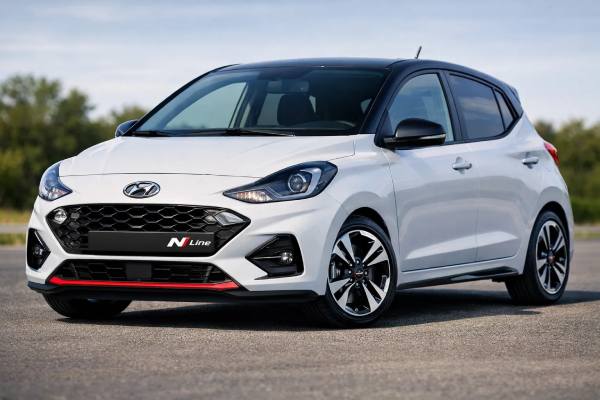
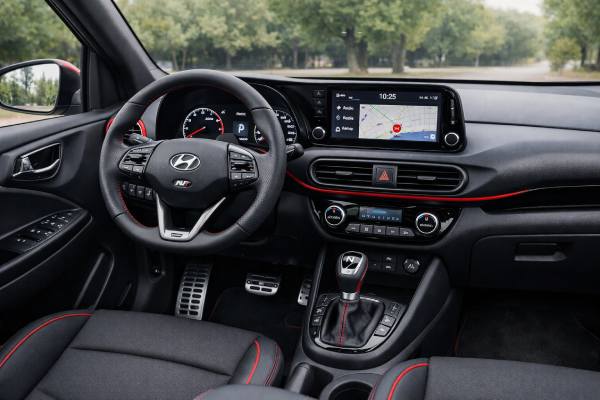
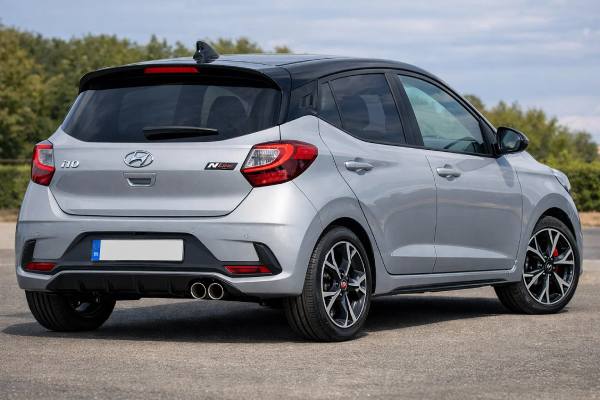
The facelifted Hyundai i10 N Line AC3 with the 1.2 MPi engine is a niche version of a city car that makes more sense than its badge-first image might suggest. It combines the sharper N Line styling, 16-inch wheels, and sport-themed interior with the simpler naturally aspirated 1.2-litre four-cylinder instead of the more performance-focused turbo engine. That matters for buyers who want the look and everyday usability of the N Line without taking on extra turbo complexity. It is also worth noting that availability was market-dependent. In some 2023–2024 markets, the facelift N Line could still be paired with the 1.2 MPi, while others focused the N Line range on the 1.0 T-GDi instead.
As a used buy, this version stands out for its smooth four-cylinder character, low running-cost potential, tidy footprint, and strong feature set for a small car. The trade-off is simple: it looks sportier than it really is.
Top Highlights
- The 1.2 MPi is smoother and simpler than the turbo option, which helps long-term ownership.
- N Line trim adds desirable styling, 16-inch wheels, and a more distinctive cabin without changing the car’s practical layout.
- Cabin space and boot volume are strong for an A-segment hatchback.
- Watch for clutch wear, 16-inch wheel damage, tyre quality, and poor ADAS calibration after front-end repairs.
- Plan on engine oil and filter every 15,000 km or 12 months in normal use.
Section overview
- Hyundai i10 N Line 1.2 defined
- Hyundai i10 N Line data
- Hyundai i10 N Line trim and safety
- Weak points and campaign checks
- Care schedule and shopper notes
- Drive feel and real economy
- Rival view and final take
Hyundai i10 N Line 1.2 defined
The facelifted Hyundai i10 AC3 is already one of the more complete city cars in its class, but the N Line version changes its character in a specific way. It does not turn the car into a true hot hatch. Instead, it gives the i10 a more assertive look, sharper interior detailing, larger wheels, and a sportier visual identity. In 1.2 MPi form, that identity is paired with the simpler, calmer engine option rather than the turbocharged one. For many owners, that is actually the more rational version.
This is the key to understanding the car. The 1.2 MPi N Line is not about straight-line pace. It is about choosing the better-looking trim without stepping up to the 1.0 T-GDi. That gives you a naturally aspirated four-cylinder, a five-speed manual, and the familiar low-stress ownership traits that come with a simple port-injected petrol engine. It also means smoother idle quality, more linear throttle response, and less mechanical complication over the long term.
The facelift brought useful updates. Hyundai revised the front-end design, changed some lighting details, updated colour and wheel options, and widened the active-safety story. Depending on market, the car gained broader SmartSense coverage, improved display hardware, more convenience equipment, and a fresher interior presentation. N Line versions kept their own visual touches, including unique bumpers, red accents, N Line badging, and sport-themed seat trim.
A major practical point is market variation. Not every 2023–2024 market offered the same N Line powertrain mix. Some countries continued to allow the N Line trim with the 1.2 MPi. Others focused the facelift N Line on the turbo engine. That is why buyers should confirm the exact configuration by VIN and local brochure rather than by trim badge alone. A car advertised simply as “i10 N Line” does not automatically tell you which engine it has.
What it does reliably tell you is the use case. This is still a very compact hatchback, just 3.675 m long, with a tight turning circle, strong visibility, and a genuinely useful cabin. The boot is competitive for the class, the rear seat is more usable than many A-segment rivals, and the controls are easy to live with. Those fundamentals matter more than the N Line branding in daily ownership.
Seen that way, the facelift i10 N Line 1.2 is appealing because it blends two priorities that do not often meet in the city-car segment: visual interest and mechanical simplicity. It has enough character to feel special, but it still works like a sensible small Hyundai. That balance is the main reason to consider it.
Hyundai i10 N Line data
This guide focuses on facelift 2023–2024 markets where the N Line trim could be paired with the 1.2 MPi engine and five-speed manual. Some published figures vary by country, seating layout, and homologation pack, so treat the figures below as the core factory range for this configuration rather than a single global VIN spec.
| Powertrain and efficiency | Hyundai i10 N Line AC3 1.2 MPi |
|---|---|
| Engine family and code | Kappa 1.2 MPi, commonly catalogued as G4LA |
| Engine layout and cylinders | Transverse inline-4 |
| Valvetrain | DOHC, 16 valves, 4 valves per cylinder |
| Bore × stroke | 71.0 × 75.6 mm (2.80 × 2.98 in) |
| Displacement | 1.2 L (1,197 cc) |
| Induction | Naturally aspirated |
| Fuel system | Multi-point petrol injection |
| Compression ratio | 11.0:1 |
| Max power | 84 PS (61.7 kW, about 83 hp) @ 6,000 rpm |
| Max torque | 117.6–118 Nm (86.7 lb-ft) @ 4,200 rpm |
| Timing drive | Chain |
| Rated combined efficiency | about 5.3–5.5 L/100 km WLTP depending on market spec |
| Real-world highway @ 120 km/h | about 6.2–6.8 L/100 km in normal use |
| Transmission and driveline | Hyundai i10 N Line AC3 1.2 MPi |
|---|---|
| Transmission | 5-speed manual |
| Drive type | FWD |
| Differential | Open |
| Chassis and dimensions | Hyundai i10 N Line AC3 1.2 MPi |
|---|---|
| Front suspension | MacPherson strut |
| Rear suspension | Coupled torsion beam axle |
| Steering | Motor-driven power steering |
| Steering ratio | 14.0:1 |
| Lock-to-lock turns | 2.64 |
| Brakes | Front ventilated discs 252 mm (9.9 in), rear discs 234 mm (9.2 in) |
| Most common tyre size | 195/45 R16 |
| Wheels | 6.5J × 16 in alloy |
| Ground clearance | 152 mm (6.0 in) |
| Length | 3,675 mm (144.7 in) |
| Width | 1,680 mm (66.1 in) |
| Height | 1,483 mm (58.4 in) |
| Wheelbase | 2,425 mm (95.5 in) |
| Turning circle | about 9.8–10.0 m kerb-to-kerb, often listed as 4.9–5.0 m minimum turning radius |
| Kerb weight | market-dependent; typically mid-900 kg range for the 1.2 manual |
| GVWR | about 1,430 kg (3,153 lb), market-dependent |
| Fuel tank | 36 L (9.5 US gal / 7.9 UK gal) |
| Cargo volume, VDA | 252 L (8.9 ft³) seats up / 1,050 L (37.1 ft³) seats folded |
| Performance and capability | Hyundai i10 N Line AC3 1.2 MPi |
|---|---|
| 0–100 km/h | 12.6 s |
| 0–62 mph | 12.6 s |
| Top speed | 171 km/h (106 mph) |
| Braking distance | not openly published in Hyundai’s public facelift material |
| Towing capacity | around 310 kg (683 lb) braked, market-dependent |
| Payload | varies by market and seating layout; roughly low-400 kg range is typical |
| Fluids and service capacities | Hyundai i10 N Line AC3 1.2 MPi |
|---|---|
| Engine oil | Use VIN-specific Hyundai-approved oil; low-viscosity 0W-20 or 5W-30 grade is commonly specified by market |
| Engine oil capacity | Verify in the VIN-specific owner’s manual or workshop data |
| Coolant | Ethylene-glycol coolant for aluminium engine systems |
| Coolant capacity | Verify in the VIN-specific owner’s manual or workshop data |
| Manual transmission fluid | Hyundai-approved M/T fluid to the exact market specification |
| Manual transmission capacity | Verify in official workshop data |
| A/C refrigerant | Verify on the under-bonnet label for the exact vehicle |
| A/C compressor oil | Verify on compressor label or service data |
| Key torque specs | Wheel fasteners and brake/suspension torque values should be confirmed in official service documentation |
| Safety and driver assistance | Hyundai i10 facelift AC3 |
|---|---|
| Euro NCAP | 3 stars under the 2020 protocol, retained through the 2023 facelift review |
| Adult occupant protection | 69% |
| Child occupant protection | 75% |
| Vulnerable road users | 52% |
| Safety assist | 59% |
| IIHS | Not rated |
| ADAS | AEB, lane support, driver attention warning, speed assistance, eCall; content varies by market and trim |
The important takeaway is that the N Line 1.2 keeps the sportier chassis hardware and styling cues, but its engine remains a calm, naturally aspirated four-cylinder rather than a serious performance unit.
Hyundai i10 N Line trim and safety
The facelift i10 range was structured differently from market to market, but the N Line consistently sat near the top of the lineup. In some countries it acted as the sportiest trim appearance package. In others it also served as the gateway to the turbo engine. For this guide, the focus is the markets where you could choose N Line trim with the 1.2 MPi manual. That makes this version a little unusual, because it looks like the driver-focused variant while mechanically staying on the simpler side of the range.
N Line equipment is more than just a badge. The facelift version typically brought bespoke front and rear bumper treatment, gloss-black mirror caps, red detailing, N Line grille treatment, unique 16-inch alloy wheels, and a cabin with N branding on the steering wheel and gear lever. Hyundai also used contrast stitching, red trim accents, and more supportive-looking seat designs to push the cabin away from plain city-car territory. In real life, these details do make the car feel more expensive and more distinctive than a standard i10.
Wheel and tyre choice matters here. The N Line usually rides on 195/45 R16 tyres, which improve visual stance and steering response compared with the smaller wheel packages on lower trims. They also make pothole damage, tyre replacement costs, and road noise more relevant. That is one of the few places where the N Line really does change ownership character.
The facelift also broadened the car’s tech appeal. Depending on market, buyers could get updated digital instrumentation, improved infotainment, rear camera support, parking sensors, climate control, heated front seats, heated steering wheel, and connected navigation features. Some markets also offered different seating layouts or efficiency packs elsewhere in the range, but N Line versions tended to stay focused on five-seat usability and the sportier cabin presentation.
Safety is a more nuanced story. Euro NCAP rated the i10 at three stars under the stricter 2020 protocol, and that rating carried through the 2023 facelift review rather than being replaced by a new full retest. The car scored 69% for adult occupant protection, 75% for child occupant protection, 52% for vulnerable road user protection, and 59% for safety assist. Those numbers are respectable for a modern city car, but not class-leading.
What improves the i10’s position is its equipment list. Hyundai gave the facelift car a fairly serious active-safety package for this segment. Forward Collision-Avoidance Assist, lane support, driver-attention monitoring, speed-limit assistance, and emergency call functionality formed the core package, while some markets added Lane Following Assist and more capable forward-collision logic. That makes the i10 easier to recommend than many older A-segment rivals that still rely mostly on passive safety.
The practical buyer advice is simple. Do not assume all N Line cars have identical safety hardware. Check the actual build, look for camera and sensor equipment, and be especially cautious of repaired front-end cars where calibration may not have been done properly after windscreens or bumpers were replaced.
Weak points and campaign checks
The facelift i10 N Line 1.2 is still a comparatively new car, so it does not yet have the deep failure history that older city cars do. That is good news, but it also means buyers should separate confirmed patterns from assumptions. So far, the most reassuring point is that the naturally aspirated 1.2 MPi and five-speed manual are among the simpler parts of the modern i10 range. There is no turbocharger, no direct injection, and no dual-clutch transmission to complicate long-term ownership.
The most common issues are likely to be ordinary wear and usage-related rather than design disasters. Clutch wear is still one to watch, especially because small Hyundais often spend their lives in traffic, on hills, or with less experienced drivers. A high bite point, slip under load, or shudder pulling away suggests the car has seen hard urban use. The remedy is straightforward, but it is still a cost to factor in.
Wheel and tyre damage are more relevant on the N Line than on a lower-trim i10. The 16-inch package looks good and sharpens response, but it is less forgiving over potholes. Bent wheels, tyre sidewall damage, poor alignment, and uneven shoulder wear deserve close inspection. Cheap tyres are a warning sign too, because they can spoil both the car’s wet-weather balance and its braking feel.
Brake corrosion is another realistic ownership issue. Light, modern hatchbacks with lots of city use can develop rear-brake surface corrosion or uneven rear-brake contribution, especially if the car spends long periods parked or is used only on short trips. The N Line’s rear-disc setup is better than drums for feel and appearance, but it still needs inspection and proper servicing.
Electrical issues so far appear more likely to be nuisance-grade than catastrophic. A weak 12 V battery can cause warning lights, stop-start trouble, or odd ADAS alerts. Parking sensors, reverse cameras, and infotainment pairing problems are also the kind of faults seen on newer small cars across the industry. These are usually irritating rather than serious, but they matter when you are buying used.
A more modern concern is calibration. The facelift i10 relies more heavily on camera-based safety features than older i10s did. Windscreen replacement, bumper damage, or even poor accident repair can leave the car with warning lights or badly functioning assistance systems. Symptoms include lane-support faults, forward-collision warnings, or inconsistent sensor behaviour. The fix may be as simple as proper calibration, but it can also expose hidden accident history.
Corrosion is not yet the headline worry, but underbody exposure, road salt, and stone damage still deserve a look, especially around the exhaust, brake lines, suspension arms, and wheel-arch liners.
On recalls and service actions, the right approach is VIN-based verification. Do not rely on online lists alone. Ask for dealer records, campaign completion evidence, and proof of software updates where applicable. On a recent car like this, a thin service file is a much bigger warning sign than a worn seat bolster.
Care schedule and shopper notes
The i10 N Line 1.2 should be treated like a simple small car with a few modern trim-level complications. The engine itself is not demanding, but the larger wheels, camera-based safety hardware, and denser equipment list mean neglect shows up in more places than it would on an older base-model hatchback.
A practical maintenance plan for ownership looks like this:
| Maintenance item | Practical interval |
|---|---|
| Engine oil and filter | Every 15,000 km or 12 months |
| Engine air filter | Inspect yearly, replace about every 30,000–45,000 km |
| Cabin air filter | Replace yearly |
| Spark plugs | Around 45,000–60,000 km depending on use and plug type |
| Brake fluid | Every 24 months |
| Coolant | Follow VIN-specific handbook schedule; if history is unclear, inspect condition closely and treat 5 years as a key checkpoint |
| Manual transmission oil | Not always scheduled early, but a preventive refresh around 60,000–90,000 km is sensible |
| Brake inspection | At every service, with special attention to rear-disc condition |
| Tyre rotation | Every 10,000–12,000 km if wear pattern allows |
| Wheel alignment | Check after pothole strikes, steering pull, or uneven tyre wear |
| Auxiliary belt and hoses | Inspect yearly |
| Timing chain | No routine replacement interval; inspect if noisy or out of phase |
| 12 V battery test | Yearly once the battery is four years old |
For a buyer, the inspection checklist is short but important:
- Confirm the car really is the 1.2 MPi N Line and not a wrongly described standard i10 or a T-GDi car.
- Start it cold and listen for unstable idle, belt noise, or warning lights.
- Test the clutch on an incline and in a higher gear.
- Inspect all four tyres closely for brand, age, shoulder wear, and sidewall damage.
- Check for steering pull or vibration that could point to bent wheels.
- Confirm rear camera, parking sensors, lane-support systems, and warning lights all behave normally.
- Look for paint mismatch, windscreen replacement history, or uneven bumper gaps that could indicate poor repair work.
- Ask for invoices, not just a digital service claim.
The best used examples are usually one-owner or carefully maintained dealer-serviced cars with matching quality tyres, complete records, and no ADAS faults. The ones to avoid are those with cheap tyres, wheel damage, vague service history, or unexplained safety-system warnings.
Long-term durability should be better than that of the 1.0 T-GDi N Line simply because the 1.2 MPi is the less stressed engine. That does not guarantee perfection, but it gives this version a meaningful ownership advantage.
Drive feel and real economy
On the road, the i10 N Line 1.2 is best understood as the sportiest-looking version of the sensible engine, not the sensible version of the fast engine. That distinction matters. The N Line styling, 16-inch wheels, and sharper cabin suggest something quite lively, but the actual driving experience is more balanced than aggressive.
The 1.2 MPi is the better engine for smoothness. Compared with the 1.0 MPi three-cylinder, it feels calmer at idle, fuller through the middle of the rev range, and less strained when loaded. Around town, that makes the car easier to drive neatly. You do not need as many revs to move away cleanly, and the four-cylinder character suits stop-start traffic better than a smaller triple. The five-speed manual is simple and easy to work with, though it is not especially short or sporty in feel.
Where the N Line package does show itself is in steering response and body control. The car turns in more crisply than lower-wheel i10s, and the 195-section tyres give it a more planted feel on dry roads. It still remains a light front-wheel-drive city hatchback, so there is only so much grip and composure available, but for its class it feels tidy and secure. The downside is firmer low-speed impact response over rough surfaces, especially where roads are broken or potholed.
Ride comfort is therefore a trade-off. On decent roads, the N Line feels controlled and mature. On bad urban surfaces, it can feel busier than a regular i10 on smaller wheels. Road noise is also a little more noticeable. That is not a flaw so much as the price of the sportier look.
Motorway work is possible, but you notice the car’s size. The 1.2 engine can cruise at speed more comfortably than the 1.0 MPi, yet it is not a fast overtaking tool. Wind noise builds, the short wheelbase reminds you what class of car you are in, and faster uphill sections require planning. This is still a city car first.
Real-world fuel economy is reasonable for a naturally aspirated petrol hatchback on 16-inch tyres:
- City: about 6.2–7.2 L/100 km
- Highway at 100–110 km/h: about 5.2–5.9 L/100 km
- Highway at 120 km/h: about 6.2–6.8 L/100 km
- Mixed use: about 5.8–6.4 L/100 km
That works out to roughly 37–41 mpg US or 44–49 mpg UK in mixed driving. Cold weather, winter tyres, short trips, and poor alignment can push the numbers higher.
The verdict from behind the wheel is straightforward. The i10 N Line 1.2 is pleasant, tidy, and smoother than the smaller-engine cars. It is not truly sporty, but it is one of the more satisfying ways to drive a small naturally aspirated city hatchback.
Rival view and final take
The facelift Hyundai i10 N Line 1.2 occupies an unusual place in the market, so its best rivals are not always the most obvious ones. It competes partly with other city cars, partly with style-led trim lines, and partly with entry superminis that tempt buyers with more size but less equipment.
The closest rival is the Kia Picanto GT-Line or X-Line 1.2. It shares much of the same engineering logic: compact size, naturally aspirated four-cylinder option, manual gearbox, and a trim strategy that mixes style with daily usability. The Kia can feel a touch more playful in presentation, but the Hyundai often matches it for practicality and feels just as easy to own. This is the natural cross-shop.
Against the Toyota Aygo X, the Hyundai feels more conventional and more substantial. The Aygo X has crossover styling and a strong urban image, but the i10 usually offers better cabin space efficiency and a more settled, more useful layout. The Hyundai also feels less novelty-driven and more like a proper small daily car.
Against older but still relevant options like the Volkswagen up!, Skoda Citigo, and SEAT Mii, the Hyundai wins on freshness of design, infotainment, and available safety tech. The VW-group cars still feel cleverly packaged and mature, but they are now older designs. The i10 facelift brings a newer user experience, even if some drivers may still prefer the older trio’s simplicity and control weights.
Against larger entry superminis, the i10’s size becomes both its greatest strength and its clearest limitation. A bigger used B-segment hatchback may offer better motorway refinement and more luggage flexibility, but it will rarely be as easy to park, as cheap to tyre, or as tidy in dense city traffic.
So is the facelift i10 N Line 1.2 worth choosing? Yes, for the right buyer. It makes the most sense if you want:
- a city car that feels better equipped and more distinctive than average,
- the smoother and simpler four-cylinder engine,
- lower long-term risk than the turbo option,
- and styling that is more interesting than a standard small hatchback.
Its main weakness is that the N Line badge raises expectations the 1.2 MPi cannot fully meet. It is brisk enough, not fast. It looks sporty, but it is fundamentally practical. That is not a criticism if you buy it for what it is.
Viewed honestly, the Hyundai i10 N Line AC3 1.2 MPi facelift is one of the smartest versions of the small-car formula: attractive, compact, well equipped, and mechanically straightforward. For many owners, that is a better answer than chasing the faster trim.
References
- Hyundai Owners Manuals 2026 (Owner’s Manual)
- Hyundai i10 | Technical data | July 2023 2023 (Technical Data)
- Hyundai wprowadza do sprzedaży odświeżony model i10 2023 (Press Release)
- EuroNCAP | Hyundai i10 2020 (Safety Rating)
- Microsoft Word – 060919_Hyundai_i10_N_Line_technical_specifications.docx 2019 (Technical Data)
Disclaimer
This article is for informational purposes only and is not a substitute for professional diagnosis, inspection, or repair. Specifications, torque values, service intervals, procedures, and even trim-engine combinations can vary by VIN, market, production date, and equipment, so always verify details against the official service and owner documentation for the exact vehicle.
If this guide helped you, please share it on Facebook, X, or another platform to support our work.