
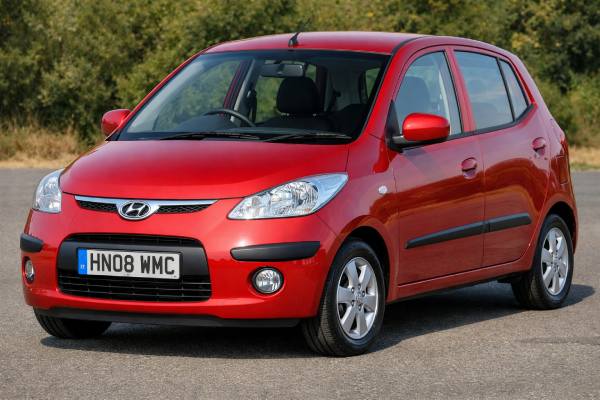
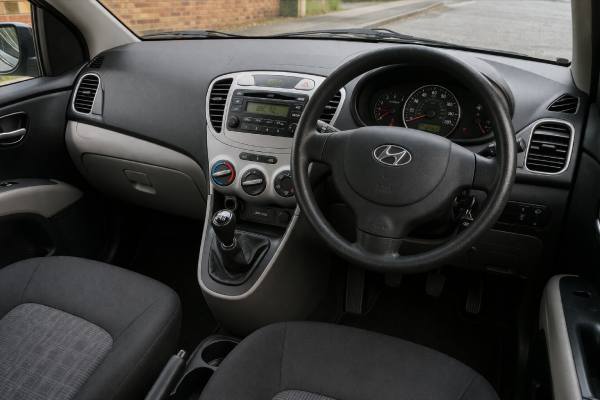
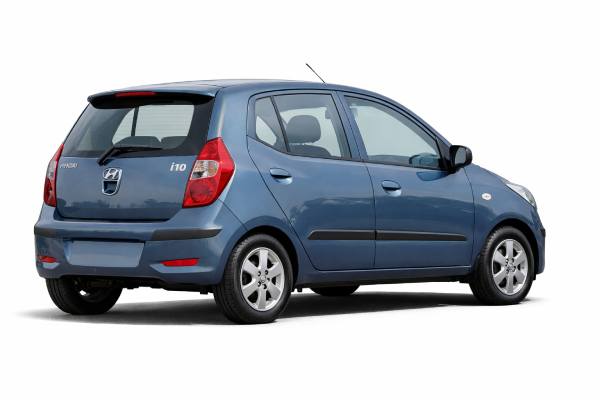
The 2008–2011 Hyundai i10 (PA) 1.1 iRDE sits in a sweet spot that many small hatchbacks missed. It is light, simple, easy to park, and usually cheaper to run than larger superminis, but it still feels like a real car rather than a bare-bones city appliance. The 1.1-litre four-cylinder petrol engine is modest on paper at 67 hp, yet it gives the i10 a smoother, less strained character than many three-cylinder rivals of the same era. For owners, the big appeal is straightforward engineering: a naturally aspirated petrol engine, a simple front-wheel-drive layout, and low-cost service parts. The trade-off is equally clear. Safety equipment is basic by modern standards, motorway pace is limited, and neglected timing-belt or cooling-system maintenance can turn a cheap car into a false economy. This guide focuses on the PA-generation 1.1 manual car and uses representative published figures where market-specific differences exist.
Owner Snapshot
- Smooth four-cylinder engine and light controls make it an easy urban car.
- Compact size, good visibility, and a tight footprint help in crowded streets.
- Running costs are usually low when the timing belt, cooling system, and ignition parts are kept on schedule.
- Safety and driver assistance are dated, with no modern active-safety suite.
- A sensible baseline is oil and filter service every 10,000 km or 12 months.
Guide contents
- Hyundai i10 PA 1.1 overview
- Hyundai i10 PA 1.1 specs
- Hyundai i10 PA 1.1 trims and safety
- Reliability, common issues, and service actions
- Maintenance and buyer’s guide
- Driving and performance
- Hyundai i10 PA 1.1 vs rivals
Hyundai i10 PA 1.1 overview
The first-generation i10 replaced the old Atos-style formula with something more useful and more grown-up. It still had a tall roof and a short overall length, but the cabin packaging was better, the dashboard was cleaner, and the driving position was more natural. In 1.1 iRDE form, the PA-generation car was aimed at buyers who wanted a city hatchback that did not feel underpowered every time the road opened up. The engine is a naturally aspirated inline-four, which matters more than the headline figure suggests. Compared with many tiny three-cylinder rivals, it is smoother at idle, less buzzy at modest speeds, and generally calmer in daily use.
For most owners, the main strengths are practical rather than exciting. The body is short and narrow enough for easy parking, but the high roofline and upright seating help it feel roomy inside. The luggage area is useful for a car in this class, and the rear seat is adequate for children or shorter adult trips. Hyundai also kept the basic mechanical package simple: front-wheel drive, a five-speed manual, uncomplicated suspension, rear drum brakes, and a small-displacement petrol engine that does not rely on turbocharging or direct injection. That simplicity is a real ownership advantage now that these cars are well into used-car age.
There are, however, limits that buyers should accept before buying one. This is not a quiet motorway cruiser. At 120 km/h, the short gearing and modest power output mean the engine works hard, overtakes need planning, and wind and tyre noise become more noticeable. Safety is also a period piece. The i10 earned a respectable Euro NCAP result for its time, but it lacks the active-safety systems now expected even on budget cars. That makes condition, tyre quality, brake performance, and careful maintenance more important than ever.
The best way to understand the 1.1 PA today is as an honest, low-complexity small car. When serviced on time, it can still be a dependable and inexpensive commuter. When neglected, the usual old-car issues appear quickly: worn clutch parts, ignition misfires, tired suspension links, and cooling-system leaks can stack up and erase its value advantage. In other words, the i10 1.1 is appealing not because it is special, but because it is straightforward, predictable, and cheap to keep right when you buy a good one. That is exactly why it still has a loyal following in the used market.
Hyundai i10 PA 1.1 specs
The figures below reflect representative published data for the 2008–2011 Hyundai i10 PA 1.1 manual. Exact numbers can vary slightly by market, facelift year, and trim. Where later regional brochures differ from earlier sheets, the difference is usually minor and worth treating as market-specific rather than mechanical.
| Item | Hyundai i10 (PA) 1.1 iRDE |
|---|---|
| Code | 1.1 iRDE |
| Engine layout and cylinders | Inline-4, SOHC, 12-valve |
| Displacement | 1.1 L (1086 cc) |
| Bore × stroke | 67.0 × 77.0 mm (2.64 × 3.03 in) |
| Induction | Naturally aspirated |
| Fuel system | Multi-point fuel injection |
| Compression ratio | 10.1:1 |
| Max power | 67 hp (50 kW) @ 5,500 rpm |
| Max torque | 99 Nm (73 lb-ft) @ 4,500 rpm |
| Timing drive | Belt |
| Rated efficiency | 4.8 L/100 km (49.0 mpg US / 58.9 mpg UK) combined |
| Real-world highway @ 120 km/h | roughly 6.0–6.8 L/100 km in normal use |
| Transmission and driveline | Value |
|---|---|
| Transmission | 5-speed manual |
| Drive type | FWD |
| Differential | Open |
| Chassis and dimensions | Value |
|---|---|
| Suspension, front / rear | MacPherson strut / torsion beam |
| Brakes, front / rear | 241 mm ventilated disc (9.5 in) / 180 mm drum (7.1 in) |
| Most popular tyre sizes | 155/70 R13, 165/60 R14, 175/60 R14 |
| Ground clearance | 165 mm (6.5 in) |
| Length | 3,565–3,585 mm (140.4–141.1 in) |
| Width | 1,595 mm (62.8 in) |
| Height | 1,540 mm (60.6 in) |
| Wheelbase | 2,380 mm (93.7 in) |
| Turning circle | about 9.6 m kerb-to-kerb; some brochures quote 4.8 m radius |
| Kerb weight | about 880–980 kg (1,940–2,160 lb), market-dependent |
| GVWR | 1,370 kg (3,020 lb) |
| Fuel tank | 35 L (9.25 US gal / 7.70 UK gal) |
| Cargo volume | 225 L / 910 L (7.9 / 32.1 ft³) |
| Performance and capability | Value |
|---|---|
| 0–100 km/h (0–62 mph) | about 15.2 s |
| Top speed | about 151–153 km/h (94–95 mph) |
| 100–0 km/h braking | about 44.7 m (147 ft) in published non-ABS data |
| Towing capacity | 700 kg (1,543 lb) braked / 400 kg (882 lb) unbraked |
| Payload | about 490 kg (1,080 lb) |
| Fluids and service capacities | Value |
|---|---|
| Engine oil | 5W-30 ACEA A3/B4 is a suitable Hyundai-listed spec for older BS IV petrol models; 3.0 L (3.17 US qt) |
| Coolant | Long-life ethylene-glycol mix, typically 50:50; about 4.62 L (4.88 US qt) |
| Manual transmission oil | API GL-4 SAE 75W-85; 1.9 L (2.01 US qt) |
| A/C refrigerant | Market-specific; verify by under-bonnet label or service data |
| Key torque spec | Wheel nuts commonly listed around 88–108 Nm (65–80 lb-ft); verify by VIN-specific service data |
| Safety and driver assistance | Value |
|---|---|
| Euro NCAP | 4 stars adult, 4 stars child, 3 stars pedestrian (2008 protocol) |
| IIHS | Not applicable for this model |
| ADAS suite | None in modern terms; ABS with EBD widely fitted, ESP only on selected late-market trims |
These numbers tell the real story of the car. It is not fast, but it is light. It is not advanced, but it is efficient and easy to service. For buyers comparing old city cars, that usually matters more than brochure bragging rights.
Hyundai i10 PA 1.1 trims and safety
Trim naming for the PA i10 varies a lot by market, so it is better to think in equipment bands than in one universal trim ladder. Entry-level cars usually came with steel wheels, simpler seat fabrics, fewer body-colour exterior parts, and a basic audio setup. Mid-spec versions often added wheel trims or alloys, remote locking, body-colour mirrors and handles, front fog lamps, and better audio inputs. Better-equipped versions in some regions added rear electric windows, leather-trimmed steering wheels, USB or auxiliary connectivity, and upgraded wheel packages. Mechanically, though, the 1.1 cars were usually very similar across trims: same basic engine, same five-speed manual, same suspension concept, and similar brake hardware.
When shopping, quick visual clues help. Base cars commonly have smaller steel wheels and plainer exterior trim. Better cars often have 14-inch wheels, fog lamps, body-colour detailing, and nicer seat fabrics. Build-year changes matter too. The later facelift period brought styling tweaks and, in some markets, slight dimension changes or revised trim names. That means a 2011 car may look different from a 2008 one without being fundamentally different under the skin. Buyers should therefore decode the exact market, build year, and equipment list rather than rely on badge names alone.
Safety was competitive enough for a budget hatchback in 2008, but it should be judged in period context. Euro NCAP tested a Hyundai i10 1.1 GLS LHD and awarded 4 stars for adult occupant protection, 4 stars for child occupant protection, and 3 stars for pedestrian protection. The report also noted that the passenger compartment stayed stable in the front impact, but chest protection for the driver was weak, there was no head-protecting side airbag for a pole test, and child-seat warning and ISOFIX marking could have been clearer. That is useful nuance: the shell was decent for its day, but the restraint and airbag package is plainly older than what modern buyers are used to.
In equipment terms, many later-market cars had ABS with EBD and front and front-side airbags as standard, plus rear ISOFIX points. ESP was much less common and often limited to selected trims or special-order configurations. There was no true modern ADAS package: no autonomous emergency braking, no lane centring, no blind-spot monitoring, and no adaptive cruise control. That makes wheel alignment, tyre choice, brake condition, and airbag warning-light checks far more important during inspection. On an older i10, basic passive safety in proper working order matters more than brochure equipment count.
Reliability, common issues, and service actions
The 1.1-litre PA i10 is generally one of those small cars that age well when used normally and serviced on time. Its biggest advantage is low complexity. There is no turbocharger, no direct injection, and no complicated automatic transmission on the common manual version. That lowers risk. The flip side is that age-related wear now matters more than design drama. On most surviving cars, the question is not whether the model is fundamentally sound, but whether a previous owner kept up with the unglamorous basics. The biggest red flag is missing proof for timing-belt service. On a cheap city car, an undocumented belt job should be treated as an immediate budget item rather than a future maybe.
Common low- to medium-cost faults usually cluster around ignition and air management. A rough idle, weak pickup, or flashing engine light often points to worn spark plugs, tired ignition components, or a dirty throttle body. These are not unusual on an older naturally aspirated petrol Hyundai, and they are usually fixable without major expense. Cooling-system neglect is a bigger concern. Small radiator leaks, ageing hoses, thermostat issues, or an overdue coolant change can cause overheating, and these engines do not reward repeated hot running. A buyer should always check for coolant smell, staining around the radiator and expansion tank, and any sign of pressure or contamination.
Driveline and chassis issues are usually age-and-use related rather than model-specific disasters. High-mileage city cars can develop clutch slip, noisy release bearings, worn engine mounts, tired drop links, and wheel-bearing hum. Rear drum brakes may bind or corrode if the car has done many short trips or sat unused. Steering and suspension are simple, but worn bushes and links can make the car feel looser than it should. None of that is unusual for this class, but the repair bill adds up quickly if a neglected example needs everything at once.
Rust risk depends heavily on climate and care. In mild climates, the shell often survives well. In salty regions, inspect rear arches, sill edges, lower door seams, tailgate seams, and the underside around mounting points. Electrical faults are usually minor: weak batteries, dirty grounds, aging central-locking motors, and switchgear issues are far more common than major harness faults. That is good news, because it keeps diagnosis fairly simple.
For recalls and service actions, the most sensible approach is VIN-based verification rather than internet hearsay. Campaign completion should be checked through Hyundai’s official recall and service-campaign tools and dealer history where available. On a car this old, proof matters more than seller memory. A complete service file, evidence of fluid changes, and recent cooling or belt work are worth more than cosmetic trim or fresh wheel covers.
Maintenance and buyer’s guide
A conservative maintenance plan is the best way to keep the i10 1.1 cheap. Even where some markets advertised long-life fluids or light annual usage, older city cars benefit from shorter intervals because they live on short trips, cold starts, and stop-start heat cycles. A practical schedule is below. It is intentionally cautious and ideal for buyers who want durability rather than minimum spend. Hyundai’s own service pages list a 10,000 km or 1 year oil-service baseline and specify 5W-30 ACEA A3/B4 for older BS IV petrol models, while the manual-transmission oil page lists API GL-4 SAE 75W-85 and 1.9 L for the i10 1.1.
| Service item | Practical interval |
|---|---|
| Engine oil and filter | Every 10,000 km or 12 months |
| Engine air filter | Inspect yearly; replace around 20,000–30,000 km |
| Cabin filter | 12 months or sooner in dusty use |
| Spark plugs | About 30,000–40,000 km for standard plugs |
| Coolant | About 4–5 years |
| Brake fluid | Every 2 years |
| Manual transmission oil | Refresh around 60,000–90,000 km |
| Timing belt | Buy only with proof, or replace early if undocumented |
| Auxiliary belt and hoses | Inspect at every annual service |
| Brake pads, shoes, and discs/drums | Inspect at every service |
| Wheel alignment and tyre rotation | Check yearly or after impact damage |
| 12 V battery test | At every service after year 4 |
For fluids and key numbers, the most useful quick values are 3.0 L of engine oil, roughly 4.62 L of coolant, and 1.9 L of manual transmission oil. Wheel-nut torque is commonly listed in the roughly 88–108 Nm range, but because documentation varies by market and wheel type, torque values should always be confirmed against VIN-specific service information before any repair work.
As a buyer, inspect the car in this order:
- Confirm the service file, especially timing-belt history.
- Start the engine cold and listen for uneven idle, belt noise, or tappet-like clatter.
- Check coolant level, condition, and signs of leakage.
- Test clutch bite point and gearbox feel.
- Drive over broken pavement to listen for link, bush, or bearing noise.
- Inspect tyres for uneven wear that suggests poor alignment or neglected suspension.
- Check every electric function, including locking, windows, heater fan, and warning lights.
- Look underneath for rust, fluid leaks, and damaged exhaust hangers.
The best cars are usually private-use examples with complete history, tidy interiors, and evidence of regular minor maintenance rather than one dramatic recent repair. Cars to avoid are those with vague belt history, overheating stories, mixed tyres, warning lights, or obvious corrosion underneath. Long-term durability is good if the car is treated like a small mechanical machine and not a disposable runabout. That is the main buying lesson here.
Driving and performance
On the road, the i10 1.1 feels exactly how a good small hatchback should feel: light, willing, and unintimidating. The controls are easy, visibility is strong, and the car shrinks around you in traffic. The engine does not provide much shove, but it responds cleanly and predictably, which suits urban driving. Around town, the modest gearing helps the car feel alert enough off the line, and the naturally aspirated four-cylinder layout gives it a smoother, calmer character than many tiny triple-cylinder rivals. That smoothness is one of the model’s quiet strengths. It is not quick, but it rarely feels coarse at normal city speeds.
Ride quality is acceptable rather than plush. The tall body and short wheelbase mean potholes and sharp ridges are felt, especially on larger wheel packages, but the chassis is simple and honest. Grip levels are modest, body roll is present, and the steering is tuned for ease rather than feedback. For the intended job, that is fine. The car feels stable enough at legal speeds, and the small footprint makes it easy to place on narrow roads. Brake feel is usually straightforward, though older examples can feel less reassuring if rear drums are sticky or the tyres are poor. Tyres make a surprisingly large difference to the i10’s confidence. Cheap rubber hurts it more than it hurts larger cars.
Published performance is around 15.2 seconds from 0–100 km/h and roughly 151–153 km/h flat out, which is enough for occasional motorway work but not much more. Real-world overtaking needs planning, especially with passengers or hills involved. At a steady 100 km/h, the car is comfortable enough. At 120 km/h, the engine starts to feel busy and noise rises. That is where the i10’s city-first design becomes obvious. It will do longer trips, but it does not enjoy them as much as it enjoys daily commuting.
Fuel economy remains one of the car’s strongest assets. The official combined figure is about 4.8 L/100 km, and careful drivers can stay close to the mid-5s in mixed real-world use. A realistic ownership range is about 5.2–6.0 L/100 km mixed, with highway use at 120 km/h often closer to 6.0–6.8 L/100 km depending on wind, tyres, load, and temperature. With a 35-litre tank, that still gives a useful touring range for such a small car. In short, the i10 1.1 drives like a sensible, honest urban hatchback: easy in town, acceptable on the open road, and best appreciated by drivers who value simplicity over pace.
Hyundai i10 PA 1.1 vs rivals
The Hyundai i10 PA 1.1 competed in one of the busiest small-car classes of its era, so its strengths only make sense in direct comparison. Against the Kia Picanto 1.1, it feels like a close cousin in philosophy: compact, simple, and inexpensive to maintain. The Hyundai usually wins on cabin packaging and the slightly more mature feel of its interior layout, while the Kia often feels just as sensible mechanically. Against a Suzuki Alto, the i10 tends to feel more substantial and smoother thanks to the four-cylinder engine, though the Alto can be lighter on its feet and even cheaper to run. Against a Chevrolet Spark or similar budget hatch, the i10’s main advantage is its cleaner mechanical simplicity and generally stronger ownership reputation.
The Toyota Aygo, Peugeot 107, and Citroën C1 trio are sharper pure city tools, especially for tight streets and low fuel use, but they often feel smaller, noisier, and less substantial on rougher roads. The i10’s bigger-car feel is a genuine selling point if you regularly carry passengers or want a small car that feels less basic. A Fiat Panda offers excellent practicality and charm, but condition and maintenance history matter even more there, and running costs can be less predictable depending on engine and market.
So where does the i10 1.1 land today? It is not the class leader for performance, image, or modern safety. It is also not the cheapest car to buy purely on badge or age. Its real edge is balance. You get a smooth four-cylinder engine, decent cabin space, easy urban manners, and simple maintenance without moving into a larger and more expensive class. That makes it a smart choice for buyers who want a dependable short-trip hatchback and who are willing to prioritise history and condition over trim vanity.
The main reasons to pick the i10 over its rivals are simple: smoother engine manners than many tiny three-cylinder cars, friendly packaging, and low ownership complexity. The main reasons to skip it are just as simple: dated crash structure by modern standards, limited motorway punch, and the risk that a cheap example has been run on a shoestring. Buy on maintenance history, not on sticker price, and the Hyundai usually makes a better case than its age suggests.
References
- Hyundai Owners manuals | Hyundai Motor UK 2026 (Owner’s Manual Hub)
- Euro NCAP in 2008: Making safety your top priority 2009 (Safety Rating)
- Adult occupant protection 2008 (Safety Rating)
- Hyundai Car Engine Oil | Hyundai India 2026 (Service Fluids)
- Manual Transmission Oil – Vehicles | Hyundai Motor India 2026 (Service Fluids)
Disclaimer
This article is for informational purposes only and is not a substitute for professional diagnosis, inspection, or repair. Specifications, torque values, service intervals, procedures, and equipment can vary by VIN, market, model year, and trim, so always verify critical details against official service documentation for the exact vehicle.
If this guide helped you, please consider sharing it on Facebook, X, or another social platform to support our work.