


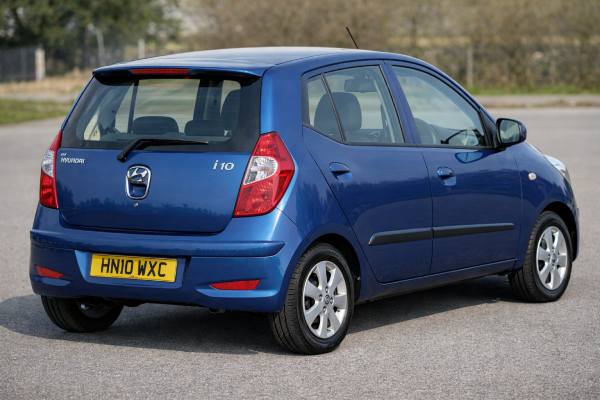
The first-generation Hyundai i10 PA with the 1.2 Kappa engine sits in a sweet spot of the small-car market. It is light, simple, easy to park, and usually cheaper to run than larger superminis, yet it feels more mature than many budget city cars from the same era. In 78 hp form, the 1.25-litre four-cylinder engine gives the i10 enough flexibility for daily commuting, light motorway work, and carrying four adults without feeling badly underpowered. That matters, because the smaller 1.1-litre cars can feel strained when loaded or driven outside town.
This is also a car where condition matters more than badge. A well-kept i10 PA can be dependable and inexpensive to own, but neglected cars show their age through worn clutches, noisy suspensions, tired brakes, and patchy service history. If you want one today, the best examples are simple, honest, and durable. The wrong ones are still cheap to buy, but no longer cheap to sort.
Quick Specs and Notes
- Strong points are its compact footprint, simple naturally aspirated engine, and low routine running costs.
- The 1.2 Kappa suits mixed use far better than the smaller 1.1, especially with passengers or hills.
- Watch for clutch wear, tired suspension mounts, rust around the exhaust and lower body, and overdue fluid changes.
- Plan on engine oil and filter every 15,000 km or 12 months in normal use, sooner for short-trip or severe-duty driving.
- Tyre rotation every 12,000 km helps the i10 keep its light steering and even brake balance.
Navigate this guide
- Hyundai i10 PA 1.2 profile
- Hyundai i10 PA 1.2 specs
- Hyundai i10 PA trims and safety
- Reliability and known faults
- Maintenance and buying advice
- Road manners and efficiency
- How it stacks up
Hyundai i10 PA 1.2 profile
The Hyundai i10 PA was designed as a true city hatchback, but the 1.2 Kappa version is the one that broadens its appeal. Instead of relying on a small three-cylinder or a weak entry engine, this variant uses a 1,248 cc inline-four that is smoother, more flexible, and better suited to real-world driving. In the 78 hp tune covered here, it is not quick by modern standards, but it is quick enough. That simple point explains why so many used buyers still prefer it.
Its biggest advantage is balance. The body is short at just over 3.56 m, visibility is good, the cabin is upright, and parking is easy. Yet the high roof and boxy layout mean it can carry adults better than many tiny rivals. It also avoids the “cheap car penalty” in a few useful ways: controls are simple, ride quality is usually decent on modest tyre sizes, and the four-cylinder engine is quieter and less buzzy than many 1.0-litre competitors.
This model also sits in an interesting middle ground in Hyundai’s history. It was not yet the polished European-market i10 that arrived later, but it already had a clear emphasis on practicality, value, and low ownership stress. In most markets, buyers were choosing it because they wanted low fuel bills, small dimensions, and a dependable commuter rather than style or performance. That is still the right lens to use today.
For current buyers, the main attraction is still straightforward ownership. There is no turbocharger, no direct injection, no dual-clutch gearbox, and no heavy electrical complexity. The manual gearbox is basic, the suspension layout is simple, and many parts are inexpensive. A good i10 PA 1.2 can therefore make sense as a first car, second household car, city runabout, or low-cost daily.
The trade-off is refinement and age. Safety equipment is basic by modern standards. Sound insulation is limited. High-speed motorway work is possible, but the car feels happier at urban and suburban speeds. And while the 1.2 engine itself is generally sound, the rest of the car now depends heavily on maintenance quality. Buyers should think less about brochure promises and more about service history, corrosion, clutch condition, steering feel, brake health, and whether the car has been cared for consistently.
In short, the i10 PA 1.2 is appealing because it is honest. It does not pretend to be sporty or luxurious. It offers sensible packaging, adequate performance, and usually modest repair bills. For a used city car, those are strong advantages.
Hyundai i10 PA 1.2 specs
For this guide, the focus is the naturally aspirated 1.2 Kappa petrol i10 PA in 57 kW and 78 PS form with the 5-speed manual. Some later market literature quoted slightly different paper outputs for closely related 1.2 versions, so always confirm by VIN and market code before ordering parts.
| Item | Hyundai i10 PA 1.2 manual |
|---|---|
| Engine code | G4LA |
| Engine layout and cylinders | Transverse inline-4 |
| Valvetrain | DOHC, 16 valves, 4 valves per cylinder |
| Bore × stroke | 71.0 × 78.8 mm (2.80 × 3.10 in) |
| Displacement | 1.25 L (1,248 cc) |
| Induction | Naturally aspirated |
| Fuel system | Multi-point fuel injection |
| Compression ratio | 10.5:1 |
| Max power | 78 hp / 57 kW / 78 PS @ 6,000 rpm |
| Max torque | 119 Nm (87.8 lb-ft) @ 4,000 rpm |
| Timing drive | Chain |
| Rated combined efficiency | 5.0 L/100 km (47 mpg US / 56.5 mpg UK) |
| Real-world highway at 120 km/h | roughly 6.0–6.8 L/100 km in good condition |
| Transmission | 5-speed manual |
| Drive type | FWD |
| Differential | Open |
| Chassis and dimensions | Hyundai i10 PA 1.2 manual |
|---|---|
| Front suspension | MacPherson strut |
| Rear suspension | Coupled torsion beam axle |
| Steering | Rack and pinion with electric assistance |
| Lock-to-lock turns | 2.99 |
| Brakes | Front ventilated discs, rear drums on most versions |
| Typical tyre size | 165/60 R14 |
| Wheels | 5.0J × 14 in |
| Ground clearance | commonly listed around 165 mm (6.5 in), market-dependent |
| Length | 3,565 mm (140.4 in) |
| Width | 1,595 mm (62.8 in) |
| Height | 1,540 mm (60.6 in) |
| Wheelbase | 2,380 mm (93.7 in) |
| Turning circle | 4.8 m (15.7 ft) |
| Kerb weight | about 996 kg (2,196 lb) |
| GVWR | 1,410 kg (3,109 lb) |
| Fuel tank | 35 L (9.25 US gal / 7.70 UK gal) |
| Cargo volume, VDA | 225 L (7.9 ft³) seats up / 910 L (32.1 ft³) seats folded |
| Performance and capacities | Hyundai i10 PA 1.2 manual |
|---|---|
| 0–100 km/h | 12.8 s |
| 0–62 mph | 12.2 s |
| Top speed | 164 km/h (101.9 mph) |
| Braked towing | up to 800 kg (1,764 lb), market-dependent |
| Unbraked towing | up to 450 kg (992 lb), market-dependent |
| Payload | about 414 kg (913 lb) |
| Engine oil | 3.5 L (3.70 US qt), API SL or above / ACEA A3 or above |
| Coolant | 4.2 L (4.44 US qt), ethylene-glycol type for aluminium radiator |
| Manual transaxle fluid | 1.9 L (2.01 US qt), GL-4 SAE 75W/85 |
| Brake and clutch fluid | 0.7–0.8 L (0.74–0.85 US qt), DOT 3 or DOT 4 |
| Safety | Hyundai i10 PA |
|---|---|
| Euro NCAP | 2008 protocol: 4-star adult, 4-star child, 3-star pedestrian |
| Euro NCAP points | Adult 26, Child 37, Pedestrian 21 |
| IIHS | Not rated |
| Standard safety basics | ABS, EBD, front airbags, front side airbags |
| Optional safety item in some markets | ESP |
| ADAS | None in the modern sense |
The numbers tell the basic story well. This is a light car with enough torque for daily use, modest tyres, and simple mechanical packaging. There is no standout spec on its own. The value comes from how these parts work together.
Hyundai i10 PA trims and safety
Trim names varied by market, but most European and UK cars were sold in forms roughly equivalent to Classic, Active, and Style, with equipment differences far more important than appearance differences. The good news is that even lower trims were not stripped beyond usefulness. Air conditioning, electric front windows, central locking, and a split-fold rear seat were widely available, and the basic cabin was easy to live with.
The 1.2 Kappa engine usually sat above the entry 1.1 in the range, so most 1.2 cars are better equipped than the cheapest PA models. That is helpful in the used market because the most desirable combination is often a mid-grade 1.2 manual with air conditioning, 14-inch wheels, remote locking, and a clean maintenance record. The very top trims add comfort items such as alloy wheels, fog lamps, better trim finishes, heated seats in some markets, or a sunroof, but the mechanical experience does not change dramatically.
Useful trim clues include wheel type, mirror and door-handle finish, fog lights, steering wheel trim, and whether the rear seat has ISOFIX anchors clearly present on the outer positions. Build stickers and VIN decoding can also help when cars have been modified, repainted, or fitted with later wheels.
From a safety point of view, the PA i10 was respectable for its class and time, but it is still a late-2000s city car. Euro NCAP’s 2008 test gave it four stars for adult occupant protection, four stars for child occupant protection, and three stars for pedestrian protection. That was acceptable, not class-leading. The structure held up reasonably well in the frontal test, but driver chest protection was rated weak. The absence of side head airbags on the tested setup meant no pole test was performed, which is important context when comparing it with newer cars.
In practical terms, the safety kit is mostly passive rather than preventative. ABS and EBD were central parts of the braking package. Front airbags and front side airbags were part of the base safety story. Rear ISOFIX anchorage points were offered on the outer rear seats. ESP, however, was not always standard and in some brochures appeared as an option. That means buyers should not assume every car has it.
There are no modern driver-assistance systems here. No autonomous emergency braking, no lane support, no blind-spot warning, and no adaptive cruise. That does not make the car unsafe to use, but it does mean the driver carries more of the workload. For many buyers this is acceptable, but it should be weighed honestly against the car’s age and intended use. If the job is urban commuting, local errands, or short mixed journeys, the safety package is understandable for its era. If the job is frequent high-speed family travel, newer rivals are clearly better.
Reliability and known faults
The i10 PA 1.2 is usually a fairly dependable old small car, but it is now old enough that wear, neglect, and poor repairs matter more than factory design alone. The engine itself is one of the better parts of the package. The 1.2 Kappa is generally smooth, willing, and durable if it gets regular oil changes and is not run low on coolant. Serious internal failures are not common on cared-for cars. Most ownership pain comes from age-related faults around it.
Common, low-to-medium cost issues
- Clutch wear and clutch bite-point problems. Symptoms are slip under load, judder when moving off, or a very high pedal bite. Remedy is usually a full clutch kit and inspection of release components.
- Suspension knocks from top mounts, drop links, bushes, or tired dampers. These show up as front-end noise over sharp bumps and looseness in the steering response.
- Exhaust corrosion, especially on short-trip cars. A blowing rear silencer or centre section is common on older city cars.
- Brake drag or uneven rear-brake performance. Cars with rear drums can suffer from sticking hardware, tired wheel cylinders, or poor handbrake balance if neglected.
- Weak 12 V batteries and charging-related oddities. Low system voltage can trigger warning lights and rough cold starts.
Occasional issues
- Electric power steering faults or intermittent warning lights. Symptoms include heavy steering, inconsistent assistance, or EPS warnings. Start with battery and charging checks before condemning steering components.
- Cooling system leaks from hoses, radiator ageing, or thermostat housing trouble. Small leaks often go unnoticed until the heater becomes weak or the expansion bottle runs low.
- Throttle response or idle quality issues from intake contamination, ageing sensors, or vacuum leaks.
- Wheel-bearing noise, especially on cars that have lived on rough roads or hit kerbs regularly.
Less common but important
- Timing-chain noise at cold start on neglected engines. The 1.2 uses a chain, not a routine replacement belt, but chains are not lifetime proof if oil changes have been skipped. Rattle, cam-crank correlation faults, or rough running deserve quick inspection.
- Rust on exhaust hangers, lower doors, wheel arches, rear hatch edges, and underbody seams. Severe rust is less common than on some rivals, but inspection still matters.
- Accident-damage repairs hidden by low car values. Cheap city cars are often repaired poorly after minor impacts.
On recalls and service actions, the safest rule is simple: check by VIN rather than by memory. Public recall visibility varies by country, model year, and registration market. A proper pre-purchase check should therefore include official VIN recall status, dealer service records where possible, and proof of completed campaigns.
The key verdict is reassuring. This is not a fundamentally fragile car. It is a small, aging hatchback that responds well to routine care and becomes irritating when maintenance is skipped. That is a good ownership profile for a budget used car.
Maintenance and buying advice
A Hyundai i10 PA 1.2 lasts best when serviced on time rather than by emergency. The official schedule is not especially demanding, and the car rewards owners who stay ahead of basic fluids, filters, tyres, and brakes.
A practical maintenance plan looks like this:
| Service item | Practical interval |
|---|---|
| Engine oil and filter | Every 15,000 km or 12 months; earlier for short trips or severe use |
| Air filter | Inspect yearly; replace around 30,000 km or sooner in dusty use |
| Cabin filter | Inspect yearly; replace yearly in most climates |
| Spark plugs | Replace around 45,000–60,000 km depending on plug type and service history |
| Coolant | First change at about 90,000 km or 60 months, then every 40,000 km or 24 months |
| Brake fluid | Every 24 months |
| Tyre rotation | Every 12,000 km |
| Manual gearbox oil | Officially often treated as fill-for-life, but a preventive refresh at 60,000–90,000 km is sensible |
| Auxiliary belts and hoses | Inspect at every annual service |
| 12 V battery test | Yearly once the battery is 4 years old |
| Alignment check | Whenever tyres wear unevenly or after suspension work |
For fluids, the important decision-making numbers are these: engine oil capacity is 3.5 L, manual transaxle fluid is 1.9 L, coolant is 4.2 L, and brake/clutch fluid is roughly 0.7 to 0.8 L. Oil spec should meet at least the handbook requirement for API SL or higher and suitable ACEA approval for the market. Use the viscosity that matches climate and official documentation for the car’s VIN.
Buyer checks should focus on the things that turn a cheap i10 into an expensive one:
- Cold start with the bonnet open. Listen for chain rattle, belt squeal, or an unstable idle.
- Clutch test uphill in a higher gear. Any slip or shudder means budget for work.
- Check coolant level and colour, then inspect the radiator, hose joints, and water-pump area.
- Drive over broken surfaces and listen for front suspension knocks.
- Confirm the steering is light and even, with no warning lamp.
- Inspect the exhaust, rear brakes, tyre wear pattern, and underbody corrosion.
- Verify both keys, all windows, central locking, heater fan, and air conditioning.
- Ask for invoices, not just stamps.
The best cars to seek are manual 1.2 examples with complete maintenance history, tidy interiors, clean coolant, quiet cold starts, and evidence of recent brake or tyre work. Cars to avoid are those with mixed tyres, warning lights, noisy front ends, rusty exhausts, poor idle quality, or no paper trail.
Long-term durability is good by old-city-car standards. The engine is usually the reason these cars survive. The deciding factor is whether the rest of the vehicle has been maintained to match it.
Road manners and efficiency
From the driver’s seat, the i10 PA 1.2 feels exactly how a sensible city hatchback should feel: light, easy, and unintimidating. Steering effort is low at parking speeds, visibility is good, and the controls are simple. That matters more in daily use than raw numbers do. The car is at its best in town, where its size and upright glass area make it easy to place on narrow roads and in tight parking spaces.
The 1.2 Kappa engine is the main reason to choose this version. It is smoother than many small three-cylinder rivals and noticeably more relaxed than the old 1.1. Throttle response is straightforward, with no turbo lag and no complicated gearbox behavior to manage. You rev it when needed, but it does not feel strained all the time. In city traffic, that makes the car calmer and easier to drive.
Ride quality is acceptable rather than plush. On the usual 14-inch tyres, the i10 deals with small bumps fairly well, but sharper edges and broken urban surfaces can send more noise into the cabin than in larger superminis. The suspension is soft enough for comfort, yet the narrow track and tall body mean it leans when pushed. Grip is fine for normal driving, but this is not a car that encourages fast cornering.
At higher speeds, the i10’s age shows. Straight-line stability is decent, but wind noise, engine noise, and short gearing make motorway driving more tiring than in a bigger car. It can handle motorway trips, especially in 1.2 manual form, but it does not feel especially settled at sustained high speeds. Braking feel is predictable, though repeated hard use will reveal the limits of the small braking hardware.
Real-world economy remains one of its best points. A healthy manual 1.2 can usually return:
- City: about 6.0 to 7.2 L/100 km
- Highway at 100 to 110 km/h: about 5.0 to 5.8 L/100 km
- Highway at 120 km/h: about 6.0 to 6.8 L/100 km
- Mixed use: about 5.6 to 6.3 L/100 km
That translates to roughly 33 to 39 mpg US or 40 to 50 mpg UK in real ownership, depending on traffic, tyres, weather, and driver habits. Cold weather and short trips can raise those numbers quickly, especially if the thermostat is weak or the car rarely fully warms through.
The verdict from behind the wheel is simple. The i10 PA 1.2 is not exciting, but it is easy to like. It does the basics cleanly, it feels light and usable, and the 1.2 engine gives it enough maturity to handle more than city-only duty.
How it stacks up
The Hyundai i10 PA 1.2 makes the most sense when you compare it with the cars people actually cross-shop in the used city-car market. It rarely wins on one headline number. It wins by being rounded.
Against the Kia Picanto of the same era, the Hyundai feels closely related in purpose. Both are simple, compact, and inexpensive to run. The Picanto can feel a little sharper in some versions, but the i10 often has the slightly more adult cabin feel and a very straightforward ownership case. Choose on condition and equipment rather than brand loyalty.
Against the Toyota Aygo, Peugeot 107, and Citroën C1 triplets, the Hyundai offers a different character. Those cars are lighter and often a little cheaper to run, but they are noisier, smaller inside, and more basic on longer trips. The i10’s four-cylinder 1.2 gives it a smoother, less frantic feel. If you mostly drive in town and want minimum complexity, the Aygo-type cars still appeal. If you want a city car that feels a bit less stripped out, the i10 is easier to recommend.
Against the Fiat Panda 1.2, the contest is closer. The Panda is brilliantly practical and has charming visibility, but it can feel older in design and more variable in electrical reliability. The Hyundai does not have the Panda’s personality, but it often feels like the safer low-drama used buy.
Against the Suzuki Alto, the i10 is more substantial. The Alto is very light and efficient, but also smaller, slower, and less versatile outside town. The Hyundai’s 1.2 engine and better cabin space make it the more complete all-rounder.
So where does the i10 PA 1.2 land overall? It is one of the better used choices if you want:
- a simple naturally aspirated petrol hatchback,
- low routine repair costs,
- easy parking and good visibility,
- and enough power to avoid feeling trapped in urban-only use.
Its main weaknesses are older crash standards, basic refinement, and the fact that the newest cars are now well into age-related maintenance territory. But judged fairly, its advantages remain strong. The 1.2 Kappa version is the one to target because it gives the PA-generation i10 the extra flexibility that turns a basic city car into a genuinely useful small daily.
References
- Hyundai Owners manuals | Hyundai Motor UK 2026 (Owner’s Manual Portal)
- 2011-Hyundai-i10-UK.pdf 2011 (Technical Data and Brochure)
- Euro NCAP in 2008: Making safety your top priority 2009 (Safety Rating)
- Adult occupant protection Child restraints Pedestrian … 2008 (Safety Rating Report)
- Check if a vehicle, part or accessory has been recalled 2026 (Recall Database)
Disclaimer
This article is for informational purposes only and is not a substitute for professional diagnosis, inspection, or repair. Specifications, torque values, service intervals, fluid approvals, and repair procedures can vary by VIN, market, production date, and equipment level, so always verify details against official service documentation for the exact vehicle.
If this guide helped you, please consider sharing it on Facebook, X, or your preferred forum to support our work.