
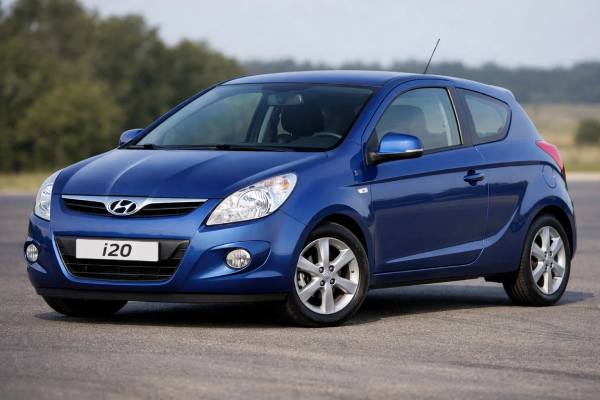
The Hyundai i20 3-door PB with the 1.6 CRDi 128 hp diesel sits at the sharp end of the first-generation i20 lineup. It combines the compact footprint and tidy packaging of a supermini with a level of diesel torque that makes it feel more substantial than its size suggests. In three-door form, it also adds a slightly sportier look without changing the car’s underlying role as an everyday hatchback.
That combination still makes sense today. A good example can be an efficient commuter, a useful motorway car, and a budget-friendly long-distance hatch all at once. The catch is age. These cars are now judged less by trim or colour and more by service history, belt replacement proof, fuel-system condition, cooling health, and corrosion underneath. Buyers who want the strongest diesel i20 from this era will find real appeal here, but only if they shop carefully. In this version, condition matters more than badge detail, and maintenance quality matters more than mileage alone.
Quick Specs and Notes
- Strong torque and a 6-speed manual make this the most effortless diesel i20 of the PB range.
- Compact 3-door body keeps the car easy to park while still offering a useful 295 L boot.
- Official combined economy is very low for the performance on offer.
- Walk away from cars with no timing-belt proof, rough cold starts, or obvious underside corrosion.
- Routine oil service is typically every 20,000 km or 12 months in normal use, and sooner in hard use.
Section overview
- Hyundai i20 3-door 128 in context
- Hyundai i20 3-door numbers and hardware
- Hyundai i20 3-door trims and safety kit
- Reliability pattern and known faults
- Maintenance schedule and buying filters
- Road feel and diesel pace
- Versus Fiesta, Polo, and others
Hyundai i20 3-door 128 in context
The 128 hp 1.6 CRDi turns the first-generation Hyundai i20 into something more interesting than its modest shape suggests. Most PB i20s are remembered as sensible small cars, bought for value and fuel economy. This version keeps that basic identity, but it adds a serious jump in usable performance. In normal driving, that changes the whole character of the car. Where the smaller 1.4 CRDi engines feel economy-led, the 1.6 CRDi 128 feels genuinely relaxed and capable.
That starts with torque. The engine’s 260 Nm output arrives low in the rev range, so the car pulls with much more authority than many superminis of the same era. In town, it feels easy and flexible. On faster roads, it no longer feels like a small car working too hard to stay with traffic. The 6-speed manual helps here as well. It gives the i20 longer legs than the lesser diesel versions and makes motorway cruising less busy. As a result, this model can feel more like a compact hatchback than an entry-level city car.
The 3-door body suits the stronger engine better than some buyers expect. It does not turn the car into a hot hatch, but it gives the i20 a cleaner side profile and a slightly more purposeful look. The long front doors improve access to the front seats, though they are less convenient in tight parking spaces. Rear-seat access is naturally less friendly than in the five-door, so this version tends to fit solo drivers, couples, or two-person households better than families that use the back seats every day.
Mechanically, the appeal is also clear. You are dealing with a conventional front-wheel-drive layout, a small common-rail turbo diesel, and no complex electrified systems. That does not mean zero risk, but it does mean the ownership story is easier to understand than on many newer cars. When problems appear, they usually follow old-diesel logic: fuel-system sensitivity, EGR soot, thermostat issues, worn mounts, clutch and flywheel wear, suspension consumables, and timing-belt neglect. That makes inspection and budgeting more straightforward for an informed buyer.
One market caveat matters. The PB i20 range varied by year and country, and the 128 hp 1.6 CRDi is not as common as the smaller diesel options. Some catalogues and classified ads blur the stronger 1.6 CRDi with lower-output versions, and some trim data is reused carelessly between 3-door and 5-door cars. That makes VIN checking and physical inspection essential.
In used form, this is the version for buyers who like the i20 shape and practicality but want the most complete diesel driving experience available in the line. It remains a rational choice, but it is the fastest, most grown-up rational choice in the family.
Hyundai i20 3-door numbers and hardware
Public official sources do not bundle every market-specific 3-door 128 hp detail into a single open brochure, so the table below reflects the most consistently published figures for the European-market PB i20 3-door 1.6 CRDi 128. Where equipment or dimensions can vary by trim, tyre package, or national market, that is noted rather than stated as universal.
| Category | Specification |
|---|---|
| Code | D4FB |
| Engine layout and cylinders | Inline-4, transverse, DOHC, 4 valves per cylinder |
| Bore × stroke | 77.2 × 84.5 mm (3.04 × 3.33 in) |
| Displacement | 1.6 L (1,582 cc) |
| Induction | Turbocharged, intercooler |
| Fuel system | Common-rail direct diesel injection |
| Compression ratio | About 17.3:1 |
| Max power | 128 hp (94 kW) @ 4,000 rpm |
| Max torque | 260 Nm (192 lb-ft) @ about 1,900–2,750 rpm |
| Timing drive | Belt |
| Rated efficiency | 4.4 L/100 km (53.5 mpg US / 64.2 mpg UK) combined |
| Real-world highway @ 120 km/h | Roughly 5.0–5.7 L/100 km (47.0–41.3 mpg US / 56.5–49.6 mpg UK) |
| Transmission and driveline | Specification |
|---|---|
| Transmission | 6-speed manual |
| Drive type | FWD |
| Differential | Open |
| Chassis and dimensions | Specification |
|---|---|
| Suspension, front | MacPherson strut |
| Suspension, rear | Torsion beam |
| Steering | Rack-and-pinion electric assist |
| Brakes | Front ventilated discs; rear discs on commonly listed higher-output 1.6 CRDi versions |
| Most popular tyre size | 185/60 R15 |
| Other common tyre size | 195/50 R16 |
| Ground clearance | About 150 mm (5.9 in) |
| Length | 3,940 mm (155.1 in) |
| Width | 1,710 mm (67.3 in) |
| Height | 1,490 mm (58.7 in) |
| Wheelbase | 2,525 mm (99.4 in) |
| Turning circle | 10.4 m (34.1 ft) |
| Kerb weight | About 1,223 kg (2,696 lb), market dependent |
| GVWR | About 1,650 kg (3,638 lb) |
| Fuel tank | 45 L (11.9 US gal / 9.9 UK gal) |
| Cargo volume | 295 L (10.4 ft³) seats up / 1,060 L (37.4 ft³) seats folded |
| Performance and capability | Specification |
|---|---|
| 0–100 km/h | About 10.4 s |
| Top speed | About 190 km/h (118 mph) |
| Braking distance | No universally published factory figure for this exact 3-door variant |
| Towing capacity | Up to about 1,100 kg (2,425 lb) braked / 450 kg (992 lb) unbraked, market dependent |
| Payload | Roughly 427 kg (941 lb), equipment dependent |
| Fluids and service capacities | Specification |
|---|---|
| Engine oil | 5W-30 commonly used in Europe; use the exact diesel specification required for the VIN; capacity about 5.3 L (5.6 US qt) |
| Coolant | Ethylene-glycol based coolant with demineralised water; capacity about 6.8 L (7.2 US qt) |
| Transmission oil | API GL-4 SAE 75W-85; about 1.9 L (2.0 US qt) |
| Brake and clutch fluid | DOT 3 or DOT 4; about 0.7–0.8 L (0.7–0.8 US qt) for service fill |
| Differential / transfer case | Not applicable |
| A/C refrigerant | Verify from under-bonnet label by VIN |
| A/C compressor oil | Verify from system label and refrigerant type |
| Key torque specs | Wheel nuts 88–107 Nm (65–79 lb-ft) |
| Safety and driver assistance | Specification |
|---|---|
| Euro NCAP | 5 stars; 88% adult, 83% child, 64% pedestrian, 86% safety assist |
| IIHS | Not applicable |
| Headlight rating | Not applicable |
| ADAS suite | No factory AEB, ACC, lane-keeping assist, blind-spot monitoring, rear cross-traffic alert, or traffic-sign assist |
The numbers explain the appeal clearly. This is still a B-segment hatchback, but it has real passing power, a strong torque curve, and low claimed consumption. That makes it one of the most convincing all-round versions of the first-generation i20.
Hyundai i20 3-door trims and safety kit
In the PB i20 range, the 1.6 CRDi 128 hp engine was usually paired with better-equipped trims rather than entry-level versions. That makes sense, because the strongest diesel sat naturally above the city-focused cars in both price and buyer expectations. Depending on the market, trim names could include labels such as Style, Premium, or comparable mid-to-upper specifications. What matters in practice is that these cars often came with more equipment than the lesser diesels, though the exact mix varied by country.
That variation means you should not trust a generic classified listing. One 3-door 1.6 CRDi might have alloy wheels, fog lamps, climate control, steering-wheel audio controls, a trip computer, and better seat trim. Another may have some but not all of those features. Wheel size is one of the easiest clues. Fifteen-inch alloys are common, while sixteen-inch wheels often suggest a better-equipped car. Inside, look for steering-wheel buttons, nicer seat fabric, metallic interior trim accents, and automatic climate-control hardware where fitted.
Mechanically, trim differences matter less than they do on performance cars, but they still matter. Wheel and tyre package can influence ride quality and noise. Brake configuration can vary by market and version, and it is always worth confirming what is actually fitted to the car rather than assuming from a brochure or advert. The strongest diesel also benefits most from decent tyres, so a well-specced car on quality rubber will feel much more complete than a stripped one on cheap tyres.
Safety is one of the PB i20’s more convincing period strengths. Euro NCAP awarded the model five stars in 2009, with 88% adult occupant protection, 83% child protection, 64% pedestrian protection, and 86% safety assist. That was an excellent result for the class at the time. The published rating applies across the i20 line, even though the tested car was a left-hand-drive 1.4 GL 5-door. For the 3-door buyer, that still matters because it confirms the underlying body structure and restraint performance were strong by supermini standards of the day.
Buyers should still understand the limits of that rating. This i20 has a solid passive-safety base, but it comes from an era before modern active safety became standard. There is no autonomous emergency braking, no adaptive cruise, and no lane-centering assistance. Electronic stability control was standard on some cars and optional on others depending on market and spec, so it is worth checking the individual car rather than assuming. ABS and multiple airbags were part of the model’s safety story, but tyre quality, brake condition, and chassis health now matter just as much.
Child-seat practicality is acceptable, though the three-door format is a compromise. Rear ISOFIX positions are present on the outer seats, but access is naturally less convenient than in the five-door. For occasional child-seat use, it can work. For daily family duty, the five-door remains the easier choice.
The best trim is usually not the flashiest one. It is the one with complete records, working air conditioning, proper tyres, a clean electrical system, and no warning lights. In a used PB i20, actual condition always beats brochure ambition.
Reliability pattern and known faults
The 1.6 CRDi 128 is not a fundamentally weak engine, but its age means every example now has to be judged as an old diesel rather than as a reputation on paper. The basic hardware can last well when maintained correctly, yet neglected cars quickly become expensive because the strongest diesel version also places the greatest load on clutch, mounts, tyres, and front-end components.
The common low-to-medium cost issues are mostly familiar diesel items. EGR contamination and intake soot build-up can cause hesitation, roughness, or reduced response. Thermostats can weaken and leave the engine slow to warm up. Fuel-filter neglect can produce harder starting, poor pull under load, or surging. Glow-plug and battery complaints are also common on older diesels, especially in cold weather. The car may crank normally but still start poorly because two or more glow plugs are weak. Suspension wear also shows up in the usual places: anti-roll-bar links, bushes, top mounts, and occasionally wheel bearings.
The medium-cost problems tend to come with mileage and hard use. Clutch wear is not unusual, and some cars develop dual-mass flywheel symptoms such as idle rattle, take-off vibration, or a slightly harsh drivetrain feel. Engine mounts can also age badly on this version, because the stronger diesel produces more vibration load than the smaller engines. When mounts soften, the car can feel coarser than it should and the gearchange can lose some of its clean feel.
Injector condition deserves real attention on any prospective purchase. A tired or imbalanced injector set can show up as smoky cold starts, uneven idle, or hot-start reluctance. Turbocharger faults are less common than general internet chatter suggests, but boost leaks, vacuum issues, or long oil service intervals can imitate turbo trouble. It is smarter to diagnose the full intake and control system before assuming the turbo itself has failed.
Timing-belt history is the biggest reliability checkpoint. This is not the kind of issue that gives a polite early warning every time. If replacement history is unclear, treat the car as overdue. Belt, tensioners, rollers, and water pump should be viewed as a single job. On an old diesel i20, documented belt work adds more value than cosmetic reconditioning.
Cooling-system health matters too. A car that takes too long to reach temperature, loses coolant slowly, or shows crusting around hose joints needs attention before it becomes a bigger problem. Because the engine is efficient, owners sometimes ignore marginal thermostats longer than they should.
Rust is the final ownership filter. Check subframe areas, seams, brake lines, rear arches, and jacking points carefully. A mechanically decent car with serious corrosion is almost always a worse buy than a cosmetically tired but structurally healthy one.
Campaign and recall verification should be done through official channels, not guesswork. Use Hyundai’s campaign lookup and service-history lookup, then confirm against the official government recall database where applicable. On this model, good paperwork is a reliability feature in its own right.
Maintenance schedule and buying filters
The strongest diesel i20 deserves a stricter maintenance approach than many budget hatchbacks receive. Hyundai’s period schedules were not careless, but the real world for a used 1.6 CRDi 128 is different. Age, unknown history, cold starts, and stop-start urban use all justify a more conservative plan. The goal is not over-maintenance. It is keeping a high-output small diesel healthy before routine issues become major bills.
A sensible real-world schedule looks like this:
- Engine oil and filter every 10,000–15,000 km or 12 months. Short trips or heavy urban use justify the shorter interval.
- Fuel filter every 60,000 km, sooner if fuel quality is questionable or drivability problems appear.
- Engine air filter inspect at every service and replace as needed.
- Cabin filter every 20,000 km or 12 months.
- Coolant first major change around 5 years, then every 2 years unless the VIN-specific schedule says otherwise.
- Brake fluid every 2 years.
- Manual gearbox oil inspect regularly and replace around 80,000–100,000 km if the service history is incomplete.
- Timing belt, tensioners, rollers, and water pump at the official interval for the exact VIN, or immediately if undocumented.
- Auxiliary belt and hoses inspect at every service and replace on condition.
- Tyre rotation and alignment check every 12,000 km or when wear patterns suggest it.
- Battery test yearly once the battery is more than about 4 years old.
- Brake inspection every service, especially rear hardware on cars that see little use.
The basic fluid picture is easy enough to manage. Engine oil capacity is about 5.3 L, coolant is about 6.8 L, and the gearbox takes about 1.9 L of GL-4 75W-85. Wheel-nut torque remains 88–107 Nm. Those figures help with ownership planning, but precise service procedures still need to be confirmed against the correct documentation for the specific vehicle.
As a buyer, inspect the car in a clear order. Start underneath. Look for rust, dampness, bent jacking points, fresh underseal hiding corrosion, and tired brake lines or fixings. Then perform a proper cold start. The engine should not feel excessively lumpy, smoky, or lazy to catch. After that, check the clutch take-up, gearbox selection, engine temperature behaviour, and whether the car pulls strongly without smoke or hesitation once warm.
A good buying checklist includes:
- Proof of timing-belt replacement.
- Recent oil and filter history.
- Correctly matched tyres with decent tread.
- No unexplained warning lights.
- Clean coolant and no crusting around hose joints.
- Stable idle and easy hot restarts.
- No obvious clutch slip or flywheel chatter.
- A quiet front suspension over small bumps.
Common reconditioning jobs after purchase are usually manageable: tyres, suspension links or bushes, battery, all fluids, filters, brakes, and sometimes an engine mount or thermostat. The expensive catches are hidden rust, injector work, and clutch-plus-flywheel replacement on top of overdue belt service.
The best cars are usually later, cleaner, mid-to-upper trim examples with ESC, working climate control, and complete records. The ones to avoid are the bargain cars with no belt proof, rough starting, cheap tyres, or corrosion that has already become structural. Long term, the durability outlook is good only when the starting point is good. That is why buying carefully matters so much.
Road feel and diesel pace
The 1.6 CRDi 128 changes the i20 more than the badge alone suggests. Around town, the car remains easy and compact, with light steering and good manoeuvrability. But once speeds rise, this version feels much more settled than the lower-powered diesels. The extra torque means less effort in everyday driving, fewer downshifts on mild inclines, and a calmer sense of pace on faster roads.
Ride quality is typical of a late-2000s supermini with a mature bias rather than a playful one. The car is firm enough to feel tidy, but not harsh when the suspension is healthy and the tyres are sensible. Over broken urban surfaces it can thump a little, especially on larger wheels, yet it generally feels stable and honest. The longer motorway gearing and stronger engine make it feel more complete than the lesser diesel versions. It is still a small hatchback, but it no longer feels out of its depth on long runs.
The steering is light and straightforward rather than rich in feedback. Cornering balance is safe and predictable, and the chassis prefers clean, tidy inputs over aggressive driving. This is not the driver’s car of the class, but it is not clumsy either. The stronger engine gives it an easy overtaking reserve that makes the whole package feel more relaxed and mature. That is the real performance benefit. It is not about chasing outright speed. It is about needing less effort.
Noise, vibration, and harshness are decent for the era, though not exceptional. Cold starts bring clear diesel clatter. Once warm, the engine settles, and at a steady cruise it is more refined than many buyers expect from a small diesel hatch. Wind noise is acceptable, tyre roar depends heavily on rubber quality, and worn mounts can make the whole car feel rougher than it should.
Real-world economy remains one of the strongest parts of the package. A healthy example can usually deliver:
- City: about 5.7–6.5 L/100 km
about 41.3–36.2 mpg US
about 49.6–43.5 mpg UK - Highway at 100–120 km/h: about 5.0–5.7 L/100 km
about 47.0–41.3 mpg US
about 56.5–49.6 mpg UK - Mixed use: about 5.1–5.8 L/100 km
about 46.1–40.6 mpg US
about 55.4–48.7 mpg UK
That is impressive given the level of performance. Official economy is low, and in real use the car can still feel very efficient if it is maintained correctly and not driven on poor tyres or with a weak thermostat.
Braking feel is simple and easy to judge. The stronger diesel benefits noticeably from quality tyres, because the chassis has enough torque to expose cheap rubber more easily than the smaller engines do. Good tyres make the car feel secure and composed. Bad ones make it noisier, less precise, and less satisfying in wet weather.
In short, this version feels like the i20 for people who actually drive beyond the city. It remains practical and modest, but it adds enough pace and long-distance ease to feel like the fully developed diesel version of the PB range.
Versus Fiesta, Polo, and others
The Hyundai i20 3-door 1.6 CRDi 128 occupies a useful middle ground against its main rivals. It is not the most playful car in the class, and it is not the most premium-feeling either. But it often lands in the sweet spot between performance, running costs, and purchase price.
Against a Ford Fiesta diesel of the same era, the Hyundai usually loses on steering feel and overall driver engagement. The Fiesta remains the more entertaining car when the road gets interesting. But the i20 fights back with stronger diesel shove in this high-output form, a more straightforward ownership feel, and often better value on the used market. For a buyer who wants ease and torque more than chassis sparkle, the Hyundai can be the better tool.
Compared with a Volkswagen Polo or Skoda Fabia diesel, the i20 tends to feel less polished in some cabin materials and slightly less refined at the edges. Yet it is often cheaper to buy and no less practical in daily use. The strongest i20 diesel also makes a good case for itself because it feels more muscular than many buyers expect from the badge. In used terms, that matters. A car that is both affordable and genuinely capable is easier to justify than one that merely looks a bit more upscale.
Against a Vauxhall Corsa diesel, the Hyundai often feels like the safer all-round recommendation when service history is equal. The Corsa can be fine, but the i20 combines better safety credibility for the era with straightforward packaging and a strong diesel option that feels less compromised. Against the Peugeot 207 or some Renault small diesels, the Hyundai may not be the most characterful, but it can feel less fussy to own.
Its closest natural relative is often the Kia Rio of the same broad family period. In that case, individual condition matters far more than badge preference. Buy the cleaner shell, the better records, and the better-kept drivetrain.
There is also a comparison inside the i20 range itself. The 1.4 CRDi versions make sense for buyers who value economy first and are content with modest pace. The 1.6 CRDi 128 is for the buyer who wants the same basic packaging with a much more complete powertrain. It is the version that makes the i20 feel most like a proper small all-round hatch rather than just a city-biased budget car.
That is the main verdict. The i20 3-door 1.6 CRDi 128 is not the iconic choice in this class. It is not the trendiest and not the purest driver’s car. But it is fast enough, efficient enough, practical enough, and simple enough to remain highly relevant as a used buy. For the right owner, that balance is more valuable than image. This is the quietly clever rival: the one that rarely dominates the conversation, but often makes the smartest case once you look past the badge.
References
- Hyundai Owners manuals 2026 (Owner’s Manual Portal)
- Routine Servicing 2026 (Service Information)
- 5-Year Warranty | New Cars | Hyundai Motor UK 2026 (Campaign and Service History Lookup)
- HYUNDAI I20 – Euro NCAP Results 2009 2009 (Safety Rating)
- Check if a vehicle, part or accessory has been recalled 2026 (Recall Database)
Disclaimer
This article is for informational purposes only and is not a substitute for professional diagnosis, repair, or workshop advice. Specifications, torque values, service intervals, procedures, and fitted equipment can vary by VIN, market, model year, and trim, so always verify details against the official Hyundai service documentation for the exact vehicle.
If this guide was useful, please consider sharing it on Facebook, X, or another platform to support our work.