
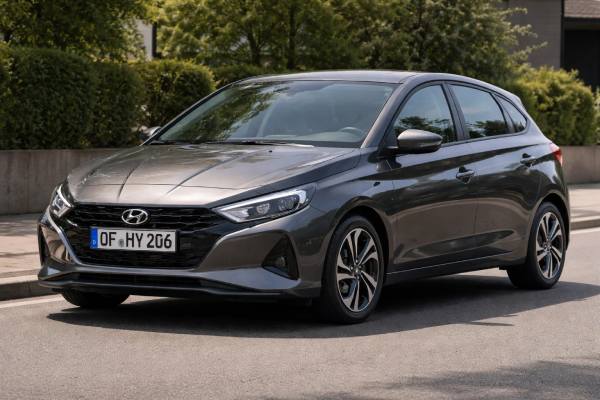
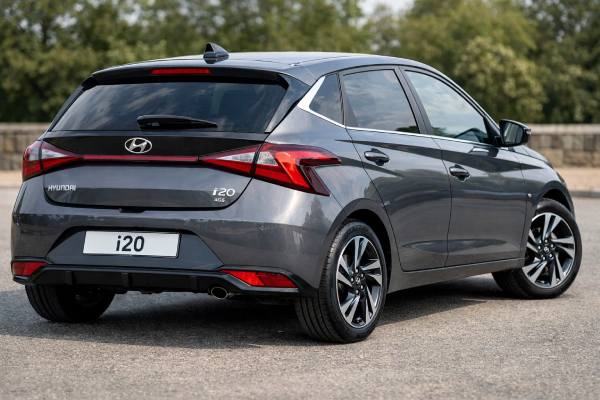
The Hyundai i20 BC3 with the 1.2 MPi 84 hp petrol engine is the straightforward version of Hyundai’s third-generation supermini. It skips turbocharging, mild-hybrid hardware, and gearbox complexity in favor of a naturally aspirated four-cylinder, a 5-speed manual, and a lighter ownership burden. That matters more than it first seems. In daily use, the BC3 i20 already offers a roomy cabin, a modern dashboard layout, useful safety technology, and a larger boot than the older GB-generation car. The 1.2 MPi version then adds the kind of powertrain many used-car buyers still prefer: simple, predictable, and easier to service long term than the 1.0 T-GDi models. The trade-off is performance. This is not the lively engine in the range, and motorway overtakes need more planning than in the turbo cars. But for buyers who value simplicity, lower risk, and solid day-to-day usability, the 1.2 MPi remains one of the most rational BC3 choices.
Key Takeaways
- The 1.2 MPi uses a simple naturally aspirated four-cylinder layout and avoids turbo-related long-term risk.
- The BC3 body is wider and longer than earlier i20s, with a 2,580 mm wheelbase and a 352 L boot.
- Euro NCAP applies the 2021 Bayon-based 4-star rating to the i20, with strong child-occupant performance.
- The biggest ownership risk is not a headline defect but neglected servicing, cheap tyres, and missed cooling or ignition work.
- Hyundai’s European schedule calls for engine oil and filter replacement every 15,000 km or 12 months in normal use.
Section overview
- Hyundai i20 BC3 Ownership Picture
- Hyundai i20 BC3 Hard Data
- Hyundai i20 BC3 Grades and Safety
- Failure Points and Service Actions
- Scheduled Care and Smart Buying
- Real-World Drive and Economy
- Rival Set and Final Take
Hyundai i20 BC3 Ownership Picture
The BC3-generation Hyundai i20 was a bigger shift than its badge might suggest. Hyundai made the car wider, a little longer, and visually much more assertive than before. The wheelbase grew to 2,580 mm, and the broader stance gives the i20 a more planted road presence and more convincing rear-seat space than many buyers expect from a supermini.
The 1.2 MPi 84 hp version is the mechanical minimalist of the mainstream range. It sits below the 1.0 T-GDi engines in performance, but its appeal is not speed. It is the familiar combination of multi-point petrol injection, no turbocharger, chain-driven cam timing, and fewer drivetrain variables to worry about once the car moves out of warranty and into long-term ownership.
That simplicity shapes the whole ownership picture. If you use a small hatchback mainly for commuting, school runs, local errands, and steady mixed-road travel, the 1.2 MPi makes a lot of sense. It is smooth enough, easier to service than the turbo engine, and less exposed to issues like severe carbon build-up, boost leaks, or dual-clutch transmission-related costs. If, on the other hand, you cover long motorway miles fully loaded or expect strong overtaking shove, the 1.0 T-GDi is the better technical match. The 1.2 is best understood as the calm, low-drama option.
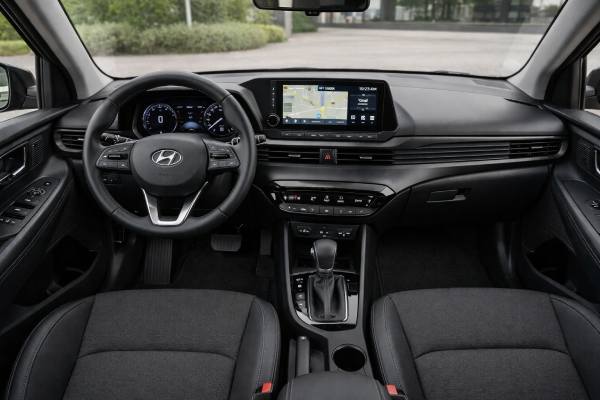
The BC3 cabin also matters. Hyundai gave the car a more digital, more design-led interior than the old i20, with a broader dashboard look and much more modern connectivity. Even though exact equipment varies by market and trim, the platform itself feels contemporary enough that the 1.2 MPi does not come across as a bare-bones compromise. It is still a modern supermini, just one with a simpler engine choice.
As a used buy, that puts the 1.2 MPi in a very specific sweet spot. It is not the fastest BC3, not the most fashionable, and not the one buyers pick for maximum spec-per-pound. It is the version many cautious owners choose when they want the newest-feeling i20 with the least demanding powertrain. That makes it especially appealing to people who keep cars for a long time and care more about predictable upkeep than about shaving a second off the 0–100 km/h time.
Hyundai i20 BC3 Hard Data
The 1.2 MPi 84 hp sits at the simple end of the BC3 range, but the rest of the car is not basic. Hyundai gave the third-generation i20 a genuinely modern platform, longer wheelbase, larger boot, and a more complete safety and tech package than many older B-segment cars. The figures below reflect official Hyundai powertrain, design, safety, and owner-manual data for the BC3 i20 and the 1.2 MPi engine.
| Powertrain and efficiency | Figure |
|---|---|
| Code | Smartstream G 1.2 / 1.2 MPi |
| Engine layout and cylinders | Inline 4, DOHC, 4 valves per cylinder |
| Displacement | 1.2 L (1,197 cc) |
| Bore × stroke | 71.0 × 75.6 mm (2.80 × 2.98 in) |
| Induction | Naturally aspirated |
| Fuel system | Multi-point petrol injection |
| Compression ratio | About 10.5:1 |
| Max power | 84 hp (61.8 kW) @ 6,000 rpm |
| Max torque | 117.6 Nm (86.7 lb-ft) |
| Timing drive | Chain |
| Rated efficiency | Typically around 5.0–5.5 L/100 km combined, market-dependent |
| Real-world highway @ 120 km/h | Usually around 6.1–6.8 L/100 km |
| Transmission and driveline | Figure |
|---|---|
| Transmission | 5-speed manual |
| Drive type | Front-wheel drive |
| Differential | Open |
| Chassis and dimensions | Figure |
|---|---|
| Suspension, front | MacPherson strut |
| Suspension, rear | Torsion beam |
| Steering | Electric power steering |
| Steering ratio | Not broadly published in the open official sources reviewed |
| Brakes | Front discs, rear drums on many 1.2 trims |
| Most common tyre sizes | 185/65 R15 or 195/55 R16 depending on trim |
| Length | 4,040 mm (159.1 in) |
| Width | 1,775 mm (69.9 in) |
| Height | 1,450 mm (57.1 in) |
| Wheelbase | 2,580 mm (101.6 in) |
| Turning circle | Around 10.4 m (34.1 ft) |
| Kerb weight | Roughly 1,040–1,100 kg depending on market trim |
| Fuel tank | 40 L (10.6 US gal / 8.8 UK gal) |
| Cargo volume | 352 L (12.4 ft³), VDA |
| Performance and capability | Figure |
|---|---|
| 0–100 km/h | Typically around 13.1 s |
| Top speed | Around 171 km/h (106 mph) |
| Towing capacity | Market-dependent; verify VIN and homologation papers |
| Payload | Market-dependent; verify VIN plate |
| Fluids and service capacities | Figure |
|---|---|
| Engine oil | API SN PLUS or above, full synthetic; commonly 0W-20 |
| Engine oil capacity | Roughly 3.6–3.8 L with filter, verify by VIN/manual edition |
| Coolant | Phosphate-based ethylene-glycol coolant, 50/50 mix suitable for most climates |
| Transmission fluid | Hyundai-specified manual gearbox oil; no routine normal-service change interval |
| A/C refrigerant | Type and charge vary by build; confirm on under-bonnet label |
| Key torque spec | Wheel nuts 88–107 Nm (65–79 lb-ft) |
| Safety and driver assistance | Figure |
|---|---|
| Euro NCAP | 4 stars (2021 rating applied from related BAYON test) |
| Adult occupant | 76% |
| Child occupant | 82% |
| Vulnerable road users | 76% |
| Safety assist | 67% |
| ADAS suite | Availability varies by trim and market; may include FCA, LKA/LFA, ISLA, DAW, HBA, BCA, RCCA, and PCA-R |
The numbers explain the car well. The body is genuinely modern and spacious for the class, the boot is stronger than the old GB i20’s, and the safety package is much more advanced than older superminis. The weak point is obvious too: the 1.2 MPi is adequate rather than quick. It is bought for low complexity, not for headline performance.
Hyundai i20 BC3 Grades and Safety
The BC3 i20 range makes more sense when you separate engine choice from trim choice. The 1.2 MPi 84 hp defines the car’s mechanical character, but the trim level defines how modern it feels to live with. In many European markets, the 1.2 appeared as the mainstream non-turbo option, often in lower and mid-grade trims but sometimes climbing high enough to include the larger screens, upgraded lighting, and a better mix of convenience equipment. That means used examples can feel very different from one another even when the engine is the same.
The good news is that the underlying BC3 cabin is strong. Hyundai gave the all-new i20 a digital-looking layout, wider-feeling dashboard, and a more modern interior atmosphere. Even when the 1.2 MPi sits in a simpler trim, it still benefits from the same platform packaging and interior design. Better trims add more value than they did on older generations because the BC3’s infotainment and driver-assistance hardware genuinely change the daily experience.
Safety is one of the model’s clearest advantages, but it needs a little explanation. Euro NCAP’s 2021 i20 result is not based on a unique i20 crash test in the usual sense. Euro NCAP states that the i20 is very closely related to the Hyundai Bayon, shares the same safety equipment, and can therefore use the Bayon-based rating. That official rating is four stars, with 76% adult-occupant protection, 82% child-occupant protection, 76% vulnerable-road-user protection, and 67% safety assist.
The detail matters more than the star count alone. The structure is fundamentally sound for the class, and the car performs well in several impact categories, especially for child protection. But it is not class-leading in every safety-assist measure, which is why equipment fitment matters.
Depending on trim and market, the i20 can offer Forward Collision-avoidance Assist with vehicle, pedestrian, and bicycle detection; Lane Following Assist; Blind-Spot Collision-avoidance Assist; Rear Cross-traffic Collision-avoidance Assist; Parking Collision-avoidance Assist Reverse; Intelligent Speed Limit Assist; and Driver Attention-style monitoring systems. The important phrase there is “depending on trim and market.” Not every 1.2 MPi has the full SmartSense package.
That leads to a practical used-car rule: do not shop this version by engine badge alone. A clean 1.2 MPi with the right safety pack, camera, parking sensors, and smartphone integration can feel like a much newer and more complete car than a lower-grade example with the same engine. For this generation, equipment verification matters almost as much as condition.
Failure Points and Service Actions
The reliability picture for the BC3 i20 1.2 MPi is more reassuring than dramatic. This is still a relatively modern car, and there is no single public, model-defining powertrain defect that dominates the official sources typically used for buyers and owners. Compared with the 1.0 T-GDi, the 1.2 MPi removes turbocharger hardware and direct-injection complexity from the equation, and that generally makes it the lower-risk long-term engine choice.
That does not mean it is trouble-free. The issues that do appear tend to fit into predictable used-car categories:
- Common, low to medium cost: batteries, tyre wear from poor alignment, front drop links, brake wear, and ordinary trim or switch faults.
- Common, medium cost: ignition-coil or spark-plug misfire, thermostat or cooling-system wear, and air-conditioning weakness.
- Occasional, medium cost: wheel bearings, engine-mount wear, door-lock or window-switch faults, and sensor-related warning lights.
- Occasional, high cost: catalytic-converter damage after long-term unresolved misfire, overheating-related engine stress, or poor accident repair correction.
- Rare but important: hidden crash history, water ingress after bad bodywork, or missed recall and service-campaign actions.
The engine itself is conceptually simple, but it still relies on good oil care. Hyundai’s maintenance schedule ties the normal oil interval to the use of the recommended full-synthetic oil. If a lower-grade oil is used, the service logic becomes less forgiving. That tells you something important: even on the simplest BC3 petrol, oil quality matters.
Cooling system care is another one to watch. The engine uses aluminum components and requires the correct phosphate-based ethylene-glycol coolant, mixed properly. Cars that have had random coolant top-ups, uncertain service history, or unexplained coolant loss deserve caution. Modern small petrol engines are generally durable, but they do not respond well to overheating neglect.
There is also a service-action point worth stating honestly. Open official recall sources do not show one broad, public, powertrain-specific campaign that defines the BC3 i20 1.2 MPi as a risky car. But campaign status is VIN-specific and should always be checked individually through the official recall portals. That is the right standard for any late-model used Hyundai: verify by VIN rather than assuming the car is clear because the seller says so.
So the reliability verdict is favorable, with conditions. This is one of the safer BC3 engines to own long term, but it still rewards evidence of careful servicing, proper fluids, sound tyres, and prompt attention to minor warning signs.
Scheduled Care and Smart Buying
The i20 BC3 1.2 MPi is one of those cars that becomes more attractive the closer you look at the maintenance schedule. The schedule is clear, and it is not unusually heavy. Engine oil and filter changes are due every 15,000 km or 12 months, spark plugs at 150,000 km or 120 months, and coolant first at 180,000 km or 10 years, then every 30,000 km or 24 months after that. That is sensible, structured, and relatively easy to budget for.
A practical ownership plan looks like this:
| Item | Practical interval |
|---|---|
| Engine oil and filter | Every 15,000 km or 12 months |
| Engine air filter | Inspect at service; replace by schedule or sooner in dust |
| Cabin air filter | Replace regularly; many manuals show replacement at each maintenance interval |
| Spark plugs | Every 150,000 km or 120 months |
| Coolant | First at 180,000 km or 10 years, then every 30,000 km or 24 months |
| Brake fluid | Inspect every 15,000 km; replace every 30,000 km |
| Drive belts | First inspect at 90,000 km or 72 months, then every 30,000 km or 24 months |
| Manual transmission fluid | No routine normal-service replacement; change if submerged in water |
| Severe-use oil service | Every 7,500 km or 6 months |
| Battery check | Inspect regularly, especially after year four |
The schedule also gives useful context for “severe” use. Repeated short trips, heavy traffic, dusty roads, mountain driving, towing, frequent stop-and-go use, and non-recommended oil all move the car into a shorter maintenance pattern. That matters because many small hatchbacks live exactly that kind of life. In practice, a cautious used buyer should think in terms of the shorter interval if the car has mostly done urban duty.
For fluid decisions, the 1.2 MPi requires full-synthetic oil meeting API SN PLUS or above, with 0W-20 commonly specified for the Smartstream G1.2. Coolant should be phosphate-based ethylene-glycol mixed correctly with deionized or soft water. Those are not exotic requirements, but they are important. A tidy service file should show that the car received the right kind of attention, not just “an oil change.”
The buyer’s checklist should focus on the basics that change the ownership story:
- Start the engine cold and listen for rough idle or ignition-related misfire.
- Confirm the service history includes annual oil changes with the right specification.
- Check for even tyre wear and decent tyre brands.
- Test all ADAS, camera, parking sensors, infotainment, and climate functions.
- Inspect brakes and suspension over a rough road.
- Look underneath for rust, impact damage, or poor repairs.
- Verify VIN-based recall and service-campaign status.
- Prefer a car with proper invoices, not just stamped service pages.
The best version is usually not the cheapest 1.2 MPi on sale. It is the one that has been treated like a modern car, not a disposable supermini. On this engine in particular, good maintenance buys you simplicity and peace of mind. Poor maintenance just turns simplicity into deferred expense.
Real-World Drive and Economy
The BC3 i20 1.2 MPi drives better than its output suggests, but not enough to hide what it is. This is an easy, predictable, naturally aspirated small hatchback. It feels smooth in low-speed driving, the clutch and gearbox are light enough for daily commuting, and the chassis itself is more mature than the engine. That last point matters. The BC3 platform is roomy, stable, and modern enough that you can feel the car would happily support more power. The 1.2 just chooses not to provide it.
Around town, that is not a problem. The engine is responsive enough for normal traffic, the 5-speed manual is simple to use, and the car’s size and visibility suit urban work well. On country roads and motorways, the 1.2’s limitations become clearer. You can cruise comfortably, but you need more revs and more planning for overtakes than you would in the 1.0 T-GDi. That makes the car feel calm rather than lively. Some drivers will see that as a weakness. Others will see it as exactly the right match for a low-stress supermini.
Ride quality is one of the model’s better traits. Hyundai gave the BC3 a more planted feel than earlier i20s, helped by the longer wheelbase and wider track. It is not the sharpest car in the class, but it is settled and easy to trust. The steering is light rather than talkative, and the car is more about stability and everyday comfort than playful cornering. That makes it a good fit for drivers who want a modern hatchback feel without a sporty edge.
Fuel economy is decent, and often one of the reasons buyers consider the 1.2 in the first place. Official combined figures generally sit around the low-to-mid 5 L/100 km range depending on market and tyre package. In real mixed use, a healthy car usually lands a bit above that, while steady 120 km/h highway driving tends to move the result into the low-to-high 6 L/100 km range. That is respectable for a naturally aspirated four-cylinder petrol, though it will not outperform the best small turbo rivals in every scenario.
Noise and refinement are acceptable rather than exceptional. The engine is smoother than a three-cylinder, and that helps the car feel more polished than many budget superminis. But because the engine has to work harder at speed, it does not feel as relaxed on the motorway as the turbo variants do. Again, that is the core trade-off of this model: smoother and simpler, but slower and less effortless.
Overall, the real-world verdict is clear. The BC3 i20 1.2 MPi is not bought for excitement. It is bought because it feels modern enough, rides well enough, and costs little enough to justify its modest pace. For many used buyers, that is a perfectly sound deal.
Rival Set and Final Take
The Hyundai i20 BC3 1.2 MPi 84 hp lives in the part of the supermini market where buyers often choose between simplicity and performance. Its obvious rivals include naturally aspirated or low-output petrol versions of the Toyota Yaris, Skoda Fabia, Volkswagen Polo, Kia Rio, and some Renault Clio and Peugeot 208 variants. Against them, the Hyundai’s biggest strengths are space efficiency, a modern-feeling cabin, decent standard safety potential, and a powertrain that stays mechanically conservative.
Compared with the 1.0 T-GDi i20, the 1.2 MPi loses out in everyday punch but wins on simplicity. Compared with older GB-generation i20s, the BC3 car feels much more contemporary, especially in layout, driver-assistance potential, and luggage space. Compared with some European rivals, it may not be the most engaging or prestige-feeling car in the class, but it is usually one of the easier ones to justify logically.
Its weaknesses are straightforward. The 84 hp engine does not fully exploit the capability of the BC3 chassis. The 5-speed manual is fine, but not especially long-legged. Real-world motorway performance is adequate rather than relaxed. And because the car is modern enough to include meaningful technology, buyers still have to shop carefully for trim level, ADAS fitment, and software health. This is not an old-school “nothing to go wrong” supermini just because the engine is simple.
The long-term ownership case, however, is strong. The schedule is clear, the engine avoids many of the usual small-turbo concerns, the safety package is credible for the class, and the cabin and boot are genuinely useful. That combination makes the 1.2 MPi one of the safest BC3 bets for buyers who keep cars beyond the first ownership cycle.
The final verdict is favorable. The Hyundai i20 BC3 1.2 MPi 84 hp is not the exciting version and not the quickest value play in the range. It is the careful buyer’s version: roomy, modern enough, sensibly engineered, and relatively low-risk if maintained properly. Its biggest advantages are simplicity, usability, and predictability. Its biggest drawbacks are modest performance and the need to choose condition and equipment carefully. Buy a good one, and it makes an unusually convincing case as a long-term supermini.
References
- Yeni i20 Kullanım Kılavuzu 2023 (Owner’s Manual)
- Petrol and Diesel Powertrains | Hyundai Motor Europe 2026 (Technical Guide)
- i20 Design | Cars – Hyundai Worldwide 2026 (Official Model Page)
- EuroNCAP | Hyundai i20 2021 (Safety Rating)
- Home | Hyundai Recalls & Service Campaigns 2026 (Recall Database)
Disclaimer
This article is for informational purposes only and is not a substitute for professional diagnosis or repair. Specifications, torque values, service intervals, fluids, procedures, and fitted equipment vary by VIN, market, build date, and trim level, so always verify them against the official service documentation and parts information for the exact vehicle.
If this guide helped you, please consider sharing it on Facebook, X, or another social platform to support our work.