
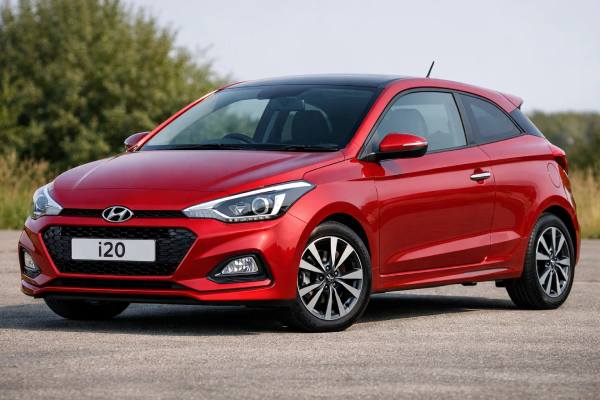
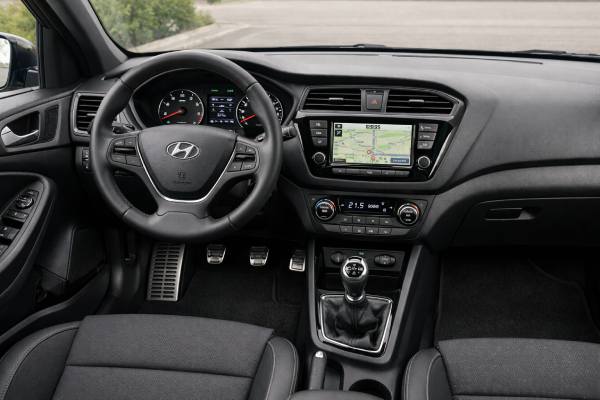
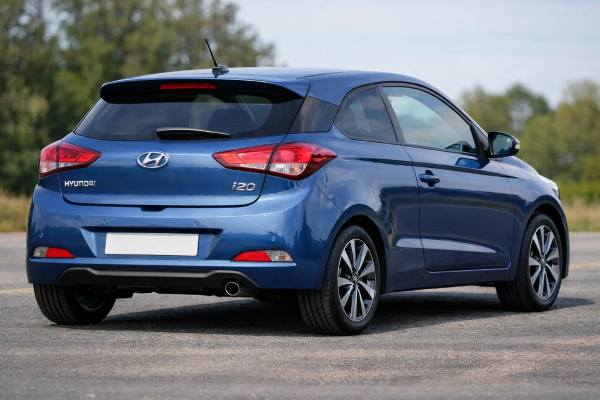
The facelifted Hyundai i20 Coupe GB with the 1.2-litre 75 hp petrol engine is one of the more straightforward small coupes you can buy used. It keeps the sharp three-door body and lower roofline that make the Coupe more distinctive than the regular i20, but underneath it remains a practical front-wheel-drive supermini with simple naturally aspirated petrol engineering. That matters because many buyers want style without buying into turbocharger, direct-injection, or dual-clutch complexity. In that sense, this version is easy to understand. It is not quick, and it was never meant to be. Instead, it offers light running costs, a useful boot, predictable road manners, and a more relaxed ownership profile than many newer small cars. The real question today is not whether the design is sound, but whether the individual car was looked after properly. Service history, suspension condition, tyres, cooling-system health, and evidence of careful use matter far more than trim name alone.
At a Glance
- The 1.2 petrol is simple, proven, and usually cheaper to maintain than small turbo alternatives.
- The Coupe body adds style without making the car much less useful day to day.
- Ride comfort, cabin usability, and boot space remain strong points for a small three-door hatch.
- Performance is modest, so this version suits city and mixed use better than heavy motorway work with full load.
- A practical baseline is engine oil and filter every 10,000 km or 12 months.
Quick navigation
- Hyundai i20 Coupe GB Facelift Basics
- Hyundai i20 Coupe GB Facelift Specs
- Hyundai i20 Coupe GB Facelift Trims and Safety
- Common Faults and Service History
- Maintenance Plan and Used Buying Guide
- Real-World Driving and Economy
- How It Compares with Rivals
Hyundai i20 Coupe GB Facelift Basics
The facelifted i20 Coupe sits in an unusual but useful niche. It looks more style-led than the ordinary five-door i20, yet it never stops being a practical supermini underneath. Hyundai managed the design well. The roofline is lower, the rear is more sculpted, and the car has more visual presence than the standard hatch, but the front seats remain roomy, the rear bench is still usable for a car of this type, and the boot is large enough to keep the Coupe from feeling like a compromise purchase.
In 1.2 75 hp form, the car is aimed at buyers who value simplicity above pace. This is the entry-level petrol end of the facelift range, and that shapes the whole ownership experience. The naturally aspirated four-cylinder engine is straightforward, easy to understand, and less mechanically demanding than a small turbo petrol. That lowers the risk of some expensive long-term faults. It also means the engine needs revs and planning. The car is perfectly workable in daily use, but it is not the version to buy if you expect strong overtaking performance or effortless high-speed touring.
The stronger part of the package is how cohesive it feels in ordinary life. The Coupe remains easy to park, simple to place in traffic, and comfortable enough over poor roads. The steering is light, visibility is better than the roofline suggests, and the raised sill line does not make it feel claustrophobic in the front. The rear is less convenient than in the five-door, but that is expected in a three-door Coupe-style hatchback.
The facelift itself matters because it kept the GB-generation i20 looking current for longer. It also brought equipment and safety improvements in some markets, especially around infotainment and optional active-safety features. That means used buyers should not just shop by year. They should shop by actual specification, because some late cars are meaningfully better equipped than others.
As a used car, the i20 Coupe 1.2 works best for buyers who want a small, low-stress petrol hatchback with a bit more style than average. It suits urban and mixed use well, and it makes sense for drivers who do not need strong rear-seat access every day. The best examples are the ones that were maintained on time, kept on decent tyres, and not treated as disposable first-car transport. In good condition, the Coupe still feels like a thoughtful, well-rounded small car.
Hyundai i20 Coupe GB Facelift Specs
Exact figures can vary slightly by market and trim, and some countries offered different power outputs for the 1.2-litre engine. The table below reflects the lower-output 1.2 petrol specification commonly associated with the facelift period and notes where market variation matters.
Powertrain and efficiency
| Item | Hyundai i20 Coupe GB facelift 1.2 petrol |
|---|---|
| Code | Kappa 1.2 MPI family |
| Engine layout and cylinders | Inline-4, DOHC, 16-valve |
| Cylinders | 4 |
| Valves per cylinder | 4 |
| Bore × stroke | 71.0 × 78.8 mm (2.80 × 3.10 in) |
| Displacement | 1.2 L (1,248 cc) |
| Induction | Naturally aspirated |
| Fuel system | Multi-point fuel injection |
| Compression ratio | About 10.5:1 |
| Max power | 75 hp (55 kW) @ 6,000 rpm |
| Max torque | About 122 Nm (90 lb-ft) @ 4,000 rpm |
| Timing drive | Chain |
| Rated efficiency | Roughly 4.7-5.1 L/100 km depending on market and tyre package |
| Real-world highway @ 120 km/h | About 5.8-6.6 L/100 km |
Transmission and driveline
| Item | Hyundai i20 Coupe GB facelift 1.2 petrol |
|---|---|
| Transmission | 5-speed manual |
| Drive type | FWD |
| Differential | Open |
Chassis and dimensions
| Item | Hyundai i20 Coupe GB facelift 1.2 petrol |
|---|---|
| Suspension front | MacPherson strut with coil springs |
| Suspension rear | Coupled torsion beam axle |
| Steering | Electric power-assisted rack and pinion |
| Steering ratio | About 2.7 turns lock-to-lock |
| Brakes | Front disc, rear disc or drum depending on market and trim |
| Most popular tyre size | 185/65 R15 or 195/55 R16 |
| Ground clearance | About 140 mm (5.5 in) |
| Length | 4,045 mm (159.3 in) |
| Width | 1,730 mm (68.1 in) |
| Height | 1,449 mm (57.0 in) |
| Wheelbase | 2,570 mm (101.2 in) |
| Turning circle | 10.2 m (33.5 ft) |
| Kerb weight | Roughly 1,020-1,120 kg (2,249-2,469 lb), market-dependent |
| GVWR | About 1,560-1,620 kg (3,439-3,571 lb), market-dependent |
| Fuel tank | 50 L (13.2 US gal / 11.0 UK gal) |
| Cargo volume | 336 L (11.9 ft³) seats up / about 1,011 L (35.7 ft³) seats folded, VDA |
Performance and capability
| Item | Hyundai i20 Coupe GB facelift 1.2 petrol |
|---|---|
| 0–100 km/h (0–62 mph) | About 13.5-14.0 s |
| Top speed | About 170 km/h (106 mph) |
| Braking distance 100–0 km/h | Typically around 39-42 m on quality tyres |
| Towing capacity | Market-specific; verify by VIN before towing |
| Payload | Commonly around 400-480 kg |
Fluids and service capacities
| Item | Hyundai i20 Coupe GB facelift 1.2 petrol |
|---|---|
| Engine oil | 5W-30 or market-approved equivalent |
| Engine oil capacity | About 3.5 L (3.7 US qt) with filter |
| Coolant | Long-life ethylene glycol mix; about 4.3 L (4.5 US qt) |
| Transmission fluid | Manual gearbox oil, about 1.5 L (1.6 US qt) |
| Differential / transfer case | Not applicable |
| A/C refrigerant | Varies by build label and market |
| A/C compressor oil | Verify by under-bonnet label or service literature |
| Key wheel-nut torque | Commonly around 88-110 Nm depending on market guidance |
Safety and driver assistance
| Item | Hyundai i20 Coupe GB facelift |
|---|---|
| Euro NCAP | 4 stars |
| Adult occupant | 85% |
| Child occupant | 73% |
| Vulnerable road user | 79% |
| Safety assist | 64% |
| IIHS | Not applicable |
| Headlight rating | Not applicable |
| ADAS suite | Basic active-safety features only; broad modern AEB, ACC, BSD, and RCTA were not standard across the range |
Hyundai i20 Coupe GB Facelift Trims and Safety
Trim names varied by country, but the facelifted i20 Coupe generally kept the same broad formula. Lower grades focused on value, while upper trims added design, infotainment, and convenience equipment that made the car feel more modern. The body itself remained one of the model’s strongest selling points. It gave the i20 a sportier profile without turning it into an impractical niche car.
The 1.2 75 hp version usually sat near the affordable end of the Coupe range. That meant simpler wheel packages, fewer cosmetic extras, and a smaller chance of advanced optional features being present. Even so, the basic car was rarely stripped in the way older superminis often were. Depending on market, you could still find useful equipment such as air conditioning, Bluetooth, steering-wheel controls, cruise control, parking sensors, a reversing camera, and a touchscreen system on better-specified examples.
Quick visual identifiers worth checking on used cars include:
- 15-inch versus 16-inch alloy or steel wheel setups
- projector lamps or standard reflector lamps
- parking sensors in the rear bumper
- multifunction steering wheel
- touchscreen infotainment
- unique interior accents and seat trim
- privacy glass or body-colour styling details
The facelift period also matters because Hyundai improved the broader i20 family’s technology offering in many markets. Some late cars added lane departure warning, lane keep assistance, autonomous emergency braking in city conditions, and driver-attention features. These systems were not universal, though, and buyers should not assume every 2018–2020 Coupe has them. Actual equipment inspection matters.
Safety performance should also be read in context. The GB-generation i20 earned a four-star Euro NCAP rating under the tougher 2015 test regime. That makes it more credible than a simple star comparison against much older cars would suggest. Structurally, the i20 has a sound safety cell and a decent set of restraint systems. In practical terms, it is a safer-feeling small hatch than many cheaper city cars from the same years.
Typical safety equipment included:
- front airbags
- side airbags
- curtain airbags
- ABS with brake assist
- electronic stability control
- hill-start assist
- ISOFIX child-seat anchor points
- tyre-pressure monitoring in some markets
The Coupe’s limitation is not basic crash protection so much as modern driver assistance. Depending on trim and market, some assistance features were available, but this is not a fully ADAS-rich car. It does not compete with later superminis that standardized emergency braking, adaptive cruise, blind-spot monitoring, and rear cross-traffic functions across the range. Buyers should see the i20 Coupe as a well-engineered conventional small car with selective modern features, not as a high-tech one.
Common Faults and Service History
The i20 Coupe 1.2 is usually one of the simpler, lower-risk versions of the GB-generation line. Its naturally aspirated four-cylinder engine avoids many of the extra concerns tied to turbocharged or direct-injection units. That said, simplicity does not eliminate age-related faults, poor maintenance, or the cost of neglected wear items. It only changes the pattern of likely problems.
Common issues, low-to-medium cost
- Front suspension noise: Drop links, bushes, and top mounts are all normal wear points. A clunk over potholes or speed humps is the classic symptom.
- Battery weakness: Small cars often develop slow cranking, warning lights, or stop-start issues from battery age before any major electrical fault appears.
- Brake wear and light-use corrosion: Rear brake hardware can become sticky on cars that have done mainly short urban runs.
- Tyre-related refinement loss: Cheap or mismatched tyres can make the Coupe feel noisier and harsher than it really is.
Occasional issues, medium cost
- Ignition-related rough running: Worn plugs, tired coils, or throttle-body contamination can produce hesitant response, uneven idle, or occasional misfire.
- Air-conditioning faults: Condenser damage, minor leaks, or compressor wear become more common as the cars age.
- Wheel-bearing noise: A road-speed-related hum is the usual clue.
- Door-lock or window issues: These are usually actuator or regulator problems rather than serious body-control faults.
Less common but more serious
- Cooling-system leaks or thermostat faults: The 1.2 is not known for chronic overheating, so any temperature instability deserves immediate attention.
- Timing-chain noise on neglected cars: The chain is a strength, not a routine service item, but poor oil history can still accelerate tensioner or guide wear.
- Poor accident repair: The Coupe’s more distinctive bodywork means badly repaired crash damage is often easier to spot once you know where to look.
Service history matters more than brochure equipment. A low-mileage car with long gaps between oil changes may be a worse buy than a higher-mileage example serviced on time every year. The best histories show not just stamps, but invoices for oil, filters, brake fluid, tyres, and brake or suspension work.
Before buying, request:
- Full service history with dates and mileage
- Cold start and warm idle check
- Test drive over rough roads
- A/C performance check
- Fault-code scan if possible
- Recall or service-campaign confirmation by VIN
One strength of this version is that its likely faults are usually ordinary used-car faults, not complicated powertrain failures. That is good news for ownership. But it still depends on buying a car that was maintained on schedule rather than repaired only when something broke.
Maintenance Plan and Used Buying Guide
The facelifted i20 Coupe 1.2 responds well to routine, conservative maintenance. That is part of its appeal. If you stay ahead of fluids and wear items, the car is usually inexpensive to keep in good health. If you defer basic service, the car becomes rougher, noisier, and less pleasant much sooner than many owners expect.
Practical maintenance schedule
| Item | Practical interval |
|---|---|
| Engine oil and filter | Every 10,000 km or 12 months |
| Engine air filter | Every 30,000 km or sooner in dusty use |
| Cabin air filter | Every 20,000 km or 24 months |
| Spark plugs | About 40,000-60,000 km depending on plug type |
| Coolant | Around 5 years or 100,000 km |
| Brake fluid | Every 2 years |
| Manual gearbox oil | Refresh around 60,000-90,000 km for long-term ownership |
| Serpentine belt and auxiliaries | Inspect every service |
| Hoses | Inspect annually for cracks, swelling, or seepage |
| Brake pads and discs | Inspect every service |
| Rear brake hardware | Inspect periodically |
| Tyre rotation | Every 10,000 km |
| Alignment | Check annually or when tyre wear appears |
| 12 V battery | Test yearly from year 4 onward |
| Timing chain | Inspect by symptom, not by fixed interval |
Useful maintenance notes
- Use the correct engine oil grade and do not stretch annual oil changes.
- Keep brake fluid on time, because time-based neglect is common on lightly used cars.
- Replace spark plugs before misfire begins rather than after.
- Use decent tyres. The i20 Coupe is unusually sensitive to tyre quality for how simple it is.
- Coolant should be correct-spec fluid, not a generic top-up mix used repeatedly.
Buyer’s checklist
- Check the car from cold, not only after the seller has warmed it up.
- Listen for front-end knocks over rough roads.
- Make sure the idle is steady and warning lights stay off.
- Test the air conditioning properly.
- Inspect the tyres for matching brands and even wear.
- Look closely at panel alignment, the front slam panel, lamp mounts, and the boot floor for crash clues.
- Test every electrical function including camera, sensors, locks, windows, mirrors, and infotainment.
Best examples to seek
- Cars with full documented annual servicing
- Cars on matched, quality tyres
- Unmodified examples
- Cars with recent brake or suspension maintenance already done
Examples to avoid
- Cars with overheating history
- Cars with repeated misfire symptoms
- Cars with obvious poor-quality body repair
- Cars with severe suspension noise and neglected tyres
Long-term durability is usually above average for the class when the car is treated properly. The biggest ownership risk is not the design. It is buying a cheap example that has been maintained too late and too lightly.
Real-World Driving and Economy
The i20 Coupe 1.2 is not fast, but it is easy to drive. That combination defines the whole ownership experience. Around town, the car feels light, narrow enough to place easily, and calm in ordinary traffic. The steering is light at parking speed, the controls are simple, and visibility remains good for a three-door with a sloping roofline.
The engine’s character is familiar if you have driven naturally aspirated superminis before. It is smooth enough and willing to rev, but it does not offer much low-end shove. In city use that is not a problem. In fact, the simplicity of the power delivery helps the car feel predictable and easy. On faster roads, though, the modest 75 hp output becomes more obvious. Overtakes need planning, long inclines often need a downshift, and a full load of passengers makes the car feel noticeably slower.
Ride quality is one of the stronger parts of the package. Hyundai tuned the GB platform for everyday comfort, and the Coupe keeps that quality. Broken urban surfaces are handled well for the class, and the car remains composed enough on the motorway. It does not have the most communicative steering in the segment, but it is predictable, stable, and easy to trust. The chassis is more about calm behaviour than fun.
Noise levels are reasonable for a small petrol three-door. At city speeds, the cabin feels refined enough. At motorway pace, tyre and wind noise become more noticeable, especially on rough surfaces or cheap replacement tyres. That is normal for the class.
Real-world economy is usually one of the car’s better traits:
- City: about 6.2-7.2 L/100 km
- Highway: about 5.0-5.9 L/100 km
- Mixed: about 5.5-6.3 L/100 km
That roughly equals:
- City: 33-38 mpg US / 39-46 mpg UK
- Highway: 40-47 mpg US / 48-56 mpg UK
- Mixed: 37-43 mpg US / 45-51 mpg UK
Cold weather, short trips, old spark plugs, low tyre pressure, and poor fuel quality can all push those figures upward. The engine rewards smooth driving more than hard driving. If you push it to keep up with faster traffic, economy drops quickly because the engine needs revs to make its power.
In daily life, the i20 Coupe 1.2 feels mature, honest, and easy. Its limitation is not how it rides or handles. It is simply that the entry-level engine does not give much extra reserve.
How It Compares with Rivals
The facelifted i20 Coupe 1.2 makes its strongest case against other three-door superminis and style-focused small hatchbacks. It is not the sharpest or the fastest option in this group, but it is often one of the more rational ones.
Against a Ford Fiesta three-door, the Hyundai usually loses on steering feel and driver appeal. The Fiesta is more engaging on a twisty road. The Hyundai counters with a more relaxed ride, strong packaging, and a simpler ownership story in naturally aspirated petrol form.
Against a Volkswagen Polo three-door, the i20 Coupe often wins on value. The Polo may feel more premium in some trims and can carry stronger badge appeal, but it often costs more to buy in equal condition. The Hyundai offers a sensible blend of design and practicality for less money.
Against a SEAT Ibiza SC, the Hyundai feels more comfort-focused and less youthful in its responses. The SEAT often feels a little sharper. The Hyundai answers with a more mature cabin vibe and easy day-to-day usability.
Against a Toyota Yaris three-door, the Hyundai often brings more style and a larger-feeling interior. The Toyota usually benefits from stronger brand confidence in long-term durability. The Hyundai is often the smarter value purchase if service history is equally strong.
Where the i20 Coupe 1.2 stands out:
- simple naturally aspirated petrol engine
- stylish body without major practicality loss
- useful boot and decent cabin space
- easy urban manners
- sensible running costs
Where it gives ground:
- modest straight-line performance
- less rear-seat convenience than a five-door
- limited modern ADAS coverage
- not especially sporty to drive
That trade-off makes sense for a certain buyer. If you want a small three-door hatch that looks better than average, feels straightforward to own, and does not burden you with extra technical complexity, the i20 Coupe 1.2 is still a compelling used option. It is not exciting, but it is coherent, and that often matters more in everyday ownership.
References
- Hyundai Owners manuals | Hyundai Motor UK 2026 (Owner’s Manual)
- Hyundai i20 – Euro NCAP Results 2015 2015 (Safety Rating)
- Home | Hyundai Recalls & Service Campaigns 2026 (Recall Database)
- i20 Coupe (2018) 2018 (Official Press Kit)
- Hyundai i20 Coupe | Technische Daten Benziner 2017 (Official Technical Guide)
Disclaimer
This article is for informational purposes only and is not a substitute for professional diagnosis, repair, or model-specific technical advice. Specifications, torque values, intervals, procedures, and fluid requirements can vary by VIN, market, trim, transmission, and equipment. Always verify the exact data against official service documentation for the vehicle before carrying out maintenance or repairs.
If this guide helped you, please consider sharing it on Facebook, X, or another social platform to support our work.