
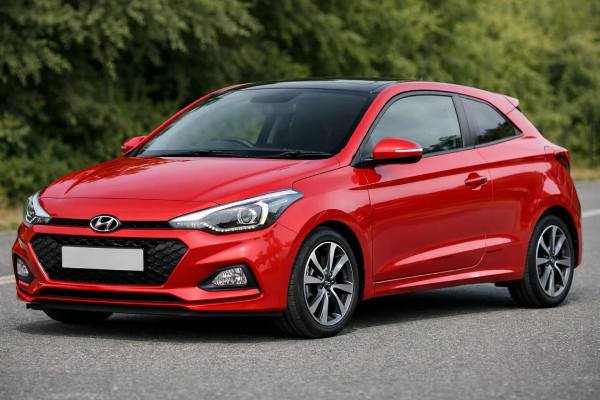
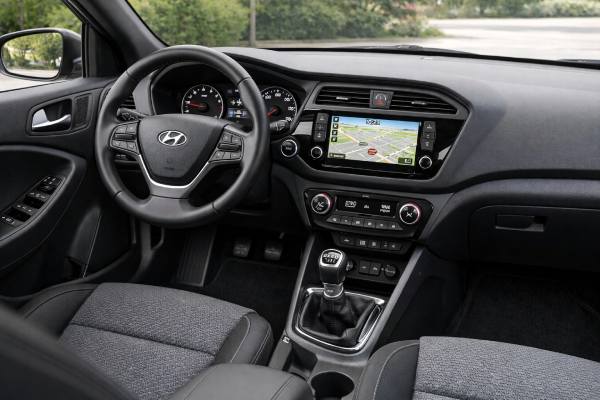
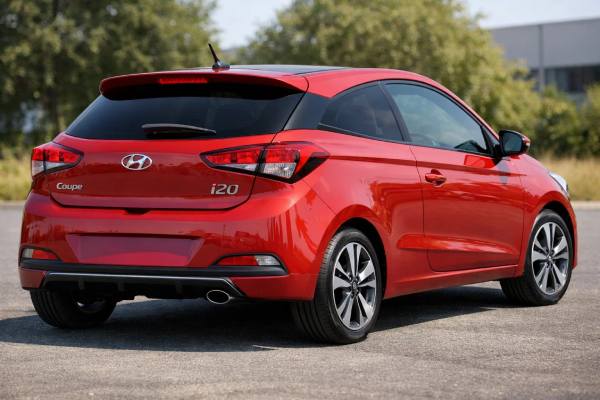
The Hyundai i20 Coupe GB 1.4 petrol is one of the more unusual used supermini choices because it mixes the cleaner, sportier three-door body with a simple naturally aspirated four-cylinder engine. That combination makes it different from the turbo-petrol i20 Coupes and, for many buyers, easier to own long term. In late-run 2018–2020 form, the wider i20 range gained fresher styling, improved infotainment, and stronger safety equipment in many markets, though exact Coupe features and engine pairings varied by region. The basic appeal stayed the same: useful hatchback practicality, a roomy cabin for the class, and a powertrain that feels honest rather than complicated. With 100 hp, the 1.4 MPi gives the Coupe enough performance to feel relaxed in normal use without bringing turbocharger or direct-injection ownership risks. Today, that matters. A well-kept example can still feel tight, stylish, and dependable. A neglected one will quickly reveal every skipped service and cheap repair.
Core Points
- The 1.4 MPi petrol engine gives the Coupe a smoother and simpler ownership profile than the turbo models.
- Coupe-specific styling and a 336 L boot make it more practical than many buyers expect from a three-door supermini.
- Manual and automatic availability varied by market, but the 1.4 remains one of the easiest late-run Coupe engines to live with.
- Buy on condition: cheap tyres, tired brakes, loose front suspension, and poor servicing can make this car feel far worse than it really is.
- A cautious oil-and-filter service every 10,000–15,000 km or 12 months is a smart used-car routine.
Navigate this guide
- Hyundai i20 Coupe facelift focus
- Hyundai i20 Coupe 1.4 figures
- Hyundai i20 Coupe trim and safety
- Age-related fault patterns
- Service plan and purchase guide
- Road behavior and fuel use
- Coupe rivals and ownership verdict
Hyundai i20 Coupe facelift focus
The i20 Coupe has always been the more style-led version of the GB-generation i20, but what makes it appealing today is that Hyundai never turned it into a compromised fashion car. It kept the practical hatchback layout, preserved real rear-seat usability for the class, and even delivered a larger boot than the five-door. That matters because plenty of three-door superminis look attractive in photos but make daily life awkward. The i20 Coupe does not. It feels like a normal small hatchback with a better side profile and a more distinctive rear end.
The 1.4-litre 100 hp petrol is also central to the model’s appeal. It is not the quickest engine fitted to the Coupe, but it is one of the least stressful to own. The small turbo engines deliver stronger mid-range shove, yet they also bring more maintenance sensitivity and more systems to watch as the car ages. The 1.4 MPi is more conventional. It is naturally aspirated, uses a straightforward four-cylinder layout, and delivers its performance in a smooth, predictable way. For many used-car buyers, that is a better match for a late-run supermini they plan to keep for several years.
There is one important point to be clear about. The broader i20 range received a notable facelift for the 2018 model year, especially in five-door form, but the Coupe’s exact specification and appearance changes varied by market. Some late-run Coupe versions carried more of the shared equipment and safety updates than others, and engine availability also differed between regions. So the right way to read “2018–2020 facelift Coupe” is as the late GB Coupe sold during the facelift period, not as one completely uniform global specification. That is why VIN, market, and actual trim matter so much on this car.
The platform itself remains one of the i20’s strongest foundations. The GB-generation car was noticeably more mature than the old PB. It gained a longer wheelbase, a more settled ride, and a cabin that felt properly competitive in Europe. The Coupe preserves that maturity. It is not razor sharp like the best Fiesta three-door, but it rides well, feels stable, and offers better comfort than many people expect from a sporty-looking small hatch.
Who should choose this version now? A buyer who wants a small coupe-like hatch with honest petrol power, real usability, and lower long-term mechanical drama than the turbo alternatives. Who should skip it? Someone who wants hot-hatch pace, the easiest possible rear-seat access, or the simplest base-model running costs. The 1.4 Coupe sits in a useful middle ground: stylish enough to feel special, but straightforward enough to make sense.
Hyundai i20 Coupe 1.4 figures
Hyundai’s official Coupe product pages and late-run market material show a fairly consistent technical picture for the 1.4 MPi version. The car uses a transversely mounted 1,368 cc naturally aspirated petrol four-cylinder, front-wheel drive, and a conventional suspension layout. Hyundai’s own Coupe performance page also notes that the 1.4 gasoline engine was available with a 4-speed automatic in some regions, while the 6-speed manual was the standard pairing for engines above the 1.25 in markets where manual 1.4 cars were offered.
Powertrain and efficiency
| Item | Figure |
|---|---|
| Engine family | 1.4 MPi petrol |
| Code | 1.4 MPi four-cylinder family |
| Engine layout and cylinders | Inline-four, 4 cylinders, DOHC, 4 valves per cylinder |
| Bore × stroke | 72.0 × 84.0 mm (2.83 × 3.31 in), market-dependent verification advised |
| Displacement | 1.4 L (1,368 cc) |
| Induction | Naturally aspirated |
| Fuel system | Multi-point petrol injection |
| Compression ratio | Typically around 10.5:1, verify by VIN-specific data |
| Max power | 100 hp / 100 PS (73.6 kW) @ 6,000 rpm |
| Max torque | 137 Nm (101 lb-ft) @ 3,500 rpm |
| Timing drive | Chain-driven timing system |
| Rated efficiency | Roughly high-5 to mid-6 L/100 km combined, depending on market, wheel size, and transmission |
| Real-world highway @ 120 km/h | Usually around 6.4–7.2 L/100 km in healthy trim |
Transmission and driveline
| Item | Figure |
|---|---|
| Transmission | 6-speed manual in many markets |
| Optional transmission | 4-speed automatic in some markets |
| Drive type | FWD |
| Differential | Open |
Chassis and dimensions
| Item | Figure |
|---|---|
| Front suspension | Subframe-mounted MacPherson struts, coil springs, gas dampers, anti-roll bar |
| Rear suspension | Semi-independent coupled torsion beam axle with separate coil springs and gas dampers |
| Steering | Electric rack-and-pinion BLAC-MDPS |
| Steering ratio / turns | 2.7 turns lock-to-lock |
| Brakes | Front ventilated discs and rear discs on better-equipped Coupe versions; exact disc sizes vary by market and wheel package |
| Most common wheel sizes | 16-inch and 17-inch alloy wheels |
| Ground clearance | 140 mm (5.5 in) |
| Length | 4,045 mm (159.3 in) |
| Width | 1,730 mm (68.1 in) excluding mirrors |
| Height | 1,449 mm (57.0 in) |
| Wheelbase | 2,570 mm (101.2 in) |
| Turning circle | 5.1 m minimum radius |
| Fuel tank | 50 L (13.2 US gal / 11.0 UK gal) |
| Cargo volume | 336 L seats up / 1,011 L seats folded, VDA |
Performance and capability
| Item | Figure |
|---|---|
| 0–100 km/h | Typically around the low-11-second range with manual transmission, market-dependent |
| Top speed | Typically around 180 km/h, market-dependent |
| Towing capacity | Market-dependent; verify by VIN and local handbook before towing |
| Payload | Market-dependent; verify from registration and handbook data |
Fluids and service-capacity guidance
| Item | Guidance |
|---|---|
| Engine oil | Use the exact Hyundai-approved petrol-engine oil specification for the VIN and market |
| Engine oil capacity | Verify by VIN-specific handbook or service data before refill |
| Coolant | Use the correct aluminium-safe Hyundai coolant specification |
| Transmission fluid | Manual and automatic versions require different fluid specifications |
| A/C refrigerant | R-134a on GB-era systems |
| Key torque specs | Verify wheel, spark plug, and service torque values using the correct workshop literature before repair |
This is not the kind of supermini that wins on one sensational figure. Its case is more balanced. The Coupe gives you better looks, a useful boot, decent body dimensions, and enough power to feel comfortable in daily driving without leaning on a turbocharger.
Hyundai i20 Coupe trim and safety
The i20 Coupe usually made the most sense when paired with stronger trim levels, and that remains true on the used market. Hyundai positioned the Coupe as a more expressive version of the i20 rather than a stripped-down three-door special. That means many cars came with better wheels, more attractive interior finishes, and more convenience equipment than an entry-level five-door hatch.
In late-run form, actual naming varied by country, but Sport, Sport Nav, and similar upper-middle or upper trims are the kind of specification level you are most likely to encounter. These cars often included 16-inch or 17-inch alloy wheels, projector headlamps with LED daytime running lights, rear privacy glass, climate control or well-equipped manual air conditioning, cruise control, Bluetooth, steering-wheel audio controls, parking sensors, rear camera display, navigation, heated mirrors, and in some markets even a heated steering wheel. Hyundai also designed the cabin so the Coupe still felt genuinely usable. The easy-entry front seats are important here because they make the rear seats far less annoying to access than in many three-door rivals.
The exterior details are part of the Coupe’s charm too. Hyundai gave it a lower-looking roofline, more dramatic rear-quarter treatment, and a cleaner, sportier stance. That makes it more memorable than the standard five-door, but there is still enough commonality with the regular i20 to keep parts supply and servicing manageable. That is a good used-car combination.
Safety was a quiet strength of the GB i20 line. Under the 2015 Euro NCAP protocol, the standard i20 earned four stars. That headline disappointed some people at the time, but the real story was more nuanced. The car’s structural performance and core safety basics were good for the class. The missing fifth star came largely from the evolving active-safety requirements rather than weak crash protection. Hyundai used a body shell with a high proportion of high-strength steel and fitted six airbags, ESC, ABS, EBD, Hill-start Assist Control, Vehicle Stability Management, and tyre-pressure monitoring.
Coupe-specific official safety pages also highlight Lane Departure Warning System, TPMS, Hill-start Assist Control, Static Bending Lights, ESC, VSM, ABS, and Brake Assist. That means the late-run Coupe can offer a better safety story than many people expect from a style-led three-door hatch. The exact standard-versus-optional split varies by region, but the underlying message is clear: Hyundai did not treat the Coupe as a lightweight image exercise.
For used buyers, the trim checklist matters a lot:
- verify whether the car should have navigation, camera, LDWS, or parking sensors,
- test every one of those systems,
- and check that any warning lights behave normally on startup.
A good high-spec Coupe feels far newer than its age suggests. A poorly maintained one with dead sensors, broken infotainment, and weak lighting quickly loses much of its appeal. With this model, condition is just as important as trim badge.
Age-related fault patterns
The i20 Coupe 1.4 MPi is one of the lower-stress petrol variants in the GB family, but that does not make it fault-free. Its reliability story is more traditional than dramatic. The engine itself is generally straightforward when serviced properly, and most problems now come from age, deferred maintenance, or cheap replacement parts rather than one famous design flaw.
Common and usually low-to-medium cost
- Front suspension wear: Expect drop links, bushes, top mounts, and dampers to be inspection items on older Coupes. Symptoms are front-end knocking, vague turn-in, or uneven tyre wear.
- Brake deterioration: Disc condition, slider condition, and brake fluid age matter. Cars that have stood unused or been maintained cheaply often feel older through the pedal than their mileage suggests.
- Battery and charging complaints: Slow cranking, odd electrical behaviour, and sporadic warning lamps are often simple 12 V battery age rather than a deep electrical failure.
Occasional and medium cost
- Ignition-related running faults: Hesitation, rough idle, or a mild misfire often point to spark plugs, coil packs, or overdue servicing. The good news is that on a naturally aspirated multi-point injected engine these are usually easier to sort than on a direct-injection turbo.
- Cooling-system ageing: Thermostat issues, tired hoses, or old coolant can lead to slow warm-up or unstable temperatures. These are not glamorous faults, but they matter because they affect both drivability and long-term durability.
- Clutch wear: Manual 1.4 cars are not hard on clutches in normal use, yet repeated city driving or poor technique can still produce a high bite point or slip under load.
Less common but more important
- Timing-chain wear from poor oil history: The chain layout avoids routine belt replacement, but it is not a lifetime excuse to skip oil changes. Cold-start rattle, timing-related fault codes, or a weak service record deserve attention.
- Crash repair issues: Coupe buyers often focus on appearance, which is exactly why poor accident repairs are easy to miss. Watch for odd panel gaps, mismatched paint, inconsistent tyre wear, and a steering wheel that sits off-centre.
- Door and seat-mechanism wear: Longer Coupe doors take more stress in tight parking spaces, and easy-entry seat hardware gets more use than on a five-door. Check for sagging doors, weak check straps, and seats that no longer slide or tilt smoothly.
Corrosion is not a headline weakness of the GB, but it should still be part of a sensible inspection. Rear beam areas, lower door edges, wheel-arch lips, brake pipes, and the tailgate opening all deserve a close look, especially in wet or salted-road climates.
Software and electronics are not the main ownership risk, but trim-dependent equipment still matters. Test Bluetooth, navigation, parking sensors, rear camera, mirrors, heater functions, central locking, and any lane-warning hardware. On a late-run Coupe, dead convenience features often signal the same low-cost ownership standards that show up in tyres, brakes, and fluid history.
The best summary is simple: this model ages like a normal hatchback, not a fragile special. That is good news. It means faults are usually visible if you inspect the car carefully. The challenge is finding one that was maintained as a complete vehicle, not just polished for sale.
Service plan and purchase guide
The i20 Coupe 1.4 works best when maintained conservatively. It is a simple petrol hatch by modern standards, but that should encourage proper routine servicing, not neglect. On the used market, the smartest approach is to assume you may need a baseline service unless the history is unusually strong.
Practical maintenance schedule
| Item | Sensible interval |
|---|---|
| Engine oil and filter | Every 10,000–15,000 km or 12 months |
| Engine air filter | Inspect yearly, replace around 30,000–40,000 km or sooner in dusty use |
| Cabin air filter | Every 15,000–20,000 km or 12 months |
| Spark plugs | Around 40,000–60,000 km depending on plug type and running quality |
| Coolant | Replace promptly if history is unclear, then follow the correct handbook schedule |
| Brake fluid | Every 2 years |
| Manual gearbox oil | Inspect for leaks and shift quality regularly; refresh around 80,000–100,000 km on ageing cars |
| Automatic transmission fluid | Service only with the exact specification and confirmed interval for the gearbox fitted |
| Auxiliary belt and hoses | Inspect at every annual service |
| Brakes, wheel bearings, suspension joints, and CV boots | Inspect every service |
| Tyres and alignment | Check yearly and after suspension work |
| 12 V battery | Test yearly once the car is beyond about year 4 |
That schedule is more cautious than many owners follow, and that is precisely why it works well. The 1.4 MPi is durable when the basics stay current. It becomes irritating only when several small service jobs are postponed until they become one large bill.
Useful service notes
- Use the correct Hyundai-approved petrol-engine oil for the car’s VIN and market.
- Confirm whether the car is manual or 4-speed automatic before any transmission service.
- Do not guess fluid refill quantities.
- Keep coolant correct and fresh. Old coolant causes far more trouble than buyers think.
- Wheel and tyre package matters for ride, handling, and refinement. Cheap tyres can make a tidy Coupe feel mediocre.
Buyer’s checklist
- Start the engine cold and listen for chain rattle, unstable idle, or warning lights.
- Check clutch feel and make sure the manual shift quality is clean and consistent.
- Inspect all four tyres for correct size, even wear, and matching quality.
- Listen for front suspension knocks over broken roads.
- Test the air conditioning, navigation, Bluetooth, parking aids, mirrors, and any lane-warning functions.
- Check that the longer front doors open and shut squarely with no sag.
- Verify recall and service-campaign status through Hyundai.
The best Coupes are rarely the flashiest advert cars. They are the ones with normal mileage, sensible tyres, straight bodywork, and a stack of boring invoices showing oil changes, brakes, filters, and occasional suspension work. Cars to avoid are the ones sold on style alone: shiny paint, big claims, but weak paperwork, cheap tyres, tired clutch feel, and several dead convenience features.
Long-term durability is good for the class. This is not a mechanically extreme car. The real risk is not complexity. It is indifference.
Road behavior and fuel use
On the road, the i20 Coupe 1.4 is more about balance than outright excitement. The 100 hp engine gives it enough performance to feel comfortable in normal use, yet it never behaves like a warm hatch. That is actually part of the appeal. You get a car that looks sportier than the average small hatchback, but still drives in an honest, everyday way.
Around town, the naturally aspirated engine is smooth and predictable. Throttle response is linear, the clutch is usually light, and the car feels easy to place in traffic. There is no turbo lag and no sudden torque surge. That makes the 1.4 especially pleasant for drivers who prefer clean, intuitive power delivery over punchy low-rpm shove.
On open roads, the difference between the 1.4 and the smaller 1.25 is easy to feel. The Coupe still needs proper gear use, but it is less breathless and more relaxed in overtaking or climbing situations. A manual car in good condition usually feels like the sweet spot because the 6-speed gearbox helps both pace and refinement. In markets where the 4-speed automatic was offered, the car is easier in traffic but generally less brisk and less efficient.
Ride quality remains one of the GB platform’s strengths. The Coupe’s looks may suggest something firmer and more compromised than the standard hatch, but the reality is more mature. It rides with decent compliance, feels stable at speed, and avoids the nervousness some fashionable three-door superminis suffer from. Steering is light and accurate, though not especially talkative. If you want the sharpest handling in the class, a Fiesta still has the edge. If you want a composed, easy car that looks good and behaves properly every day, the Hyundai has a strong case.
NVH depends heavily on condition and wheel choice. On quality tyres, the Coupe feels reasonably refined for its class. On cheap 17-inch rubber with weak alignment or worn dampers, it quickly becomes noisier and less settled. This is one of those cars where tyre quality changes the whole impression.
Real-world fuel use is respectable rather than remarkable. In healthy trim, most drivers can expect roughly:
- around 7.3–8.4 L/100 km in heavy city use,
- around 6.4–7.2 L/100 km at a true 120 km/h motorway cruise,
- and around 5.9–6.8 L/100 km in mixed driving.
Those figures are fair for a naturally aspirated 100 hp supermini that prioritises simplicity over extreme economy. They also explain the ownership appeal. The Coupe 1.4 is not chasing hybrid numbers, but it offers predictable consumption without the extra maintenance sensitivity of a small turbo engine.
The driving verdict is clear. This is the Coupe for people who want the looks without the extra complexity. It is smooth, tidy, practical enough, and quick enough to feel satisfying in everyday use.
Coupe rivals and ownership verdict
The i20 Coupe 1.4 lives in a slightly unusual corner of the used market because there are fewer three-door superminis now than there once were. Its direct rivals include the Ford Fiesta three-door 1.25 or 1.4, SEAT Ibiza SC, Volkswagen Polo three-door petrol models, Peugeot 208 three-door-era cars, and, in some markets, the DS 3 in lower-output petrol form. Each rival has a clearer single strength. The Fiesta is more entertaining to drive. The Polo can feel more substantial. The DS 3 has more image. The Hyundai’s strength is that it combines style, space, and straightforward ownership unusually well.
Against a Fiesta, the Coupe gives up some steering feel and sharpness, but often offers a richer sense of design and surprisingly good practicality. Against a Polo, it may feel a little less premium in some details, yet it tends to be a more distinctive car for the money. Against a DS 3, it is less fashionable but easier to justify with its hatchback practicality and simpler mechanical story.
Its biggest in-house rival is probably the i20 Coupe 1.0 T-GDi 120. That turbo car is quicker and more flexible. But it also asks more of the owner over time. If you want the smarter long-term used-car proposition and can live with a gentler performance level, the 1.4 MPi makes a lot of sense.
The late-run timing is also a plus. Cars from the 2018–2020 period often benefit from the wider i20 range’s improved infotainment, better equipment mixes, and stronger perceived maturity, even though exact Coupe specification varied by region. That means the right car can still feel surprisingly current in everyday use.
Where does it fall short?
- It is not the quickest Coupe version.
- It is not the most exciting B-segment car to steer.
- Rear access is still less convenient than a five-door.
- Exact trim and safety equipment vary enough by market that blind buying is risky.
But the strengths are just as clear:
- attractive three-door styling,
- honest four-cylinder petrol power,
- roomy cabin and useful boot,
- lower long-term complexity than turbo alternatives,
- and a platform that rides and behaves with real maturity.
So who should choose it? Buyers who want a small hatchback with extra character, but without stepping into hot-hatch running costs or turbo-engine risk. It suits commuters, first-time buyers moving up from smaller cars, and owners who want something uncommon without being difficult.
Who should look elsewhere? Drivers wanting the sharpest chassis, the quickest overtakes, or the absolute simplest base-spec supermini. Those buyers may be better served by a Fiesta, a turbo i20, or a standard five-door hatch.
As a used buy, the Hyundai i20 Coupe GB 1.4 100 hp is easy to respect. It is not the loudest choice, but it is one of the more rational stylish small cars of its era. Find one with straight bodywork, proper service history, and good tyres, and it becomes a very satisfying long-term ownership proposition.
References
- i20 Coupe Performance – Find a Car | Hyundai GT 2026 (Technical Guide)
- i20 Coupe Safety – Find a Car | Hyundai GT 2026 (Safety Guide)
- i20 Coupe Interior – Find a Car | Hyundai GT 2026 (Product Guide)
- Hyundai i20 – Euro NCAP Results 2015 2015 (Safety Rating)
- Hyundai Owners manuals | Hyundai Motor UK 2026 (Owner’s Manual)
Disclaimer
This article is for informational purposes only and is not a substitute for professional diagnosis or repair. Specifications, torque values, intervals, procedures, fluid requirements, and equipment can vary by VIN, market, trim, wheel package, transmission, and model year, so always verify the exact details against the correct official service documentation for the specific vehicle.
If this guide helped you, please consider sharing it on Facebook, X, or another social platform to support our work.