
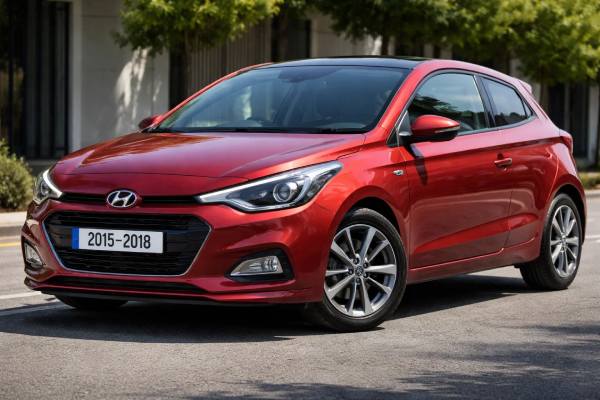
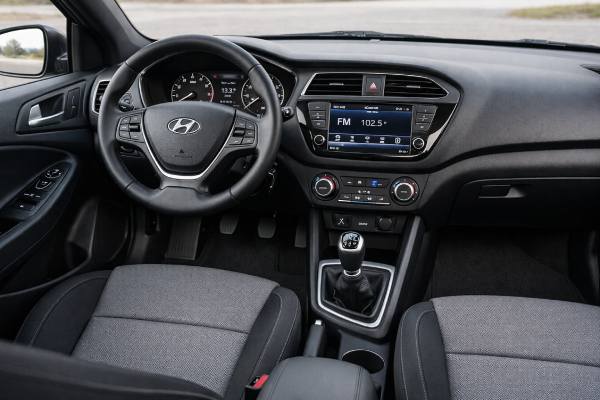
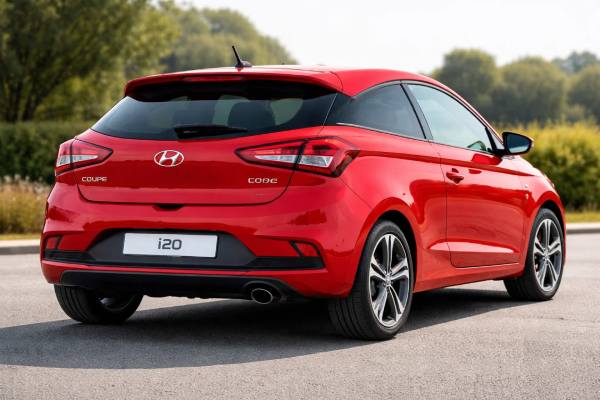
The Hyundai i20 Coupe GB 1.4 with 100 hp is one of the more sensible small coupes of its era. It borrows the stronger points of the standard GB-generation i20—good packaging, solid ride comfort, straightforward controls, and a mature feel for a supermini—but wraps them in a lower, more distinctive three-door body. Under the skin, this version stays reassuringly simple. It uses a naturally aspirated four-cylinder petrol engine, front-wheel drive, and conventional manual or automatic transmissions depending on market. That matters in the used market, because it avoids several of the costly trouble spots that can come with downsized turbo engines or more complex drivetrains. The trade-off is clear enough: this is not a hot hatch. It is quick enough for real life, but it is built for easy ownership rather than excitement. For buyers today, the real separator is condition. Service history, suspension health, transmission behaviour, and evidence of careful use matter far more than trim label alone.
Top Highlights
- The 1.4 petrol gives the i20 Coupe a smoother, more relaxed character than the smaller non-turbo engines.
- The Coupe body adds style without turning the car into an impractical niche choice.
- Cabin comfort, boot space, and highway stability are strong points for the class.
- Automatic versions are easy to live with, but they are not especially quick and should shift cleanly when warm and cold.
- A sensible service baseline is fresh engine oil and filter every 10,000 km or 12 months.
On this page
- Hyundai i20 Coupe GB at a Glance
- Hyundai i20 Coupe GB Specification Guide
- Hyundai i20 Coupe GB Trims and Safety
- Known Issues and Service History
- Maintenance Costs and Buying Tips
- Daily Driving and Real Economy
- How the i20 Coupe GB Fares Against Rivals
Hyundai i20 Coupe GB at a Glance
The i20 Coupe arrived as the more style-led member of the GB-generation i20 family, but Hyundai did not turn it into a compromised fashion piece. That is why it still makes sense as a used car. Compared with the regular five-door i20, the Coupe has a lower roofline, a more dramatic side profile, and a cleaner rear treatment, yet it remains recognizably practical. Front-seat access is easy, rear accommodation is still usable for a supermini coupe, and the boot is actually one of the car’s quiet strengths.
The 1.4-litre 100 hp petrol engine is important to the overall picture. It gives the car a more rounded character than the smaller 1.2 unit. Around town, it feels less strained. On open roads, it holds speed more naturally. With passengers on board, it remains calm enough that the car feels like a small hatchback built for proper daily use, not just short urban hops. It still needs revs to deliver its best, but it is a notably better match for the larger-feeling GB platform.
The main ownership appeal is mechanical simplicity. This is a naturally aspirated multi-point-injected four-cylinder engine, not a high-output small turbo unit. That reduces the risk of expensive long-term issues related to turbocharging, high-pressure direct injection, and more complex cooling demands. In many markets the 1.4 was offered with either a six-speed manual or a conventional four-speed automatic. Neither setup feels modern in a sporty sense, but both are straightforward and familiar to maintain.
The Coupe body does change the ownership equation slightly. The long front doors look good and make front access easy, but rear entry is naturally less convenient than in the five-door. For singles, couples, or small households, that often does not matter much. For families regularly loading children or adults into the back, it matters more than the styling brochures suggest. This is a car that works best when the rear seats are occasional rather than constant-use space.
As a used purchase, the i20 Coupe is strongest when bought on condition. Good paint, straight panels, correct tyres, smooth air conditioning, quiet suspension, and clean service records tell you far more than trim level. The car’s design is sound. The challenge is finding one that was maintained like a valued hatchback rather than treated like a cheap runabout.
Hyundai i20 Coupe GB Specification Guide
Exact figures vary slightly by market, wheel package, and transmission, but the Hyundai i20 Coupe GB 1.4 petrol was generally sold with Hyundai’s Kappa-family 1.4-litre naturally aspirated engine in 100 PS form. The table below reflects the common European specification.
Powertrain and efficiency
| Item | Hyundai i20 Coupe GB 1.4 petrol |
|---|---|
| Code | Kappa 1.4 MPI family |
| Engine layout and cylinders | Inline-4, DOHC, 16-valve |
| Cylinders | 4 |
| Valves per cylinder | 4 |
| Bore × stroke | 72.0 × 84.0 mm (2.83 × 3.31 in) |
| Displacement | 1.4 L (1,368 cc) |
| Induction | Naturally aspirated |
| Fuel system | Multi-point fuel injection |
| Compression ratio | 10.5:1 |
| Max power | 100 hp (74 kW) @ 6,000 rpm |
| Max torque | 134 Nm (99 lb-ft) @ 3,500 rpm |
| Timing drive | Chain |
| Rated efficiency | Roughly 5.2-6.0 L/100 km depending on trim and transmission |
| Real-world highway @ 120 km/h | About 6.1-7.0 L/100 km |
Transmission and driveline
| Item | Hyundai i20 Coupe GB 1.4 petrol |
|---|---|
| Transmission | 6-speed manual or 4-speed automatic, market-dependent |
| Drive type | FWD |
| Differential | Open |
Chassis and dimensions
| Item | Hyundai i20 Coupe GB 1.4 petrol |
|---|---|
| Suspension front | MacPherson strut, coil springs, anti-roll bar |
| Suspension rear | Coupled torsion beam axle |
| Steering | Electric power-assisted rack and pinion |
| Steering ratio | About 2.7 turns lock-to-lock |
| Brakes | Front 256 mm ventilated discs, rear 262 mm solid discs |
| Wheels and tyres | 185/65 R15 or 195/55 R16 |
| Ground clearance | About 140 mm (5.5 in), market-dependent |
| Length | About 4,045 mm (159.3 in) |
| Width | 1,730 mm (68.1 in) |
| Height | About 1,449 mm (57.0 in) |
| Wheelbase | 2,570 mm (101.2 in) |
| Turning circle | About 10.2 m (33.5 ft) |
| Kerb weight | Roughly 1,070-1,160 kg (2,359-2,557 lb) |
| GVWR | Roughly 1,580-1,650 kg (3,483-3,638 lb), market-dependent |
| Fuel tank | 50 L (13.2 US gal / 11.0 UK gal) |
| Cargo volume | 336 L (11.9 ft³) seats up / around 1,011 L (35.7 ft³) seats folded |
Performance and capability
| Item | Hyundai i20 Coupe GB 1.4 petrol |
|---|---|
| 0–100 km/h (0–62 mph) | About 11.6 s manual, slower for automatic |
| Top speed | About 184 km/h (114 mph) |
| Braking distance 100–0 km/h | Typically around 38-41 m on quality tyres |
| Towing capacity | Market-specific; verify by VIN and handbook before towing |
| Payload | Commonly around 420-490 kg |
Fluids and service capacities
| Item | Hyundai i20 Coupe GB 1.4 petrol |
|---|---|
| Engine oil | 5W-30 or market-approved equivalent |
| Engine oil capacity | Roughly 3.3-3.7 L (3.5-3.9 US qt) with filter |
| Coolant | Long-life ethylene glycol mix; exact capacity varies by market |
| Transmission / ATF | Hyundai-approved manual gear oil or ATF, depending on gearbox |
| Differential / transfer case | Not applicable |
| A/C refrigerant | Type and charge vary by build label |
| A/C compressor oil | Verify on service literature or under-bonnet label |
| Key wheel-nut torque | Commonly around 88-110 Nm, market-dependent |
Safety and driver assistance
| Item | Hyundai i20 Coupe GB |
|---|---|
| Euro NCAP | 4 stars |
| Adult occupant | 85% |
| Child occupant | 73% |
| Vulnerable road user | 79% |
| Safety assist | 64% |
| IIHS | Not applicable |
| Headlight rating | Not applicable |
| ADAS suite | No standard AEB, ACC, blind-spot monitoring, or rear cross-traffic alert |
Hyundai i20 Coupe GB Trims and Safety
The i20 Coupe was not just a three-door i20 with fewer doors. Hyundai gave it a more distinctive roofline, different body details, and a slightly more style-conscious market position. Even so, equipment structures still depended heavily on region. Some markets used names such as Sport, Sport Plus, Style, or Premium. Others grouped the same features under different local trim labels. That means used buyers should verify equipment on the actual car rather than rely on brochure memory or seller claims.
Mechanically, the 1.4 petrol Coupe stayed straightforward. Most examples shared the same core powertrain, front-wheel-drive layout, and chassis setup, with variation focused on wheel size, tyres, infotainment, interior trim, parking aids, and climate features. In practical terms, the most noticeable trim-dependent differences are often wheel package, seat material, steering-wheel equipment, and whether the car has extras like rear parking sensors, camera assistance, heated seats, or upgraded lighting.
Useful visual identifiers include:
- 15-inch steel wheels versus 16- or 17-inch alloys
- projector headlights and LED daytime running lights on better-equipped cars
- body-colour exterior details
- multifunction steering wheel
- parking sensors or reversing camera
- unique Coupe interior colour accents in some markets
The Coupe’s body itself also changes the use case. It gives the car more visual character than the five-door, and the lower roofline helps it stand out in the class. Hyundai managed the design well enough that rear space did not collapse into pure style-over-function compromise. Rear access is still less convenient than in the five-door, but the Coupe remains more usable than many small coupes before it.
Safety is a solid area, though not a class-leading one under later test rules. Euro NCAP awarded the GB-generation i20 four stars in 2015 under a tougher protocol than many older rivals faced. That rating should be read in context. It reflects a car with a credible structure and decent passive safety, but one that did not have the level of standard advanced assistance systems that later helped push scores higher.
Typical safety equipment included:
- front airbags
- side airbags
- curtain airbags
- ABS
- ESC and vehicle stability functions
- ISOFIX child-seat points
- tyre-pressure monitoring on some versions
- lane departure warning on selected higher-spec markets
That last point matters. Some Coupe trims could be fitted with lane departure warning, but this is still not a modern ADAS-heavy car. Autonomous emergency braking, adaptive cruise control, blind-spot monitoring, and rear cross-traffic alert were generally absent. Buyers should see the i20 Coupe as a well-equipped conventional small hatchback with stylish bodywork, not as an early semi-autonomous car.
Known Issues and Service History
The Hyundai i20 Coupe GB 1.4 petrol is usually a dependable used car when maintained properly. Its reputation benefits from the fact that the engine is naturally aspirated and relatively unstressed. That does not mean every example is trouble-free. Age, mileage, tyre neglect, suspension wear, and patchy service history matter more now than original brochure claims.
Common issues, low-to-medium cost
- Front suspension knocks: Drop links, bushes, and top mounts wear over time. The symptoms are clunks over potholes and a less tidy front-end feel.
- Battery-related electrical complaints: Weak batteries can create poor starting, warning lights, stop-start issues where fitted, and odd electrical behaviour.
- Brake wear and rear-brake neglect: Cars used mainly in town can suffer sticky rear hardware or uneven brake feel.
- Tyre wear and alignment drift: The Coupe responds noticeably to poor tyres. Cheap mismatched rubber can make the steering feel worse than it really is.
Occasional issues, medium cost
- Ignition and idle issues: Worn spark plugs, tired coils, or throttle-body contamination can cause rough idle, hesitation, or misfire under load.
- Automatic gearbox sluggishness: On automatic cars, harsh or delayed shifts often point to wear, tired fluid, or a car that was simply not maintained as well as it should have been.
- Air-conditioning faults: Common aging issues include low refrigerant charge, condenser damage, or compressor wear.
- Wheel-bearing noise: A humming sound that rises with road speed is the normal clue.
Less common but more serious
- Cooling-system leaks or thermostat problems: This engine is not known for chronic overheating, so any temperature instability should be treated as abnormal.
- Timing-chain noise on badly neglected engines: The chain is a long-life item, but poor oil service can still shorten tensioner or guide life.
- Poor crash repair: In this price bracket, questionable accident repair is often a bigger real-world risk than engine or gearbox design.
There is no single dominant failure pattern that defines the model. That is actually part of the i20 Coupe’s appeal. Problems tend to be ordinary used-car problems, not platform-defining disasters. The key question is always whether the car was serviced on time and repaired properly when needed.
Before purchase, ask for:
- Full service history with annual oil changes
- Proof of recall or campaign checks by VIN
- Cold-start behaviour and smooth idle
- Quiet suspension over rough roads
- Smooth operation of air conditioning and all electrical features
- Clean automatic shifting if the car is not a manual
A maintained i20 Coupe usually ages honestly. A neglected one can feel disappointing through a stack of small faults.
Maintenance Costs and Buying Tips
This is a car that rewards conservative maintenance. Because the 1.4 MPI engine is simple, regular fluids and basic wear-item care go a long way. Owners who stay ahead of service usually get a reliable, easy-to-live-with hatchback. Owners who chase the longest possible intervals often create the very problems that later buyers notice first.
Practical maintenance schedule
| Item | Practical interval |
|---|---|
| Engine oil and filter | Every 10,000 km or 12 months |
| Engine air filter | Every 30,000 km, sooner in dusty conditions |
| Cabin air filter | Every 20,000 km or 24 months |
| Spark plugs | About 45,000-60,000 km depending on plug type |
| Coolant | Around 5 years or 100,000 km, then inspect more closely by age |
| Manual gearbox oil | Refresh around 60,000-90,000 km if keeping long term |
| Automatic transmission fluid | Refresh around 60,000 km for long-term ownership |
| Brake fluid | Every 2-3 years |
| Serpentine belt and tensioner | Inspect every service |
| Hoses | Inspect annually for swelling, seepage, or cracks |
| Brake pads and rotors | Inspect every service |
| Rear brake hardware | Inspect periodically |
| Tyre rotation | Every 10,000 km |
| Alignment | Check yearly or whenever tyre wear appears |
| 12 V battery | Test yearly from year 4 onward |
| Timing chain | Inspect by symptom rather than mileage alone |
Useful fluid guidance
- Use the correct viscosity and approval for the market.
- Do not treat automatic transmission fluid as lifetime fluid.
- Keep coolant fresh and correctly mixed.
- Change brake fluid by time, not just distance.
- Use quality spark plugs and ignition parts rather than the cheapest options.
Buyer’s checklist
- Check cold start and idle smoothness.
- Listen for front-end knocks on broken roads.
- Inspect tyres closely for age, brand mismatch, and uneven wear.
- Confirm the air conditioning cools quickly.
- Test every switch, window, lock, and parking aid.
- Inspect panel gaps, headlamp mounts, and the boot floor for crash-repair clues.
- Verify the steering returns naturally and the car tracks straight.
Best examples to seek
- Unmodified cars
- Cars with documented servicing every year
- Cars on good tyres with recent brake work
- Cars with smooth manual or automatic operation and no warning lights
Examples to avoid
- Cars with sloppy shifts or delayed engagement
- Cars with overheating history
- Cars with visible front-end repair and poor panel alignment
- Cars with repeated electrical faults and weak battery history
The i20 Coupe is not expensive to keep when bought well. Most long-term ownership pain comes from buying a neglected one too cheaply.
Daily Driving and Real Economy
The i20 Coupe 1.4 drives much like a well-sorted small hatchback with a bit more visual flair. That is good news, because it means the car is easy to live with. Around town, the steering is light, the pedals are easy to judge, and visibility remains decent despite the more sloped roofline. The engine feels smoother and less stretched than the smaller non-turbo alternatives, which suits the slightly more substantial feel of the Coupe body.
The six-speed manual version is the more satisfying of the two common drivetrains. It lets the engine stay in its usable range more easily and helps the car feel more alert on open roads. The four-speed automatic is friendlier in traffic but clearly less modern in character. It is smooth enough when healthy, though slower to react and less efficient. Buyers choosing the automatic should see it as a convenience feature, not a performance upgrade.
Ride quality is one of the Coupe’s stronger traits. Hyundai tuned the GB platform for everyday comfort, and the Coupe keeps that character. It absorbs rough urban roads well enough for the class and remains composed on longer motorway drives. Steering feel is not especially rich, but the car is predictable and confidence-inspiring. It is calmer than sporty rivals, which many owners will prefer.
In real use, the 1.4 petrol delivers reasonable rather than standout economy:
- City: about 7.2-8.5 L/100 km
- Highway: about 5.7-6.8 L/100 km
- Mixed: about 6.4-7.3 L/100 km
That works out to roughly:
- City: 28-33 mpg US / 33-39 mpg UK
- Highway: 35-41 mpg US / 42-50 mpg UK
- Mixed: 32-37 mpg US / 39-44 mpg UK
Cold weather, short trips, low tyre pressures, and old ignition parts can push those figures higher. Manual cars usually do better than automatic ones in the same conditions. The car’s aerodynamic shape helps on the highway, but this is still a naturally aspirated petrol with only moderate torque, so speed has a noticeable effect on fuel use.
Overall, the Coupe’s road manners match its broader personality: easy, mature, and more practical than its styling first suggests.
How the i20 Coupe GB Fares Against Rivals
The Hyundai i20 Coupe 1.4 competes best as a balanced small coupe-hatch rather than a driver’s car. It makes its case through honest engineering, practical space, and relatively low long-term risk.
Against a Ford Fiesta three-door, the Hyundai usually loses on steering feel and fun. The Fiesta is the more engaging car on a twisting road. The Hyundai counters with a roomier cabin, a calmer ride, and in 1.4 MPI form, less mechanical complexity than some turbo Fiesta alternatives.
Against a Volkswagen Polo three-door, the Hyundai often wins on value for money and can feel more generously equipped for the purchase price. The Polo may have a more premium image and a more solid-feeling interior in some trims, but equal-condition cars can cost more.
Against a Toyota Yaris three-door, the i20 Coupe offers stronger style and often better perceived value. The Toyota usually benefits from stronger resale trust and a low-drama reputation. The Hyundai appeals more to buyers who want something less plain without moving into something fragile.
Against a SEAT Ibiza SC, the Hyundai is usually the more comfort-focused choice. The Ibiza can feel sharper and more youthful to drive. The i20 Coupe often answers with a more settled ride and a stronger sense of everyday practicality.
Where the i20 Coupe GB stands out:
- distinctive styling without major practicality loss
- smooth naturally aspirated 1.4 petrol
- credible ride comfort
- solid safety basics for its era
- usually sensible used pricing
Where it gives ground:
- not especially sporty
- automatic version feels dated
- less rear-seat convenience than a five-door
- no strong modern ADAS offering
For the right buyer, these trade-offs are easy to accept. If you want a small coupe-style hatchback that still works as a real daily car, the Hyundai i20 Coupe 1.4 is an underrated option. It is not thrilling, but it is honest, usable, and often better value than flashier rivals.
References
- Hyundai Owners manuals | Hyundai Motor UK 2026 (Owner’s Manual)
- Hyundai i20 – Euro NCAP Results 2015 2015 (Safety Rating)
- Home | Hyundai Recalls & Service Campaigns 2026 (Recall Database)
- New Generation i20 Coupe Press information 2015 (Official Technical Guide)
- Hyundai i20 Coupe PASSENGER CAR PRICELIST* 2015 (Official Price List)
Disclaimer
This article is for informational purposes only and is not a substitute for professional diagnosis, repair, or vehicle-specific technical advice. Specifications, torque values, intervals, procedures, and fluid requirements can vary by VIN, market, transmission, trim, and equipment. Always verify the exact data against the official service documentation for the vehicle before carrying out maintenance or repairs.
If this guide helped you, please consider sharing it on Facebook, X, or another social platform to support our work.