
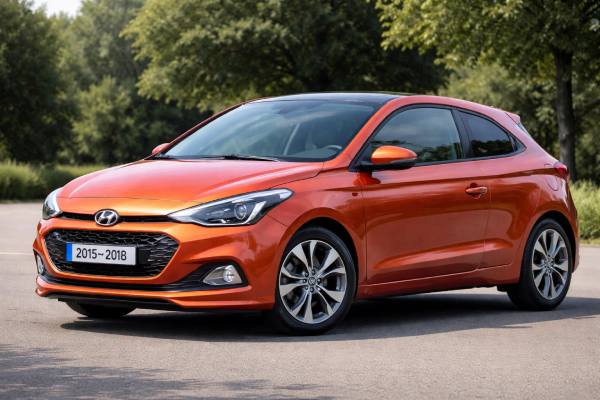
The Hyundai i20 Coupe GB with the 1.25-litre 84 hp petrol engine is the style-led version of Hyundai’s second-generation supermini, but its real appeal goes beyond looks. Under the lower roofline and longer doors, it keeps the same simple front-wheel-drive layout, naturally aspirated four-cylinder engine, and practical engineering that make the regular i20 a sensible used car. That matters because this is not a warm hatch or a fashion-only special. It is a small coupe-shaped hatchback designed for buyers who want cleaner styling without giving up everyday usefulness. On the used market, the 1.25 84 hp version is attractive for another reason: it avoids the extra complexity of turbocharging while still offering enough power for ordinary commuting and mixed-road use. The trade-off is straightforward. It feels refined and easy to own, but it is not especially quick. For buyers who care more about low drama than high excitement, that is often a fair exchange.
Top Highlights
- The 1.25 petrol engine is mechanically simple and usually lower-risk long term than many small turbo rivals.
- The Coupe body adds a more distinctive look while keeping strong cabin space and a useful hatchback layout.
- Ride quality, visibility forward, and everyday usability are good for a car in this class.
- Weak examples can need suspension work, tyres, brakes, batteries, and overdue fluid service before they feel right again.
- In normal service, Hyundai commonly scheduled engine oil and filter changes every 15,000 km or 12 months.
Jump to sections
- Hyundai i20 Coupe GB Essentials
- Hyundai i20 Coupe GB Data
- Hyundai i20 Coupe GB Trims
- Frequent Faults and Recalls
- Care Schedule and Buying Tips
- Driving Feel and Economy
- Rival Comparison and Verdict
Hyundai i20 Coupe GB Essentials
The Hyundai i20 Coupe GB arrived as the sharper-looking three-door member of the second-generation i20 family. Hyundai gave it a lower roofline, a more dramatic side profile, longer front doors, and styling details that made it look more athletic than the regular five-door. Yet the engineering philosophy stayed grounded. This remained a practical B-segment hatchback with a conventional front-engine, front-wheel-drive layout, simple suspension, and a clear focus on everyday use rather than niche performance.
That is important because the 1.25-litre 84 hp petrol is the model’s real character point. It tells you exactly what kind of Coupe this is. Hyundai did not pair the body with a demanding high-output engine in this version. Instead, it used the familiar naturally aspirated Kappa-family four-cylinder petrol unit that also appeared in the standard i20 range. The result is a coupe-styled hatchback that feels honest and predictable rather than fast or aggressive. In a used market filled with small turbo engines, that simplicity is still appealing.
The body changes are not just cosmetic. Hyundai’s period launch information emphasized that the Coupe retained the five-door model’s strengths while adding a more dynamic silhouette. The roofline sits lower, the rear styling is more distinct, and the boot grows slightly to 336 litres, which is a useful advantage rather than a mere design talking point. Easy-entry front seats with memory also help rear-seat access, which matters because many three-door superminis look good on paper but become awkward in daily life. The i20 Coupe is more thoughtful than that.
For ownership, the key question is whether the 84 hp engine is enough. In most daily scenarios, it is. Town driving, suburban commuting, school runs, and ordinary mixed-road use suit the engine well. It is smooth, predictable, and easy to service. The limitation appears on faster roads with a full load, where the lack of turbo torque becomes more obvious. Buyers who want strong overtaking pace or effortless motorway performance will usually prefer a turbocharged rival or a stronger engine. Buyers who want a lower-risk petrol hatchback with no major surprises may well prefer this one.
The GB-generation i20 also moved the model further upmarket than the older PB car. Cabin quality improved, ride comfort matured, and overall refinement took a clear step forward. That helps the Coupe version because it avoids feeling like a style-only spin-off. It looks more distinctive than the five-door, but underneath it still delivers the practical strengths that made the GB i20 competitive. In used-car terms, that combination is its main advantage. It offers personality without sacrificing common sense.
Hyundai i20 Coupe GB Data
The i20 Coupe GB 1.25 84 hp is a simple car by modern standards, and its specification reflects that. Hyundai paired a naturally aspirated multi-point-injection petrol engine with a 5-speed manual gearbox and front-wheel drive, then wrapped it in the Coupe-specific three-door body. The numbers do not promise excitement, but they do show a well-balanced small hatchback with sensible dimensions, usable interior room, and modest running costs.
| Powertrain and efficiency | Figure |
|---|---|
| Code | Kappa 1.25 MPI, commonly referenced in the G4LA family |
| Engine layout and cylinders | Inline 4, DOHC, 4 valves per cylinder |
| Bore × stroke | 71.0 × 78.8 mm (2.80 × 3.10 in) |
| Displacement | 1.2 L (1248 cc) |
| Induction | Naturally aspirated |
| Fuel system | Multi-point fuel injection |
| Compression ratio | 10.5:1 |
| Max power | 84 hp (62 kW) @ 6000 rpm |
| Max torque | 122 Nm (90 lb-ft) @ 4000 rpm |
| Timing drive | Chain |
| Rated efficiency | Around 5.0–5.2 L/100 km combined depending on wheel and trim package |
| Real-world highway @ 120 km/h | Usually about 6.1–6.9 L/100 km |
| Transmission and driveline | Figure |
|---|---|
| Transmission | 5-speed manual |
| Drive type | Front-wheel drive |
| Differential | Open |
| Chassis and dimensions | Figure |
|---|---|
| Suspension, front | MacPherson strut |
| Suspension, rear | Torsion beam |
| Steering | Electric power steering |
| Brakes | Front discs, rear drums on many 1.25 trims |
| Wheels and tyres | Common sizes include 175/70 R14, 185/60 R15, and 195/55 R16 |
| Length | About 4045 mm (159.3 in) |
| Width | 1734 mm (68.3 in) |
| Height | About 1449 mm (57.0 in) |
| Wheelbase | 2570 mm (101.2 in) |
| Turning circle | About 10.2 m (33.5 ft) |
| Kerb weight | Roughly 1050–1090 kg depending on trim |
| GVWR | Market-dependent; verify by VIN plate |
| Fuel tank | 50 L (13.2 US gal / 11.0 UK gal) |
| Cargo volume | 336 L seats up, over 1000 L with rear seats folded |
| Performance and capability | Figure |
|---|---|
| 0–100 km/h | About 12.8 s |
| Top speed | 170 km/h (106 mph) |
| Payload | Roughly 430–500 kg depending on specification |
| Fluids and service capacities | Figure |
|---|---|
| Engine oil | Usually 5W-30 or 5W-40 depending on market guidance; about 3.6 L |
| Coolant | Hyundai-approved coolant mixture; verify exact capacity by VIN and market |
| Manual transmission fluid | Hyundai-approved manual gearbox oil; verify fill quantity by gearbox code |
| A/C refrigerant | Type and charge vary by build and market; check under-bonnet label |
| Key torque spec | Wheel nuts 88–107 Nm (65–79 lb-ft) |
| Safety and driver assistance | Figure |
|---|---|
| Euro NCAP | 4 stars in 2015 standard test configuration |
| Adult occupant | 85% |
| Child occupant | 73% |
| Vulnerable road users | 79% |
| Safety assist | 64% |
| ADAS suite | ESC standard in many markets; lane departure warning and speed-limit information depended on trim or safety pack |
These figures explain the car’s real-world position. The Coupe looks sportier than the five-door, but the underlying 1.25 84 hp powertrain keeps it in the sensible half of the supermini market. It offers just enough performance for general use and enough cabin and cargo space to remain practical. That mix is the whole point of this model.
Hyundai i20 Coupe GB Trims
The i20 Coupe GB was designed to offer a more dynamic body style without abandoning the main i20 range’s practical strengths. That philosophy carried into trim structure. In many markets, the Coupe broadly mirrored the five-door’s grade ladder, with entry, mid, and higher-spec versions that changed convenience, wheels, cabin finish, and safety equipment more than they changed the car’s basic mechanical identity.
Lower-spec cars usually came with the essentials: manual air conditioning or basic climate functions, cloth trim, electric front windows, central locking, and simple infotainment with USB or Bluetooth in many European markets. Mid-grade versions often improved the car meaningfully by adding alloy wheels, better seat trim, steering-wheel controls, cruise-related functions, and upgraded cabin materials. Higher trims could include touchscreen infotainment, reversing camera or sensors, automatic climate control, LED-related exterior details, or model-specific appearance packages.
For the 1.25 84 hp engine, wheel size matters more than many buyers expect. The Coupe can be found on several tyre packages, and smaller wheels often suit this version well. They reduce tyre costs, improve ride comfort, and preserve the car’s easygoing character. Larger wheel options look better and sharpen the visual stance, but on an 84 hp naturally aspirated engine they do more for style than for measurable everyday performance.
The Coupe-specific details are what set this car apart from the standard i20 hatchback. Hyundai’s press information highlighted the lower roofline, unique rear-end treatment, Coupe-only styling touches, easy-entry front seats with memory function, and the larger 336-litre boot. Those are not trivial details. They help the Coupe avoid the usual three-door penalty of feeling less useful than the car it is based on. In this case, the more dramatic body shape comes with surprisingly little practical loss.
Safety equipment needs careful attention when shopping. Euro NCAP’s 2015 result for the i20 reflected a 4-star rating in the standard tested configuration. That score was not due to weak crash structure so much as the safety-equipment mix expected under the test protocol. Hyundai offered a decent basic safety package, but driver-assistance features such as lane departure warning and speed-limit information were not universal across all markets and trims. Some cars are significantly better equipped than others.
That means trim verification is more important than badge reading. A seller might list a car as if every Coupe included the same safety specification, but used buyers should confirm actual equipment in person. Check for the relevant controls, instrument-cluster menus, original sales brochure information if available, and VIN-based equipment lookup where possible.
The ideal used example is usually a mid-spec or higher-spec Coupe with working air conditioning, a sensible wheel package, documented maintenance, and a clear record of what equipment it actually has. Since the 1.25 84 hp is bought for balance rather than outright performance, those ownership details matter more than cosmetic trim hierarchy.
Frequent Faults and Recalls
The Hyundai i20 Coupe GB 1.25 84 hp usually enjoys a good reputation because of its simple engine and straightforward layout, but no used supermini is trouble-free forever. The difference here is that most faults are familiar, predictable, and usually manageable if caught early. The biggest risks come not from inherent complexity, but from neglect, deferred maintenance, and the reality that many of these cars have now become budget transport.
A useful way to map the reliability picture is by frequency and cost.
- Common, low to medium cost: worn drop links, front suspension bush wear, tired dampers, brake wear, old batteries, and uneven tyre wear from neglected alignment.
- Common, medium cost: clutch wear, wheel bearings, thermostat issues, air-conditioning weakness, and minor exhaust corrosion.
- Occasional, medium cost: ignition-coil or spark-plug related misfire, engine-mount wear, window-switch or lock issues, and steering-assist complaints.
- Occasional, high cost: catalytic-converter damage after unresolved misfire use, overheating-related engine stress, and serious rust repair on neglected cars.
- Rare but important: unresolved recall or service-campaign work, hidden crash damage, or water ingress from poor repair after accident or glass replacement.
The engine itself is normally one of the least worrying parts of the package. The naturally aspirated layout removes turbo-related concerns, and the chain timing system avoids a routine timing-belt replacement bill. Still, that should not be mistaken for no risk at all. Chains depend on clean oil and reasonable service intervals. Repeatedly delayed oil changes can still create tensioner wear, chain noise, or timing-correlation issues over time. Persistent cold-start rattle deserves attention, especially if it lasts longer than a brief initial noise.
Cooling health is another overlooked area. Small petrol hatchbacks are often maintained cheaply, and owners may postpone coolant changes or thermostat replacement until symptoms become obvious. That is not ideal. Any sign of repeated coolant loss, overheated smell, fan behavior that seems abnormal, or a seller who cannot explain past cooling work should make a buyer cautious.
The Coupe body adds a few practical age points of its own. Longer front doors take more stress in tight parking spaces, easy-entry seat mechanisms should be tested carefully, and rear-access trim can wear on higher-mileage cars. These are not usually major failures, but they matter if the car will regularly carry rear passengers.
Rust is less of a headline issue here than on much older cars, but it still deserves inspection. Check the underside, sills, wheel arches, brake lines, subframe mounting areas, and any signs of poor body repair. Corrosion is especially important if the car spent time in wet or salted climates.
For recall and campaign work, Hyundai’s official recall and service-campaign lookup tools should always be checked by VIN. Even when a model is generally dependable, market-specific campaigns or software updates can exist. The safest buying approach is simple: verify VIN history, inspect the car cold, drive it long enough to reveal suspension or clutch issues, and give more weight to maintenance evidence than to a polished exterior.
Care Schedule and Buying Tips
One of the strongest arguments for the i20 Coupe 1.25 84 hp is that it is easy to maintain properly. This is not a car that demands unusual service procedures or constant specialist attention. It simply needs regular, sensible upkeep. That makes it attractive to private owners who want predictable costs, but it also means skipped maintenance stands out quickly in the way the car drives.
A practical schedule begins with routine oil service. Hyundai commonly used annual or 15,000 km servicing for this generation in many European markets, and that remains a sensible baseline for a naturally aspirated petrol engine with chain timing. On older examples or cars with uncertain history, it is wise to stay conservative rather than stretch intervals.
| Item | Practical interval |
|---|---|
| Engine oil and filter | Every 15,000 km or 12 months |
| Engine air filter | Inspect every service and replace by condition |
| Cabin air filter | Inspect annually and usually replace every 12 months |
| Spark plugs | Replace by schedule for the plug type fitted; inspect earlier if idle quality changes |
| Coolant | Replace by time and mileage as specified, not only when a fault appears |
| Auxiliary belts | Inspect regularly with age and mileage |
| Brake fluid | Every 2 years is sensible |
| Brake pads, shoes, discs, drums | Inspect at every service |
| Manual gearbox oil | Check for leaks and renew on age and mileage if history is missing |
| Tyre rotation | Around every 12,000 km |
| Battery test | Annually from about year four onward |
| Timing chain | No routine replacement interval, but inspect if noisy or if timing faults appear |
| Core fluids and values | Figure |
|---|---|
| Engine oil capacity | About 3.6 L |
| Wheel nut torque | 88–107 Nm |
| Fuel tank | 50 L |
| Engine type | Naturally aspirated MPI petrol |
When buying, focus on the condition markers that change the ownership experience most:
- Start the engine fully cold and listen for chain noise, misfire, or rough idle.
- Check that the engine pulls cleanly through the rev range without hesitation.
- Inspect clutch operation and make sure the bite point is not excessively high.
- Drive over rough surfaces and listen for front-end knocks from links or bushes.
- Check tyre condition and wear pattern for signs of alignment neglect.
- Test air conditioning, windows, locks, mirrors, infotainment, and dashboard functions.
- Inspect the underside for rust, leaks, and signs of accident repair.
- Verify the easy-entry seat function and general Coupe-specific trim condition.
- Confirm oil, plugs, brakes, and coolant history.
- Check recall and service-campaign status by VIN.
The trims worth seeking are usually well-kept mid-level or upper-middle cars with useful comfort equipment and sensible wheel size. Very cheap examples can still be worth saving, but only if the body, engine, and service record are fundamentally sound. Otherwise, the cost of catching up on tyres, brakes, suspension, battery, and overdue fluids can quickly erase the price advantage.
Long-term durability is usually good when the car is maintained on schedule. That is why the best-used example is rarely the cheapest one. It is the one that has already been looked after like a proper car rather than treated as disposable transport.
Driving Feel and Economy
The i20 Coupe 1.25 84 hp feels very much like the car its specification suggests: smooth, predictable, and more mature than sporty. The Coupe name and body style create a slightly more energetic impression before you drive it, but once on the road the 84 hp petrol quickly defines the character. This is a calm supermini with a neat body, not a junior performance hatch.
That does not make it dull in ordinary use. Around town, the engine is responsive enough, the clutch is easy to manage, and the visibility forward is good. The steering is light and works well in parking or daily traffic. The naturally aspirated engine also has a clean, linear response that some drivers actually prefer to the more sudden boost of small turbo engines. You know what it is doing, and the car rarely feels awkward or jerky at low speed.
Ride quality is one of the stronger points. Like the regular GB i20, the Coupe feels more substantial than many smaller hatchbacks of similar age. It settles nicely over broken surfaces, especially on moderate wheel sizes, and the cabin has a mature feel for the class. Noise control is respectable too. The engine is quieter and smoother than Hyundai’s small diesels, and the GB platform does a better job of refinement than the old PB generation.
The limitation is pace. With 84 hp and 122 Nm, the i20 Coupe is perfectly usable but not brisk once the road opens up. The 5-speed manual means the driver needs to work the engine more on inclines, in overtakes, or with a full passenger load. At motorway speed, the car remains stable and competent, but the engine does not have abundant reserve. Buyers who do frequent high-speed runs or want stronger passing performance may find the turbocharged alternatives easier to live with.
That said, performance is only one part of the verdict. The other is fuel economy, and the 1.25 usually returns respectable numbers for a naturally aspirated four-cylinder petrol. Official combined figures around the low-5 L/100 km range remain realistic in gentle use. In ordinary mixed driving, most owners should expect something in the upper-5 to mid-6 L/100 km range depending on traffic, weather, wheel size, and driving style. At a true 120 km/h cruise, consumption often rises into the low-to-high 6 L/100 km range, which is still acceptable for a simple non-turbo petrol supermini.
Braking feel is generally straightforward and confidence-inspiring, though actual performance depends heavily on tyre quality and maintenance. A well-kept Coupe feels tidy and cohesive. A neglected one can feel much slower and older than the numbers suggest because worn tyres, poor alignment, weak dampers, and tired brakes dull the whole experience.
Overall, the driving verdict is easy to summarize. The i20 Coupe 1.25 84 hp is not about excitement. It is about comfort, predictability, and just enough performance to support low-stress daily use.
Rival Comparison and Verdict
The Hyundai i20 Coupe 1.25 84 hp sits in an interesting niche because it mixes coupe-like styling with ordinary supermini ownership logic. Its natural rivals include the Ford Fiesta three-door, Volkswagen Polo three-door where available, SEAT Ibiza SC, Kia Rio three-door, and other small hatchbacks that tried to blend style with practicality. Some of those cars have sharper strengths. The Fiesta is often more engaging to drive. The Polo can feel more mature inside. The Ibiza can look more overtly sporty.
The Hyundai’s advantage is balance. It gives buyers a more distinctive body shape without forcing them into a complex or high-strung engine. The naturally aspirated 1.25 petrol is not exciting, but it is easy to understand and often easier to own than downsized turbo rivals once the cars age. Cabin space also remains strong, especially by three-door standards, and the 336-litre boot is a real benefit rather than a marketing footnote.
Against the regular five-door i20 GB, the Coupe is the choice for buyers who want the sharper look and do not often need the extra convenience of rear doors. The trade-off is manageable because Hyundai preserved much of the normal i20’s practicality. Against the lower-power 75 hp 1.25, the 84 hp version is clearly the one to choose. It is still not fast, but it feels less strained and more usable in ordinary real-world driving.
Its weaknesses are clear too. The Coupe body will never be as easy to use as a five-door in family life. The 84 hp engine is only adequate on fast roads. And because these cars are now budget-friendly, condition varies widely. A poor example can feel worn, noisy, and much slower than expected. A good one, by contrast, feels like a thoughtful and underrated used buy.
That is really the final verdict. The Hyundai i20 Coupe GB 1.25 84 hp is a strong option for buyers who want style without surrendering practicality and who value mechanical simplicity over fashion-driven engine technology. Its best qualities are low ownership drama, decent efficiency, roomy packaging, and a more distinctive appearance than the standard hatchback. Its drawbacks are modest performance and the need to buy carefully. Chosen well, it makes a convincing case as one of the more sensible coupe-shaped superminis of its period.
References
- Hyundai Owners Manuals | Hyundai Motor UK 2026 (Owner’s Manual)
- Press information 2015 (Manufacturer press kit)
- Hyundai i20 2017 (Brochure)
- Hyundai i20 – Euro NCAP Results 2015 2015 (Safety Rating)
- Home | Hyundai Recalls & Service Campaigns 2026 (Recall Database)
Disclaimer
This article is for informational purposes only and is not a substitute for professional diagnosis or repair. Specifications, torque values, intervals, procedures, and fitted equipment can vary by VIN, market, build date, and trim level, so always verify them against the official service documentation and parts information for the exact vehicle.
If this guide helped you, please consider sharing it on Facebook, X, or another social platform to support our work.