
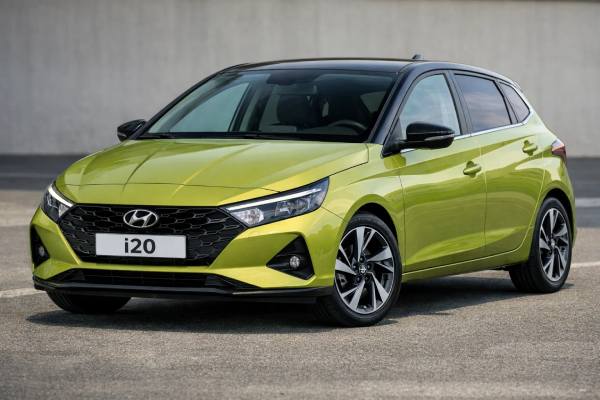
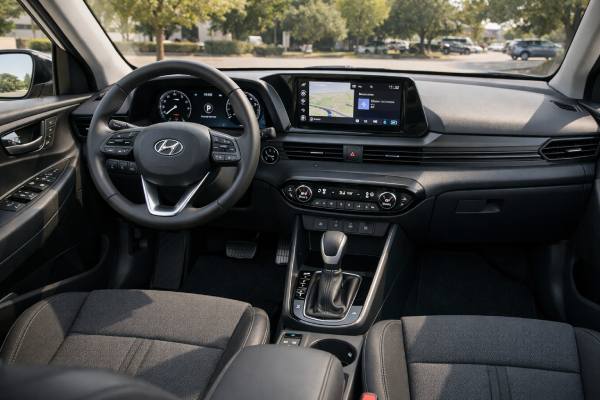
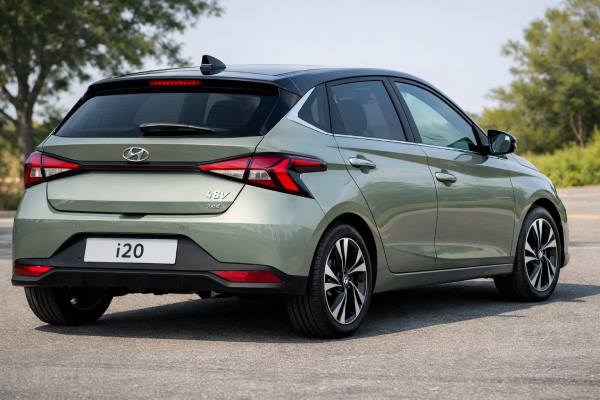
The facelifted Hyundai i20 BC3 with the 1.0 T-GDi 100 hp engine is one of the most balanced versions of Hyundai’s small hatchback. It combines the sharper 2023 update with a compact but flexible turbocharged three-cylinder, a roomy 2,580 mm wheelbase, and a 352-litre boot that makes the car feel more useful than its size first suggests. In this form, the i20 is no longer just a city car. It is small enough for easy urban driving, yet it has enough torque, safety technology, and motorway composure to work as a genuine everyday all-rounder. The engineering appeal is easy to explain: 998 cc, 172 Nm from low revs, front-wheel drive, simple torsion-beam rear suspension, and a modern cabin with stronger connectivity and driver-assistance support than earlier generations offered. The main ownership question is not whether the design makes sense. It does. The key is whether the individual car has been maintained with the discipline a small turbo direct-injection petrol deserves.
Key Takeaways
- The 1.0 T-GDi 100 hp engine gives the facelift i20 strong everyday flexibility thanks to 172 Nm from 1,500 rpm.
- A 2,580 mm wheelbase and 352-litre VDA boot make it one of the more practical small hatchbacks in its class.
- The 2023 facelift adds broader modern safety and infotainment appeal without changing the i20’s easy-to-own core layout.
- Oil quality and service timing matter more than mileage alone, because this is a turbocharged direct-injection petrol.
- A careful real-world service plan is an oil-and-filter change every 10,000–15,000 km or 12 months.
Jump to sections
- Hyundai i20 BC3 facelift basics
- Hyundai i20 BC3 facelift spec sheet
- Hyundai i20 BC3 facelift trims and ADAS
- Trouble areas and service-history checks
- Maintenance plan and buyer pointers
- Real-world driving and economy
- Where it fits against rivals
Hyundai i20 BC3 facelift basics
The 2023 facelift did not turn the BC3 i20 into a completely different car. It refined an already strong formula. Hyundai updated the front and rear styling, refreshed wheel designs and trim structure, and improved the technology story, while leaving the basic strengths alone. That matters because the BC3 already had the fundamentals right: a long wheelbase for the class, tidy exterior dimensions, a useful boot, and a cabin that feels more mature than older i20 generations did. The facelift simply made the package look fresher and more competitive in a market where small hatchbacks have to work harder to stand out.
The 1.0 T-GDi 100 hp engine is the sweet spot for many buyers. It is not the most powerful version of the range, but it is strong enough to avoid the “good but slow” verdict that often follows small naturally aspirated hatchbacks. Hyundai quotes 172 Nm from 1,500 to 4,000 rpm, and that broad torque band is the thing that most changes the car’s character. In traffic, the engine feels more eager than the power figure implies. On motorway slip roads, hills, or two-lane overtakes, it gives the i20 enough flexibility to feel modern rather than strained.
The body is another reason the i20 keeps making sense. Overall length is 4,065 mm, width is 1,775 mm, height is 1,450 mm, and wheelbase is 2,580 mm. Those numbers put it right in the heart of the B-segment, but the packaging is better than average. A 352-litre boot and a 1,165-litre maximum luggage volume with the seats folded make it more useful than many buyers expect from a car of this size. It still feels compact enough for city work, yet it can handle airport runs, weekly shopping, or a small family’s normal routine without feeling cramped.
From an ownership point of view, the facelifted 100 hp i20 sits in a useful middle ground. It avoids the extra cost and complexity that usually come with larger or more premium hatchbacks, but it still gives you a current-looking interior, meaningful ADAS, and enough performance to feel like a complete car. The main caveat is that it remains a turbocharged direct-injection petrol. That means good oil, sensible service timing, and clean cooling-system health matter more than with an old-school naturally aspirated supermini. Treated properly, though, it offers a strong mix of performance, efficiency, and practicality for the class.
Hyundai i20 BC3 facelift spec sheet
The facelifted BC3 i20 1.0 T-GDi 100 hp was sold with slightly different trim and transmission mixes depending on market, but current technical sheets give a reliable baseline for the post-facelift model. That makes them a useful reference point for the core mechanical layout and dimensions.
Powertrain and efficiency
| Item | Hyundai i20 (BC3 facelift) 1.0 T-GDi 100 hp |
|---|---|
| Engine family | Kappa 1.0 T-GDi |
| Engine layout and cylinders | Transverse I-3, DOHC, 12 valves |
| Displacement | 1.0 L (998 cc) |
| Bore × stroke | 71 × 84 mm (2.80 × 3.31 in) |
| Induction | Turbocharged |
| Fuel system | Gasoline direct injection |
| Compression ratio | 10.5:1 |
| Max power | 100 hp (73.5 kW) @ 4,500–6,000 rpm |
| Max torque | 172 Nm (127 lb-ft) @ 1,500–4,000 rpm |
| Timing drive | Chain |
| Rated efficiency | Official facelift WLTP numbers vary by market and trim; broadly mid-5 L/100 km figures are typical |
| Real-world highway @ 120 km/h | Typically around 5.8–6.7 L/100 km |
The engine is small, but it does not feel weak because the torque arrives early and stays useful across a wide range. It is a better daily driver than the old small naturally aspirated options, especially once traffic speeds rise above city pace.
Transmission, driveline, chassis, and dimensions
| Item | Hyundai i20 (BC3 facelift) 1.0 T-GDi 100 hp |
|---|---|
| Transmission | 6-speed manual or 7-speed DCT, market dependent |
| Drive type | Front-wheel drive |
| Differential | Open |
| Front suspension | MacPherson strut |
| Rear suspension | Coupled torsion beam axle |
| Steering | Motor Driven Power Steering |
| Steering ratio | Not consistently listed in current open facelift sheets |
| Front brakes | 280 mm ventilated discs (11.0 in) |
| Rear brakes | 262 mm solid discs (10.3 in) |
| Most common tyre sizes | 195/55 R16 or 215/45 R17 depending on trim |
| Length | 4,065 mm (160.0 in) |
| Width | 1,775 mm (69.9 in) excluding mirrors |
| Height | 1,450 mm (57.1 in) |
| Wheelbase | 2,580 mm (101.6 in) |
| Turning circle | About 10.2 m (33.5 ft) |
| Kerb weight | About 1,065–1,200 kg (2,348–2,646 lb), trim and gearbox dependent |
| GVWR | 1,600–1,630 kg (3,527–3,593 lb) |
| Fuel tank | 40 L (10.6 US gal / 8.8 UK gal) |
| Cargo volume | 352 L seats up / 1,165 L seats down (12.4 / 41.1 ft³), VDA |
That size and weight balance is one of the i20’s quiet strengths. It remains easy to park and light enough to feel responsive, but it also offers enough cabin and luggage room to work as more than just a city car.
Performance, towing, and service capacities
| Item | Hyundai i20 (BC3 facelift) 1.0 T-GDi 100 hp |
|---|---|
| 0–100 km/h | About 10.4–11.4 s, depending on transmission and exact spec |
| Top speed | About 176–188 km/h (109–117 mph), market dependent |
| Braked towing | Up to 1,110 kg (2,447 lb) |
| Unbraked towing | 450 kg (992 lb) |
| Roof load | 70 kg (154 lb) |
| Payload | About 425–540 kg (937–1,191 lb), trim dependent |
| Fluid or spec | Value |
|---|---|
| Engine oil | About 3.6 L (3.8 US qt) drain and refill |
| Oil specification | ACEA C2; some manuals also note API SN full synthetic requirement |
| Recommended viscosities | 0W-20, 0W-30, 5W-30, or 5W-40 depending on climate and market guidance |
| Coolant | About 5.73 L (6.06 US qt) |
| Manual transmission fluid | About 1.5–1.6 L (1.6–1.7 US qt) |
| DCT fluid | About 1.6–1.7 L (1.7–1.8 US qt) where fitted |
| Brake and clutch fluid | About 0.7–0.8 L, DOT 4 |
| Wheel lug nut torque | 88–107 Nm (65–79 lb-ft) |
Those service figures matter because they help you judge whether past workshop invoices sound plausible. On a turbo small car, accurate fluids and sensible intervals are much more important than they look on paper.
Hyundai i20 BC3 facelift trims and ADAS
Trim structure varies by country, but the facelift i20 usually follows a clear pattern: a usable entry version, a better-equipped middle trim, and upper versions that add more convenience, styling, and technology. In some markets, trims include Advance, Premium, Ultimate, and N Line S. That is useful because it shows how broadly Hyundai now spreads core safety and infotainment rather than hiding everything worthwhile in the top model.
For most buyers, the middle trims are the sweet spot. Advance and Premium grade cars usually offer the equipment that changes day-to-day ownership most: rear camera, better infotainment, digital cluster support, smartphone integration, cruise-related functions, and useful safety tech. Upper trims add items such as a larger 10.25-inch navigation setup, wireless charging, upgraded sound, blind-spot support, and appearance upgrades including larger wheels. These features are welcome, but they also increase tyre cost and the number of things to inspect on a used car. A cleaner mid-grade car is often a better ownership proposition than a tired high-spec one.
Safety and driver assistance are stronger points on the facelift car than they were on older i20 generations. In current specification sheets, Autonomous Emergency Braking and Forward Collision Avoidance Assist for cars, pedestrians, and cyclists are standard across the listed range, as are Intelligent Speed Limit Warning, Lane Follow Assist, Lane Keep Assist, eCall, and TPMS. Blind Spot Collision Warning appears on some higher trims, while a Driver Assistance Pack can add functions such as Smart Cruise Control and Blind Spot Avoidance Assist. That is a meaningful shift from the older i20 story, where stronger ADAS was often patchier or higher-trim only.
Euro NCAP still applies the BC3 i20’s four-star rating, based on the closely related BAYON safety package. The published category scores are 76% for adult occupant protection, 82% for child occupant protection, 76% for vulnerable road users, and 67% for safety assist. That is a respectable modern small-car result, but it is also a reminder that not every trim has the same avoidance or support technology in every market. A used buyer should verify actual sensor and assistance fitment instead of assuming from the year alone.
The practical rule is simple: buy by equipment, not just by badge. Check whether the car has 16- or 17-inch wheels, camera, blind-spot warning, navigation, wireless charging, and any driver-assistance pack extras. The facelift i20’s better technology story is one of its main advantages, but only if the specific car in front of you actually has the hardware you expect.
Trouble areas and service-history checks
The facelifted i20 1.0 T-GDi is still new enough that long-term failure data is not as developed as it is for older PB or GB cars. That means it would be misleading to present a long list of “classic failures” as if the model had a deep, settled pattern of age-related problems. The fairer picture is that the car’s reliability outlook is broadly positive, but its long-term health depends heavily on how well owners handle the realities of a small turbo direct-injection petrol.
Common low-to-medium cost issues to watch
- Ignition-related rough running, usually from spark plugs or coil packs.
- Battery weakness causing stop-start inconsistency or nuisance warnings.
- Rear-brake corrosion or uneven wear on lightly used cars.
- Tyre noise or poor ride quality caused by cheap replacement tyres rather than by the car itself.
Occasional medium-cost concerns
- Boost-hose leaks causing flat response, hiss, or inconsistent torque.
- Cooling-system seepage from hoses, joints, or plastic housings.
- Clutch wear on manual cars driven mainly in urban stop-start traffic.
- DCT hesitation or shudder at low speed on cars fitted with the 7-speed dual-clutch transmission.
Less common but more serious risks
- Timing-chain noise on cars with poor oil history.
- Turbo wear accelerated by stretched oil intervals or repeated overheating.
- Drivability roughness from carbon accumulation over time, which can affect direct-injection engines used mostly for repeated cold short trips.
The owner’s manual reinforces the main theme here: the engine depends on correct oil quality, and severe-use conditions call for much shorter oil-service intervals than the normal schedule. The manual also notes that if a lower-grade oil than required is used, the engine oil and filter must be replaced according to the severe maintenance schedule. That is a very important clue for used buyers. On this engine, “service history” is not just the presence of stamps. It is whether the oil choice and timing were actually sensible.
Software and calibration history matter as well. Facelift cars can receive updates that affect drivability, warning sensitivity, or transmission behavior on applicable versions. There is no single defining software flaw in the official sources, but it is still worth preferring cars with dealer or reputable specialist histories over cars that have been serviced anonymously with no digital record. Official VIN recall and service-campaign checks are also worth doing before purchase.
So the reliability verdict is not that the 1.0 T-GDi is risky. It is that it is modern. Treat it like an older naturally aspirated commuter hatch and it may disappoint you later. Treat it like a small turbo engine that wants proper oil, healthy cooling, and believable maintenance, and it looks like a very reasonable used prospect.
Maintenance plan and buyer pointers
The official Hyundai schedule is only the starting point. For real-world ownership, especially once the car is out of its first-owner period, the smarter strategy is slightly more conservative. The owner’s manual lays out both a normal petrol-engine schedule and a severe-use schedule, and the severe-use section is very revealing. For the 1.0 T-GDi, severe-use oil and filter changes are every 5,000 km or 6 months, while the normal schedule is materially longer. That does not mean every car needs 5,000 km oil changes. It means short trips, heavy traffic, poor oil, dust, salt, towing, and repeated stop-go driving matter enough that Hyundai publishes a very short fallback interval.
Practical maintenance schedule
| Item | Practical interval |
|---|---|
| Engine oil and filter | Every 10,000–15,000 km or 12 months |
| Severe-use reference | 5,000 km or 6 months in the cited owner’s manual |
| Air cleaner filter | Inspect annually; replace sooner in dusty use |
| Cabin filter | About every 12 months |
| Spark plugs | About every 70,000 km under the cited normal schedule |
| Valve clearance | Inspect at 90,000 km or 108 months for 1.0 T-GDi in the cited manual |
| Drive belt | First inspect at 90,000 km or 72 months, then every 30,000 km or 24 months |
| Brake and clutch fluid | Every 40,000 km or 3 years in the cited manual |
| Engine coolant | Inspect at every service; first replace at 100,000 km or 60 months, then every 40,000 km or 24 months |
| Manual transmission fluid | Market manuals vary; inspect for leaks and shift quality, and replace by condition or severe-use plan |
| DCT fluid | Every 120,000 km in the cited severe-use section where fitted |
| Tyres and alignment | Inspect regularly; rotate and align as wear pattern requires |
| 12 V battery | Test yearly once age passes about 4 years |
This schedule is more useful than a single brochure interval because it reflects how people really use these cars. The most important decisions are simple. Keep fresh oil in it, do not ignore cooling issues, and do not let tyres and brakes slide just because the car is still relatively new.
Buyer’s checklist
- Start the engine cold and listen for prolonged chain rattle or unstable idle.
- Confirm smooth boost delivery from low rpm without hissing or flat response.
- Check for coolant smell or dried residue around hoses and housings.
- Inspect tyres closely for cheap brands or uneven wear.
- Test the rear brakes for drag or roughness after the road test.
- On manual cars, check clutch take-up and slip under full load.
- On DCT cars, drive in traffic and check for shudder or hesitant take-up.
- Verify annual oil changes, not just total number of service stamps.
- Run an official VIN recall and campaign check before paying.
The best used facelift i20s are likely to be cars with ordinary, boring histories: annual servicing, decent tyres, strong electrics, and no cooling drama. On a small turbo hatchback, boring is good.
Real-world driving and economy
In daily driving, the facelift i20 1.0 T-GDi 100 feels more complete than its size suggests. The engine is the main reason. It gives the car enough torque to feel lively in the kind of low- and medium-speed conditions where small hatchbacks spend most of their lives. Pulling away from junctions, climbing a ramp, or joining a motorway takes much less effort than it does in a small naturally aspirated supermini. That is the key advantage of this version. It feels easy.
The car’s road manners match that engine well. The chassis is not overtly sporty, but it is tidy and predictable. Steering is light, quick enough for town, and calm at higher speed. The wheelbase helps the i20 feel more substantial than older small hatchbacks, and the car is stable enough on faster roads that it can handle commuting mileage without feeling overworked. It is not as playful as a Ford Fiesta, but it is easy to trust and easy to place, which is exactly what many owners want.
Ride quality depends quite a bit on wheel size. Cars on 16-inch tyres usually strike the best balance. They keep the car composed without making rough urban surfaces feel sharp. Seventeen-inch examples look better and often come with higher trims, but they will expose poor road surfaces, worn dampers, or cheap tyres more quickly. In used form, tyre quality can change the verdict more than rim size alone. That is worth remembering because a badly shod i20 can feel noisier and harsher than the model really is.
Real-world economy is good rather than magical. Official post-facelift data points to broadly mid-5 L/100 km consumption, depending on trim and transmission, but a healthy used car in mixed driving will more often sit around 5.8–6.8 L/100 km. At a real 120 km/h cruise, high-5s to mid-6s are realistic. Dense winter city use can easily move that upward. The important point is that the i20 delivers a useful blend of torque and economy without demanding diesel-style usage patterns or the heavier running costs of a larger hatch.
The overall performance verdict is straightforward. The 100 hp i20 is not quick in the warm-hatch sense, but it is quick enough to feel modern and flexible. For a broad audience, that matters more than a headline sprint time. It behaves like the kind of small hatchback most people actually want to own: easy in town, capable on the motorway, and efficient enough not to feel like a compromise.
Where it fits against rivals
The facelift i20 1.0 T-GDi 100 sits in the busiest part of the small-car market, so comparison matters. Its obvious rivals are the Ford Fiesta 1.0 EcoBoost 100, Volkswagen Polo 1.0 TSI 95, Skoda Fabia 1.0 TSI, SEAT Ibiza 1.0 TSI, Renault Clio TCe 90, Toyota Yaris 1.5, and Kia Rio 1.0 T-GDi. Each of them has a strength. The Hyundai’s role is to be balanced rather than dominant in one isolated area.
Against the Fiesta, the Hyundai usually loses on steering feel and chassis sparkle. The Ford is the better driver’s car. The i20 fights back with a more comfort-first feel, a roomy cabin, and a stronger technology-and-practicality case for buyers who are not searching for fun first. Against the Polo, Fabia, and Ibiza, the Hyundai may not feel quite as premium or as polished in every detail, but it often makes a stronger value case once specification and condition are compared honestly. Against the Clio, it feels a bit more conservative but also more straightforward. Against the Toyota Yaris, it can offer more interior and luggage usefulness, while the Toyota answers with its reputation and hybrid options. Those are fair trade-offs, not obvious wins or losses.
The i20’s most important comparison may actually be inside Hyundai’s own range. The 1.2 MPi is the simplicity play. The 1.0 T-GDi 100 is the balance play. The 120 hp versions bring more performance, but for many owners the 100 hp car is already enough. That is why this facelift version makes sense. It captures the benefits of the newer BC3 body and facelifted cabin tech without becoming needlessly expensive or overly specialized.
The final verdict is clear. Buy this car if you want a small hatchback that feels genuinely modern, useful, and easy to live with, and if you are willing to respect the service needs of a small turbo petrol. Skip it if your priority is the sharpest possible handling or the absolute simplest non-turbo mechanical package. For most buyers, though, the facelift i20 1.0 T-GDi 100 hits a very attractive middle ground between performance, practicality, safety, and cost.
References
- Hyundai i20 | Technical, Specifications and Pricing | Model year 2025 | April 2024 2024 (Technical Data)
- i20 2025 (Brochure)
- Εγχειρίδια Κατόχου – Hyundai Ελλάς ΑΒΕΕ 2026 (Owner’s Manual portal)
- EuroNCAP | Hyundai i20 2021 (Safety Rating)
- Home | Hyundai Recalls & Service Campaigns 2026 (Recall Database)
Disclaimer
This article is for informational purposes only and is not a substitute for professional diagnosis, repair, or vehicle-specific technical advice. Specifications, torque values, service intervals, procedures, safety equipment, and fitted features can vary by VIN, market, trim, and production date, so always verify critical details against official service documentation for the exact vehicle.
If this guide helped you, please consider sharing it on Facebook, X, or another social platform to support our work.