
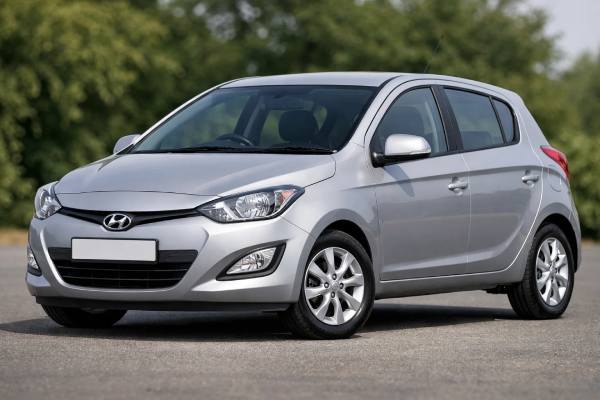
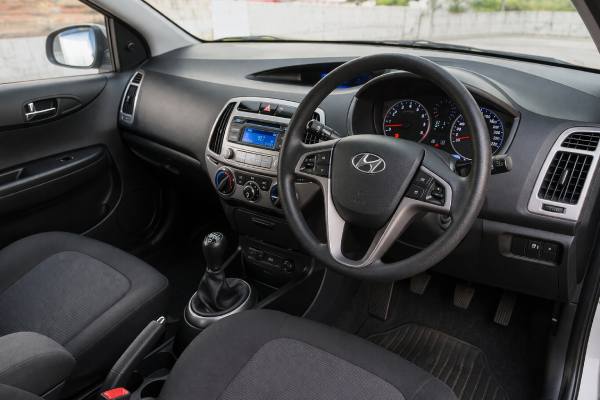
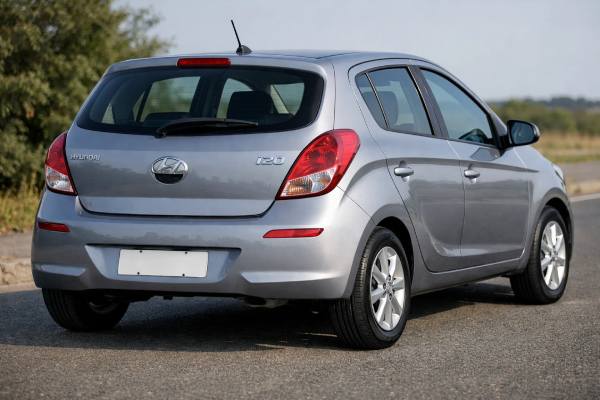
The facelifted Hyundai i20 PB 1.4 CRDi 90 is the version of the first-generation i20 that makes the strongest case as a practical long-distance supermini. It kept the core strengths of the earlier car, including sensible cabin space, easy controls, and low running costs, but wrapped them in a sharper front-end design, cleaner trim structure, and a more mature overall feel. The key engineering appeal is simple: a 1.4-liter four-cylinder turbo-diesel, front-wheel drive, and a 6-speed manual gearbox in most facelift-market versions. That does not sound exotic, but it suits the car well. The torque output makes the i20 feel stronger in normal driving than the 90 hp figure suggests, and official economy remained a major selling point. For used buyers today, the facelift matters because it brings Euro 5-era updates, revised trim packaging, and some meaningful differences between Blue Drive and non-Blue Drive versions. Buy on condition and service history, and this remains one of the more rational small diesel hatchbacks of its era.
Top Highlights
- Strong 220 Nm torque and a 6-speed manual make the facelift diesel feel easy and relaxed in real traffic.
- The cabin, boot, and general packaging remain competitive for a small hatchback from this period.
- Blue Drive versions offer especially strong official fuel economy and low CO2 output.
- Short-trip use, overdue oil changes, and neglected cooling or fuel-filter service can turn a good diesel into an expensive one.
- A careful owner should plan on oil and filter service every 12 months, or sooner under heavy urban or severe-use driving.
Explore the sections
- Hyundai i20 facelift diesel profile
- Hyundai i20 facelift numbers and capacities
- Hyundai i20 facelift trims and safety kit
- Common faults and official actions
- Service needs and smart buying
- Everyday performance and economy
- Facelift i20 versus key alternatives
Hyundai i20 facelift diesel profile
The 2012 to 2014 facelift is the version of the PB-generation i20 that feels the most complete. Hyundai did not reinvent the car, but it revised enough of the exterior and equipment mix to make the model look fresher and more competitive. The updated hexagonal grille, revised lamps, wheel designs, and cleaner trim presentation gave the i20 more presence, while the powertrain range shifted toward lower emissions and stronger official economy. In diesel form, the 1.4 CRDi 90 remained the more useful all-rounder if you needed more motorway ability than the smaller diesel provided.
The core reason the 1.4 CRDi 90 works is torque. With 220 Nm available from low revs, the facelift i20 feels more flexible than many small petrol rivals from the same period. It pulls well away from junctions, copes better with hills and passengers than the power figure suggests, and does not need to be worked hard to make progress. In facelift specification, this engine is commonly paired with a 6-speed manual gearbox, which improves cruising compared with older small diesels that were left turning harder at highway speed. The result is not a sporty hatchback, but a small car that feels more settled and capable outside town than many people expect.
Another reason the facelift version matters is that Hyundai tightened the efficiency story. In many markets, the car moved fully into Euro 5-era tuning, and in the UK brochure at least, Blue Drive versions brought stop-start, low-rolling-resistance tyres, and notably lower CO2 and fuel-consumption figures. That matters in ownership terms because a facelift 1.4 CRDi can look very different on paper depending on whether it is a standard diesel or a Blue Drive model. Buyers who only compare “i20 1.4 CRDi 90” listings can miss those differences.
The body itself remains one of the i20’s best features. It is still a supermini, but it never feels especially cramped. The rear seat is usable, the boot is genuinely practical, and the controls are easy to understand even now. The i20 facelift also held onto a strong safety reputation for the class, which helps it remain relevant as a used choice for budget-conscious families.
None of that means the facelift is flawless. It is still a small, older diesel hatchback. Refinement is only moderate by current standards, the steering is more functional than engaging, and neglected examples can become irritating quickly through wear, warning lights, and minor faults. But judged on what it was designed to do, the facelifted i20 1.4 CRDi 90 remains an honest and well-judged package: compact, economical, easy to drive, and mature enough to cope with more than just city work.
Hyundai i20 facelift numbers and capacities
For the facelift 2012 to 2014 i20 PB diesel, the cleanest technical picture comes from the facelift brochure data and the broader owner-manual coverage for the 2008–2014 range. The engine architecture stays familiar, but facelift cars bring the updated body dimensions, Euro 5 status, and a stronger bias toward the 6-speed manual gearbox.
Powertrain and efficiency
| Item | Hyundai i20 PB Facelift 1.4 CRDi 90 |
|---|---|
| Code | Market-dependent; verify by VIN and build data |
| Engine layout and cylinders | Inline-4, DOHC, 16-valve |
| Valves per cylinder | 4 |
| Bore × stroke | 75 × 79 mm |
| Displacement | 1.4 L (1396 cc) |
| Induction | Turbo-diesel |
| Fuel system | Common-rail direct injection |
| Compression ratio | 17.0:1 |
| Max power | 89 hp (66 kW) @ 4000 rpm |
| Max torque | 220 Nm (162 lb-ft) @ 1500–2750 rpm |
| Timing drive | Verify exact timing-drive detail by VIN before major parts ordering |
| Rated efficiency | About 3.7 L/100 km for Blue Drive, about 4.3 L/100 km for some non-Blue facelift trims |
| Real-world highway @ 120 km/h | Usually around 5.0 to 5.5 L/100 km in healthy cars |
Transmission and driveline
| Item | Figure |
|---|---|
| Transmission | 6-speed manual |
| Drive type | FWD |
| Differential | Open |
Chassis and dimensions
| Item | Figure |
|---|---|
| Suspension, front | MacPherson strut with gas dampers |
| Suspension, rear | Coupled torsion beam axle with gas dampers |
| Steering | Rack-and-pinion with electric power assistance |
| Steering ratio / lock-to-lock | 2.8 turns lock-to-lock |
| Turning circle, kerb-to-kerb | 5.2 m |
| Brakes | Disc front and rear; exact diameters vary by wheel and market, so verify by VIN before parts ordering |
| Wheels and tyres | 185/60 R15 common; 195/50 R16 on higher trims |
| Length | 3995 mm |
| Width | 1710 mm |
| Height | 1490 mm |
| Wheelbase | 2525 mm |
| Kerb weight | About 1232 kg, depending on body style and trim |
| GVWR | 1650 kg |
| Fuel tank | 45 L |
| Cargo volume | 295 L seats up / 1060 L seats folded, VDA |
Performance and capability
| Item | Figure |
|---|---|
| 0–100 km/h | About 13.5 s |
| 0–62 mph | 13.5 s |
| Top speed | 108 mph (about 174 km/h) |
| Towing capacity | Up to 1100 kg braked, depending on market and homologation |
| Unbraked trailer | 450 kg |
| Payload | About 418 kg on typical facelift figures |
Fluids and service capacities
| Item | Figure |
|---|---|
| Engine oil specification | ACEA B4 or equivalent diesel-capable specification |
| Engine oil capacity | 5.3 L |
| Manual transaxle fluid | GL-4 SAE 75W-85 |
| Manual transaxle capacity | 1.9 L |
| Coolant capacity | 6.8 L |
| Brake and clutch fluid | About 0.7–0.8 L |
| A/C refrigerant | R-134a; confirm charge by under-bonnet label |
| A/C compressor oil | Verify by system label and workshop documentation |
| Key torque specs | Wheel nuts 88–107 Nm |
The most important practical note is that facelift i20 diesel data is still not perfectly identical across all markets. The safest buying and servicing habit is to treat brochure figures as the shape of the car, but confirm tyres, brakes, body style, and parts by VIN before spending money.
Hyundai i20 facelift trims and safety kit
The facelift i20 range looks simple at first glance, but trim makes a meaningful difference. In the UK-facing facelift material, the key grades were Classic, Active, Style, and Blue, with Blue Drive efficiency features folded into selected versions. That means two facelift i20 diesels can share the same basic engine yet differ in wheels, comfort equipment, official economy, and even how the car feels at speed.
For most buyers, the sensible trim sweet spot sits in the middle of the range. Active models usually add the equipment that matters in daily use without going too far into cosmetic extras. On facelift cars, that often means Bluetooth with voice recognition, steering-wheel audio controls, air conditioning, glovebox cooling, better speaker count, and a more complete convenience feel than entry trims. Style models move the car further upscale with climate control, larger alloy options, automatic lights and wipers, reversing sensors, and in some markets a reversing camera integrated into the mirror. These features help the facelift i20 feel much newer than the calendar suggests.
Blue Drive deserves separate attention. It was not just a badge exercise. The package typically brought stop-start technology, low-rolling-resistance tyres, and lower official CO2 output. That makes Blue Drive versions attractive for fuel-conscious buyers and for anyone shopping in a market where annual tax or company-car treatment once mattered. The trade-off is that Blue-oriented trims can omit a few comfort items or use lower-resistance tyre packages that buyers may not want to replace like-for-like.
Trim also affects operating costs. Fifteen-inch-wheel cars on 185/60 R15 tyres are normally the most sensible long-term choice because tyres are cheaper and ride comfort is often better. Sixteen-inch cars can look sharper and feel slightly tighter in response, but the gains are modest compared with the increase in tyre cost and the slightly firmer low-speed ride.
Safety remains a strong point. The i20 platform earned a 5-star Euro NCAP result in 2009, and Hyundai continued to market the facelift around that reputation. Equipment typically included six airbags, ABS with EBD, electronic stability control, Vehicle Stability Management, seatbelt reminders, front pretensioners, ISOFIX outer rear-seat anchorages, a passenger-airbag deactivation switch, and reinforced body structure. For a supermini of this age, that is a respectable passive and stability-control package.
What the facelift does not bring is modern ADAS. There is no mainstream autonomous emergency braking, no adaptive cruise control, no blind-spot warning, and no real lane-centering support. That is important for two reasons. First, buyers should judge it by its period, not by today’s standards. Second, simpler safety electronics can be easier to live with long term, provided the fundamentals are correct. Matching tyres, good wheel-speed sensor health, and proper alignment still matter because ABS and stability systems depend on accurate signals. A facelift i20 with warning lights or mismatched tyres should never be dismissed as “just an old car thing.”
Common faults and official actions
The facelifted i20 1.4 CRDi 90 does not have a single defining catastrophe, but it does follow a clear used-diesel pattern. A well-serviced car is usually dependable and easy to live with. A neglected one can pile on medium-cost irritations that quickly erase the appeal of buying a cheap supermini diesel. The right way to assess these cars is by prevalence, age, and maintenance discipline rather than by myths.
Common lower-cost problems usually sit in the chassis and cabin. Expect worn front drop links, tired suspension bushes, noisy wheel bearings, ageing dampers, and the occasional interior or switchgear fault. Paint chipping and cosmetic wear also show up on many cars. None of this is unusual for the class, but it matters because these faults shape how “used up” the car feels. A tidy-driving i20 should not feel loose, clangy, or electrically scruffy.
Occasional medium-cost issues tend to involve the cooling system, clutch, and diesel ancillaries. Small radiator leaks, hose ageing, thermostat problems, and coolant seepage deserve attention because a minor loss can turn into overheating if ignored. Clutch wear is also worth watching, especially on urban cars. A high biting point, shudder on take-up, or poor hill-start behaviour suggests money will be needed soon. On the diesel side, boost-hose leaks, airflow-meter faults, EGR-related contamination, and glow-plug or starting complaints can all appear with age and mileage.
The higher-cost risks are predictable. Injector problems, turbo wear, or DPF-related trouble are more likely on cars that have had poor oil-change discipline, cheap fuel, or years of short-trip use. The 1.4 CRDi should feel eager from low revs and should not smoke heavily under load. Symptoms that deserve caution include repeated limp mode, excess black smoke, whistling beyond normal turbo noise, hard starting, rough idle when hot, or poor pull in the mid-range. Those faults do not automatically mean disaster, but they do mean a cheap purchase can become an expensive one quickly.
Software and calibration issues are less visible in public sources than on newer cars, but they still matter. If a facelift i20 has erratic idle behaviour, repeated warning lamps, or inconsistent cold-start manners, it is worth asking whether dealer-level updates were ever applied. On older Hyundais, owners often focus on parts replacement and forget that software updates were sometimes part of the official fix path.
As for recalls and service campaigns, the best rule is simple: trust the VIN, not the seller’s memory. Public UK recall tools and Hyundai’s own campaign checker are the right places to verify whether a car has any open actions. Public sources do not show a heavy, obvious list of facelift-specific diesel campaigns that define the model, which is good news, but that makes documentation even more important. Ask for proof of recall completion, dealer invoices, and service records. A used diesel without a proper paper trail is always a riskier buy than a cleaner documented example that costs more upfront.
Service needs and smart buying
The facelift i20 1.4 CRDi rewards conservative maintenance. Official Hyundai schedules for this generation were designed around long intervals under normal use, but real-world used ownership is different. Age, short trips, and uncertain service history all argue for a more careful approach. The smartest thing a new owner can do is establish a clean maintenance baseline early rather than wait for problems.
Practical maintenance schedule
| Item | Practical interval |
|---|---|
| Engine oil and filter | Every 15,000 to 20,000 km or 12 months |
| Severe-use oil and filter | Every 10,000 km or 6 months |
| Engine air filter | Inspect every service, replace as needed |
| Cabin air filter | Every 20,000 km or 12 months |
| Fuel filter | Around 60,000 km, sooner with poor fuel quality or water contamination |
| Coolant | First major replacement around 100,000 km or 5 years, then about every 40,000 km or 2 years |
| Brake and clutch fluid | Every 2 years |
| Manual gearbox oil | Check condition and refresh around 80,000 to 100,000 km if history is unknown |
| Auxiliary belts and hoses | Inspect every service |
| Brake pads, discs, lines, and handbrake | Inspect every service |
| Tyre rotation and alignment | Check regularly and after suspension work |
| 12 V battery | Test annually once older than about 4 years |
| Timing components | Verify exact timing-drive design and service guidance by VIN before major work |
Useful fluid and torque figures
| Item | Figure |
|---|---|
| Engine oil capacity | 5.3 L |
| Manual transaxle capacity | 1.9 L |
| Coolant capacity | 6.8 L |
| Fuel tank | 45 L |
| Brake/clutch fluid | About 0.7–0.8 L |
| Wheel nut torque | 88–107 Nm |
For buyers, the inspection checklist should start with evidence, not cosmetics. Look first for a complete service history, especially invoices showing oil grade, fuel-filter changes, brake-fluid service, and cooling-system work. A stamped book is better than nothing, but parts-and-labour invoices are much more convincing. Then inspect the engine bay for coolant residue, damp hose joints, oil sweat around turbo plumbing, and any diesel smell near the filter or lines.
The test drive should be long enough to warm the engine fully. The car should start promptly, idle evenly, pull hard from low revs, and settle into a calm cruise without vibration or warning lamps. Steering should stay consistent, the clutch should take up cleanly, and the brakes should feel straight and stable. Any overheating smell, limp-mode behaviour, or obvious flat spot in the mid-range needs explanation before purchase.
The trims to target are generally the well-kept Active or Style cars, especially if they sit on sensible wheel sizes and come with clear history. Blue Drive versions are appealing if you want the best official economy, but condition matters more than specification. The versions to avoid are not defined by badge so much as by neglect. A cheap facelift diesel with vague history, multiple warning lights, and overdue service work is almost always a false economy. Long term, the i20’s durability outlook is solid if you maintain it like a diesel and not like an appliance.
Everyday performance and economy
On the road, the facelift i20 1.4 CRDi 90 is better than its numbers suggest. The official 0–62 mph time of 13.5 seconds is merely average, but the engine’s torque delivery gives the car an easier, stronger character in day-to-day driving. It does not need much throttle to get moving, it copes well with mild inclines, and it feels much less strained than many small petrol engines when carrying people or luggage. That is why the 1.4 CRDi makes sense for drivers who regularly leave the city.
The 6-speed manual is a big part of the facelift car’s appeal. It helps the engine stay in its useful torque band without feeling busy, and it gives the i20 a calmer motorway manner than many older small diesels with shorter gearing. In practice, the car feels most comfortable when driven smoothly rather than aggressively. There is some turbo lag below the strongest part of the torque curve, but it is mild by the standards of the era and easy to work around.
Ride and handling are honest rather than playful. The suspension setup is simple, predictable, and tuned around everyday stability, not sharp turn-in. That suits the car’s mission well. It tracks cleanly on the motorway, absorbs normal road damage competently on 15-inch tyres, and does not ask much of the driver in town. Steering is light and easy, though not rich in feedback. On poor surfaces, worn examples can feel crashy or loose, which is usually a maintenance issue more than a design flaw.
Noise levels are typical for a small diesel hatchback of this period. Around town, you will hear some diesel clatter. At higher speeds, wind and tyre noise become more obvious than in a modern small hatch. But the facelift remains reasonably composed, especially compared with cheaper-feeling rivals from the same era. The best examples feel mature rather than bargain-basement.
Fuel economy is still a major part of the verdict. Official combined figures of about 3.7 L/100 km for Blue Drive versions were excellent for the time, while non-Blue facelift cars in higher trims could sit around 4.3 L/100 km. Real-world driving is naturally less dramatic. A healthy car usually returns something around 5.0 to 6.0 L/100 km on open-road and motorway-heavy use, with mixed use often landing in the mid-5s. Heavy traffic, winter running, short trips, and a loaded car will raise that number. Even so, for drivers doing regular mileage, the facelift 1.4 CRDi still makes a convincing case. It is not quick, but it is easy, efficient, and genuinely useful.
Facelift i20 versus key alternatives
The facelift i20 1.4 CRDi 90 competes best on balance. It was never the most exciting supermini diesel on sale, but it combined enough torque, enough space, strong period safety, and sensible running costs into a package that still makes sense in the used market. That remains its strongest advantage today. It is a car you buy because it fits real life well, not because it dominates one single category.
Against sharper-driving rivals, the Hyundai may feel a little reserved. Some competitors from the same era offered better steering feel or more eager front-end response. But the i20 often answers with easier ownership. The cabin feels usefully spacious for the class, the luggage area is practical, and the controls are straightforward. For buyers who want a small hatchback that can commute, travel, and carry family gear without complaint, that balance matters more than a livelier chassis.
Its diesel engine gives it another edge for the right user. If you cover regular motorway or mixed-distance mileage, the 1.4 CRDi feels more relaxed than many small naturally aspirated petrol rivals. It delivers its performance where real drivers use it, in the low and mid rev range, and it remains economical even when driven at real-road speeds. That makes it especially appealing as a budget long-distance commuter or second family car.
The car loses ground when the buyer’s priorities change. If most journeys are short and urban, an ageing diesel is simply harder to justify. If you want modern driver assistance, the facelift i20 belongs to an earlier safety era. And if you value handling sparkle above all else, other superminis can feel more entertaining. The Hyundai is not trying to be any of those things.
So who should buy one? The best fit is a driver who values economy, simplicity, and honest practicality more than image or excitement. The best version is usually a documented facelift Active or Style, or a Blue Drive car in clearly good condition if economy is the top priority. The wrong version is any cheap example with vague history, visible cooling issues, and signs of diesel neglect. Buy the right facelift i20 and it still feels like a grown-up small hatchback. Buy the wrong one and it becomes another old diesel with bills attached. The difference is not the badge. It is the history.
References
- Hyundai Owners manuals | Hyundai Motor UK 2026 (Owner’s Manual)
- Handleidingen | Hyundai Motor Nederland 2026 (Owner’s Manual)
- HYUNDAI I20 – Euro NCAP Results 2009 2009 (Safety Rating)
- Home | Hyundai Recalls & Service Campaigns 2026 (Recall Database)
- Check if a vehicle, part or accessory has been recalled 2026 (Recall Database)
Disclaimer
This article is for informational purposes only and is not a substitute for professional diagnosis, inspection, or repair. Specifications, torque values, service intervals, fluid requirements, and procedures can vary by VIN, market, trim, emissions equipment, and fitted options, so always verify against the official service documentation for the exact vehicle.
If this guide was useful, please consider sharing it on Facebook, X, or another platform to support our work.