
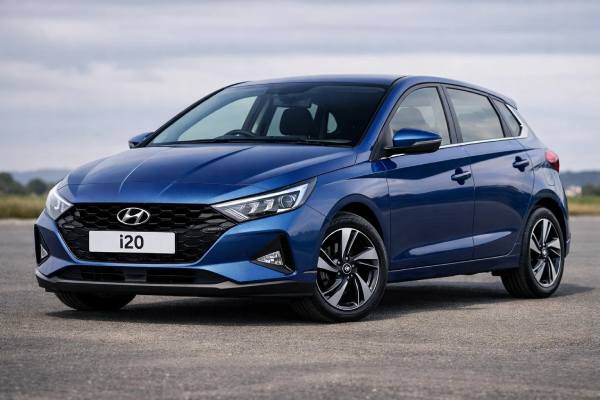
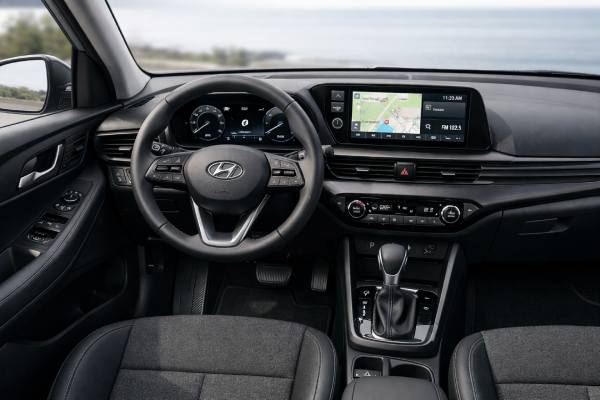
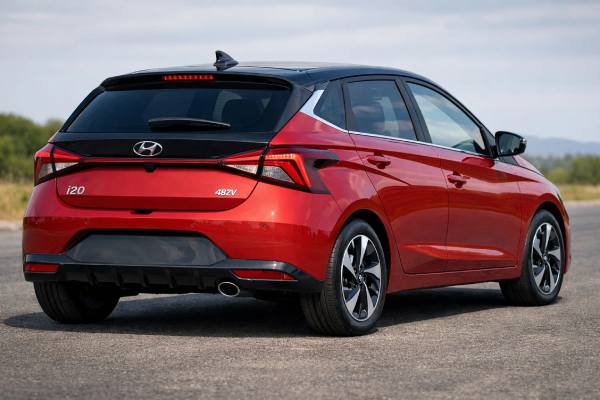
The facelifted Hyundai i20 BC3 with the 1.0 T-GDi 48V powertrain in its 120 hp class is one of the more interesting modern superminis because it mixes three things that do not always come together in this segment: low running costs, useful real-world torque, and a genuinely mature cabin and tech package. It is still a small front-wheel-drive hatchback, but the mild-hybrid system, stronger turbo tune, and choice of 6-speed iMT or 7-speed DCT give it a more grown-up feel than the basic petrol versions. The 2023 facelift also matters. Hyundai improved the safety package, refreshed the styling, and kept the roomy 352-litre boot that already made the BC3 i20 a practical small car. For buyers today, the main questions are simple: which markets really got the 120 hp version, which gearbox is the smarter used buy, and what early trouble spots deserve attention. This guide answers those questions clearly.
Essential Insights
- The 120 hp 48V setup gives the BC3 i20 much stronger mid-range pull than the lower-output versions.
- Cabin space, boot room, and standard connectivity remain strong points for a small hatchback.
- The facelift added better standard safety equipment, especially forward collision and lane-support functions.
- Gearbox choice matters: the iMT is efficient but more complex than a plain manual, while the DCT needs careful test-driving.
- A practical oil-change target is every 10,000 to 15,000 km or 12 months, depending on use.
Section overview
- Hyundai i20 BC3 ownership brief
- Hyundai i20 BC3 tech sheet
- Hyundai i20 BC3 grades and ADAS
- Reliability risks and software updates
- Maintenance map and purchase checks
- Road manners and fuel use
- Rival picture in 2025
Hyundai i20 BC3 ownership brief
The facelifted BC3-generation Hyundai i20 is a sharper and more polished small car than many buyers expect, and the 1.0 T-GDi 48V in 120 hp form is the version that gives it real pace without pushing it into full hot-hatch territory. It sits in a sweet spot. The car is light enough to feel responsive, the turbo three-cylinder has enough torque to make everyday driving easy, and the mild-hybrid system helps trim fuel use without bringing the complexity of a full hybrid.
One important detail needs to be clear from the start: this specific 120 hp facelift combination existed in Hyundai’s broader European technical data, but market availability varied. Some countries kept the 120 PS mild-hybrid option in the regular i20 and N Line family, while others simplified the regular hatch range and pushed buyers toward the 100 PS setup or toward N Line-branded versions. That means shoppers should not assume every 2023–2025 facelift i20 seen online with sporty wheels or dark trim is automatically the 120 hp car. VIN-level checking and original sales specification matter.
In ownership terms, the BC3 i20 has several strengths. The cabin is spacious for the class, the boot is genuinely useful, and the infotainment and instrument hardware look more modern than those in many older rivals. Hyundai also pushed standard safety kit harder with the facelift, which helps the car feel current even if its core platform predates the latest crop of superminis.
The 48V system is best seen as a support layer rather than a separate drive source. It helps with efficiency, smoother stop-start behavior, and coasting functions on iMT-equipped cars, but it does not turn the i20 into an EV-like urban hatch. The driving character still comes mainly from the 1.0-litre turbo petrol engine. In official European data, the 120-rated version is quoted at 120 PS, which is about 118 hp in imperial terms, so some markets and listings round that up or simply call it 120 hp. For buyers, the important number is torque. With 200 Nm available, the car feels noticeably stronger than the lower-output tune.
As a used buy, this version is promising but still young enough that the long-term reliability picture is developing. That is both good and bad. The good part is that most surviving cars are not especially old. The bad part is that weak maintenance habits can already show up because owners assume a modern Hyundai small car can be serviced casually. The best examples are dealer- or specialist-maintained cars with clean software history, strong battery condition, and no gearbox complaints. The wrong ones usually show warning signs early: poor tyres, jerky low-speed driveline behavior, unresolved warning lights, or patchy servicing.
Hyundai i20 BC3 tech sheet
The facelifted BC3 i20 1.0 T-GDi 48V 120 is best understood as a light B-segment hatch with a high-output mild-hybrid petrol setup rather than a heavily electrified car. Hyundai’s 2023 European technical data is the key source for the core drivetrain and body figures, but some trim and transmission details still vary by country.
Powertrain and efficiency
| Item | Specification |
|---|---|
| Code | Smartstream / Kappa 1.0 T-GDi 48V, commonly associated with G3LE-family public listings |
| Engine layout and cylinders | Inline-3, DOHC, 4 valves per cylinder |
| Bore × stroke | 71.0 × 84.0 mm (2.80 × 3.31 in) |
| Displacement | 1.0 L (998 cc) |
| Mild-hybrid assist | 48 V mild-hybrid system with starter-generator support; public 2023 facelift sheet does not separately state motor type or battery chemistry |
| System voltage | 48 V |
| Induction | Turbocharged |
| Fuel system | Direct injection |
| Compression ratio | 10.5:1 |
| Max power | 120 PS (about 118 hp / 88 kW) @ 6,000 rpm |
| Max torque | 200 Nm (148 lb-ft) @ 2,000–3,500 rpm |
| Timing drive | Chain |
| Rated efficiency | 5.5–5.1 L/100 km (42.8–46.1 mpg US / 51.4–55.4 mpg UK), depending on transmission and trim |
| Real-world highway at 120 km/h | About 5.8–6.8 L/100 km (40.6–34.6 mpg US / 48.7–41.5 mpg UK) |
Transmission and driveline
| Item | Specification |
|---|---|
| Transmission | 6-speed intelligent manual transmission (6iMT, code family M6CF1e) or 7-speed dual-clutch transmission (7DCT, code family D7GF1-2) |
| Drive type | FWD |
| Differential | Open |
Chassis and dimensions
| Item | Specification |
|---|---|
| Suspension, front / rear | MacPherson strut / coupled torsion beam axle |
| Steering | Rack-and-pinion with motor-driven power steering |
| Steering ratio | Hyundai publishes 15.0 and 13.1 values for different steering hardware listings |
| Steering lock-to-lock | 2.7 turns |
| Brakes | Front ventilated disc, rear drum standard or rear solid disc optional depending on trim |
| Front brake diameter | 256 mm (10.1 in) on smaller-wheel setups, 280 mm (11.0 in) on larger-wheel setups |
| Rear brake diameter | 203.2 mm (8.0 in) drum standard / 262 mm (10.3 in) solid disc optional |
| Wheels and tyres | 195/55 R16 and 215/45 R17 are the most relevant facelift sizes |
| Ground clearance | 140 mm (5.5 in) |
| Length / Width / Height | 4065 / 1775 / 1450 mm (160.0 / 69.9 / 57.1 in) for standard i20 body |
| Wheelbase | 2580 mm (101.6 in) |
| Turning circle | Approximately 10.4 m (34.1 ft) kerb-to-kerb |
| Kerb weight | Roughly 1090–1225 kg (2403–2701 lb), depending on trim and transmission |
| GVWR | 1620–1650 kg (3571–3638 lb) |
| Fuel tank | 40 L (10.6 US gal / 8.8 UK gal) |
| Cargo volume | 352 L (12.4 ft³) seats up / 1165 L (41.1 ft³) seats down, VDA |
Performance and capability
| Item | Specification |
|---|---|
| 0–100 km/h | 10.1 s (6iMT) / 10.3 s (7DCT) |
| 0–62 mph | 10.1–10.3 s |
| Top speed | 190 km/h (118 mph) |
| Braking distance 100–0 km/h | Not consistently published by Hyundai for this exact trim |
| Towing capacity | Typically around 1110 kg (2447 lb) braked / 450 kg (992 lb) unbraked where homologated; verify by VIN and market |
| Payload | 420–535 kg (926–1179 lb) |
Fluids and service capacities
| Item | Specification |
|---|---|
| Engine oil | Hyundai-approved full synthetic petrol-engine oil; 0W-30 or 5W-30 are the most sensible Europe-focused choices depending on climate and approval |
| Engine oil capacity | About 3.6 L (3.8 US qt) with filter; verify by VIN and service literature |
| Coolant | Ethylene-glycol long-life coolant for aluminium cooling systems |
| Coolant capacity | About 5.7 L (6.0 US qt), verify by VIN |
| Transmission fluid | Use Hyundai-approved fluid for the exact gearbox family only |
| A/C refrigerant | Market and build-date dependent; check under-bonnet label before service |
| Brake fluid | DOT 4 |
| Key torque specs | Always verify from VIN-specific workshop data before wheel, drain-plug, and spark-plug service |
Safety and driver assistance
| Item | Specification |
|---|---|
| Crash rating | Euro NCAP 4 stars |
| Euro NCAP detail | 76% adult occupant, 82% child occupant, 76% vulnerable road users, 67% safety assist |
| IIHS | Not applicable for this market model |
| Headlight rating | Not applicable |
| ADAS suite | FCA with city, interurban, pedestrian and cyclist recognition; lane keep assist and lane following assist standard in facelift-era material; blind-spot, rear cross-traffic and navigation-based smart cruise available by market and trim |
The main point from the hard numbers is that Hyundai gave the i20 enough power and enough torque to feel genuinely quick for a mainstream supermini, while keeping the car light, compact, and easy to run.
Hyundai i20 BC3 grades and ADAS
Trims on the facelift BC3 i20 depend heavily on market, which matters more here than on many older hatchbacks. In some countries the regular i20 range centered on mainstream grades such as Advance, Premium, and Ultimate. In others, the stronger 120-rated mild-hybrid setup sat closer to N Line-flavoured or upper-spec versions. That means buyers need to separate body style, appearance pack, and powertrain before assuming what a car has.
For the regular facelift i20, the main equipment ladder usually works like this. Lower and middle trims cover the essentials: alloy wheels, digital instruments, smartphone integration, rear camera, parking sensors, and the core Hyundai Smart Sense safety package. Higher trims add climate control, heated seats, heated steering wheel, upgraded lighting, navigation hardware, Bluelink, wireless charging, and in some markets Bose audio or keyless entry. The real-world result is positive: even non-luxury versions of the facelift i20 often feel well equipped.
Useful quick identifiers include:
- 16-inch wheels on many mid-range cars and 17-inch wheels on richer trims
- 10.25-inch navigation and upgraded cluster hardware on higher-spec models
- heated seat and heated wheel controls on premium-oriented cars
- black roof, privacy glass, and sportier bumpers on styling-led or N Line-type versions
- blind-spot or rear cross-traffic features usually appearing only toward the top of the range
Mechanical differences are not dramatic in the way they would be on an N model. This is not a car with wildly different suspension hardware, locking differentials, or multiple brake packages across all trims. Most variation is in wheel size, rear brake spec, gearbox choice, and ADAS content. That makes condition and equipment more important than badge wording alone.
Safety is one of the facelift’s strongest selling points. Hyundai added more assistance features as standard, especially forward collision systems that now include cyclist recognition and lane-following support. For many small-car buyers, this matters more than raw performance. The BC3 i20 feels like a newer-generation product because it does more active safety work in the background than earlier i20s.
Airbag provision, stability control, child-seat anchors, eCall, and tyre-pressure monitoring are all part of the basic safety picture. The Euro NCAP story also needs context. The i20’s 2021 Euro NCAP result is based on the closely related Bayon test, which Euro NCAP explicitly applied to the i20 because of shared safety equipment. That is useful because it tells buyers the crash structure and assistance package are credible, but it also reminds them that safety ratings depend on exact equipment fit. A lightly specified market version is not always the same as a fully loaded brochure car.
After repairs, calibration is worth attention. If the car has lane-following, forward camera functions, or blind-spot systems, a windscreen change or front-end accident repair should be checked carefully. A used i20 with warning lights, poorly aligned panels, or dead driver-assistance features is not a smart bargain. On this generation, tech condition is part of structural confidence.
Reliability risks and software updates
Because the facelift BC3 120 mild-hybrid is still relatively new, its reliability pattern is less about long-established catastrophic defects and more about early wear points, software behavior, and maintenance discipline. That should reassure most buyers. This is not a model with a giant public record of major mechanical failure. But it is also not a car that should be maintained casually.
A good way to think about it is by prevalence and cost.
Common or plausible low-to-medium cost issues
- 12 V battery weakness and stop-start oddities
Short-trip use, long periods of standing, and repeated urban running can upset battery condition. Symptoms include lazy starting, stop-start refusal, mild-hybrid or warning messages, and erratic infotainment behavior. Often the cure is a proper battery test and coding or replacement, not random part swapping. - Infotainment or connectivity glitches
Freezing screens, pairing issues, and delayed telematics updates are usually software-related rather than hardware failures. OTA map support helps, but owners still benefit from keeping updates current. - Rear brake corrosion on lightly used cars
This remains a normal small-car issue. Even newer i20s can show underused rear brakes, especially in damp climates and urban driving. Uneven pad wear, weak handbrake action, or rusty disc faces are the usual clues.
Occasional issues worth taking seriously
- iMT actuator or control-hydraulic complaints
The intelligent manual transmission is clever, but it is not mechanically simpler than a regular manual. Hyundai’s own service literature includes actuator-fluid checks, which tells you this system deserves attention. Symptoms can include jerky take-up, warning messages, inconsistent clutch engagement, or refusal to shift cleanly. On test drives, any repeated hesitation or obstruction feeling deserves diagnosis. - 7DCT low-speed shunt or hesitation
Not every car will do this, but dry-clutch dual-clutch gearboxes can feel awkward in stop-start traffic when worn, overheated, or badly calibrated. The key is repeatability. One slightly abrupt manoeuvre is not a verdict. Repeated low-speed surging or delayed drive engagement is. - Timing-chain or oil-service neglect risk
The 1.0 T-GDi family is not famous for exploding, but like most small DI turbo engines it depends on clean oil. Cold-start chain noise, rough idle, or correlation-type engine faults are never things to ignore. - Direct-injection deposit build-up
On higher-mileage examples used mainly for short trips, intake deposit build-up can slowly dull idle quality and response. At the age of most facelift cars this is still more occasional than common, but it belongs on the long-term radar.
Software and campaign logic
Software matters more on this generation than on older i20s. Powertrain, driver-assistance, telematics, and cluster behavior can all be influenced by updates. That does not mean the car is fragile. It means service history should include dealership or specialist diagnostic access, not just stamps.
For buyers, the right pre-purchase questions are:
- Has every recall or service campaign been completed?
- Has the car had any gearbox or ADAS warning lights?
- Has it had a windscreen replacement or front-end repair?
- Are map, telematics, and software systems current?
- Does the 48 V system behave normally in daily use?
Because the model is new, the sensible conclusion is balanced. The facelift BC3 i20 120 48V looks broadly sound, but gearbox behavior, battery condition, and software cleanliness matter more than they did on simpler old superminis.
Maintenance map and purchase checks
The smartest way to own this i20 is to treat it as a modern turbocharged small car with mild-hybrid support, not as a disposable city hatch. That means shorter oil discipline, careful attention to transmission behavior, and regular brake and battery inspection.
Practical maintenance schedule
| Item | Practical interval | Notes |
|---|---|---|
| Engine oil and filter | Every 10,000–15,000 km or 12 months | Short trips and hard use justify the shorter end |
| Engine air filter | Inspect every service; replace about 30,000 km | Earlier in dusty use |
| Cabin air filter | Every 15,000–20,000 km or 12 months | Helps HVAC and demisting performance |
| Spark plugs | About 45,000–60,000 km | Earlier if misfire or rough idle appears |
| Coolant | Check level and condition every service; full replacement around 5 years is sensible preventive practice | Verify official market schedule |
| Brake fluid | Every 2 years | DOT 4 |
| Tyre rotation | Every 10,000–15,000 km | Especially worthwhile on 17-inch wheel cars |
| Alignment check | At least yearly or after major pothole impacts | Helps tyre life and steering straightness |
| Rear brake inspection | Every service | Lightly used cars can corrode before they wear out |
| Timing chain | No fixed routine replacement | Listen for rattle, inspect if faults or noise appear |
| 12 V battery test | Yearly after year three | Important for mild-hybrid and stop-start stability |
| 48 V system health check | During annual service | Look for charging, warning-light, and start-stop issues |
| iMT actuator fluid level | Inspect at service if iMT equipped | Especially important if engagement quality changes |
| DCT check | Inspect for leaks, overheating symptoms, and low-speed behavior | Do not assume “sealed for life” means ignore it |
Fluid and capacity decisions that matter
For most owners, the critical points are these:
- use Hyundai-approved full synthetic oil of the correct viscosity and approval
- do not improvise gearbox fluid choices
- keep brake fluid fresh
- verify refrigerant type from the vehicle label before A/C work
- treat repeated coolant loss as a fault, not a topping-up habit
Buyer’s guide checklist
Before purchase, request:
- complete service history with dated oil changes
- proof of recall or campaign completion
- a cold start with bonnet open
- a long enough drive to test low-speed gearbox behavior
- a battery test if the car has seen mostly urban use
- diagnostic scan evidence if any warning light has ever appeared
Then inspect:
- front bumper and windscreen area for ADAS repair history
- tyre brand and wear consistency
- rear brake condition
- steering straightness on a level road
- smooth boost delivery from low rpm
- cabin electronics, camera, sensors, and phone connectivity
- charging behavior of the 12 V system and normal stop-start operation
The best cars are usually unmodified, well-documented, and fitted with decent tyres. The ones to avoid are those with unresolved transmission complaints, patchy servicing, or signs of crash repair around camera and sensor areas. Long-term durability looks good, but only if the car is maintained proactively.
Road manners and fuel use
On the road, the facelift BC3 i20 120 48V feels like a small car that has been engineered for ordinary drivers rather than for magazine headlines. That is praise. It is quick enough to feel effortless, refined enough to cope with motorway use, and easy enough to drive daily without becoming dull.
The engine is the key improvement over slower versions. The 200 Nm torque figure gives the car a stronger shove in the middle of the rev range, so it does not need to be thrashed to keep up with traffic. This makes the i20 feel more relaxed and more mature than the power number alone suggests. The official 0–100 km/h figure a touch above ten seconds is respectable, but the real story is the easy overtaking response and the calmer feel on fast roads.
The 6iMT version is an interesting compromise. It delivers the efficiency benefits of Hyundai’s electronically controlled clutch and coasting strategy while keeping the basic engagement of a manual-style gearbox. Some drivers like its smoothness once familiar with it. Others never fully warm to the more artificial take-up. The 7DCT is the easier car in traffic, but it needs a careful low-speed test drive because dual-clutch behavior varies more with use and condition.
Ride quality is tidy rather than plush. On 16-inch wheels the car has a good balance of absorption and body control. On 17s it looks sharper and turns in with a bit more conviction, but it also sends more edge through the cabin on broken surfaces. Steering is accurate enough, though not especially rich in feedback. Like many modern Hyundais, it feels secure and cleanly judged rather than playful.
Cabin noise is well managed for the class. At city speed, the engine is rarely intrusive. At motorway pace, tyre and wind noise are present but not excessive, and the car’s long wheelbase for the segment helps it feel planted. That said, it does not have the isolation of a larger hatch, and rough surfaces will still remind you that this is a supermini.
Real-world economy should usually land around:
- city: 6.5–7.7 L/100 km, or 36.2–30.5 mpg US and 43.5–36.7 mpg UK
- highway: 5.8–6.8 L/100 km, or 40.6–34.6 mpg US and 48.7–41.5 mpg UK
- mixed driving: 5.4–6.2 L/100 km, or 43.6–37.9 mpg US and 52.3–45.6 mpg UK
Cold weather, short-trip driving, and repeated stop-start work will widen those figures quickly. The overall verdict is strong. The 120 48V setup gives the i20 enough performance to feel satisfying without spoiling the car’s main strength, which is easy everyday usefulness.
Rival picture in 2025
Against its main rivals, the facelift Hyundai i20 1.0 T-GDi 48V 120 sits in a clever middle ground. It rarely dominates a single category, but it combines enough strengths that it becomes easy to recommend.
Against the Volkswagen Polo 1.0 TSI, the Hyundai usually loses on cabin polish and the softest motorway refinement. The Polo still feels slightly more expensive inside. But the i20 often matches it on usable performance and can beat it on equipment value.
Against the SEAT Ibiza 1.0 TSI, the Hyundai feels a touch less sharp to drive but usually more mature in safety equipment and cabin presentation. The two are closely matched, and the Hyundai’s strong boot and feature list help it stay very competitive.
Against the Renault Clio TCe, the i20 offers a more straightforward cabin logic and often a cleaner infotainment experience. The Clio may feel a little more stylish inside, but the Hyundai usually makes daily use simpler.
Against the Skoda Fabia 1.0 TSI, the i20 gives away some sheer rear-seat and boot packaging cleverness, because the Fabia is one of the space leaders. However, the Hyundai fights back with a more distinctive design and a very complete standard safety story.
Against the Toyota Yaris, the i20 cannot match the Yaris for full-hybrid low-speed efficiency, but it can feel roomier and less cramped inside, and it avoids the pricing premium that sometimes follows Toyota’s reputation.
This Hyundai is best for buyers who want:
- a genuinely quick-enough small hatch without stepping into hot-hatch costs
- strong safety and infotainment equipment
- useful cabin and boot space
- lower complexity than a full hybrid
- a modern design without a premium badge price
It is less ideal for buyers who want:
- the most engaging steering in the class
- the quietest ride on the motorway
- the lowest urban fuel use of a full hybrid
- the simplest possible transmission setup in all markets
The broader verdict is simple. The facelift BC3 i20 120 48V is one of the most rounded modern superminis if you find the right market-spec car. It is quick enough, roomy enough, safe enough, and efficient enough to make sense as an everyday car, while still feeling a bit more polished than many rivals priced around it.
References
- Hyundai i20 | Technical Data | August 2023 2023 (Technical Data)
- New i20 attracts with elegant and sporty design 2023 (Press Release)
- Hyundai announces new i20 prices and specifications 2023 (Pricing and Specifications)
- Hyundai i20 2021 (Safety Rating)
- Check if a vehicle, part or accessory has been recalled – GOV.UK 2026 (Recall Database)
Disclaimer
This article is for informational purposes only and is not a substitute for professional diagnosis, repair, or VIN-specific service work. Specifications, torque values, capacities, service intervals, procedures, and fitted equipment can vary by VIN, market, trim, transmission, and production date, so always verify details against official Hyundai service documentation for the exact vehicle.
If this guide helped you, please consider sharing it on Facebook, X, or another social platform to support our work.