

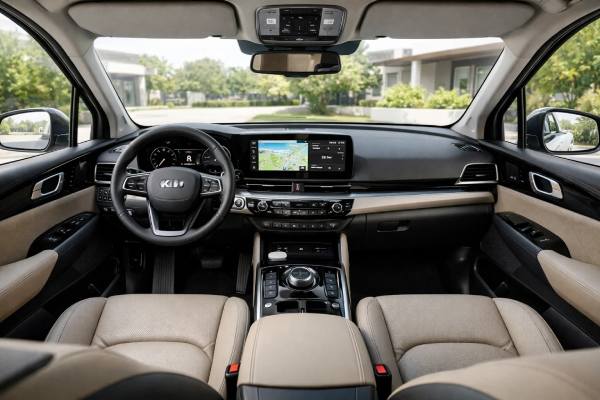

The 2025–present Kia Carnival (KA4 facelift) with the Smartstream 3.5-liter V6 is a modern “MPV with SUV cues” that prioritizes predictable power delivery, packaging efficiency, and family-grade durability over flashy performance. The 3.5 GDI+MPI setup matters: it blends direct injection for output with port injection support that can help reduce intake-valve deposit risk compared with DI-only designs. Paired with an 8-speed automatic and front-wheel drive, it is tuned to move a full cabin smoothly, not chase headline acceleration.
As an ownership proposition, the Carnival’s strengths show up in daily use: large door openings, flexible seating, and a long wheelbase that helps calm highway motion. The facelift-era safety story also improves, with structural updates noted by major test bodies for newer model years. The trade-off is simple: it is a big, heavy vehicle, and it rewards timely fluid service, brake attention, and realistic expectations for fuel use in city driving and under load.
Quick Specs and Notes
- Strong, smooth V6 output for a loaded cabin; no turbo heat or lag to manage.
- Long wheelbase and multi-link rear help ride comfort and straight-line stability.
- Safety performance improves for facelift-era testing, but equipment varies by trim and market.
- Expect city economy to drop noticeably with short trips, winter fuel blends, and full passenger loads.
- Plan engine oil service at 12 months or 12,000 km (7,500 mi) (or sooner for severe use).
Navigate this guide
- Kia Carnival KA4 facelift deep dive
- Kia Carnival KA4 3.5 specs table
- Kia Carnival KA4 trims and safety tech
- Reliability and known fixes
- Maintenance plan and buying tips
- Road feel and efficiency
- Rivals and best alternatives
Kia Carnival KA4 facelift deep dive
The facelift-era Carnival KA4 keeps the core formula—long wheelbase, sliding doors, three-row seating—but refines the “big vehicle, small stress” experience. With the 3.5-liter V6, the engineering priorities are easy to spot: steady torque, clean shift logic, and cooling capacity aimed at hot days with a full cabin. It is not a minivan that feels light; it is a minivan that feels controlled.
The V6’s character is an ownership advantage. Power arrives in a linear, naturally aspirated way, so the drivetrain is less dependent on turbo boost management and intercooler heat control when the vehicle is loaded. In day-to-day driving, that translates to fewer “surprises” when merging or climbing grades. It also means the Carnival tends to feel calmer under partial throttle than many smaller-displacement turbo competitors, especially at highway speeds.
Packaging is where the Carnival earns its keep. A long wheelbase reduces fore-aft pitching over highway undulations, and the rear multi-link suspension helps separate ride comfort from cargo and passenger load. The low step-in height and the sliding doors also change the ownership experience in ways spec sheets miss: easier child-seat loading, easier third-row access, and less door-ding anxiety in tight parking spaces.
The facelift period also ties into safety and structure. If you are shopping 2025 and newer specifically, you are not only choosing updated styling and infotainment; you are also selecting a model year range that major safety testing organizations recognize as having structural and restraint changes compared with earlier KA4 production runs.
Where owners need to stay realistic is operating cost physics. This is a large, tall, heavy vehicle with a V6, and the “easy power” comes with fuel consumption that can climb quickly in dense city use, short trips, winter conditions, or when towing. Tires, brakes, and alignment also matter more than on smaller crossovers, simply because there is more mass to manage.
A good way to frame the Carnival KA4 3.5 is this: it is built to carry people and gear with minimal drama, provided you treat it like the load-capable machine it is—service it on time, keep tires matched and properly inflated, and avoid ignoring early signs of brake vibration or transmission hesitation.
Kia Carnival KA4 3.5 specs table
Below are spec tables focused on the facelift-era Carnival KA4 with the 3.5-liter V6 (287 hp in some markets). Availability and exact figures can vary by region, emissions certification, and trim.
Powertrain and efficiency
| Item | Specification |
|---|---|
| Code | Smartstream 3.5 V6 (Lambda III family in many markets) |
| Engine layout and cylinders | V6, DOHC, 24 valves, hydraulic lash adjusters |
| Bore × stroke | 92.0 × 87.0 mm (3.62 × 3.43 in) |
| Displacement | 3.5 L (3,470 cc) |
| Induction | Naturally aspirated |
| Fuel system | GDI + MPI (direct injection plus multi-port injection) |
| Compression ratio | 12.3:1 |
| Max power | 287 hp (214 kW) @ 6,400 rpm |
| Max torque | 260 lb-ft (353 Nm) @ 5,000 rpm |
| Timing drive | Chain (typical for this engine family; verify by VIN/market) |
| Rated efficiency (example, EPA) | 11.2 L/100 km combined (21 mpg US / 25 mpg UK) |
| City / highway (example, EPA) | 13.1 / 9.0 L/100 km (18 / 26 mpg US) |
| Real-world highway @ 120 km/h (75 mph) | Commonly ~9.0–10.5 L/100 km (22–26 mpg US), load and wind dependent |
Transmission and driveline
| Item | Specification |
|---|---|
| Transmission | 8-speed automatic |
| Drive type | FWD |
| Differential | Open (traction managed via brake-based stability and traction control) |
| Key ratios (1st / 8th / final) | 4.808 / 0.648 / 3.510 |
Chassis and dimensions
| Item | Specification |
|---|---|
| Suspension (front / rear) | MacPherson strut / multi-link |
| Steering | Column-mounted electric power steering; ratio ~14.23:1 |
| Brakes (front / rear) | Ventilated disc / solid disc |
| Brake diameter | 325 mm (12.8 in) front and rear |
| Wheels and tyres (popular sizes) | 235/65 R17 (base) or 235/55 R19 (common upper trims) |
| Ground clearance | 173 mm (6.8 in) |
| Length / width / height | 5,156 mm / 1,994 mm / 1,740–1,775 mm (203.0 / 78.5 / 68.5–69.9 in) |
| Wheelbase | 3,091 mm (121.7 in) |
| Turning circle (kerb-to-kerb) | ~11.7 m (38.4 ft) in some markets; confirm for your trim/tyres |
| Kerb (curb) weight | ~2,066–2,181 kg (4,555–4,810 lb), trim dependent |
| GVWR | ~2,850 kg (6,283 lb) |
| Fuel tank | 72 L (19.0 US gal) |
| Cargo volume | SAE: 1,138 L (40.2 ft³) seats up, 4,109 L (145.1 ft³) max; VDA figures vary by market |
Performance and capability
Real-world performance is highly load-sensitive (passengers, cargo, tyre type, and grade). Use these as planning numbers, not guarantees.
| Item | Typical figure |
|---|---|
| Acceleration 0–100 km/h (0–62 mph) | Often mid-7s to low-8s seconds, depending on test method and load |
| Top speed | Usually electronically limited; market dependent |
| Braking distance 100–0 km/h | Strongly tyre-dependent; expect “minivan typical” rather than sporty |
| Towing capacity (braked / unbraked) | Up to 1,588 kg (3,500 lb) / 454 kg (1,000 lb) in some markets; check your certification label |
| Payload | Varies widely by trim and seating; verify door-jamb label |
Fluids and service capacities (verify by VIN and service literature)
Many official public spec sheets do not publish full service fill volumes. Use these as a checklist to confirm in the owner’s/service documentation for your exact vehicle.
| Item | What to confirm |
|---|---|
| Engine oil | Spec (often 0W-20 meeting current API/ILSAC requirements); capacity varies by market and service method |
| Coolant | Type/standard and premix ratio; total system capacity |
| Transmission fluid | OEM ATF spec for the 8-speed; service method (drain/fill vs full exchange) |
| Brake fluid | DOT rating and replacement interval |
| A/C refrigerant | Refrigerant type and charge mass from under-hood label (can vary by market/year) |
| Key torque specs | Drain plug, wheel lug torque, brake bracket bolts (use service manual values for safety) |
Safety and driver assistance (high level)
| Item | Notes |
|---|---|
| Crash ratings | IIHS publishes ratings that apply across multiple model years; see trim details below |
| ADAS suite | AEB (vehicle/pedestrian/cyclist), ACC, lane support, blind-spot functions, rear cross-traffic alerts; standard vs optional varies by trim/market |
| Headlight performance | Rating depends on headlamp type and trim; verify your exact configuration |
Kia Carnival KA4 trims and safety tech
Trims and equipment matter more on the Carnival than they do on many SUVs, because the vehicle can be configured around how a family actually uses it—eight seats for maximum people capacity, or a more premium second-row experience that treats the middle seats like a “captain’s chair lounge.” When comparing facelift-era KA4 trims, focus on functional differences, not just cosmetics.
Seating configurations and “how it lives”:
- 8-passenger layouts typically favor maximum flexibility. If you routinely carry three people in the second row, this is the practical pick.
- 7-passenger setups often add more comfort features in the second row, sometimes with “VIP lounge” style seats on higher trims. The trade-off is that the second row can become less convenient to remove or reconfigure, depending on the seat design.
- Look for easy identifiers: second-row controls (power functions), integrated ottomans/leg supports on premium seats, and whether the third row folds into the floor smoothly (a key usability trait in real life).
Infotainment and convenience packages:
Upper trims commonly bundle larger displays, upgraded audio, surround-view camera systems, and rear-seat entertainment options. These features tend to be reliable, but they increase the number of modules that can require software updates over time. If you plan long-term ownership, pick a configuration you will truly use rather than simply the most complex spec.
Mechanical and functional differences by trim:
The core drivetrain is generally consistent for the 3.5 V6, but wheels and tires change significantly. Moving from 17-inch to 19-inch wheels can sharpen steering response slightly, yet it can also increase replacement tire cost and make pothole impacts harsher. For mixed city use and long trips, the “middle wheel” choice often rides best.
Safety ratings and what they mean:
- IIHS (U.S.) ratings are particularly useful for U.S.-market shoppers because they separate structural crash performance from crash-avoidance tech. Some tests apply across multiple model years, and side-impact evaluations may be specific to facelift-era production. Ratings can also depend on headlight configuration and whether key crash-prevention features are standard.
- Euro NCAP ratings may not exist for every market version of the Carnival, and test results can be outdated if they refer to a different regional spec or earlier generation. Treat any non-matching test result with caution.
Airbags and child-seat practicality:
Expect multiple rows of airbags in well-equipped markets, including curtain airbags that cover rear seating positions. For families, also confirm:
- ISOFIX/LATCH position count and whether third-row anchors are available.
- Easy access to tether anchors and the routing of top-tether straps.
- The ability to fit rear-facing seats without forcing front-seat compromises (a major comfort factor on long drives).
ADAS calibration after service:
Any time the windshield is replaced, the front radar is disturbed, or the alignment is adjusted significantly, plan for ADAS calibration checks. Proper calibration protects two things: safety performance and your patience—poor calibration can trigger warnings, cause overly cautious braking, or create lane-keeping “tugging” that feels like a steering problem.
Reliability and known fixes
For the facelift-era Carnival KA4 with the 3.5 V6, “reliability” is best understood as a set of predictable wear points plus a smaller set of software or campaign updates. The goal for owners is not perfection; it is early detection and timely service so small issues do not become expensive ones.
Common vs occasional vs rare issues (what to watch)
Common (low to medium cost tier):
- Brake wear and vibration under load: A heavy, people-carrying vehicle is hard on front brakes, especially with city driving, hills, and frequent stops.
Symptoms: steering-wheel shake during braking, pulsation, or squeal.
Likely cause: pad deposits, rotor runout, or overheated friction material.
Remedy: proper pad bedding, rotor resurfacing or replacement, and ensuring caliper slides move freely. - Tire noise and uneven wear: Alignment drift and under-inflation show up quickly due to vehicle mass.
Symptoms: humming at highway speed, feathered tread, steering pull.
Remedy: alignment check, rotations on schedule, and replacing tires as a matched set when wear is uneven.
Occasional (medium cost tier):
- 8-speed shift quality complaints: Many modern automatics adapt to driving style. Short-trip use and frequent stop-and-go can make shifts feel busier than expected.
Symptoms: hesitation, flare, or harsh 2–3 shifts, especially when cold.
Likely causes: adaptive learning, fluid condition, or software calibration.
Remedy: check for updates first, then consider a fluid service if mileage and usage justify it. - Power door and sensor “gremlins”: Sliding doors, hands-free sensors, and liftgate systems are convenient, but they add switches and latches that can need adjustment.
Symptoms: intermittent closing, warning chimes, sensor mis-detection.
Remedy: latch alignment, cleaning sensor areas, and addressing weak 12 V battery health early.
Rare (higher cost tier):
- Cooling or accessory system leaks: Not common, but any leak on a hot-running, load-capable vehicle can escalate quickly.
Symptoms: coolant smell, overheating, visible residue, A/C performance drop.
Remedy: pressure testing, early hose or seal replacement, and correct coolant spec.
Software, campaigns, and service actions
A key facelift-era ownership theme is software logic. Manufacturers often release ECM or other module updates to refine emissions compliance, drivability, and diagnostic thresholds. When a campaign applies, it is usually the most cost-effective fix—sometimes the only official fix—for specific fault patterns. If you experience inconsistent idle quality, unusual readiness monitor behavior, or unexplained warning lights, checking for open campaigns should be step one before parts swapping.
Pre-purchase checks to request
- Full service history showing oil services at sensible intervals.
- Proof of completed campaigns/recalls (dealer printout or official VIN lookup result).
- Evidence of brake and tire maintenance (rotation records and alignment checks).
- A test drive with a fully warmed drivetrain, plus a few cold-start observations if possible.
- A scan for stored codes (even if the dash is clear), especially if shopping used.
The Carnival tends to reward owners who treat early warnings seriously. Catching a developing brake vibration, a weakening 12 V battery, or a calibration issue early usually costs far less than trying to “drive through it” until it becomes a failure.
Maintenance plan and buying tips
A practical maintenance plan for the Carnival KA4 3.5 V6 should match how the vehicle is actually used. Many Carnivals do short trips (school runs) mixed with heavy-load highway travel (family trips). That pattern is harder on oil, brakes, and the 12 V system than mileage alone suggests.
Practical service schedule (distance or time, whichever comes first)
Every 12 months or 12,000 km (7,500 mi) (shorten for severe use: frequent short trips, extreme heat/cold, towing)
- Engine oil and filter (confirm correct viscosity/spec for your market).
- Multi-point inspection: leaks, hoses, belt condition, and underbody checks.
- Tire rotation and pressure check; inspect for shoulder wear and cupping.
- Brake inspection (pads, rotor condition, caliper slide movement).
Every 24 months
- Cabin air filter (often sooner if dusty/pollen-heavy areas).
- Brake fluid condition check; replace if moisture is high or per schedule.
- A/C performance check and condenser cleaning if debris-prone driving is common.
Every 48 months (typical planning interval)
- Engine air filter (often sooner in dusty areas).
- Coolant strength and condition check; replace per official interval.
- Alignment check even if tires “look fine” (cheap compared with tire replacement).
At 100,000–160,000 km (60,000–100,000 mi) planning window
- Spark plugs (interval depends on plug type and market schedule).
- Consider transmission fluid service strategy: some markets treat it as “lifetime,” but many long-term owners benefit from periodic drain-and-fill service, especially with towing or heavy city use.
Timing components (chain guidance):
The V6 generally uses a chain. Chains do not have a fixed “replace at X miles” interval like belts, but they should be monitored. If you ever see correlation faults, cold-start rattle, or persistent timing-related codes, treat it as a diagnostic priority.
Ownership-focused fluid and parts choices
- Use the OEM-recommended oil spec and keep intervals conservative if your driving is mostly short trips.
- Use quality brake pads matched to your driving (quiet touring pads for family use; avoid overly aggressive compounds that dust heavily).
- Replace tires in matched sets and keep them properly inflated. A “slightly low” tire on a heavy vehicle can wear out fast.
Buyer’s guide: what to inspect
Exterior and chassis
- Uneven panel gaps around sliding doors (signs of prior damage or poor adjustment).
- Door tracks and rollers for smooth motion and low noise.
- Underbody scrapes near the front bumper and mid-floor (ground clearance is modest).
Powertrain
- Smooth cold start, steady idle, and consistent shifting once warm.
- No coolant odor or dried residue at hose connections.
Cabin electronics
- Every seat and belt buckle warning should behave correctly.
- Check power doors, liftgate, parking sensors, cameras, and driver-assist features without warning messages.
Best long-term picks (general guidance)
For long ownership, many buyers do best with a mid-to-upper trim that has the safety tech they want but avoids the most complex second-row seating if they frequently reconfigure the cabin. If your family needs maximum flexibility, prioritize the configuration that makes the second and third rows easiest to use daily. Convenience that goes unused is not value.
Road feel and efficiency
The Carnival KA4 3.5 is at its best when you drive it like a refined transporter: smooth throttle, planned braking, and steady highway pacing. That aligns with the vehicle’s fundamental strengths—long wheelbase stability and a V6 that does not need to “spool up” to deliver usable power.
Ride, handling, and NVH (noise, vibration, harshness)
Ride quality: The long wheelbase and rear multi-link suspension help the Carnival avoid the choppy, busy motion some crossovers develop on rough highways. Even on larger wheels, it generally stays composed over expansion joints, though 19-inch tire packages can transmit sharper impacts on potholes.
Steering and stability: The steering is tuned for ease rather than feedback. You should expect light-to-moderate effort with a stable on-center feel, which helps on long trips and in crosswinds. In tight urban turns, the Carnival feels large, but it is predictable—an important trait when the cabin is full of passengers.
Braking feel: Pedal feel is typically confidence-inspiring for a family vehicle, but braking consistency depends heavily on pad choice and whether the vehicle is repeatedly asked to slow down from speed with a heavy load. If you live in hilly areas or tow, treat brake inspections as routine, not optional.
Cabin noise: At steady highway speeds, wind and tire noise are often more noticeable than engine sound, because the V6 is not working hard. Tire choice, tread wear, and alignment can change cabin noise dramatically over time.
Powertrain character
The 3.5 V6 delivers its effort in a straightforward way: build revs, build speed, and keep the cabin calm. The 8-speed automatic usually blends into the background when driven smoothly. Under aggressive throttle, you may feel multiple downshifts, but it is rarely abrupt. In mixed driving, the “sweet spot” is using the V6’s midrange rather than forcing full-throttle kickdowns.
Drive modes (where fitted) typically adjust throttle mapping and shift timing. For most owners, a normal or eco-oriented mode provides the smoothest family experience; sport mode can be useful when merging in heavy traffic, but it can also increase shift activity that feels less relaxed.
Real-world efficiency
Expect the biggest gap between rating and reality in three situations:
- Short trips: the engine spends more time warming up, and fuel economy suffers.
- High speeds: pushing a large frontal area through air costs fuel quickly.
- Full loads: passengers, cargo, roof boxes, and towing add meaningful demand.
As a planning reference for many drivers:
- Highway cruising can be reasonable if speeds are moderate and tires are in good condition.
- City use is where fuel economy can disappoint, especially with stop-start traffic and heavy A/C demand.
Load and towing notes
When towing within rated limits, stability is usually the stronger point; fuel use is the penalty. Plan for a noticeable consumption increase and pay attention to:
- Tire pressures (including the trailer).
- Brake condition before towing season.
- Cooling system health and clean airflow through the radiator/condenser stack.
If you want the Carnival to feel “effortless,” keep it maintained like a working vehicle. The engineering can handle family duty well, but it responds best to consistent upkeep.
Rivals and best alternatives
The Carnival’s closest rivals tend to fall into two categories: traditional minivans built around family practicality and three-row crossovers that sacrifice sliding-door ease for SUV styling. Your best alternative depends on what you value most.
If you want maximum family practicality
Honda Odyssey: Often the benchmark for interior ergonomics and day-to-day cleverness. If you value easy second-row access, strong resale, and a long history of minivan-focused design, it remains compelling. The trade-off is that some buyers prefer the Carnival’s newer tech packaging and styling approach.
Toyota Sienna (hybrid-only in many markets): The efficiency play. If your driving is mostly city and mixed commuting, the Sienna’s hybrid system can save significant fuel over time. The trade-off is a different power delivery feel (eCVT-style behavior) and potentially higher complexity in electrified components, though Toyota’s hybrid track record is strong.
Chrysler Pacifica: Often offers useful family features and available plug-in hybrid variants in some markets. It can be a great fit if you want EV-like around-town driving (for PHEV users) and don’t mind managing charging. The trade-off is that long-term reliability perceptions vary, so the “buy the best-maintained example” rule matters even more.
If you’re cross-shopping three-row SUVs
A three-row SUV can make sense if you regularly travel on rough roads, want available AWD systems (market dependent), or simply prefer SUV seating height and cargo access. However, SUVs rarely match a minivan’s sliding-door convenience, third-row access, or low-effort child-seat loading.
The Carnival’s key competitive advantage is not a single spec number—it is how the whole package works when life is messy: strollers, groceries, child seats, grandparents, and long highway days. If that is your world, the Carnival remains one of the most rational “big family vehicle” choices, especially with the predictable V6 power delivery.
Quick comparison guidance
- Pick the Carnival 3.5 if you want smooth, conventional power and a modern interior with flexible seating.
- Pick the Sienna hybrid if fuel savings and city efficiency are top priority.
- Pick the Odyssey if you want proven minivan usability with a strong ownership ecosystem.
- Pick a three-row SUV only if you truly need SUV-specific traits (certain AWD systems, ground clearance, or a preferred body style), and you accept the door-access trade-offs.
References
- 2025 Kia Carnival Specifications 2025 (Manufacturer Specifications) ([Kia Media][1])
- Gas Mileage of 2025 Kia Carnival 2025 (Fuel Economy Database) ([Fuel Economy][2])
- 2025 Kia Carnival 2025 (Safety Rating) ([IIHS Crash Testing][3])
- Check for Recalls: Vehicle, Car Seat, Tire, Equipment | NHTSA 2026 (Recall Database) ([NHTSA][4])
- ATTENTION: ALL DEALER PARTS & SERVICE MANAGERS 2025 (Service Campaign Document)
Disclaimer
This article is for informational purposes only and is not a substitute for professional inspection, diagnosis, or repair. Specifications, torque values, service intervals, and procedures can vary by VIN, market, production date, and equipment. Always verify details using the official owner’s manual and factory service documentation for your exact vehicle, and consult a qualified technician when safety or drivability is involved.
If this guide helped you, consider sharing it on Facebook, X (Twitter), or your favorite forum to support our work.