

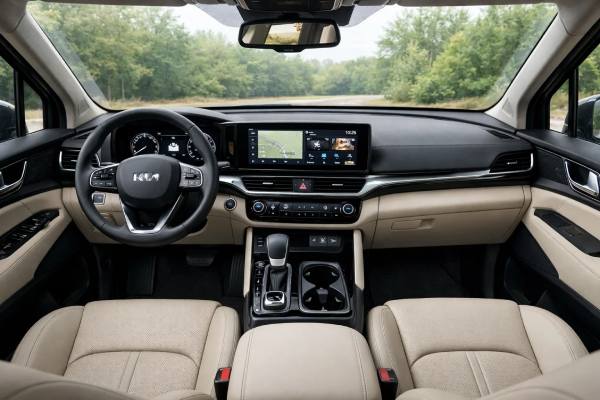

The Kia Carnival (KA4) with the Smartstream G3.5 V6 is the “do-it-all” people mover for owners who want minivan practicality without giving up strong highway performance. From 2021 through 2024, this 290 hp, naturally aspirated 3.5-liter V6 pairs with an 8-speed automatic and front-wheel drive to deliver confident passing power, predictable behavior under load, and a towing rating that’s useful for small campers or utility trailers. The engineering story is less about one standout number and more about balance: a roomy cabin, clever seat configurations, and modern active-safety tech wrapped around a straightforward gasoline powertrain.
If you’re shopping used, the big questions are trim content (because features swing widely), sliding-door and infotainment behavior, and whether the vehicle has had recall work completed. This guide focuses on the KA4 V6 specifically, with practical ownership notes.
Owner Snapshot
- Strong, smooth V6 power for full-family highway trips and confident merging.
- Flexible seating and cargo space that make it work like a family shuttle or a weekend hauler.
- Higher trims add meaningful comfort and safety tech, not just cosmetic upgrades.
- Plan for intake-valve carbon and more frequent oil service if you do mostly short trips.
- Oil and filter service is typically every 12 months or 12,000 km (7,500 mi) in normal use; shorten for severe duty.
Navigate this guide
- Kia Carnival KA4 3.5 explained
- Kia Carnival KA4 key specifications
- Kia Carnival KA4 trims and safety tech
- Reliability patterns and recalls
- Maintenance plan and buying tips
- Road feel and real economy
- Rivals and best alternatives
Kia Carnival KA4 3.5 explained
The KA4-generation Carnival is built around a simple promise: minivan functionality with a more SUV-like look and a powertrain that doesn’t feel strained when loaded. In 2021–2024 V6 form, you get a 3.5-liter Smartstream gasoline V6 rated at 290 hp, driving the front wheels through an 8-speed automatic. There’s no turbocharger to manage and no hybrid system to learn—just a large-displacement engine tuned for smoothness and consistent output.
That matters in everyday use. A fully occupied minivan is heavy, and the Carnival’s V6 keeps the power delivery predictable when you’re merging onto motorways, climbing long grades, or running the air conditioning hard in summer. It’s also a better match for occasional towing than smaller turbo engines that can generate a lot of heat under sustained load. The Carnival’s towing capability (when properly equipped) makes it realistic to pull small camping trailers or utility loads without turning the drivetrain into a constant high-stress situation.
From a packaging standpoint, the Carnival’s biggest advantage is how “square” the usable space is. Cargo behind the third row is genuinely practical for strollers and groceries, and with rows folded, you can carry bulky items that would defeat most three-row SUVs. The sliding doors are the real lifestyle feature—tight parking spaces, school drop-offs, and child seats are simply easier.
For buyers, the KA4 V6 sweet spot is often about trim selection rather than chasing a specific year. Many reliability and day-to-day satisfaction issues come down to equipment: powered door mechanisms, seat track complexity, wheel size, and driver-assistance sensors. A clean service history and completed recall work often matter more than a one-year difference in build date.
Kia Carnival KA4 key specifications
Below are V6-focused specs that owners and buyers actually use. Values can vary slightly by market, VIN, and trim; treat them as a strong baseline and verify for your exact vehicle.
Powertrain and efficiency (V6)
| Item | Specification |
|---|---|
| Engine code (market naming) | Smartstream G3.5 (Lambda III family in some references) |
| Layout and cylinders | V6, DOHC, 24 valves, hydraulic lash adjusters |
| Displacement | 3.5 L (3,470 cc) |
| Bore × stroke | 92.0 × 87.0 mm (3.62 × 3.43 in) |
| Induction | Naturally aspirated |
| Fuel system | GDI + MPI (direct + multi-port injection) |
| Compression ratio | 12.3:1 |
| Max power | 290 hp (216 kW) @ 6,400 rpm |
| Max torque | 355 Nm (262 lb-ft) @ 5,000 rpm |
| Timing drive | Chain (typical for this V6 family; confirm by engine variant) |
| Fuel | Regular unleaded (87 AKI or higher, where applicable) |
Transmission and driveline
| Item | Specification |
|---|---|
| Transmission | 8-speed automatic |
| Drive type | FWD |
| Differential | Open (traction controlled via brake-based systems) |
Dimensions, weights, and capacities
| Item | Specification |
|---|---|
| Length | 5,155 mm (203.0 in) |
| Width | 1,995 mm (78.5 in) |
| Height | 1,740 mm (68.5 in) |
| Wheelbase | 3,090 mm (121.7 in) |
| Ground clearance | 172 mm (6.8 in) |
| Turning circle (kerb-to-kerb) | 11.9 m (39.0 ft) |
| Curb weight | 1,981–2,143 kg (4,368–4,723 lb) |
| GVWR | 2,730 kg (6,018 lb) |
| Fuel tank | 72 L (19.0 US gal) |
Cargo volume (typical U.S.-style figures)
| Configuration | Volume |
|---|---|
| Behind 3rd row | 1,139 L (40.2 ft³) |
| Behind 2nd row | 2,405 L (84.9 ft³) |
| Max (behind 1st row) | 4,110 L (145.1 ft³) |
Brakes, wheels, and tires (common fitments)
| Item | Specification |
|---|---|
| Brakes (front/rear) | 17 in / 16 in discs (approx. 432 / 406 mm) |
| Common tire sizes | 235/65R17, 235/60R18, 235/55R19 |
| Spare | Compact spare common; confirm by trim/market |
Performance and capability (owner-relevant)
| Item | Specification |
|---|---|
| Towing capacity (braked) | Up to 1,587 kg (3,500 lb) when properly equipped |
| Payload | Varies by trim and equipment; check door-jamb label |
Fluids and service capacities (decision-level)
These can vary by exact engine/transmission variant and market. Use them as a planning guide.
| Fluid | Spec (typical) | Capacity (typical) |
|---|---|---|
| Engine oil | Full synthetic; viscosity commonly 0W-20 or 5W-30 depending on market and climate | ~6.2 L (6.6 US qt) |
| Coolant | Ethylene glycol-based, long-life; typically 50/50 mix | ~10.0 L (10.6 US qt) |
| Automatic transmission | Manufacturer ATF spec required | ~8.3 L (8.8 US qt) |
Key torque specs (practical “check-first” items):
These are commonly in the right neighborhood for modern Kia/Hyundai platforms, but always verify for your VIN/service manual before final tightening.
| Fastener | Typical torque range |
|---|---|
| Wheel lug nuts | 90–110 Nm (66–81 lb-ft) |
| Engine oil drain plug | 35–45 Nm (26–33 lb-ft) |
Kia Carnival KA4 trims and safety tech
Trim strategy is where the Carnival can feel like two different vehicles. The KA4 V6 remains the same basic drivetrain, but your ownership experience changes with door hardware, seating layouts, and driver-assistance equipment.
Trims and options (typical structure)
Many markets use a ladder that starts with an entry grade (often “LX” or equivalent), then mid grades (EX), and higher trims (SX, SX Prestige). The names vary by country, but the content pattern is consistent:
- Entry and mid trims: Best value for durability-focused buyers. You typically get the core family features—sliding doors, strong HVAC, practical infotainment—without every motorized mechanism. Fewer powered seat functions can mean fewer high-cost failures later.
- Upper trims: Add the comfort and convenience people actually notice daily: upgraded audio, more camera views, power tailgate, ventilated seats, extra driver-assistance sensors, and bigger wheels. This is where the Carnival becomes a long-distance family cruiser.
Seating configurations and “quick identifiers”
Look for these fast checks when viewing a used example:
- Second-row layout: Some versions use removable captain’s chairs; others have a bench. The more complex the seat (power adjustments, ottomans, swivels in some markets), the more you should inspect operation.
- Door behavior: Powered sliding doors should open smoothly, quietly, and consistently. Jerky movement, loud clicking, or reversing mid-close often points to track wear, cable/actuator strain, or sensor alignment issues.
- Wheel size: 19-inch wheels look great but can raise tire costs and make ride quality harsher on broken pavement.
Safety ratings and what they mean
Safety results depend on region and test protocols. In North America, the Carnival has published crash-test information through common rating systems for some model years and trims. If you’re shopping used, confirm the exact year and the test version used—rating bodies update their tests, and the same “star” or “grade” label may not be equivalent across years.
Safety systems and driver assistance (ADAS)
Carnival safety tech generally falls into three buckets:
- Always-there basics: multiple airbags, stability control, traction control, ABS with electronic brake distribution, and child-seat anchors (LATCH/ISOFIX) across both outboard second-row seats (and sometimes third-row anchors depending on market).
- Camera and radar features: forward collision avoidance (AEB), blind-spot monitoring, rear cross-traffic alert, lane keeping assistance, and adaptive cruise control. These are often standard or widely available, but the exact package changes by trim and year.
- Calibration-sensitive systems: lane cameras, front radar, and surround-view cameras can require calibration after windshield replacement, bumper work, or suspension alignment. Budget time and money for correct calibration if repairs were done cheaply.
Practical takeaway: choose the trim whose features you will actually use, then inspect those systems carefully. A loaded trim is excellent when it’s working perfectly, but it’s also the one that punishes deferred maintenance and low-quality repairs.
Reliability patterns and recalls
The Carnival KA4 V6 is generally a straightforward vehicle mechanically, but reliability depends heavily on usage profile (short trips vs. long highway runs), how well sliding doors and electronics are maintained, and whether recall work has been completed.
Common, occasional, and rare issues (with cost tiers)
Common (low to medium cost):
- Infotainment glitches: random reboots, slow response, Bluetooth dropouts, or camera delay.
Symptoms → cause → remedy: lagging screen or intermittent connection → software bugs or low-voltage sensitivity → update software, check 12V battery health, inspect grounds. - Sliding door track contamination: gritty movement or squeaks.
Symptoms → cause → remedy: noisy rollers or stiff travel → dirt and dried lubricant in track → clean and apply correct lubricant; inspect rollers for flat spots.
Occasional (medium cost):
- Power sliding door motor/cable strain: especially if doors are forced or tracks are dirty.
Symptoms → cause → remedy: door reverses mid-close, beeps, struggles uphill → high drag, worn rollers, weak motor/cable → service track first; replace worn hardware if needed. - Brake vibration on heavier trims: bigger wheels, heavier curb weight, and lots of city braking can accelerate rotor wear.
Symptoms → cause → remedy: steering shake under braking → rotor thickness variation/pad deposits → proper bed-in, rotor resurfacing/replacement, check caliper slide pins.
Rare to occasional (higher cost):
- Direct-injection carbon buildup: even with added MPI, long oil intervals and short trips can still encourage deposits on intake valves over time.
Symptoms → cause → remedy: rough idle, misfires, reduced response → intake valve deposits or PCV/oil vapor management → cleaning service (walnut blasting where applicable), ensure PCV system is healthy, shorten oil intervals. - Cooling system seepage: aging hoses/clamps, thermostat housing, or radiator end tanks can seep with time and heat cycles.
Symptoms → cause → remedy: sweet smell, low coolant, crusty residue → minor leak → pressure test, repair early to prevent overheating.
Mileage and age bands
- 0–60,000 km (0–40k mi): software and trim-related issues dominate (infotainment, sensor alignment, door behavior).
- 60,000–120,000 km (40k–75k mi): brakes, suspension bushings, door hardware wear, and battery aging become more noticeable.
- 120,000 km+ (75k+ mi): maintenance discipline separates good examples from expensive ones: cooling system integrity, transmission fluid condition, and engine deposit control matter more.
Recalls, service actions, and how to verify
Recalls and service campaigns vary by country. The safest approach is process-based:
- Run the VIN through your region’s official recall lookup (or the manufacturer’s portal).
- Ask for dealer service history showing recall completion dates.
- Physically inspect: some recall repairs leave updated part markings or revised fasteners.
If a seller can’t document recall completion, treat it as a negotiation point and assume you’ll schedule a dealer visit immediately after purchase.
Maintenance plan and buying tips
The Carnival’s V6 doesn’t demand exotic care, but it does reward consistency. The goal is to control heat, deposits, and wear in a heavy vehicle that often lives a stop-and-go life.
Practical maintenance schedule (distance and time)
Use this as a solid baseline; follow the stricter “severe use” cadence if you do short trips, heavy city driving, dusty roads, frequent idling, or towing.
- Engine oil and filter: every 12 months or 12,000 km (7,500 mi); severe use: 6 months or 8,000 km (5,000 mi).
- Engine air filter: inspect every oil service; replace about 24,000–48,000 km (15k–30k mi) depending on dust.
- Cabin air filter: every 12 months or 15,000 km (9k–10k mi) for best HVAC performance.
- Coolant: typically every 5 years or 100,000–160,000 km (60k–100k mi) depending on coolant type and market schedule.
- Brake fluid: every 2 years, regardless of mileage (moisture control is the point).
- ATF (8-speed automatic): inspect condition regularly; consider service around 96,000–120,000 km (60k–75k mi) earlier if towing or heavy city use.
- Spark plugs: often 160,000 km (100k mi) on modern V6 designs, but confirm for your exact plug type and market schedule.
- Serpentine belt and hoses: inspect annually after ~5 years; replace when cracking or glazing appears.
- Tires: rotate every 10,000–12,000 km (6k–7.5k mi); align annually or with uneven wear.
- 12V battery: test annually after year 3; replacement window is often 4–6 years depending on climate and power-door use.
Fluids: what matters in the real world
- Use the correct oil spec and viscosity for your region. A thinner oil can help efficiency; a slightly thicker grade may be recommended in hotter climates or specific markets. Don’t guess—match the spec.
- Transmission fluid: avoid universal fluids unless explicitly approved for the spec. Shift quality and clutch life depend on friction characteristics.
- Coolant: mixing incompatible coolant types can shorten corrosion protection. If you must top up, use compatible coolant or distilled water temporarily, then correct it properly.
Buyer’s guide: inspection checklist
Bring a flashlight, spend 30 minutes, and focus on the expensive-to-fix items:
- Sliding doors: open/close repeatedly (manual and powered). Listen for grinding, clicking, or reversing. Check track alignment and roller smoothness.
- Tailgate: power liftgate should lift consistently and latch without repeated tries.
- Cooling system: look for dried residue around radiator end tanks, hose joints, and thermostat housing.
- Transmission behavior: smooth shifts, no harsh engagement into Drive/Reverse, and no shudder under light acceleration.
- Brakes and tires: uneven tire wear suggests alignment or suspension bushing wear.
- ADAS warnings: any warning lights for radar/camera systems can mean costly sensor or calibration issues.
- Interior electronics: test every seat switch, USB port, rear HVAC control, camera view, and parking sensor.
Durability outlook: A well-maintained KA4 V6 can be a long-term family workhorse. The big risk isn’t a fragile engine—it’s neglect: overdue fluids, dirty door tracks, and ignored warning lights that turn small issues into expensive ones.
Road feel and real economy
A minivan’s job is to feel calm, even when life isn’t. The Carnival largely succeeds: it’s stable at speed, predictable in corners, and tuned to keep passengers comfortable rather than “sporty.”
Ride, handling, and NVH (noise, vibration, harshness)
- Ride quality: On 17- or 18-inch wheels, the Carnival absorbs rough pavement well for the class. The 19-inch setups look premium but transmit more sharp impacts and can make potholes feel louder.
- Straight-line stability: The long wheelbase helps it track confidently on the motorway, even with crosswinds and a full load.
- Steering feel: Light and accurate, prioritizing easy parking over feedback. The turning circle is respectable for a vehicle of this size, and visibility is good once you learn the corners.
- Cabin noise: The V6 stays smooth at cruise, and the 8-speed tends to hold a steady gear on mild grades. Wind noise and tire roar depend heavily on tire brand and door seal condition.
Powertrain character
The Smartstream 3.5 V6 is tuned for linear response. There’s no turbo lag; instead, it builds power progressively as revs climb. Passing power is strong, and the transmission typically downshifts cleanly when you ask for acceleration. Under heavy load (full passengers, cargo, and A/C), it may hold lower gears longer—normal behavior to manage heat and maintain speed.
Real-world fuel economy
Expect economy that’s reasonable for a large V6 minivan, with the usual caveat: short trips and cold weather hurt consumption.
Typical U.S.-style ratings for the V6 FWD are commonly around:
- City: ~12.4 L/100 km (19 mpg US)
- Highway: ~9.0 L/100 km (26 mpg US)
- Combined: ~10.7 L/100 km (22 mpg US)
With a 72 L (19.0 gal) tank, a realistic mixed-range target is often 600–700 km (370–435 mi) depending on speed, temperature, and load.
Towing and load behavior
When properly equipped up to 1,587 kg (3,500 lb), the Carnival is well suited to light towing:
- It stays stable if you load the trailer correctly (tongue weight matters).
- Braking confidence depends on trailer brakes and proper setup—use them.
- Expect a noticeable fuel penalty under tow. A 15–30% increase in consumption is common with moderate towing; more if you tow at high speed or into headwinds.
The practical bottom line: the Carnival V6 feels relaxed doing family work. Treat it like the heavy vehicle it is—keep tires, brakes, and fluids fresh—and it will reward you with a stress-free drive.
Rivals and best alternatives
The Carnival KA4 V6 sits in a competitive sweet spot: it’s newer-feeling than some long-running rivals, but it competes against strong “known quantities” with deep ownership histories. Here’s how it typically stacks up.
Versus Honda Odyssey
- Why choose Carnival: fresh design, strong feature value on higher trims, very usable cargo space.
- Why choose Odyssey: long-established minivan benchmark for packaging and everyday refinement; widely understood service profile.
- Decision tip: pick the one with the better maintenance history and the trim you actually want—both can be excellent family vehicles.
Versus Toyota Sienna (hybrid)
- Why choose Carnival: simpler non-hybrid system for owners who prefer conventional drivetrains; strong V6 passing power; towing is straightforward.
- Why choose Sienna: hybrid efficiency advantage is substantial for high-mileage commuters and city-heavy driving.
- Decision tip: if fuel cost and city use dominate, hybrid wins; if highway load and towing matter, the V6 Carnival remains compelling.
Versus Chrysler Pacifica
- Why choose Carnival: strong value, modern interior design, and a generally straightforward V6/8AT combination.
- Why choose Pacifica: available plug-in hybrid option in some markets and clever seating concepts.
- Decision tip: evaluate reliability history carefully on any used minivan—buy the cleanest, best-documented example, not just the best-looking deal.
Versus three-row SUVs
If you’re cross-shopping SUVs, the Carnival’s advantages are practical:
- Sliding doors in tight spaces
- Lower step-in height for kids and older passengers
- Better “boxy” cargo space for strollers and bulky items
- Often a smoother ride due to minivan-focused tuning
SUVs can win on AWD availability and off-pavement confidence, but most families rarely use those strengths day-to-day.
Best-fit summary: The Carnival KA4 V6 is strongest for families who prioritize space, predictable performance, and modern features—and who want a minivan that doesn’t feel underpowered when life gets heavy.
References
- 2024 Kia Carnival Specifications 2024 (Specifications)
- Find and Compare Cars 2024 (Fuel Economy and Safety)
- 2024 Kia Carnival minivan 2024 (Safety Rating)
- Part 573 Safety Recall Report 24V-025 2024 (Recall Database)
- Recommended lubricants and capacities 2024 (Owner’s Manual)
Disclaimer
This article is for informational purposes only and is not a substitute for professional inspection, diagnosis, or repair. Specifications, torque values, service intervals, fluids, and procedures can vary by VIN, market, model year, and equipment. Always verify details using your official owner’s manual, factory service information, and manufacturer updates for your exact vehicle.
If you found this guide useful, please consider sharing it on Facebook, X (Twitter), or your favorite forum to support our work.