
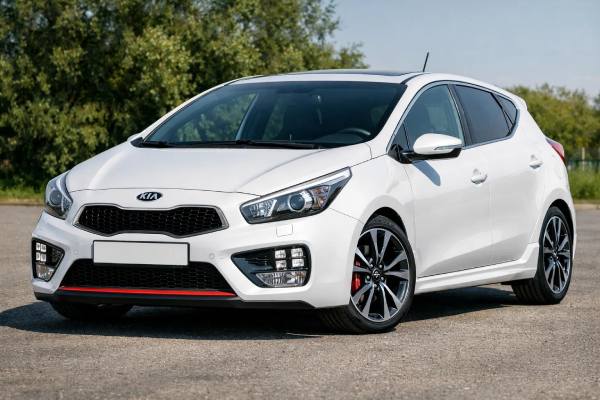

The Kia Cee’d GT (JD) is a rare kind of warm hatch: quick enough to feel special, mature enough to live with every day, and practical enough to justify as an only car. Its 1.6-litre turbocharged GDI engine (Gamma II T-GDi) delivers strong mid-range torque, so it feels eager in real traffic without demanding high rpm. Kia also used the GT to sharpen the chassis—stiffer springs and dampers, stronger brakes, and stickier 18-inch tyres—while keeping the cabin civil and the luggage space intact.
For owners, the big story is how a direct-injection turbo petrol behaves over time: it rewards clean oil, good fuel, and sensible warm-up habits. If you buy wisely and maintain it proactively, a Cee’d GT can be a durable, entertaining alternative to the usual hot-hatch shortlist—often with lower running costs and fewer “track toy” compromises.
Owner Snapshot
- Strong mid-range pull and easy overtakes, even with passengers and luggage.
- Practical five-door hatch packaging with everyday comfort still intact.
- Generally solid core mechanicals if serviced on time with the correct oil.
- Direct-injection turbo can develop intake carbon build-up on frequent short trips.
- Change engine oil every 10,000–12,000 km (6,000–7,500 mi) or 12 months for best long-term health.
Guide contents
- Kia Cee’d GT JD in focus
- Kia Cee’d GT 1.6 T-GDi specs
- Kia Cee’d GT trims and safety tech
- Reliability hotspots and recalls
- Maintenance plan and buyer advice
- Driving character and efficiency
- GT rivals and alternatives
Kia Cee’d GT JD in focus
Think of the Cee’d GT (JD) as a “grown-up” performance hatch: it is tuned to feel fast and confident on real roads, not only at the limit. The 1.6 T-GDi engine gives it the character most owners notice first. Peak torque sits in the mid-range, so you do not need to wring it out to make progress. That matters in daily use—slip roads, overtakes, and hilly roads feel effortless, and the car stays relaxed at motorway speeds.
Kia’s GT changes are not cosmetic only. The suspension and steering were revised to support higher cornering loads, with firmer damping and springs, and the GT typically rides on wider, lower-profile tyres. Compared with a standard Cee’d, you get sharper turn-in and stronger braking confidence, but you also inherit a firmer ride over broken surfaces. On the right tyres and alignment, it feels planted and stable; on cheap tyres or worn bushes, it can feel edgy and noisy.
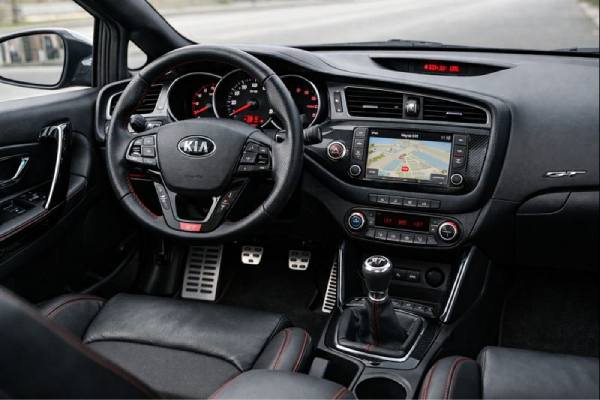
Inside, the GT leans toward a supportive, driver-focused layout rather than a hardcore cockpit. Deeply bolstered front seats help on long drives and spirited runs, and the instrument cluster and trim details signal that it is the performance model without feeling boy-racer. Importantly, you still keep the practical stuff: usable rear seats, a proper boot, and straightforward ergonomics.
Ownership is mostly about managing “modern turbo petrol” realities. Direct injection (GDI) improves efficiency and response, but it can allow intake-valve carbon build-up over time—especially on short journeys where the engine rarely gets fully hot. Turbocharged engines also respond best to fresh oil and careful warm-up. If you treat it like a regular commuter appliance, you may face more deposits, more heat-stress on fluids, and more small faults. Treat it like a performance car that happens to be practical, and it usually returns the favour.
Kia Cee’d GT 1.6 T-GDi specs
The figures below focus on the 2013–2015 Cee’d GT (JD) hatchback with the 1.6 T-GDi petrol engine and 6-speed manual. Some values vary by market, wheel/tyre package, and equipment, so use them as a decision guide and verify by VIN when ordering parts.
Powertrain and efficiency
| Item | Specification |
|---|---|
| Code | Gamma II 1.6 T-GDi (commonly referenced as G4FJ in many markets) |
| Engine layout and cylinders | I-4, DOHC, 16 valves (4 valves/cyl), CVVT |
| Bore × stroke | 77.0 × 85.4 mm (3.03 × 3.36 in) |
| Displacement | 1.6 L (1,591 cc) |
| Induction | Turbocharged (single turbo) |
| Fuel system | GDI (gasoline direct injection) |
| Compression ratio | ~9.5:1 (market dependent) |
| Max power | 201 hp (150 kW) @ ~6,000 rpm |
| Max torque | 265 Nm (195 lb-ft) @ ~1,750–4,500 rpm |
| Timing drive | Chain |
| Rated efficiency (combined) | ~7.4 L/100 km (≈32 mpg US / 38 mpg UK), market dependent |
| Real-world highway @ 120 km/h | ~7.5–8.3 L/100 km (≈28–31 mpg US / 34–38 mpg UK) in mild weather |
Transmission and driveline
| Item | Specification |
|---|---|
| Transmission | 6-speed manual |
| Drive type | FWD |
| Differential | Open (traction control uses brake-based intervention) |
Chassis and dimensions
| Item | Specification |
|---|---|
| Suspension (front/rear) | MacPherson strut / independent rear (multi-link layout in many EU specs) |
| Steering | Electric power assist (rack-and-pinion) |
| Brakes | 4-wheel discs (front typically ventilated) |
| Wheels/tyres (popular GT fitment) | 225/40 R18 (18 in rim) |
| Length / width / height | ~4,310 / 1,780 / 1,450 mm (169.7 / 70.1 / 57.1 in) |
| Wheelbase | ~2,650 mm (104.3 in) |
| Turning circle | ~10.6 m (34.8 ft), market dependent |
| Kerb weight | ~1,350–1,420 kg (2,976–3,131 lb), equipment dependent |
| Fuel tank | ~53 L (14.0 US gal / 11.7 UK gal) |
| Cargo volume | ~380 L seats up / ~1,300 L seats down (method varies by market) |
Performance and capability
| Item | Typical figure |
|---|---|
| 0–100 km/h (0–62 mph) | ~7.7 s |
| Top speed | ~230 km/h (143 mph) |
| Braking 100–0 km/h | ~36–38 m (varies by tyres and test method) |
| Towing capacity | Market dependent; often ~1,200–1,500 kg braked / ~600 kg unbraked |
| Payload | Typically ~450–550 kg (varies by spec and GVWR) |
Fluids and service capacities (decision-level guidance)
| Fluid | Typical specification |
|---|---|
| Engine oil | ACEA A5/B5 or C3 (market dependent); common viscosities: 5W-30 or 5W-40; capacity ~4.0 L (≈4.2 US qt) with filter |
| Coolant | Long-life OAT type; mix typically 50/50; capacity often ~5.5–6.5 L (varies) |
| Manual gearbox oil | Usually 75W-85 GL-4; capacity often ~1.8–2.1 L |
| A/C refrigerant | R134a; charge varies by system (commonly ~450–550 g) |
Key torque specs (critical fasteners only, verify by service manual)
| Fastener | Typical torque |
|---|---|
| Wheel nuts | ~88–108 Nm (65–80 lb-ft), wheel dependent |
| Engine oil drain plug | ~35–45 Nm (26–33 lb-ft) |
| Spark plugs | ~18–25 Nm (13–18 lb-ft), plug design dependent |
Safety and driver assistance (typical for the era)
| Item | Notes |
|---|---|
| Crash ratings | Euro NCAP: 5 stars (Cee’d family test generation for this era) |
| Core systems | ESC, ABS, EBD, traction control, hill-start assist (market dependent) |
| ADAS | Limited by modern standards; some markets offered city-braking style systems later, but many 2013–2015 cars rely mainly on stability and traction systems |
Kia Cee’d GT trims and safety tech
The Cee’d GT range is usually simple: you are buying the performance model rather than navigating dozens of engines and gearboxes. In most European markets of 2013–2015, the GT identity is delivered through a consistent mechanical package (1.6 T-GDi + 6-speed manual + sport chassis) and then you choose equipment and appearance options.
Trims and options that matter
Common GT identifiers include the dual exhaust outlets, more aggressive bumpers, larger alloy wheels (often 18-inch), and GT badging. Inside, heavily bolstered front seats are the quickest giveaway, along with sport-style cluster graphics and trim accents.
Options and equipment to pay attention to when buying used:
- Seat type and condition: Many cars came with deep-bolster sport seats. Check bolster wear, seat heater operation, and seat-rail movement. Driver’s seat wear often signals heavy mileage even if the odometer looks modest.
- Headlights: Xenon or projector-type headlights (market dependent) can be expensive if units are damaged. Confirm auto-levelling and washer operation where fitted.
- Infotainment and navigation: Factory navigation units age quickly. Test Bluetooth pairing, microphone clarity, GPS lock, and steering-wheel controls. A weak 12 V battery can also create “ghost” infotainment faults.
- Sunroof or panoramic roof (if equipped): Inspect for wind noise, water leaks, and smooth operation. Drain blockage can create wet headliners and corroded connectors.
- Wheel and tyre package: 18-inch tyres cost more and amplify ride harshness. Uneven inner-edge wear is a clue for alignment drift or worn rear bushes.
Year-to-year changes (what to watch)
In this period, changes are often subtle: small equipment adjustments, infotainment updates, or emissions and calibration tweaks. What matters most is not the brochure list—it is the maintenance record and whether the car has been kept on quality tyres with correct alignment. A well-sorted earlier car can feel better than a neglected later one.
Safety ratings and real-world safety equipment
The Cee’d family achieved strong Euro NCAP results for the era, and the GT benefits from the same underlying structure. In practice, your used-car safety outcome depends on condition:
- Confirm airbag and ABS warning lights illuminate at key-on and go out after start.
- Test ESC/traction control function on a low-grip surface only when safe and legal.
- Check brake performance consistency: a soft pedal can mean old brake fluid, overheated pads, or caliper issues.
ADAS (advanced driver assistance) expectations
Do not shop a 2013–2015 Cee’d GT expecting modern lane-centering or robust automatic emergency braking across all trims. Many cars of this era focus on stability control and braking fundamentals. If a specific car advertises a city-braking system, confirm it actually functions and that any windscreen-mounted sensors or camera areas are undamaged—windscreen replacement quality matters for calibration and visibility.
Reliability hotspots and recalls
A Cee’d GT can be dependable, but it has a different risk profile from a naturally aspirated port-injected hatch. Below is a practical way to think about issues by prevalence and cost, with typical symptoms and what usually fixes them.
Common (watch closely)
- Intake carbon build-up (medium cost):
Symptoms: rough idle, hesitant cold response, reduced fuel economy, occasional misfires under load.
Root cause: direct injection sprays fuel into the cylinder, not onto intake valves, so deposits can build—especially with short trips.
Remedy: cleaning (often walnut blasting) and a driving pattern that includes fully warmed, longer runs. - Ignition coils and spark plugs (low to medium):
Symptoms: misfire under boost, flashing MIL, poor acceleration.
Root cause: heat and boost stress ignition components.
Remedy: replace plugs with correct heat range and gap; replace coils as needed (many owners do them in sets). - PCV and breather system oiling (low):
Symptoms: oily intake piping, slightly higher oil consumption, intermittent idle issues.
Root cause: crankcase ventilation routing and worn valves.
Remedy: PCV replacement and inspection of hoses and clamps.
Occasional (depends on driving and maintenance)
- Turbo control and wastegate-related noise (medium):
Symptoms: rattle on lift-off or low rpm, inconsistent boost feel.
Root cause: wear in actuator/linkage or boost control components.
Remedy: inspection, actuator adjustment or replacement parts; verify boost hoses and clamps first. - Cooling system wear (medium):
Symptoms: slow warm-up (stuck-open thermostat), overheating in traffic, coolant smell.
Root cause: thermostat aging, radiator or hose leaks, cap issues.
Remedy: pressure test, replace thermostat and weak hoses, refresh coolant correctly. - Engine mounts (medium):
Symptoms: vibration at idle, clunk on throttle changes, wheel hop under hard launches.
Root cause: mount fatigue from torque loads.
Remedy: replace worn mounts; check alignment and tyre condition to reduce hop.
Rare but costly (confirm before purchase)
- Fuel system high-pressure issues (higher cost):
Symptoms: hard starting, power loss, limp mode, rail pressure faults.
Root cause: high-pressure fuel pump or sensor faults on GDI systems.
Remedy: diagnosis with proper scan data; parts replacement only after confirmation. - Timing chain stretch (higher cost, uncommon):
Symptoms: rattle at start-up, correlation codes, rough running.
Root cause: long oil intervals, poor oil quality, or high mileage wear.
Remedy: chain and tensioner service when out of spec or symptomatic.
Software and calibrations (often overlooked)
Driveability complaints sometimes trace to ECU updates rather than hardware. If a car has odd throttle response, inconsistent boost, or stubborn fault codes, a dealer history check can reveal whether updates were applied. Aftermarket tuning can also mask issues; treat unknown remaps as a reliability variable unless you have documented professional work and conservative settings.
Recalls and service actions
Because recall coverage is VIN-specific and market-specific, the best approach is procedural:
- Run an official VIN recall check and save the result.
- Ask for dealer invoices showing completion of recall work.
- Confirm no warning lights remain and that the car passes a full scan.
Even if the GT itself is not the centre of a recall, shared components across the model line can be involved (switchgear, restraint systems, or supplier batches). A “clean VIN” is a meaningful buying advantage.
Maintenance plan and buyer advice
A durable Cee’d GT is usually the result of two things: shorter oil intervals than the bare minimum, and consistent attention to heat-management items (coolant, intake plumbing, ignition). The schedule below is conservative on purpose—good for long-term ownership and for cars that see city driving.
Practical maintenance schedule (distance/time)
- Engine oil and filter: every 10,000–12,000 km (6,000–7,500 mi) or 12 months. Turbo + GDI engines benefit from clean oil.
- Air filter: inspect every 15,000 km; replace every 30,000 km (20,000 mi) or sooner in dusty areas.
- Cabin filter: every 15,000 km (10,000 mi) or 12 months.
- Spark plugs: typically 60,000–90,000 km (37,000–56,000 mi) depending on plug type and market interval; shorten if tuned.
- Brake fluid: every 2 years, regardless of mileage.
- Coolant: follow the official long-life interval for your VIN/market; many long-life OAT fills are 5–10 years depending on spec—verify before assuming.
- Manual gearbox oil: not always listed as routine, but changing every 90,000–120,000 km (55,000–75,000 mi) is a sensible longevity move.
- Tyre rotation and alignment: rotate every 10,000–12,000 km; check alignment at least yearly or after pothole impacts.
- Aux belt and hoses: inspect yearly; replace when cracked or noisy.
- 12 V battery: test annually after year 4; many last 4–6 years depending on climate and usage.
Fluids, parts choices, and “small decisions” that matter
- Use a quality oil that meets the correct ACEA/API spec for your market and emissions equipment. If you are unsure, choose the official spec listed for the car’s VIN rather than a generic “5W-30 is fine” assumption.
- Stick to top-tier fuel when possible; at minimum, use the recommended octane for the GT’s tune. Consistent knock control activity can raise exhaust temperatures and stress components.
- Do not cheap out on tyres. The chassis tuning assumes good rubber, and poor tyres increase wheel hop, torque steer, and braking distances.
Buyer’s guide: what to inspect before purchase
Bring a scan tool if possible, and focus on items that are expensive to “catch up” on:
- Service history: oil interval proof, spark plug changes, brake fluid dates, and coolant history.
- Intake and boost plumbing: oil residue, loose clamps, cracked hoses, and intercooler condition.
- Cold start behaviour: listen for unusual chain noise, check idle stability, and watch for smoke.
- Clutch and gearbox: bite point, slip under boost in higher gears, synchro smoothness (especially 2nd/3rd).
- Suspension and steering: knocking over bumps (links/bushes), uneven tyre wear, steering-centre alignment.
- Brakes: vibration (warped discs), sticky calipers, tired fluid (soft pedal).
- Corrosion hotspots: underside seams, rear subframe areas, brake lines, and around any repaired accident damage.
Best ownership “sweet spot”
A lightly modified GT with unknown tuning can be a gamble. The safest long-term play is a stock or lightly maintained car with documented servicing, good tyres, and evidence of careful ownership. If you want more power, plan for supporting maintenance: shorter plug intervals, stricter oil changes, and a higher standard of cooling and intake upkeep.
Driving character and efficiency
On the road, the Cee’d GT’s personality is defined by torque and composure. The engine’s boost arrives early enough that you can short-shift and still make fast progress. In city driving, it feels muscular rather than frantic. On a back road, it pulls strongly from the mid-range, and the 6-speed manual gives you enough control to keep the engine in its best band without constant shifting.
Ride, handling, and NVH (noise, vibration, harshness)
Compared with a standard Cee’d, the GT rides firmer—most noticeable on sharp-edged bumps, patched tarmac, and potholes. The payoff is better body control: it feels more tied down in quick direction changes and more stable during hard braking. Steering is generally predictable rather than chatty; it points accurately, but it is not the last word in “hydraulic-era” feedback.
Tyres and alignment shape the experience more than many owners expect:
- Quality tyres reduce torque steer, wheel hop, and road roar.
- Incorrect rear alignment can create nervous high-speed behaviour and rapid inner-edge wear.
- Worn bushes and links add knocks and make the car feel less precise.
Powertrain character and real-world pace
Throttle response is typically clean for a turbo petrol of this era, but you may notice mild lag if you demand full boost from very low rpm. Once on boost, the engine feels strong and linear through the mid-range. The gearbox is usually the limiting factor for “easy speed”: if the clutch is tired or the tyres are cheap, hard launches turn into wheel hop rather than forward motion. A smooth, rolling start is often the quickest way to deploy power.
Real-world efficiency (what owners actually see)
Expect fuel economy to swing widely with temperature, trip length, and driving style:
- City: ~9.0–12.0 L/100 km (≈20–26 mpg US / 24–31 mpg UK)
- Highway (100–120 km/h): ~7.5–8.3 L/100 km (≈28–31 mpg US / 34–38 mpg UK)
- Mixed: ~8.2–10.0 L/100 km (≈23–29 mpg US / 28–34 mpg UK)
Short trips in cold weather can easily add 10–20% consumption because the engine spends more time warming up and the cabin heater increases load. If you mostly do short journeys, plan for more frequent oil changes and consider occasional longer drives to reduce deposit build-up risk.
Braking and confidence
In good condition, the GT brakes feel strong and repeatable for normal fast-road use. If the pedal feels soft or the car pulls under braking, do not assume “that’s how they are.” Old brake fluid, uneven pad deposits, or sticky calipers are common fixable causes. A brake fluid change every two years is one of the best value maintenance items on any performance-oriented hatch.
GT rivals and alternatives
Shopping a 2013–2015 Cee’d GT usually means you are cross-shopping established hot hatches and fast “warm hatch” trims. The Kia’s advantage is balance: it offers meaningful performance without sacrificing day-to-day comfort and practicality.
Versus Volkswagen Golf GTI (Mk7-era)
- Golf GTI strengths: more refined power delivery, stronger aftermarket and specialist support, often higher interior polish.
- Cee’d GT strengths: typically better value used, straightforward mechanical package, and often lower entry price for similar pace.
- Decision point: choose the Golf if you prioritise refinement and platform depth; choose the Kia if you want a simpler, value-focused performance hatch.
Versus Ford Focus ST (Mk3)
- Focus ST strengths: more outright punch and a louder, more aggressive character.
- Cee’d GT strengths: usually calmer daily manners, less “always on” feeling, and a more subtle look.
- Decision point: if you want the most dramatic experience, the ST wins; if you want quick pace without the theatre, the Kia fits better.
Versus Renault Mégane GT/RS and similar “driver’s cars”
- Renault strengths: sharper chassis focus in many trims, very engaging steering feel on the right variant.
- Kia strengths: easier ownership profile when stock and well maintained, often fewer specialty-part surprises, and a more relaxed cabin.
- Decision point: buy the Renault for maximum handling character; buy the Kia for an all-rounder that still entertains.
Versus Hyundai i30 Turbo and other warm hatches
- Warm hatch strengths: often newer for the money, sometimes more modern infotainment and safety equipment.
- Cee’d GT strengths: stronger performance identity and a more focused chassis package than many “almost GTI” trims.
- Decision point: if you value newer tech, newer may win; if you want a clear performance step-up, the GT badge matters.
The best fit for the Cee’d GT
The Cee’d GT is at its best for drivers who:
- want a single car that can commute, road-trip, and still feel special on a favourite road;
- are willing to maintain a turbo GDI engine properly;
- prefer a subtle performance car over a loud statement.
If that sounds like you, the GT can be one of the smarter used-performance buys of its era—especially when you find a stock example with excellent records, good tyres, and a clean recall history.
References
- Geneva Motor Show 2013 2013 (Press Kit)
- Distinctive looks, new engines and more dynamic driving for Kia cee’d range in 2015 2014 (Press Release)
- Kia cee’d with Euro NCAP 5 stars. 2012 (Safety Rating)
- Kia Recalls | Kia Europe 2026 (Recall Database)
Disclaimer
This article is for informational purposes only and is not a substitute for professional diagnosis, inspection, or repair. Specifications, torque values, service intervals, and procedures vary by VIN, market, model year, and equipment. Always verify details using official Kia service documentation and the exact parts information for your vehicle.
If this guide helped, please consider sharing it on Facebook, X (Twitter), or your favourite forum/community to support our work.