
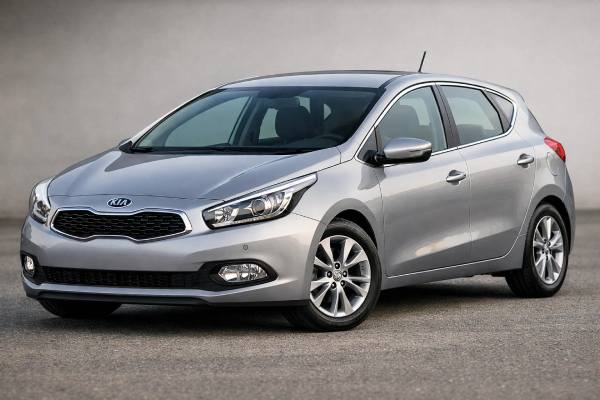
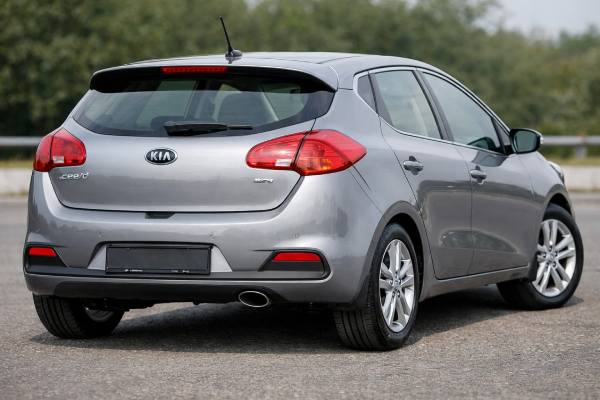
The 2012–2015 Kia Cee’d (JD) with the 1.4 Gamma MPi (100 hp) is a “simple on purpose” European C-segment hatch: naturally aspirated petrol, timing chain, and a conventional 6-speed manual in most markets. That combination keeps ownership straightforward—no turbocharger heat management, no direct-injection carbon worries, and generally forgiving running costs if you keep up with fluids and basic ignition maintenance. It’s not a fast car, but it is a steady one: predictable power delivery, calm motorway manners, and a chassis that feels more mature than many budget-branded rivals from the same era. The JD generation also brought a solid safety structure and a modern cabin layout, making it a practical used buy today—provided you confirm service history, check for suspension wear, and verify recall status by VIN before purchase.
At a Glance
- A simple, chain-driven 1.4 MPi setup that’s usually cheaper to run than small turbos of the same era.
- Balanced ride and stable high-speed feel for a family hatch, with easy, predictable handling.
- Strong practicality for the class: useful boot shape and everyday cabin ergonomics.
- Ownership caveat: age-related wear (bushings, wheel bearings, coils/sensors) matters more than “engine drama.”
- Plan on engine oil and filter service about every 12 months or 10,000–15,000 km (market and use dependent).
Guide contents
- Kia Cee’d JD 1.4 MPi ownership overview
- Kia Cee’d JD 1.4 MPi specs and dimensions
- Kia Cee’d JD trims, options, and safety gear
- Reliability, common faults, and service actions
- Maintenance schedule and buyer’s checklist
- Driving feel, performance, and real economy
- How it stacks up against key rivals
Kia Cee’d JD 1.4 MPi ownership overview
If you’re shopping the 2012–2015 Cee’d JD range, the 1.4 MPi 100 hp version is the “mechanically calm” choice. It uses the Hyundai-Kia Gamma family in a multi-port injection (MPi) layout, which generally tolerates short trips and mixed fuel quality better than early small direct-injection units. In everyday terms, you get a conventional petrol engine that warms up quickly, doesn’t rely on high boost, and usually asks only for regular oil services and routine wear items to keep it happy.
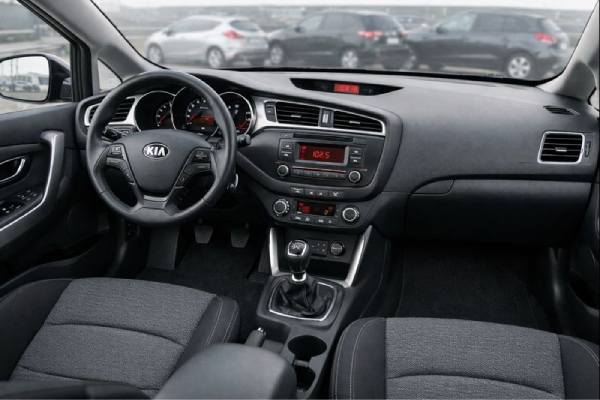
Where this Cee’d shines is in balanced, low-stress ownership. The chassis is tuned for European roads: a stable motorway footprint, controlled body motions, and steering that feels consistent even as the car ages—assuming suspension bushings and tyres are kept in good shape. Cabin design is practical rather than flashy, with good sightlines and a straightforward control layout. On higher trims it can feel genuinely “near-mainstream” rather than budget-oriented.
The trade-off is performance. With 100 hp and modest low-rpm torque, it rewards smooth driving and planning rather than snap overtakes. On steep grades or fully loaded, you’ll use the gearbox more. That’s not a defect so much as a matching exercise: if most of your driving is urban and suburban with occasional highway runs, it’s a great fit. If you do heavy motorway passing, mountainous commuting, or frequent full-load trips, you may prefer a larger petrol or a diesel—though those bring their own complexity.
As a used buy, the JD 1.4 MPi’s biggest determinants are condition and history. A car that has had regular oil services, timely spark plugs, and attention to brakes and suspension will typically feel tight and dependable. A neglected one may still run, but it will feel tired: knocks from worn front lower-arm bushings, noisy wheel bearings, or misfires from aging ignition coils can quickly erode the “easy ownership” advantage. The good news is that these are usually manageable, parts are widely available, and diagnosis tends to be straightforward compared with more complex powertrains.
Kia Cee’d JD 1.4 MPi specs and dimensions
Specifications vary slightly by market, body style (hatch vs Sportswagon), wheel size, and emissions package. The tables below focus on the common 2012–2015 hatchback configuration with the 1.4 MPi 100 hp engine.
Powertrain and efficiency
| Item | Specification |
|---|---|
| Code | G4FA (Gamma) |
| Engine layout and cylinders | Front transverse, I-4, DOHC, 4 valves/cyl |
| Displacement | 1.4 L (1,396 cc) |
| Bore × stroke | 77.0 × 75.0 mm (3.03 × 2.95 in) |
| Induction | Naturally aspirated (NA) |
| Fuel system | MPi / PFI (multi-port injection) |
| Compression ratio | ~10.5:1 |
| Max power | 100 hp (74 kW) @ ~5,500 rpm |
| Max torque | 137 Nm (101 lb-ft) @ ~4,200 rpm |
| Timing drive | Chain |
| Rated efficiency (typical) | ~6.1 L/100 km (38.6 mpg US / 46.3 mpg UK) combined |
| Real-world highway @ 120 km/h | Often ~6.5–7.5 L/100 km depending on tyres, load, and temperature |
Transmission and driveline
| Item | Specification |
|---|---|
| Transmission | 6-speed manual (most common) |
| Drive type | FWD |
| Differential | Open |
Chassis and dimensions (typical hatchback)
| Item | Specification |
|---|---|
| Suspension (front/rear) | MacPherson strut / multi-link (market-dependent; some trims use torsion beam) |
| Steering | Electric power steering (rack-and-pinion) |
| Brakes | 4-wheel discs on many trims; rear discs may vary by spec |
| Wheels/tyres (popular sizes) | 195/65 R15, 205/55 R16, 225/45 R17 |
| Length / width / height | ~4,310 / 1,780 / 1,470 mm (169.7 / 70.1 / 57.9 in) |
| Wheelbase | ~2,650 mm (104.3 in) |
| Turning circle (kerb-to-kerb) | ~10.6 m (34.8 ft) |
| Kerb (curb) weight | ~1,250–1,330 kg (2,756–2,932 lb) depending on trim |
| Fuel tank | ~53 L (14.0 US gal / 11.7 UK gal) |
| Cargo volume | ~380 L seats up / ~1,318 L seats down (method varies by market/VDA) |
Performance and capability (typical)
| Item | Specification |
|---|---|
| Acceleration | 0–100 km/h (0–62 mph): ~12.8 s |
| Top speed | ~182 km/h (113 mph) |
| Towing capacity | Market-dependent; commonly modest for 1.4 petrol—confirm by VIN plate and handbook |
| Payload | Typically ~500–600 kg depending on trim and GVWR |
Fluids and service capacities (common guidance)
These numbers can vary by gearbox, radiator spec, and equipment level—verify against the under-bonnet label and the correct service manual for your VIN.
| Fluid | Typical spec and capacity |
|---|---|
| Engine oil | ACEA A5/B5 (many markets), viscosity commonly 5W-30; capacity ~3.6 L (3.8 US qt) |
| Coolant | Ethylene glycol-based long-life coolant; capacity often ~5.8 L (6.1 US qt) |
| Manual gearbox oil | GL-4 manual trans fluid; capacity commonly ~1.8–2.0 L (confirm by gearbox code) |
| A/C refrigerant | Typically R134a on these years; charge varies by system (check under-bonnet sticker) |
Safety and driver assistance (baseline overview)
| Item | Typical availability |
|---|---|
| Crash ratings | Euro NCAP 5-star (tested early JD generation) |
| Core safety systems | ABS, ESC, traction control; front, side, and curtain airbags (count varies by market) |
| ADAS | Lane-related warning and blind-spot functions may appear on higher trims/late cars; AEB/ACC generally not typical for early 2012-era builds |
Kia Cee’d JD trims, options, and safety gear
Trim naming changes by country, but the pattern is consistent: a practical base model, one or two “comfort” middle trims, and a higher trim with more convenience and tech. When you’re buying used, the fastest way to identify equipment is to look for the combination of wheel size, headlamp style, steering wheel controls, and infotainment screen type—then confirm using the VIN build sheet if possible.
Trims and options that affect ownership
Common equipment steps you’ll see across many markets:
- Wheels and tyres: 15-inch setups ride more softly and cost less to replace; 17-inch packages look sharper but are more sensitive to potholes and can increase cabin road noise.
- Climate and comfort: manual A/C vs automatic climate control; heated seats and heated steering wheel appear on higher trims and are desirable in colder climates.
- Infotainment: basic radio with USB/AUX, upgraded units with larger displays, and (on some cars) navigation packages. If you care about long-term usability, check that the head unit buttons and screen are responsive and that Bluetooth pairs reliably.
- Idle Stop and Go (ISG) / eco packages: some cars have start-stop. It can reduce fuel use in heavy traffic, but it also increases the importance of the correct battery type and good charging health.
Mechanical differences on the 1.4 MPi are usually small—this model is more about equipment than hardware—but wheel/tyre packages and brake specification can change the feel and running costs. If you drive rough roads daily, prioritise smaller wheels and a clean suspension history over “top trim” badges.
Safety ratings and what they mean here
The JD Cee’d earned a strong Euro NCAP result for its time. More important than the star count is how the car behaves in real ownership: a stiff passenger cell, effective seatbelts and pretensioners, and stability control that helps keep the car out of trouble in the first place. For a family hatch from the early 2010s, it is a reassuring base.
Do note that crash tests evolve. A 5-star rating in 2012 does not equal a 5-star rating under the newest protocols. Treat the rating as confirmation that the structure and restraint systems were competitive for its era, then focus on what’s actually fitted on the specific car you’re buying (airbag count, ESC presence, tyre condition, and brake health).
Safety systems and driver assistance you may encounter
Typical safety equipment you should expect:
- ABS and ESC: usually standard, and a must-have for wet or snowy conditions.
- Airbags: commonly front + front side + curtain airbags; some markets add more depending on spec.
- Child-seat provisions: ISOFIX/LATCH points on outer rear seats are common—check covers and anchor integrity.
Driver assistance on 2012–2015 Cee’ds is generally “light” compared with newer cars. Depending on market and trim you may find:
- Cruise control and speed limiter (helpful on long trips).
- Lane departure warning on certain higher specs.
- Blind-spot monitoring on some cars (often later in the run or as part of a package).
After any windscreen replacement, alignment work, or front-end repairs, verify that any camera or radar-based features (if equipped) operate correctly. Even simple lane systems can be affected by poor alignment or incorrect glass.
Reliability, common faults, and service actions
The 1.4 MPi Cee’d JD tends to be “reliability by simplicity.” Most problems are not catastrophic; they’re the usual aging-car issues that show up when maintenance is stretched or the car has lived in heavy stop-start use. A good way to think about it is prevalence (how often you’ll see it) and cost tier (how painful it is when it happens).
Common and usually low-to-medium cost
- Ignition coils and spark plugs (common, low/medium):
Symptoms: rough idle, misfire under load, flashing engine light.
Likely cause: aging coil packs or worn plugs; sometimes oil contamination from a leaking valve cover gasket.
Remedy: replace plugs on schedule; coils as needed (often one fails, but sets can age together). - Sensors and emissions ancillaries (common, low/medium):
Symptoms: intermittent check-engine light, poor throttle response, higher fuel consumption.
Likely cause: oxygen sensor aging, crank position sensor intermittency, or minor vacuum leaks.
Remedy: diagnose with live data, fix the root cause rather than clearing codes. - Suspension bushings and drop links (common, medium):
Symptoms: clunks over bumps, vague steering on-centre, uneven tyre wear.
Likely cause: front lower control arm rear bush wear, stabiliser links, or top mounts.
Remedy: replace worn components, then align the car; don’t skip alignment—tyres are expensive. - Wheel bearings (occasional, medium):
Symptoms: humming that rises with speed, often louder when loading one side in a bend.
Remedy: replace the affected hub/bearing assembly.
Occasional and higher cost (but not typical “engine killers”)
- Clutch wear and dual-mass flywheel (occasional, medium/high):
Symptoms: slipping in higher gears, judder when taking off, rattles at idle (some setups).
Cause: high-mileage city use, poor driving habits, or prior towing beyond comfort.
Remedy: clutch kit; flywheel inspection and replacement if needed. - Cooling system age issues (occasional, medium):
Symptoms: slow coolant loss, sweet smell, overheating in traffic.
Cause: hose aging, radiator seam leaks, water pump seepage.
Remedy: pressure test; replace weak components proactively if the car is nearing a decade-plus of age.
Software, calibrations, and recall/TSB reality
On this generation, updates are usually about drivability, warning lights, and infotainment stability rather than fundamental engine redesign. The practical advice is simple:
- Run a VIN recall check before purchase and again after purchase.
- Ask for dealer history printouts if the seller claims “all recalls done.”
- Treat warning lights as data, not drama—scan the car properly and follow the evidence.
Because recall and service campaigns vary by market, the safest approach is VIN-based verification rather than relying on online lists or hearsay. A car can look perfect and still have an open campaign.
Pre-purchase checks that matter most on this model
- Cold start: listen for abnormal rattles, hunting idle, or strong vibration.
- Test drive on rough roads: suspension knocks, steering play, or brake shudder.
- Check all electrical functions: windows, mirrors, central locking, infotainment, parking sensors/camera (if fitted).
- Inspect tyres for uneven wear (often a clue to alignment or worn bushings).
- Look for fluid seepage: valve cover area, coolant staining, and gearbox casing.
- Confirm service records: oil, plugs, brake fluid, and coolant intervals matter more than “it passed inspection.”
Maintenance schedule and buyer’s checklist
A 1.4 MPi Cee’d JD rewards regular, boring maintenance. The engine is not demanding, but it does expect clean oil, healthy ignition parts, and cooling system integrity. Use the schedule below as a practical baseline, then adjust to your market’s official handbook and your driving style.
Practical maintenance schedule (distance/time)
- Engine oil and filter: every 10,000–15,000 km or 12 months.
If the car does many short trips or idles in traffic daily, stick closer to 10,000 km. - Engine air filter: inspect every service; typically replace 30,000 km (sooner in dusty areas).
- Cabin filter: 15,000–30,000 km depending on environment and allergies.
- Spark plugs: commonly 60,000–90,000 km (confirm plug type—iridium lasts longer).
- Brake fluid: every 2 years regardless of mileage.
- Coolant: long-life coolant often goes 5–10 years depending on spec; if history is unknown on a used car, many owners choose to refresh it early for peace of mind.
- Manual gearbox oil: not always listed as routine, but a preventive change around 100,000–120,000 km can support shift quality and longevity.
- Aux/serpentine belt and pulleys: inspect at services; often replaced around 90,000–120,000 km or when cracking/noise appears.
- Brakes (pads/rotors): inspect at every service; expect wide variation based on driving style.
- Tyres: rotate every 10,000–12,000 km; align if wear appears or after suspension work.
- 12 V battery: test annually; start-stop cars are pickier and may need the correct AGM/EFB type.
Fluid specifications and “decision-grade” numbers
- Engine oil: use the viscosity and ACEA/API spec listed for your market and temperature range. Many European applications use ACEA A5/B5-type oils; don’t substitute a random “close enough” grade if the car has start-stop.
- Oil capacity: about 3.6 L for the 1.4 Gamma in JD applications, but always fill by dipstick level, not by number alone.
Essential torque values (verify by VIN manual)
Torque specs vary by wheel type and component revision, but these are common “sanity check” figures used across many Kia/Hyundai applications:
- Wheel lug nuts/bolts: often in the 90–110 Nm range
- Spark plugs: often around 15–25 Nm depending on plug seat type
- Engine oil drain plug: commonly around 35–45 Nm
Use them only as guidance—always follow the official service data for your exact engine and fastener.
Buyer’s guide: what to seek, what to avoid
Seek:
- Evidence of regular oil services (time-based matters as much as mileage).
- A car that tracks straight, brakes smoothly, and has even tyre wear.
- Smaller wheels if you live with potholes—running costs are lower and ride comfort is better.
- A seller who can show recall checks or dealer visits, not just verbal assurances.
Be cautious with:
- Modified suspension without alignment paperwork.
- Persistent warning lights, “recently cleared” codes, or sellers who won’t allow a scan.
- Noticeable drivetrain shudder on take-off (could be clutch, mounts, or prior abuse).
- Water leaks around hatch seals or door seals (can create long-term electrical gremlins).
Long-term durability outlook
With consistent servicing, it’s realistic for a 1.4 MPi Cee’d JD to age gracefully. The engine is rarely the limiting factor; the car’s long-term feel depends on suspension freshness, corrosion prevention in harsh climates, and keeping small electrical faults from becoming chronic annoyances. Buy the cleanest, best-documented example you can—even if it costs more upfront.
Driving feel, performance, and real economy
The 1.4 MPi Cee’d JD drives like a traditional European family hatch: composed, predictable, and happier when you maintain momentum rather than demanding instant punch. Around town, the engine is smooth and easy to meter in traffic. On the open road, the car feels planted for its class, with a stable body and reassuring straight-line behaviour—especially on sensible tyre sizes.
Ride, handling, and NVH
- Ride: generally compliant, with a slightly “firm European” edge on larger wheels. If you test drive a 17-inch car and feel sharp impacts over broken tarmac, don’t assume “that’s normal”—it may be tyre pressure, worn dampers, or tired bushings.
- Handling: neutral and confidence-building. This isn’t a hot hatch, but it changes direction cleanly and stays composed in fast bends when the suspension is healthy.
- NVH (noise, vibration, harshness): road noise is the main factor, strongly affected by tyre brand and wheel size. Engine noise rises when you work it hard, but it’s typically not coarse.
Powertrain character and gearing
Naturally aspirated petrol engines build power with revs. In this Cee’d, that means:
- Best response comes above low rpm. If you short-shift everywhere, it will feel sluggish.
- Overtakes require planning. A downshift or two is normal; the engine is happier spinning than lugging.
- Manual gearbox feel is usually light and easy, but worn mounts or old gearbox oil can make shifts feel notchier than expected.
If your test drive includes a hill, try a third-gear pull from low speed. A healthy car will accelerate steadily without hesitation or misfire. Any bucking, stumbling, or flashing engine light points you back to ignition or sensor diagnosis.
Real-world efficiency
Official combined numbers are typically around the low-6 L/100 km range, but real use depends heavily on speed and trip length.
- City: often 7.5–9.0 L/100 km if traffic is heavy.
- Highway (100–120 km/h): often 6.5–7.5 L/100 km, with higher figures in winter or with roof racks.
- Mixed driving: commonly 6.8–7.8 L/100 km for many owners.
Cold weather tends to penalise short-trip economy more than long-trip economy. If you do mostly 5–10 minute runs, consider more frequent oil changes and don’t judge the car harshly for higher consumption—it’s normal for an engine that rarely reaches full operating temperature.
Key performance metrics that affect the verdict
- 0–100 km/h: about 12–13 seconds—adequate, not quick.
- Top speed: roughly 180 km/h class—fine for motorway cruising, but overtakes rely on downshifts.
- Braking feel: typically stable and consistent if the car has good tyres and fresh brake fluid; pulsing suggests warped rotors or uneven pad deposits.
In short: this is a car for calm, smooth drivers who value predictability and manageable costs over strong acceleration. If that’s your priority, it’s one of the more sensible ways into a modern-feeling used hatch.
How it stacks up against key rivals
To judge the Cee’d JD 1.4 MPi fairly, compare it to other early-2010s mainstream hatches with similar power: Ford Focus, Volkswagen Golf, Opel/Vauxhall Astra, and even its close cousin the Hyundai i30. The Cee’d’s competitive edge is rarely “best in class” on a single spec sheet line—it’s the ownership blend.
Versus Ford Focus (Mk3, small petrol)
- Focus strengths: sharper steering feel and cornering precision; lots of chassis polish.
- Cee’d advantage: typically simpler powertrain in MPi form and often calmer long-term running costs.
- Used-buyer takeaway: choose the Focus for driver engagement; choose the Cee’d for low-drama daily use—especially if you’re trying to avoid complex turbo issues in older small engines.
Versus Volkswagen Golf (Mk7, smaller petrol)
- Golf strengths: refined cabin materials, strong resale perception, and very efficient turbo options when healthy.
- Cee’d advantage: straightforward MPi engineering, often cheaper parts and labour, and less sensitivity to driving style.
- Used-buyer takeaway: a well-kept Golf can feel more premium, but a neglected one can become expensive quickly. The Cee’d is often the safer bet when service history is incomplete.
Versus Opel/Vauxhall Astra (J era)
- Astra strengths: solid high-speed stability, often good seats, and wide parts availability.
- Cee’d advantage: generally cleaner “simple petrol” experience and a cabin layout many drivers find more intuitive.
- Used-buyer takeaway: both can be good; the deciding factor is condition. The Cee’d often feels easier to live with when you want predictable maintenance rather than chasing intermittent electronic quirks.
Versus Hyundai i30 (GD era)
- i30 strengths: extremely similar ownership profile; often similar engines and parts.
- Cee’d advantage: market-specific equipment differences—some Cee’d trims offer a nicer feature mix for the money.
- Used-buyer takeaway: don’t treat this as brand preference—treat it as “best example wins.” Choose the car with the cleaner history, quieter suspension, better tyres, and fewer warning lights.
Bottom line for shoppers
The Cee’d JD 1.4 MPi is a smart rival alternative when you want:
- A conventional petrol hatch without turbo complexity
- A stable, comfortable commuter that doesn’t punish you with surprises
- A cabin and safety baseline that still feels modern enough for daily life
If you can accept modest acceleration and you buy on condition (not trim badge), it compares very well to the class staples—and often costs less to put right once it’s yours.
References
- euroncap_kia_ceed_2012_5stars.pdf 2012 (Safety Rating)
- Kia C’eed – Crash Test 2012 2012 (Safety Rating)
- Kia Recalls | Kia Europe 2026 (Recall Database)
- Oil-Grades-and-Capacities.pdf 2023 (Service Data)
Disclaimer
This article is for informational purposes only and is not a substitute for professional diagnosis, inspection, or repair. Specifications, torque values, service intervals, and procedures can vary by VIN, market, engine calibration, and installed equipment. Always verify details against the correct official owner’s and service documentation for your vehicle, and follow qualified technician guidance when safety-critical systems are involved.
If you found this guide useful, please consider sharing it on Facebook, X (Twitter), or your favourite forum to help others and support our work.