
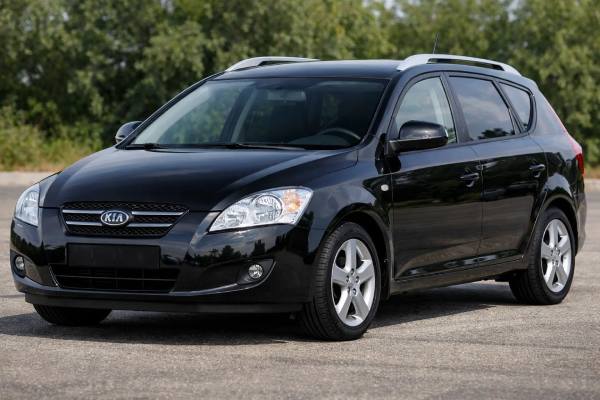
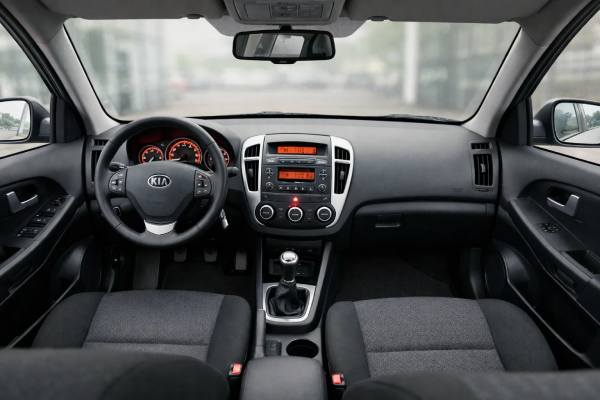
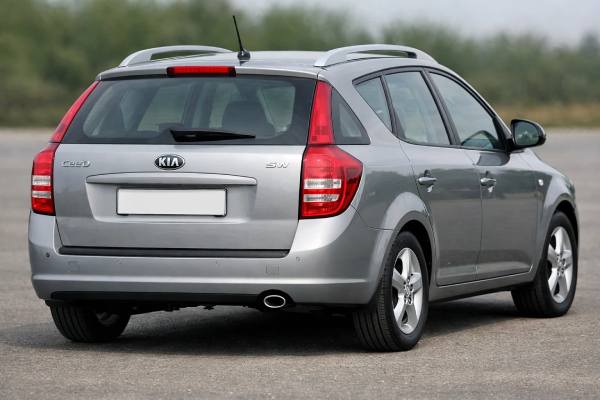
The Kia Cee’d SW (ED) with the 1.4-litre G4FA petrol is the “practical-first” version of the early Cee’d lineup: wagon cargo room, simple naturally aspirated engineering, and running costs that stay predictable if you keep up with routine service. With 109 hp, it is not a fast estate, but it’s usually adequate for commuting and mixed driving, and it’s easier on consumables than the heavier, more powerful variants. The G4FA is a chain-driven DOHC 16-valve engine that rewards regular oil changes and clean intake air; most long-term issues come from neglected cooling system maintenance, tired ignition components, or small oil leaks rather than major internal failures.
For buyers today, the SW body style also means checking rear suspension wear and load-related items (shocks, springs, rear bushings). If you want a compact wagon that can handle family duties without complex diesel emissions hardware, this is one of the simplest choices in the 2007–2009 bracket—provided you confirm service history and corrosion condition.
What to Know
- Practical wagon cargo space without the complexity of turbo diesel emissions systems.
- Chain-driven 1.4 petrol is generally durable when oil changes are done on time.
- Expect modest performance when fully loaded; plan passing manoeuvres accordingly.
- Watch for cooling system age issues (radiator, thermostat, hoses) on higher-mileage cars.
- Change engine oil and filter every 10,000–12,000 km or 12 months.
Guide contents
- Kia Cee’d SW ED 1.4 overview
- Kia Cee’d SW G4FA specs
- Kia Cee’d SW trims and safety
- Reliability issues and service actions
- Maintenance plan and buyer’s guide
- Driving, performance, and economy
- How it compares to wagon rivals
Kia Cee’d SW ED 1.4 overview
The Cee’d SW (Sportswagon) takes the basic strengths of the ED-platform hatchback—solid structure, straightforward mechanical layout, and good everyday ergonomics—and adds the one feature many owners actually need: usable cargo capacity without stepping up to a larger class. With the 1.4-litre G4FA petrol, the SW becomes a “low-drama” ownership proposition. It is naturally aspirated (no turbo), runs on conventional unleaded fuel, and avoids the expensive emissions hardware that can complicate older diesel wagons.
That simplicity doesn’t mean it’s maintenance-free. The SW body is heavier than the hatch, and that changes how the 1.4 feels. Around town it’s pleasant and easy, but on hills or with a full load you’ll use more revs and more gear changes. The advantage is that the powertrain is generally tolerant when cared for: a chain-driven valvetrain, modern electronic fuel injection, and a cooling system that is easy to service. Most complaints you’ll hear from owners are about performance expectations, not frequent engine failures.
From a chassis point of view, the SW’s extra weight and longer rear overhang can accelerate wear in rear dampers, rear bushes, and sometimes wheel bearings—especially on cars that have regularly carried tools, strollers, or holiday luggage. A good test drive should include rough pavement and a listen for rear knocks, plus a check for uneven rear tyre wear that hints at tired suspension components.
If you’re considering one today, prioritize overall condition over trim level. A clean, rust-free SW with documented oil services and a cooling system that has been refreshed at sensible intervals will usually be a better buy than a “high spec” example that has been run on bargain tyres and skipped maintenance. This is the kind of wagon that pays you back for buying carefully.
Kia Cee’d SW G4FA specs
The specifications below are typical for the Kia Cee’d SW (ED) with the 1.4 G4FA petrol in the 2007–2009 period. Exact figures vary by market, gearbox, wheel size, and body equipment, so verify by VIN for parts ordering and service procedures.
Powertrain and efficiency
| Item | Specification (typical) |
|---|---|
| Code | G4FA |
| Engine layout and cylinders | Inline-4, DOHC, 16 valves (4 valves/cyl) |
| Bore × stroke | ~77.0 × 75.0 mm (3.03 × 2.95 in) |
| Displacement | 1.4 L (~1,396 cc) |
| Induction | Naturally aspirated (NA) |
| Fuel system | Multi-point injection (MPI) |
| Compression ratio | Typically around ~10.5:1 (variant dependent) |
| Max power | 109 hp (80 kW) @ ~6,200 rpm |
| Max torque | Typically ~137 Nm (101 lb-ft) @ ~4,200 rpm |
| Timing drive | Chain |
| Rated efficiency | Often ~6.3–7.2 L/100 km (37–33 mpg US / 45–39 mpg UK) depending on test cycle |
| Real-world highway @ 120 km/h | Commonly ~7.0–8.0 L/100 km (34–29 mpg US / 40–35 mpg UK) |
Transmission and driveline
| Item | Typical configuration |
|---|---|
| Transmission | 5-speed manual (common); some markets may differ |
| Drive type | FWD |
| Differential | Open |
Chassis and dimensions (SW / wagon)
| Item | Typical SW range (verify by trim) |
|---|---|
| Suspension (front / rear) | MacPherson strut / multi-link or torsion beam (market/trim dependent) |
| Steering | Rack-and-pinion, power-assisted |
| Brakes | Front ventilated discs; rear discs or drums depending on trim/market |
| Wheels/tyres (popular size) | 195/65 R15 or 205/55 R16 |
| Ground clearance | ~145–155 mm (~5.7–6.1 in) |
| Length / width / height | Wagon typically longer than hatch; verify by market spec |
| Wheelbase | ~2,650 mm (104.3 in) |
| Turning circle | ~10.6 m (~34.8 ft) |
| Kerb weight | Often ~1,260–1,360 kg (2,778–2,998 lb) depending on equipment |
| Fuel tank | ~53 L (14.0 US gal / 11.7 UK gal) |
| Cargo volume | SW typically offers meaningfully more than hatch; method varies by market |
Performance and capability
| Metric | Typical figure (SW is usually slower than hatch) |
|---|---|
| 0–100 km/h (0–62 mph) | ~11.5–13.5 s (gearbox/body/tyres dependent) |
| Top speed | ~175–185 km/h (109–115 mph) |
| Payload | Strongly trim- and tyre-dependent; check door-jamb plate |
| Towing capacity | Market-dependent; verify approval plate and handbook |
Fluids and service capacities (verify by VIN)
| Item | Typical guidance |
|---|---|
| Engine oil | API/ACEA petrol spec; common viscosity 5W-30 (climate dependent) |
| Engine oil capacity | Often around ~3.3–3.6 L with filter (variant dependent) |
| Coolant | Long-life coolant; typical 50/50 mix |
| Manual gearbox oil | Commonly 75W-85/75W-90 depending on gearbox code |
| Brake fluid | DOT 4 |
| A/C refrigerant | Often R134a; charge varies (check under-hood label) |
Key torque specs (typical ranges; verify)
- Wheel nuts: ~90–110 Nm (66–81 lb-ft)
- Oil drain plug: ~25–35 Nm (18–26 lb-ft)
Kia Cee’d SW trims and safety
With older Cee’d SW models, trim names can mislead because they change across countries and import histories. The better approach is to identify the equipment that affects safety, running costs, and day-to-day comfort.
Trims and options that matter on the SW
- ESC (electronic stability control):
Prioritize a car with ESC if possible. It can make a real difference in emergency avoidance, especially in wet conditions with the rear loaded. - Wheel size and ride comfort:
15-inch packages typically ride better and keep tyre costs down—often a sensible match for a family wagon. 16-inch wheels can feel sharper but are more sensitive to alignment and potholes. - Rear brake type:
Rear discs offer consistent braking but need caliper slider care; rear drums are simpler and cheaper but can be more sensitive to corrosion if the car sits. - Roof rails and towing prep:
If you plan roof boxes or bike carriers, inspect rails and mounting points. If towing is relevant, verify the towbar is properly certified and that the cooling system is healthy. - Interior practicality:
Split-fold rear seats, load covers, and cargo nets are small details that make the SW more useful. Replacing missing cargo bits can be surprisingly expensive.
Safety ratings and the “what year” effect
The ED Cee’d earned strong crash-test results for its era, and that still counts in structural terms. However, remember that testing standards have evolved. A well-maintained 2007–2009 car with multiple airbags and ESC can still be a sensible safety choice compared with many older wagons, but it will not offer modern crash avoidance tech.
Safety systems and driver assistance
Typical safety equipment in this generation includes:
- Front airbags; side and curtain airbags on many trims
- ABS with electronic brake-force distribution
- ESC and traction control on some trims/markets
- ISOFIX child-seat anchors
- Seatbelt pretensioners
Advanced driver assistance systems such as AEB, lane keeping, and adaptive cruise are generally not part of this package. For real-world safety, your biggest controllable factors are tyres, brakes, and suspension condition. On a wagon, rear shock performance is especially important when carrying load: weak dampers can increase stopping distance and reduce stability in quick lane changes.
Reliability issues and service actions
The 1.4 G4FA petrol is usually dependable, and most problems you’ll encounter at this age come from wear, maintenance shortcuts, or heat cycles rather than fundamental design flaws. Think in terms of “age management”: rubber parts, sensors, and fluids.
Common (low to medium cost)
- Ignition coils and spark plugs (common, low–medium):
Symptoms: misfire under load, rough idle, flashing engine light.
Cause: coil breakdown with age, worn plugs, moisture intrusion.
Fix: plugs at correct interval, replace weak coils, inspect plug wells for oil. - Accessory belt and pulley noise (common, low):
Symptoms: squeal at start-up, chirping at idle.
Cause: belt wear, tired idler/tensioner bearings.
Fix: replace belt and worn pulleys before they fail. - Small oil seepage (common, low):
Symptoms: oily residue around valve cover or timing cover area.
Cause: gasket ageing, crankcase ventilation issues.
Fix: reseal as needed; ensure PCV system is functioning.
Occasional (can become expensive if ignored)
- Cooling system ageing (occasional, medium):
Symptoms: fluctuating temperature gauge, weak cabin heat, coolant smell, slow loss of coolant.
Cause: thermostat wear, radiator end-tank ageing, hose fatigue.
Fix: pressure test, replace weak components, refresh coolant at correct intervals. - Catalyst or oxygen sensor faults (occasional, medium):
Symptoms: engine light, poor fuel economy, sluggish response.
Cause: sensor ageing, exhaust leaks, long-term rich/lean conditions.
Fix: proper diagnosis before parts swapping; check for exhaust leaks first.
SW-specific wear points
Because the wagon is often used for carrying loads:
- Rear shock absorbers and rear bushes can wear earlier.
Symptoms: rear bouncing, instability over dips, knocking sounds.
Fix: replace shocks in pairs; inspect springs and top mounts. - Rear wheel bearings can be stressed by constant load and poor road surfaces.
Symptoms: humming that changes with speed and cornering.
Fix: confirm with road test; replace bearing/hub as required.
Recalls and service actions
At this age, recall completion depends on previous owners. The practical step is to run the VIN through Kia’s official recall resources and request documentation from the seller. Even when a recall is complete, a dealer history printout can reveal whether the car has had consistent servicing or long gaps.
Maintenance plan and buyer’s guide
A good maintenance plan for the 1.4 SW is about keeping the engine clean inside, maintaining stable cooling, and preventing “small” wear items from cascading into bigger costs.
Practical maintenance schedule (distance/time)
- Engine oil and filter: 10,000–12,000 km or 12 months
- Short-trip or cold-climate use: lean to the shorter interval.
- Spark plugs: typically 40,000–60,000 km (verify plug type)
- Air filter: 20,000–30,000 km (inspect yearly)
- Cabin filter: 15,000–20,000 km or yearly
- Coolant: typically 5 years initially, then 2–3 years (confirm coolant type)
- Brake fluid: every 2 years
- Manual gearbox oil: consider 80,000–120,000 km for longevity
- Brake inspection: each service; clean and lubricate caliper sliders (rear discs)
- Tyre rotation: 10,000–12,000 km; alignment check annually
- Accessory belt: inspect yearly; replace if cracked/noisy
- 12 V battery: test annually; replace window often 4–6 years
Fluid choices and decision-making notes
- Use an oil viscosity that matches your climate; many owners run 5W-30 year-round, but extremely cold or hot regions may differ.
- Use quality coolant and correct mix ratio; overheating events shorten the life of gaskets, sensors, and plastics.
- Brake fluid age matters more than mileage—wagons that sit can accumulate moisture faster.
Buyer’s inspection checklist (SW-focused)
- Rust and underbody: check sills, rear arches, and the underside around suspension mounting points.
- Rear suspension: listen for knocks over bumps; look for uneven rear tyre wear.
- Cooling system: check for dried coolant residue around radiator end tanks and hose joints.
- Engine idle and response: it should idle smoothly and rev cleanly; hesitation may indicate ignition maintenance is due.
- Clutch and gearbox (manual): clutch should engage smoothly without judder; gearbox should not crunch on quick shifts.
- Cargo area function: test seat folding, tailgate struts, and whether water ingress has occurred (damp spare wheel well is a red flag).
Best-fit ownership expectations
- Best for: practical hauling, commuting, and mixed driving where simplicity matters.
- Less ideal for: drivers expecting quick overtakes with a full load—this is a rev-and-shift petrol wagon, not a torque-heavy turbo car.
Driving, performance, and economy
The Cee’d SW with the 1.4 petrol drives like a compact wagon should: stable, predictable, and more focused on comfort and practicality than outright speed. The key to enjoying it is matching your driving style to the engine’s character.
Ride, handling, and NVH
- Ride quality: generally compliant, especially on 15-inch tyres. The SW’s extra rear weight can make it feel settled on the highway but a bit more sensitive to worn rear dampers.
- Handling balance: safe understeer at the limit; tyre choice and alignment have an outsized effect on steering feel.
- Noise: at motorway speed, tyre roar is usually the main sound. A droning noise often points to rear tyres or wheel bearings rather than the engine.
Powertrain character
The G4FA makes its best power higher in the rev range. In real terms:
- Keep it above ~2,500 rpm when you want responsive acceleration.
- Expect downshifts on hills, especially with passengers or luggage.
- The upside is smoothness and predictable throttle response, with fewer “surprises” than a turbo engine.
Real-world efficiency
Fuel consumption depends heavily on speed and load:
- City: often 7.5–9.0 L/100 km (31–26 mpg US / 38–31 mpg UK) depending on traffic and trip length.
- Highway (100–120 km/h): commonly 7.0–8.2 L/100 km (34–29 mpg US / 40–34 mpg UK).
- Mixed: often 6.8–8.0 L/100 km (35–29 mpg US / 42–35 mpg UK).
Expect higher consumption when the wagon is loaded and when running winter tyres.
Useful performance metrics (typical)
- 0–100 km/h: roughly 11.5–13.5 s (wagon body and gearing matter).
- Passing power: adequate but requires planning; the car rewards early downshifts.
If your priority is low stress at high speed with a full family load, a larger engine may suit you better. If your priority is predictable costs, simple maintenance, and wagon practicality, the 1.4 SW can still be a very rational choice.
How it compares to wagon rivals
In the late-2000s compact wagon class, the Kia Cee’d SW 1.4 sits in a “value and simplicity” lane. Many rivals offer sharper performance or more premium interiors, but that often comes with higher parts prices or more complex engines.
Ford Focus Estate 1.6 petrol
- Pros: excellent chassis feel, widely available parts.
- Cons: some versions can be more sensitive to neglected cooling and ignition service; condition varies widely.
Opel/Vauxhall Astra Caravan 1.6 petrol
- Pros: comfortable seats, often good value used.
- Cons: can be heavier-feeling; some engines known for higher oil use depending on variant.
Volkswagen Golf Variant 1.6 petrol
- Pros: refined cabin, strong resale.
- Cons: usually pricier to buy; some owners stretch service intervals because the car “feels fine,” which can hide maintenance debt.
Where the Cee’d SW 1.4 typically wins
- Simplicity: no turbo, no diesel emissions hardware, and generally straightforward servicing.
- Ownership value: often cheaper to buy for similar condition and age.
- Practical packaging: wagon utility without moving up to a bigger car.
Bottom line: the Cee’d SW 1.4 is best viewed as a dependable tool—an estate that does daily life well. Choose on condition, tyres, and maintenance history, and it can remain a cost-effective wagon even today.
References
- Kia cee’d Owner’s Manual 2009 (Owner’s Manual)
- Kia Recalls | Kia Europe 2026 (Recall Database)
- Kia cee’d 2007 (Safety Rating)
- Adult occupant protection Child restraints Pedestrian … 2007 (Safety Rating)
Disclaimer
This article is for informational purposes only and is not a substitute for professional inspection, diagnosis, or repair. Specifications, torque values, service intervals, and procedures vary by VIN, market, and equipment; always verify details using official Kia service documentation for your exact vehicle.
If this guide helped, please consider sharing it on Facebook, X (Twitter), or your preferred platform to support our work.