
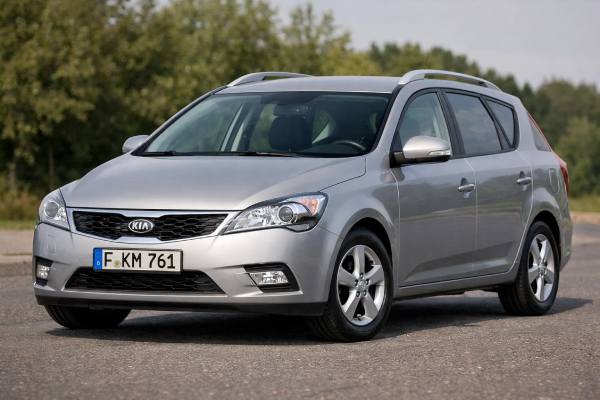
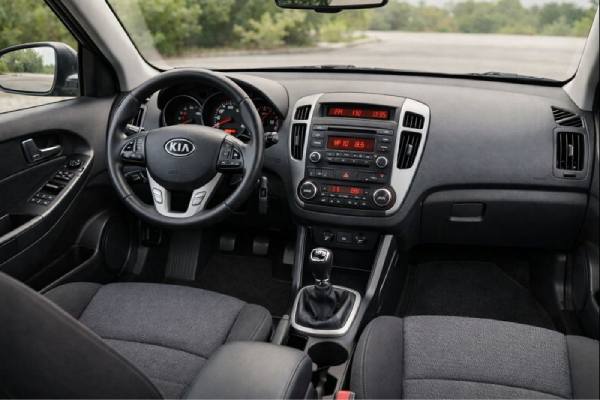
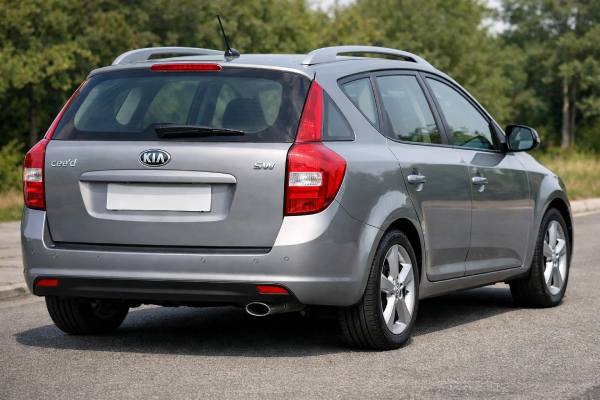
The facelift Kia Cee’d SW (ED) with the 1.6 CRDi D4FB (115 hp) is one of the most “grown-up” versions of the first-gen Cee’d wagon: strong mid-range torque, long-legged highway manners, and a practical boot without the weight and running costs of larger diesels. In daily use, this engine feels relaxed because it makes useful pulling power low in the rev range—ideal for loaded family trips and steady commuting. The trade-off is that diesel ownership rewards the right driving pattern and maintenance habits: frequent cold starts and short trips can stress the EGR and, on later emissions versions, the diesel particulate filter (DPF). Get the servicing rhythm right and this Cee’d SW can be a durable, economical long-term car with predictable wear items and straightforward chassis upkeep.
Owner Snapshot
- Strong low-rpm torque makes it easy to drive when loaded, especially on hills and motorways.
- Wagon boot and wide opening suit strollers, luggage, and DIY runs without “SUV” fuel costs.
- Efficient at steady speeds; best results come from longer trips and warm running.
- Short-trip use can accelerate EGR/DPF soot issues—plan occasional longer drives.
- Typical engine oil interval: 15,000 km or 12 months (use the correct low-ash diesel spec).
Navigate this guide
- Kia Cee’d SW ED 115hp profile
- Kia Cee’d SW ED 1.6 CRDi data
- Kia Cee’d SW ED equipment and safety
- Reliability risks and fixes
- Service schedule and buyer checks
- Road performance and economy
- Rival wagons compared
Kia Cee’d SW ED 115hp profile
Think of the facelift Cee’d SW as a sensible European wagon with a diesel that was tuned for real roads rather than bragging rights. The D4FB 1.6 CRDi (115 hp) is at its best when you want steady, low-stress pace: it pulls cleanly from low rpm, cruises with fewer downshifts, and still stays frugal if you drive smoothly. In the wagon body, the engine’s character matters more than peak power. You feel the torque when merging, climbing, or carrying passengers and luggage—situations where a small petrol engine can feel busy.
The facelift years (roughly 2009–2012) also brought incremental improvements you notice as an owner: tighter noise control than early cars, more mature interior trim in many markets, and a generally solid chassis that doesn’t develop odd rattles quickly if it hasn’t been abused. Steering is light and predictable, suspension tuning is geared toward comfort, and the wagon’s longer roofline gives it a calm, stable feel at speed.
Where this model asks for respect is in diesel-specific “health management.” If your use is mostly short trips—especially in winter—soot builds faster. That doesn’t mean the car is unreliable; it means the car needs the right routine: correct oil, clean air supply, timely fuel filtration, and occasional long runs so the exhaust system reaches full operating temperature. Also expect a few common diesel wear items with age: glow plugs, vacuum lines, engine mounts, and—depending on driving style—clutch and dual-mass flywheel.
As a used buy, the sweet spot is a car with service history that shows consistent oil changes (not stretched), fuel filter replacements, and evidence of sensible motorway use. If you find that, the Cee’d SW 1.6 CRDi 115 is one of those wagons that simply gets on with the job: practical, economical, and easy to live with.
Kia Cee’d SW ED 1.6 CRDi data
Below are the core specifications owners and buyers typically look for. Treat exact figures as market- and VIN-dependent (especially emissions equipment, gearing, and kerb weight).
Powertrain and efficiency (D4FB 115)
| Item | Spec (typical) |
|---|---|
| Engine code | D4FB (1.6 CRDi) |
| Layout | Inline-4 turbo-diesel |
| Valvetrain | DOHC, 4 valves/cyl (16V) |
| Displacement | 1.6 L (≈1,582 cc) |
| Induction | Turbocharged (intercooled) |
| Fuel system | Common-rail direct injection |
| Max power | 115 hp (85 kW) @ ~4,000 rpm |
| Max torque | ~255 Nm (188 lb-ft) @ ~1,900 rpm |
| Timing drive | Chain (verify by VIN/market) |
| Emissions | Euro 4 / Euro 5 depending on year/market; some versions use DPF |
| Rated economy (combined) | ~4.7–5.2 L/100 km (50–45 mpg US / 60–54 mpg UK) |
| Real-world highway @ 120 km/h | ~5.5–6.3 L/100 km (43–37 mpg US / 51–45 mpg UK) |
Transmission and driveline
| Item | Spec (typical) |
|---|---|
| Drive type | FWD |
| Manual gearbox | 5- or 6-speed (market dependent) |
| Automatic | Limited availability in some markets/years |
| Differential | Open |
Chassis and dimensions (SW / wagon)
| Item | Spec (typical) |
|---|---|
| Front suspension | MacPherson strut |
| Rear suspension | Multi-link |
| Steering | Electric power steering (most markets) |
| Front brakes | Ventilated discs ~280 mm (11.02 in) |
| Rear brakes | Disc ~262 mm (10.31 in) (some base trims may vary) |
| Popular tyre size | 195/65 R15 or 205/55 R16 (varies by trim) |
| Ground clearance | ~150 mm (5.91 in) |
| Length / Width / Height | ~4505 / 1790 / 1535 mm (177.36 / 70.47 / 60.43 in) |
| Wheelbase | ~2650 mm (104.33 in) |
| Turning circle | ~10.6 m (34.78 ft) |
| Kerb weight | ~1,300–1,420 kg (2,866–3,131 lb) |
| GVWR | commonly ~1,850–1,950 kg (4,079–4,299 lb) |
Capacity and practicality
| Item | Spec (typical) |
|---|---|
| Fuel tank | ~53 L (14.00 US gal / 11.66 UK gal) |
| Cargo volume | ~534 L seats up / ~1,664 L seats down (method varies by market) |
| Roof load | commonly ~80 kg (check handbook for your rails and trim) |
Performance (realistic expectations)
| Metric | Result (typical) |
|---|---|
| 0–100 km/h (0–62 mph) | ~11.0–12.0 s |
| Top speed | ~185–190 km/h (115–118 mph) |
| Braking 100–0 km/h | ~38–41 m (setup and tyres matter most) |
| Towing | Often approved in the ~1,200–1,500 kg braked range (market and trim dependent) |
Fluids and service capacities (quick-reference)
| Fluid | Spec guidance (typical) |
|---|---|
| Engine oil | Low-ash diesel oil (ACEA C2/C3 type), commonly 5W-30 |
| Oil capacity | ~5.3 L (≈5.6 US qt) with filter (verify by engine variant) |
| Coolant | Ethylene glycol long-life coolant; typical 50/50 mix (capacity varies) |
| Brake fluid | DOT 4 |
| A/C refrigerant | R134a (charge varies by system; check under-bonnet label) |
Key torque specs (typical, verify): wheel nuts ~90–110 Nm; engine oil drain plug often ~30–40 Nm; front caliper carrier bolts commonly ~75–90 Nm.
Kia Cee’d SW ED equipment and safety
Trims and options: what changes in real ownership
Trim naming varies widely by country (examples include LX/EX, Vision, “1/2/3,” or regional special editions). Instead of chasing a badge, focus on the items that change comfort, tyre cost, and long-term hassle:
- Wheels and tyres: 15-inch packages ride softer and cost less; 16-inch often feels tighter in corners. Avoid badly curbed alloys—often a clue the car lived in city potholes.
- Climate control: manual A/C is simpler; automatic climate is nicer but adds blend-door motors and extra sensors.
- Cruise control: a meaningful upgrade for diesel owners because it encourages steady, efficient highway driving.
- Heated seats and mirrors: genuinely useful in cold climates and reduces windshield scraping and idle warm-ups.
- Audio and infotainment: head units differ by year; some cars have factory Bluetooth, others rely on aftermarket kits.
Quick identifiers when viewing a used car
- Look for the engine cover label (CRDi) and confirm 115 hp / 85 kW in registration documents.
- Check whether the car has DPF: some markets note it on paperwork; you may also see a DPF-related warning symbol on the cluster during the ignition self-check.
- A 6-speed manual (if fitted) usually indicates more relaxed highway rpm than a 5-speed.
Safety ratings: what they mean for a 2009–2012 wagon
The first-gen Cee’d family was well-regarded for its era. Euro NCAP testing for the model line is commonly associated with a strong result under the protocol used at the time. Keep in mind two important context points:
- Protocols changed: modern percentage breakdowns (Adult/Child/VRU/Safety Assist %) may not be published for older tests in the same way they are today.
- Safety equipment depends on trim: stability control (ESC) and side/curtain airbags may be standard in some markets and optional in others.
Safety systems and driver assistance (what to expect)
For most facelift ED wagons, the realistic equipment list looks like this:
- Airbags: front airbags as standard; many trims add side and curtain airbags.
- Braking and stability: ABS and electronic brakeforce distribution are common; ESC/traction control may be standard later or on higher trims.
- Child seats: ISOFIX/LATCH rear outboard positions are typical; always check anchor condition and plastic guides.
- ADAS: don’t expect modern AEB or lane assist. Any “driver assistance” is usually limited to stability systems rather than camera/radar automation.
Service implication: after suspension or steering work, ensure the steering angle sensor and stability system calibrations are correct if your variant supports calibration routines—miscalibration can trigger warning lights or odd ESC intervention on rough roads.
Reliability risks and fixes
This engine and platform can be dependable, but age and diesel soot management define the ownership experience. Below is a practical, symptom-led view.
Common (high prevalence)
- EGR valve and intake soot build-up (short trips, lots of idle time)
Symptoms: hesitant throttle at low rpm, smoke under load, reduced economy, occasional engine light.
Likely cause: soot accumulation in EGR valve and intake tract.
Remedy: EGR cleaning or replacement; intake cleaning if heavily restricted; verify boost hoses and vacuum control at the same time. - DPF loading (where fitted)
Symptoms: frequent regeneration attempts, rising fuel use, limp mode, DPF warning (varies by cluster).
Likely cause: repeated short journeys prevent complete regeneration.
Remedy: correct oil (low-ash), fix any boost/EGR faults first, then forced regen or professional cleaning if needed. Long motorway drives help only if the system is otherwise healthy. - Clutch and dual-mass flywheel wear (driving style dependent)
Symptoms: shudder when taking off, rattling at idle with clutch engaged, vibration under load.
Likely cause: high-torque diesel pulses plus city stop-start use.
Remedy: clutch kit and DMF together is often the sensible approach at higher mileage.
Occasional (medium prevalence)
- Injector sealing or fuel system sensitivity
Symptoms: diesel smell, rough idle, harder starting, ticking noise.
Likely cause: injector seal leakage or fuel contamination/water.
Remedy: seal service and proper seat cleaning; replace fuel filter on schedule; avoid running the tank very low. - Turbo control or boost leaks
Symptoms: weak pull, whistle/hiss, smoke, underboost codes.
Likely cause: split intercooler hoses, sticky actuator, vacuum leaks.
Remedy: pressure test boost tract; replace aged hoses; check vacuum supply and actuator movement. - Glow plugs and cold-start system aging
Symptoms: rough cold starts, smoke on start, glow plug light issues.
Remedy: replace glow plugs as a set if multiple are weak; check relay and battery condition.
Rare (but costly when it happens)
- Cooling system neglect leading to overheating
Symptoms: temperature spikes, coolant loss, cabin heat changes.
Remedy: resolve leaks early; keep coolant fresh; don’t ignore a slow loss.
Recalls, service actions, and verification
Recall activity differs by market. The most reliable approach is to check:
- Official VIN-based recall lookup where your country provides it, and
- Dealer service history printout showing campaigns completed.
Because these cars are now older, many “issues” you’ll see are not design flaws but the result of stretched servicing, poor-quality oil, or repeated short-trip use. A well-maintained diesel wagon usually feels smooth, pulls evenly, and has a clean maintenance paper trail.
Service schedule and buyer checks
A good maintenance plan for the 1.6 CRDi is less about doing everything early and more about doing the right things consistently—especially anything that protects the turbo, injectors, and emissions hardware.
Practical maintenance schedule (distance or time)
Every 15,000 km or 12 months
- Engine oil and filter (use the correct low-ash diesel spec).
- Visual check: boost hoses, vacuum lines, coolant level, oil leaks.
- Brake inspection (pad thickness, slider condition) and tyre wear pattern check.
Every 30,000 km or 24 months
- Engine air filter (sooner in dusty areas).
- Cabin filter.
- Full chassis check: ball joints, bushings, rear multi-link wear points.
Every 45,000–60,000 km
- Fuel filter (critical for injector life; don’t skip).
- Brake fluid (every 2 years is a safe rule if exact interval is unknown).
Every 90,000–120,000 km (or as needed by symptoms)
- Coolant replacement (also age-based; many owners do 5 years as a sensible maximum).
- Accessory belt and tensioner inspection; replace if cracked/noisy.
- EGR and intake inspection/cleaning if the car lives on short trips.
Timing drive guidance
- Many D4FB variants use a timing chain, which typically has no fixed replacement interval. Treat it as “inspect by symptoms”: cold-start rattle, persistent timing correlation faults, or evidence of poor oil history should push you toward deeper inspection. Always verify your exact engine variant.
Fluids and “decision-making” details
- Oil matters more than brand hype: pick the correct diesel spec and change it on time. A healthy turbo and clean oil control system are your biggest long-term wins.
- Don’t ignore small boost leaks: a minor hose split can raise soot, trigger EGR/DPF issues, and make the car feel lazy.
- Use quality fuel and keep the tank above the last bar: it reduces water/contaminant risk and keeps the low-pressure side happier.
Buyer’s checklist (what to inspect in 30 minutes)
- Cold start: should fire cleanly without long cranking; excessive smoke or uneven idle is a warning sign.
- Service proof: oil changes should be consistent; look specifically for fuel filter replacements.
- Road test in 3rd/4th gear: steady pull from ~1,500 rpm should be smooth; surging suggests boost/EGR issues.
- Clutch take-up and vibration: shudder can mean DMF wear.
- Underbody and rear suspension: check for play and uneven tyre wear; wagons carry loads and can wear rear links/bushes.
- Rust hotspots: wheel arches, rear subframe areas, and seam edges (varies by climate and storage).
- Electricals: windows, mirrors, A/C performance, central locking—small issues add up.
Long-term outlook: with consistent oil and filtration care, these engines can cover high mileage. The cars that become expensive are usually those with repeated short-trip use plus stretched servicing.
Road performance and economy
How it feels on the road
The 115 hp diesel doesn’t try to be sporty; it tries to be effective. Around town, the torque arrives early, so you short-shift and ride the midrange rather than revving out. That makes the car feel calmer than many small petrol wagons of the era. On the motorway, the wagon tracks steadily and feels composed—especially with a 6-speed manual, where cruising rpm tends to drop enough to reduce noise and fuel use.
Ride and handling: The Cee’d SW’s suspension is comfort-first, but it’s not floaty. The rear multi-link helps it stay settled over broken surfaces and when loaded. Steering is light and predictable, though feedback is modest by modern enthusiast standards. With fresh tyres and good alignment, it’s an easy long-distance companion.
NVH (noise, vibration, harshness): Expect typical small-diesel sounds at idle and during cold running. Once warmed up and cruising, wind and tyre noise become more noticeable than the engine—especially on older, hard-compound tyres.
Powertrain character
- Best zone: roughly 1,700–3,000 rpm for real-world progress.
- Throttle response: generally good once the turbo is on boost; below that, it can feel slightly sleepy if you request acceleration too early in too high a gear.
- Gearbox feel: manuals are usually light and easy; a notchy shift can signal old gearbox oil or worn linkages.
Real-world efficiency (what owners typically see)
Economy depends heavily on trip type:
- City, lots of cold starts: ~6.5–7.8 L/100 km (36–30 mpg US / 43–36 mpg UK)
- Highway 100–120 km/h: ~5.5–6.3 L/100 km (43–37 mpg US / 51–45 mpg UK)
- Mixed driving: ~5.8–6.8 L/100 km (41–35 mpg US / 49–42 mpg UK)
Cold-weather effect: short winter trips can add 10–20% consumption because warm-up takes longer and regenerations (if DPF equipped) may occur more often.
Metrics that change the verdict
- 0–100 km/h: expect about 11–12 seconds in healthy form—adequate for modern traffic, not quick.
- Passing power: the midrange is the point; a downshift to keep it above ~1,800 rpm matters more than chasing the redline.
- Braking feel: usually stable and confidence-inspiring if sliders are clean and fluid is fresh; sponginess often points to overdue brake fluid or tired hoses.
Load carrying
With passengers and luggage, the diesel’s torque is exactly why this version works. You’ll feel less strain on inclines, and you won’t need to wring it out. Do keep tyre pressures correct when loaded—many wagons feel “wobbly” simply because rear tyres are underinflated.
Rival wagons compared
The Cee’d SW 1.6 CRDi 115 sits in a crowded class of sensible diesel wagons. Here’s how it typically stacks up as a used buy.
Versus Ford Focus Estate 1.6 TDCi
- Focus advantage: sharper steering and chassis feel; often more engaging on a twisty road.
- Kia advantage: usually straightforward ownership if serviced correctly; strong value and often simpler trim complexity.
- Watch-outs: Focus TDCi variants can be sensitive to oil spec and turbo health; both cars dislike neglected servicing.
Versus Volkswagen Golf Variant / Jetta Variant 1.6 TDI
- VW advantage: strong motorway refinement and often a more “premium” cabin feel.
- Kia advantage: purchase price and parts value; less risk of paying “brand tax” on routine repairs.
- Watch-outs: some TDI systems have costly emissions hardware; Kia’s diesel system can also cost money (DPF/EGR), but the entry price is often lower.
Versus Opel/Vauxhall Astra Sports Tourer 1.7 CDTi (older) or 1.6 CDTi (newer)
- Astra advantage: good seats and long-distance comfort; sometimes better high-speed quietness.
- Kia advantage: often simpler mechanical package and solid day-to-day ergonomics.
- Watch-outs: Astra diesels vary widely by generation; check which engine family you’re buying, as reliability profiles differ.
Versus Hyundai i30 CW 1.6 CRDi
- Hyundai advantage: near-identical mechanicals; sometimes different trim value in your market.
- Kia advantage: often stronger warranty history and resale perception in some regions.
- Reality: buy on condition and history—these are close cousins.
The practical verdict
Choose the Cee’d SW 1.6 CRDi 115 if you want:
- An efficient wagon that feels relaxed on real roads,
- A sensible cabin and usable boot without SUV running costs,
- A diesel that rewards good service habits.
Consider a petrol alternative (or a newer diesel) if your life is mostly short city trips. In that use case, the “diesel savings” can disappear into soot-related maintenance. But for mixed driving and regular highway runs, the Cee’d SW diesel remains a strong, rational used-car choice.
References
- euroncap_kia_ceed_2007_5stars.pdf 2007 (Safety Rating)
- Engine Oil Grades and Capacities 2023 (Service Fluids Guide)
- Ceed-OM-EN.pdf 2010 (Owner’s Manual)
Disclaimer
This article is for informational purposes only and is not a substitute for professional diagnosis, inspection, or repair. Specifications, torque values, service intervals, fluids, and procedures vary by VIN, market, emissions equipment, and trim level—always verify details using your official owner’s manual and the correct service documentation for your exact vehicle.
If this guide helped you, please consider sharing it on Facebook, X/Twitter, or your favorite forum to support our work.