
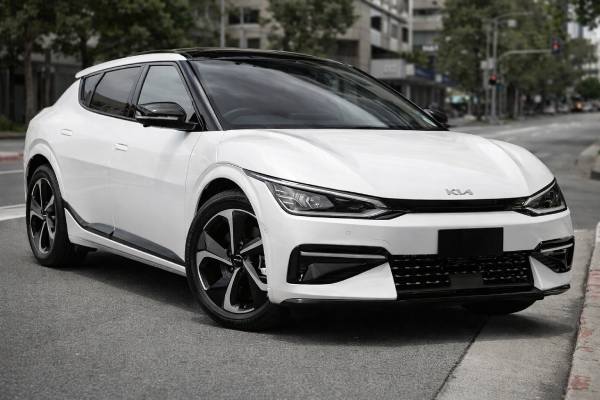
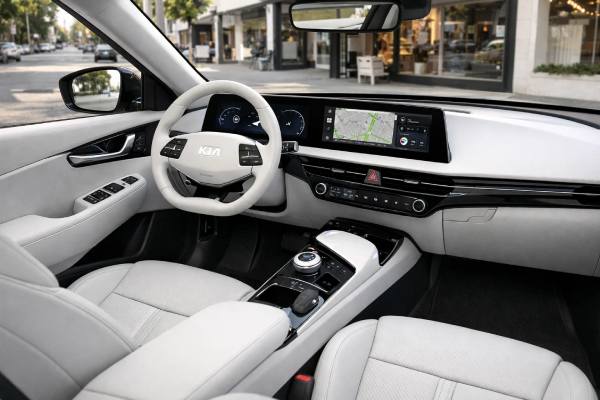
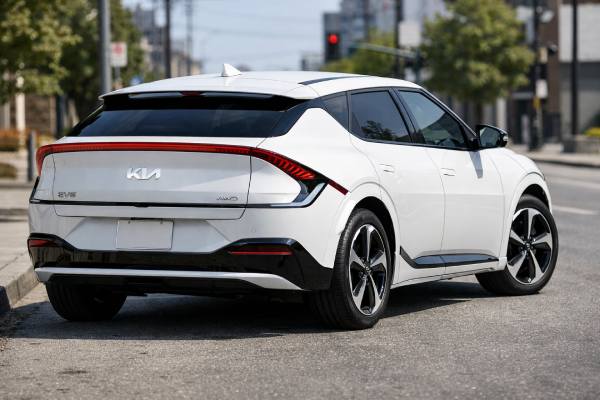
Kia’s EV6 AWD (CV) with the 77.4 kWh pack is the “do-it-all” version of the early EV6 lineup: dual motors for confident traction, a long-range battery that still charges quickly, and an 800-volt electrical architecture designed for repeatable fast-charging rather than just headline peak numbers. In daily ownership, this model rewards drivers who value stable highway manners, secure wet-weather grip, and a strong mid-range surge for overtakes—while also asking you to think a bit more about tires, alignment, and charging habits than a softer, slower EV.
This guide focuses on what actually matters after the novelty fades: which trims change hardware (not just badges), what range you can plan around at real motorway speeds, where reliability has shown patterns, and how to keep the high-voltage and 12-volt systems happy long term.
Owner Snapshot
- Strong all-weather traction and brisk passing power without needing the high-performance GT.
- 800-V charging architecture supports short, practical fast-charge stops on long trips.
- Real motorway range drops noticeably at 120 km/h, so route planning matters more than in slower commuting.
- Watch for recall and service-campaign completion related to charging and the 12 V system.
- Rotate tires about every 10,000–12,000 km (or 6–8 months) to control wear and road noise.
Navigate this guide
- Kia EV6 AWD CV in depth
- Kia EV6 AWD CV spec tables
- Kia EV6 AWD CV trims and ADAS
- Known problems and campaigns
- Service schedule and buying checks
- How it drives and charges
- AWD EV6 versus competitors
Kia EV6 AWD CV in depth
The 77.4 kWh EV6 AWD is built around Kia/Hyundai’s E-GMP platform, and the headline you feel every day is balance: a low battery pack gives the EV6 a planted center of gravity, while the dual-motor layout adds traction and stability that you can actually use in rain, slush, and cold tarmac. In this 2021–2024 window, the AWD version is the “sweet spot” for drivers who want confident grip and quick overtakes but don’t need the extra stiffness, tire cost, and energy demand of the GT.
Power delivery and traction. The AWD EV6 doesn’t just launch harder; it also feels more relaxed when you merge or pass at motorway speeds because it can blend torque across axles rather than asking one motor to do everything. In practice, this reduces wheelspin on damp surfaces and makes the car feel calmer when you accelerate mid-corner on a sweeping on-ramp. You still get classic EV immediacy—just with fewer traction-control interruptions.
Battery and thermal behavior. The 77.4 kWh pack brings two owner advantages: (1) you can plan around a meaningful buffer in winter, and (2) you can arrive at a fast charger without feeling forced to charge to a high state of charge (SOC) “just in case.” Like most modern EVs, this EV6 is happiest living between roughly 20–80% SOC for routine use, using higher SOC mainly when you need the full trip range.
Fast charging, as a system—not a headline. The 800-V class architecture is valuable because it supports high charging power at a reasonable battery current. That tends to mean less heat for the same charging rate, and more consistent charging sessions when conditions are right. The key ownership skill is learning when the battery is warm enough and when preconditioning is needed—because a cold battery can turn a quick stop into a long one.
What this AWD version is best for.
- Mixed climates (rain, snow, shoulder seasons) where traction matters.
- Frequent highway travel where stability and mid-range punch are valuable.
- Owners who want long-range usability but still care about charging speed.
What it’s not.
- The most efficient EV6 configuration; the front motor and extra driveline losses cost range.
- The cheapest tire-and-brake ownership path; torque and weight work tires harder, and regen-heavy driving can promote brake corrosion if you never use the friction brakes.
If you treat this EV6 like a high-torque, heavy hatchback—rotate tires, keep pressures correct, and stay current on software and recall work—it delivers a notably “complete” ownership experience for its era.
Kia EV6 AWD CV spec tables
Powertrain, battery, and efficiency
| Spec | Value |
|---|---|
| Powertrain layout | Dual-motor AWD |
| System power | 239 kW (325 PS) |
| System torque | 605 Nm |
| Traction battery (gross) | 77.4 kWh |
| Traction battery (usable) | 74.0 kWh |
| Battery chemistry | NMC |
| Cell count | 384 |
| Pack configuration | 192s2p |
| Nominal voltage | 697 V |
| Architecture class | 800 V |
| WLTP range (TEL) | 506 km |
| WLTP consumption (TEL) | 172 Wh/km |
| WLTP range (TEH) | 484 km |
| WLTP consumption (TEH) | 180 Wh/km |
| EVKX 120 km/h range | 333 km (207 mi) |
| EVKX 120 km/h consumption | 24 kWh/100 km |
Driveline and charging
| Spec | Value |
|---|---|
| Transmission | Single-speed reduction |
| Drive type | AWD |
| AC connector | Type 2 |
| DC connector | CCS |
| Charging port location | Rear side – right |
| AC charging power | 11 kW |
| DC fast-charge peak | 233 kW |
| DC power (10–80%) | 200 kW |
| DC 10–80% charging time | 18 min |
| AC charging time (0→400 km) | 8 h |
| Battery preconditioning | Possible |
| Preconditioning trigger | Navigation-supported |
Performance and capability
| Spec | Value |
|---|---|
| 0–100 km/h | 5.2 s |
| Top speed | 185 km/h |
| Towing capacity (braked) | 1,600 kg |
| Towing capacity (unbraked) | 750 kg |
Chassis, dimensions, and weights
| Spec | Value |
|---|---|
| Length | 4,680 mm |
| Width | 1,880 mm |
| Height | 1,550 mm |
| Wheelbase | 2,900 mm |
| Curb weight | 2,090 kg |
| Turning circle | 11.6 m |
| Cargo (rear trunk) | 490 L |
| Cargo (max) | 1,300 L |
| Frunk | 20 L |
Safety and driver assistance ratings
| Spec | Value |
|---|---|
| Euro NCAP (May 2022) | 5 stars |
| Euro NCAP adult occupant | 90% |
| Euro NCAP child occupant | 86% |
| Euro NCAP vulnerable road users | 64% |
| Euro NCAP safety assist | 87% |
| IIHS award | Top Safety Pick+ |
| IIHS note | Award applies to vehicles built after Aug 2022 |
Kia EV6 AWD CV trims and ADAS
Trims vary by market, but the pattern stays consistent: the EV6 AWD powertrain can appear across mid and upper trims, while the equipment that changes ownership tends to cluster around wheels/tires, headlights, cabin comfort tech (heat pump in some markets), and the most advanced driver-assistance sensors.
Common trim “families” you’ll see (market-dependent):
- Core/entry AWD trims (often the value pick): typically smaller wheels, fewer styling add-ons, and sometimes simpler headlight hardware. This can matter because smaller wheels usually improve ride comfort and real-world range, especially in winter.
- GT-Line / sport appearance trims: usually add larger wheels, sportier seats, and more camera-based convenience tech. The look is great, but the larger wheel and tire package can be the single biggest contributor to harsher ride and higher road noise on rough asphalt.
- High-spec trims with comfort packs: where you’ll most often find premium audio, ventilated seats, 360° cameras, remote parking functions, and (in some regions) heat-pump or “winter” packages.
Quick identifiers when shopping used (practical, not theoretical):
- Wheel size and tire sidewall are visible in photos and predict a lot about ride and range. If you see low-profile tires on 20-inch wheels, assume more road noise and slightly higher energy use.
- Headlight design can hint at ADAS capability tiers and IIHS headlight outcomes in North America. If you’re shopping US-market cars, confirm the build date matters for IIHS award applicability.
- Exterior camera count (front + mirrors + rear) is a fast way to identify 360° camera and some parking-assist packages.
- Badging is imperfect. Some markets badge “GT-Line” as an appearance package while hardware differs; always confirm wheel size, seat functions, and sensor suite.
Safety ratings—how to read them for this model.
- Euro NCAP (May 2022) awarded the EV6 five stars, with strong adult and child scores, a mid-pack vulnerable road-user score, and a high safety-assist score. That profile suggests robust structure and effective active safety, while reminding you that pedestrian/cyclist outcomes depend heavily on AEB calibration and sensor cleanliness.
- IIHS (US) lists the EV6 with a Top Safety Pick+ award for certain build conditions, and also breaks down headlights and crash-prevention performance. For buyers in North America, it’s worth checking the exact model year and build month against IIHS notes, because equipment and production timing can affect award eligibility.
ADAS and what changes year to year. Most 2021–2024 EV6 AWD vehicles offer the core suite: automatic emergency braking (AEB), lane-keeping support, adaptive cruise control (ACC), blind-spot monitoring, and rear cross-traffic alert. The key differences are:
- Lane system feel: some cars steer more assertively in lane centering, others feel more “suggestive.” Test this on a straight road at 90–110 km/h to see if you like the steering corrections.
- Sensor coverage: higher trims may add extra cameras, improved parking automation, or better surround view, which matters for daily use in tight cities.
- Post-repair calibration: after windshield replacement, front bumper work, or alignment changes, ADAS calibration quality matters. A car that “pings” false lane warnings or shows intermittent radar/camera faults may simply need correct calibration—so ask for documentation.
The best trim choice for ownership is usually the one with the wheel/tire package and driver-assistance set that match your roads and your tolerance for road noise—because those two factors influence satisfaction more than small differences in upholstery or ambient lighting.
Known problems and campaigns
Overall, the EV6 AWD is a modern EV with fewer moving parts than a combustion SUV, but it is not “maintenance-free.” The reliability story is mainly about software, charging hardware, and the 12-volt ecosystem that supports everything from locks to high-voltage contactors.
Below is a practical map by prevalence and cost tier, followed by symptom → cause → remedy patterns you can recognize.
Common (medium to high impact)
1) ICCU / 12 V charging-related faults (high impact when it happens).
- Symptoms: warning messages about the electrical system, repeated 12 V battery warnings, progressive reduction in available drive power, or a no-start condition after parking.
- Likely root cause: integrated charging control unit (ICCU) and associated protection components can fail or degrade, affecting 12 V charging.
- Remedy: campaign/recall inspection, software updates, and in some cases component replacement. This is one of the first things to verify via VIN history and dealer records because it can turn into a recovery event if it occurs away from home.
2) Software behavior affecting charging or alerts (medium impact).
- Symptoms: inconsistent fast-charge performance, unexpected charging taper, phantom warnings, intermittent sensor alerts, or infotainment glitches.
- Likely root cause: control modules (BMS, charging logic, ADAS) are sensitive to calibration versions.
- Remedy: official updates (dealer-applied and/or OTA where supported). If a seller says “it just needs a reset,” treat that as a prompt to check for documented updates.
Occasional (usually medium impact)
3) Charge-port latch, door, or seal issues (medium).
- Symptoms: port won’t unlock smoothly, port door doesn’t sit flush, water or grime around the connector area, or AC sessions failing to start reliably.
- Likely root cause: latch mechanism wear, alignment, or seal contamination; sometimes a connector temperature sensor or cable handling issue contributes to session interruptions.
- Remedy: clean/inspect seals, confirm connector engagement, and repair latch hardware if it binds. In wet climates, a careful inspection of the port surround and underbody shields is worth doing.
4) Brake feel and corrosion from regen-heavy driving (low to medium).
- Symptoms: scraping noise after rain, vibration under light braking, or a “grabby” feel after long periods of mostly one-pedal driving.
- Likely root cause: friction brakes don’t get used hard enough to keep the rotors clean; surface corrosion builds, then gets unevenly removed.
- Remedy: periodic firm braking from higher speeds (when safe), plus routine inspection. This is more of an ownership habit than a design defect, but it affects noise and brake life.
Rare (can be expensive)
5) Drive-unit bearing or reduction-gear noises (medium to high).
- Symptoms: whining that changes with speed (not HVAC), rumble under load, or a pronounced pitch change on lift-off.
- Likely root cause: bearing wear, gear mesh issues, or in some cases a motor-related harmonic.
- Remedy: diagnosis is critical—tire noise can mimic drivetrain noise. A good road test on multiple surfaces helps separate the two. If confirmed, repair costs can be significant, so warranty coverage and service history matter.
Recalls, TSBs, and service actions—how to handle them
- Don’t rely on the seller’s memory. Ask for printouts or digital proof of completion and confirm via an official VIN recall lookup.
- Look for campaign layering. Some vehicles can receive an initial software fix, then later a revised campaign that adds inspection steps or replaces components.
- Pre-purchase request list: service invoices showing campaign completion, any ICCU-related inspection or replacement paperwork, and proof of recent 12 V battery testing if the car is 3+ years old.
If you’re shopping used, the safest approach is simple: treat recall completion as a requirement, not a “nice to have.” It is the difference between a very satisfying EV and an occasional headache.
Service schedule and buying checks
A good EV maintenance plan focuses on tires, brakes, coolant loops (where applicable), the 12 V battery, and software. The EV6 AWD adds one more reality: torque and weight make small oversights (low tire pressure, misalignment) show up quickly in noise, vibration, and range.
Practical maintenance schedule (everyday-owner friendly)
Every 10,000–12,000 km or 6–8 months
- Rotate tires (front-to-rear pattern appropriate to tire type) and check tread depth across the width.
- Check tire pressures cold and compare left/right; small differences can pull the car and trigger stability control more often in rain.
- Inspect brakes for rotor surface condition and pad movement; do a short “brake cleaning” routine if you drive mostly on regen.
Every 20,000 km or 12 months
- Cabin air filter replacement (or at least inspection if you drive in dusty areas).
- Alignment check, especially if you see inside-edge tire wear or steering wheel off-center.
- Suspension and steering inspection: look for bush wear, play, and uneven tire wear patterns that hint at geometry drift.
Every 40,000–60,000 km or 24–36 months
- Brake fluid change is a smart interval in humid climates or heavy city traffic because moisture absorption can reduce braking consistency.
- A/C system performance check (cooling and dehumidifying). EVs rely heavily on HVAC, and weak A/C can increase energy use in summer.
Around 3–5 years (time-based priority)
- 12 V battery test and proactive replacement if capacity is weak. Many EV “strange behavior” complaints are rooted in a tired 12 V battery rather than the traction battery.
- Inspect cooling system components for seepage or damage to radiators and underbody shields, especially if you drive on rough roads.
Severe-use adjustments (do these sooner)
- Frequent DC fast charging: add more frequent tire rotations and keep a closer eye on charging behavior; if charging slows significantly, check for software updates and ensure battery preconditioning works.
- Cold climate: prioritize cabin filter changes, check door seals, and confirm HVAC heat performance.
- Towing: monitor tire wear and consider more frequent brake inspections, because weight transfer and stability systems work harder.
Used-buyer checklist (high-value, low-drama)
Traction battery health
- Ask for a battery state-of-health (SOH) report or diagnostic readout if the seller can provide it.
- On a test drive, note the predicted range at a known SOC (for example, 70–80%) and compare it to your typical consumption expectations for your climate.
Fast-charge behavior
- If possible, do a short DC session: watch how quickly power rises, how soon taper starts, and whether the car throws charging errors.
- Confirm battery preconditioning can be triggered (often by navigating to a fast charger).
Charging hardware
- Inspect the charge port for looseness, cracked plastics, or signs of water intrusion.
- Test AC charging if you can; a car that is “DC-only” in practice can become inconvenient at home.
Chassis and body
- Look underneath: the battery pack area should appear straight, with intact shields and no crushed jacking points.
- Check for uneven tire wear (especially inner edges), which often signals alignment needs and can be expensive if it has already ruined a tire set.
Electronics and OTA history
- Confirm infotainment stability, camera clarity, and ADAS functions.
- Ask whether the car has received recent updates and whether any warning lights have appeared and “gone away.”
Which versions to seek
- For mixed climates, prioritize trims that include the comfort and visibility features you will use daily (heated seats/steering, strong headlights, surround cameras), and consider smaller wheels if ride comfort and range matter most.
Long-term durability outlook: with recalls addressed and basic maintenance habits in place, the EV6 AWD’s biggest cost variables are tires, occasional brake service due to corrosion patterns, and rare-but-expensive charging or power-electronics events—so service history and campaign completion matter more than the badge on the tailgate.
How it drives and charges
The EV6 AWD’s personality is defined by two things: low-slung stability and instant torque that the chassis can actually use. It feels more composed than many taller electric crossovers at motorway speeds, and the dual-motor system gives it an effortless, confident shove for merging and overtaking.
Ride, handling, and NVH
On typical roads, the EV6 rides with a firm, controlled feel rather than a soft float. The battery mass keeps body roll in check, which makes lane changes and long sweepers feel tidy. The trade-off is that rough surfaces and expansion joints can be more noticeable—especially on larger wheel packages with lower-profile tires. Road noise is also more tire-dependent than many buyers expect: aggressive tread patterns and wide tires can turn the EV6 from “quiet EV” into “noticeable hum” at 110–130 km/h.
Steering and braking feel
Steering is generally precise and predictable, with a stable on-center feel that suits long trips. Braking is where EV ownership habits matter:
- Regen-heavy driving reduces pad wear but can allow rotor corrosion.
- The handoff between regenerative and friction braking is usually smooth, but you’ll feel it more during gentle, last-meter stops in traffic.
A good habit is to do a few firm stops weekly (when safe) to keep the friction brakes working cleanly.
Powertrain character and drive modes
The AWD system delivers torque smoothly, and the car rarely feels “scrabbly” even on wet surfaces. Eco/Normal/Sport modes typically adjust throttle mapping, regen behavior, and sometimes HVAC strategy. If you care about range, Eco is useful—but the EV6 remains perfectly drivable in Normal without feeling wasteful, especially in mild weather.
Real-world efficiency and range
This is where expectations need to be realistic. Official WLTP numbers are useful for comparing trims, but planning a trip requires speed-based thinking.
At 120 km/h, real-world estimates show roughly 333 km of range with consumption around 24 kWh/100 km under favorable conditions. That is a meaningful drop from slower-speed range, and it’s why the AWD EV6 feels “long-range” in daily life but can feel merely “adequate” on sustained fast motorway legs.
Practical range takeaways:
- City driving: the EV6 can be very efficient when speeds are low and regen is used well.
- Highway driving: speed is the biggest lever; reducing from 130 to 115 km/h often saves more range than any drive mode tweak.
- Cold weather: expect a real penalty, especially on short trips where the cabin and battery start cold.
Charging performance in daily use
Home charging at 11 kW AC is the most ownership-friendly way to live with this EV6: it makes overnight charging routine and reduces your dependence on public infrastructure. The fast-charge story is strongest when you arrive with a warm battery and a low-to-mid SOC. In those conditions, the EV6 AWD can deliver short, efficient charging stops rather than long waits.
To get the best real-world charging experience:
- Arrive low: target 10–20% SOC when possible.
- Precondition: navigate to the charger so the car prepares the battery.
- Leave early: charging speed tapers as SOC rises; 10–80% is the sweet spot for trip timing.
If you drive like this EV6 was designed to be used—short DC stops, steady motorway speeds, and consistent home charging—it behaves like a modern long-distance EV rather than a “city car that can road trip.”
AWD EV6 versus competitors
The EV6 AWD sits in a crowded segment: midsize electric crossovers and fastback-ish SUVs that promise long range, quick acceleration, and easy road trips. The best comparison is not just range or 0–100, but charging consistency, ride comfort, and ownership friction.
Hyundai Ioniq 5 AWD (platform cousin)
Why choose it instead: a more upright seating position, often a softer ride feel, and a cabin layout some buyers find more “lounge-like.”
Why choose EV6 AWD instead: a sportier driving position, sleeker aerodynamics, and a more planted feel at motorway speeds.
Both share platform DNA, so shopping comes down to ergonomics, trim availability, and price in your market.
Tesla Model Y Long Range (if available in your region)
Why choose it instead: very strong charging network integration (region-dependent), simple route planning, and excellent software ecosystem.
Why choose EV6 AWD instead: more conventional cabin controls for some functions, a different ride/handling balance, and (for many) a more distinctive interior design and build feel.
If you value “plug in and the car does the planning,” Tesla still has an edge; if you want a more traditional ownership feel with strong fast-charge hardware, the EV6 remains compelling.
Volkswagen ID.4 GTX / Skoda Enyaq 80x (where sold)
Why choose them instead: comfort-forward tuning, roomy cabins, and often a calmer ride on rough roads.
Why choose EV6 AWD instead: sharper response, more engaging steering feel, and very competitive charging architecture for its generation.
If you prioritize comfort and space over “sporty,” the VW-group options can be more relaxing daily.
Ford Mustang Mach-E AWD
Why choose it instead: a distinct driving character and strong performance in many trims.
Why choose EV6 AWD instead: charging architecture advantages and a refined highway demeanor that many owners find easier to live with long term.
Polestar 2 AWD (fastback alternative)
Why choose it instead: premium feel, strong performance, and a more sedan-like driving position.
Why choose EV6 AWD instead: more practical crossover packaging and, for many, more comfortable rear space.
Bottom-line positioning
The EV6 AWD is a strong pick for drivers who want:
- Confident all-weather traction
- Real-world fast charging that supports road trips
- A planted, stable highway feel
Choose a rival instead if you prioritize:
- The softest ride and maximum cabin height (often Ioniq 5 / Enyaq)
- Deeply integrated charging-route planning (often Model Y)
- A more premium-badge cabin experience (often Polestar/Genesis alternatives)
The EV6 AWD’s advantage is that it blends performance and road-trip usability without demanding a “performance-car lifestyle.” You just need to buy the right wheel/tire setup for your roads—and ensure recall and software history are clean.
References
- Kia EV6 Long Range AWD (2021-2024) price and specifications – EV Database 2024 (Specifications)
- Kia EV6 Long Range AWD range & consumption | EVKX.net 2024 (Real-World Range)
- Official Kia EV6 2022 safety rating 2022 (Safety Rating)
- 2022 Kia EV6 4-door SUV 2022 (Safety Rating)
- 2022-2024 my ev6 vehicles 2024 (Recall Document)
Disclaimer
This article is for informational purposes only and is not a substitute for professional diagnosis, inspection, or repair. Specifications, torque values, service intervals, software campaigns, and procedures can vary by VIN, market, model year, and equipment. Always verify details using your official Kia service information, owner documentation, and dealer records before making maintenance or purchase decisions.
If you found this guide useful, please consider sharing it on Facebook, X/Twitter, or your favorite forum to help others research their EV6 ownership and support our work.