
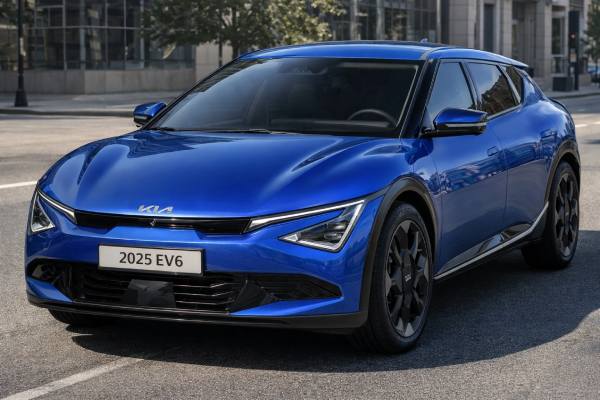
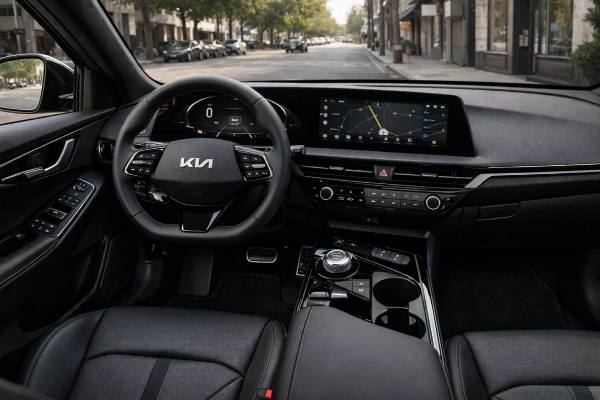
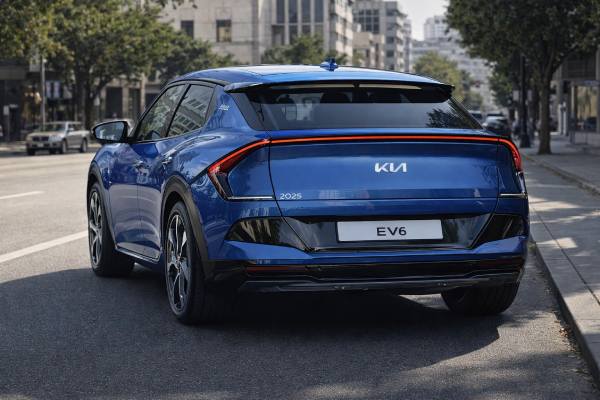
The facelifted Kia EV6 (CV) with the 63.0 kWh battery and 167 hp rear motor is the “daily-driver” version of Kia’s E-GMP platform: quick enough to feel effortless, efficient enough to travel without constant charging math, and engineered around fast DC charging rather than just big-battery range. The refresh matters because it pairs a more usable standard-range pack with the EV6’s low-slung chassis and strong thermal control—two traits that shape how the car rides, grips, and sustains power in real use.
For owners, the big wins are predictable energy use, stable high-speed manners, and a cabin that feels purpose-built for EV life (preconditioning, driver aids, and strong one-pedal calibration). The trade-offs are mostly ownership-details: keeping the 12 V system healthy, staying current on software campaigns, and choosing wheels/tires that match your comfort and range priorities.
What to Know
- Fast DC charging capability for a standard-range EV, with short stops when conditions are right.
- Strong day-to-day efficiency and smooth rear-drive balance, especially on smaller wheel packages.
- Practical WLTP-rated range for commuting and mixed driving, with clear winter penalties to plan for.
- Reliability is mostly software-and-support: verify recall and update history before you buy used.
- Rotate tires every 10,000–12,000 km (or 12 months) to keep wear even and efficiency steady.
Section overview
- Kia EV6 CV facelift explained
- Kia EV6 CV 63 kWh specifications
- Trims, packages, and driver assist
- Reliability, fault patterns, and campaigns
- Maintenance plan and used buying tips
- Real-world driving, range, and charging
- How it stacks up against rivals
Kia EV6 CV facelift explained
This EV6 variant is the standard-range, rear-wheel-drive facelift model: a 63.0 kWh battery feeding a single rear motor rated at 167 hp (125 kW). In everyday terms, it’s the EV6 that prioritizes charging speed, efficiency, and lighter curb weight over maximum acceleration. The result is often the “sweet spot” for drivers who do mostly commuting, mixed suburban travel, and occasional highway trips—especially in markets where the higher trims push price and tire costs up quickly.
Engineering-wise, the EV6 sits on Kia/Hyundai’s E-GMP skateboard platform, which places the battery low and flat in the floor. That layout does three useful things: it reduces body roll, improves straight-line stability in crosswinds, and gives the suspension an easier job because the mass is centralized and low. On this 167 hp RWD setup, you also avoid the extra front drive unit, which typically helps efficiency and keeps steering feel cleaner over broken surfaces.
The facelift-era EV6 also benefits from an EV maturity curve: battery conditioning logic, charge-session stability, and driver-assistance tuning tend to improve via software as the fleet grows. That matters more than many shoppers realize. Two cars with identical motors can feel very different if one preconditions the pack reliably before a fast charger, holds steady charging power without nuisance faults, and has cleaner brake blending between regen and friction braking.
This 63 kWh model’s real value shows up in trip rhythm. With a smaller pack, you don’t “brute force” range; you drive and charge smarter. The EV6 helps by being relatively efficient at moderate speeds and by supporting strong peak DC charging—so your best trips usually look like shorter, more frequent charging stops rather than one long, slow session. If you mainly drive highways at 120–130 km/h, you’ll still want to plan with realistic consumption, but you can often recover a meaningful chunk of range quickly when the battery is warm and you arrive with a low state of charge.
Ownership-wise, think of this EV6 as a software-led car with strong hardware underneath. It rewards buyers who (1) keep updates current, (2) treat the 12 V system as a real maintenance item, and (3) choose tires based on efficiency and noise, not only looks. Do those three things, and the 63 kWh EV6 can be one of the lowest-effort EVs to live with: quiet, stable, quick off the line, and genuinely easy to charge on modern DC networks.
Kia EV6 CV 63 kWh specifications
Powertrain, battery, and efficiency
| Spec | Value |
|---|---|
| Powertrain layout | BEV, single-motor rear drive |
| Motor type | Permanent-magnet synchronous (PMSM) |
| Motor count and axle | 1 motor, rear axle |
| Max power | 167 hp (125 kW) |
| Max torque | 350 Nm (258 lb-ft) |
| Battery nominal capacity | 63.0 kWh |
| Battery usable capacity | 60.0 kWh |
| Battery chemistry | Lithium-ion (NMC) |
| System voltage | 523 V |
| WLTP range (combined) | 394 km (245 mi) |
| WLTP energy use (combined) | 16.4 kWh/100 km |
| Real-world highway @ 120 km/h | 20.0 kWh/100 km |
| Real-world highway range @ 120 km/h | 270 km (168 mi) |
Driveline and charging
| Spec | Value |
|---|---|
| Drive unit | Single-speed reduction gear |
| Drive type | RWD |
| AC charge connector (EU) | Type 2 |
| DC charge connector (EU) | CCS2 |
| Charging port location | Right rear quarter |
| Onboard charger (AC) | 11.0 kW |
| DC fast-charge peak | 195 kW |
| DC 10–80% | 18 min |
| AC 0–100% | 6 h 30 min |
Performance and capability
| Spec | Value |
|---|---|
| 0–100 km/h (0–62 mph) | 8.7 s |
| Top speed | 185 km/h (115 mph) |
| Towing capacity (braked) | 750 kg (1,653 lb) |
Chassis and dimensions
| Spec | Value |
|---|---|
| Body style | 5-door crossover |
| Length | 4,695 mm (184.8 in) |
| Width (excl. mirrors) | 1,890 mm (74.4 in) |
| Height | 1,550 mm (61.0 in) |
| Wheelbase | 2,900 mm (114.2 in) |
| Cargo volume (seats up) | 490 L (17.3 ft³) |
Safety and driver assistance
| Spec | Value |
|---|---|
| Euro NCAP overall rating | 5 stars |
| Euro NCAP Adult Occupant | 90% |
| Euro NCAP Child Occupant | 86% |
| Euro NCAP Vulnerable Road Users | 64% |
| Euro NCAP Safety Assist | 87% |
Fluids and key service specs
| Spec | Value |
|---|---|
| Brake fluid specification | DOT 4 |
| A/C refrigerant | R-1234yf |
Trims, packages, and driver assist
Even when you shop the “63 kWh / 167 hp” EV6 as a single powertrain, the ownership experience changes a lot with trim structure, wheel/tire packages, and driver-assistance content. In many European markets, this standard-range configuration is positioned as the entry point—often paired with comfort and tech packs rather than performance hardware. That makes it a smart buy if you want the EV6’s platform and charging competence without the cost and tire wear that come with bigger wheels and higher outputs.
Trims and options that matter most (functionally):
- Wheels and tires (range and NVH lever): Smaller wheels typically ride better, weigh less, and reduce road noise. Wider or stickier tires improve lateral grip but usually cost you efficiency at highway speed. If you do frequent motorway travel, prioritize the most aerodynamic, lowest rolling-resistance tire package offered on your trim.
- Heat pump and cold-weather hardware: If your market offers a heat pump, it’s one of the few options that can materially improve winter efficiency and defrost performance. It also helps maintain cabin comfort without hammering consumption during short trips.
- Battery preconditioning behavior: Some trim and infotainment configurations integrate charger routing and preconditioning more cleanly. For regular DC users, confirm the car can reliably precondition the pack when navigating to a fast charger, and that it displays charging status clearly.
- Lighting and visibility packages: Matrix/advanced headlamps (where offered) can be a genuine safety upgrade on dark rural roads. If you drive a lot at night, this can matter more than an audio package.
- Convenience tech: Power tailgate, better seat heating/ventilation, and upgraded cameras change day-to-day satisfaction, especially in dense city parking.
Quick identifiers when buying used (how to tell what you’re looking at):
- Wheel size and tire spec are the fastest visual cues and often correlate with trim level.
- Interior switchgear and camera count can reveal whether the car has higher-level parking assist or surround-view.
- Infotainment layout and menu structure may indicate a newer head unit generation and feature set.
Safety ratings: what the scores mean
The EV6 has achieved a 5-star Euro NCAP rating, with strong Adult Occupant scoring and high Safety Assist performance. For shoppers, the important nuance is why those categories matter:
- Adult/Child Occupant results reflect structure, restraint design, and how well the car manages crash energy.
- Vulnerable Road Users is influenced by AEB tuning and front-end design.
- Safety Assist reflects lane support, speed assistance, AEB performance, and availability of key systems.
ADAS and calibration realities (after repairs)
Driver-assistance systems are only as good as their calibration. If a used EV6 has had windshield replacement, front bumper work, or suspension geometry changes (curb strikes are common), you want proof that the shop performed proper camera/radar calibration. Symptoms of poor calibration include:
- lane centering that “hunts” within the lane,
- adaptive cruise braking that feels late or abrupt,
- phantom forward-collision warnings.
If you’re shopping cross-year, also verify whether the car supports over-the-air updates for its ADAS modules in your market, or whether updates must be installed at the dealer. The best EV6 ownership experience typically comes from cars that received the latest charging, battery management, and driver-assist software—because these updates often refine both reliability and the way the car feels in daily driving.
Reliability, fault patterns, and campaigns
The facelift EV6 benefits from platform learning, but it still shares core architecture with earlier E-GMP cars—so reliability is best understood as “mostly solid hardware, with a few high-impact electrical and software items worth tracking.” Below is a practical way to map issues by prevalence and cost/severity, along with what owners typically notice first.
Common (usually low to medium severity)
- 12 V battery weakness or repeated discharge (medium cost, high annoyance)
Symptoms: intermittent no-start, warning messages, electronics acting “glitchy,” repeated low-voltage faults.
Likely root cause: 12 V battery aging early, high accessory load, or DC–DC charging strategy interacting with short-trip use.
Remedy: battery testing with a proper conductance tester, software updates where applicable, and replacing the 12 V battery with the correct spec when it fails testing. If you see repeated low-voltage events, ask for a diagnostic report showing charging behavior and fault history—not just a battery swap. - Infotainment or connectivity glitches (low cost)
Symptoms: slow boot, dropped phone pairing, occasional camera/parking assist lag.
Likely root cause: head unit software bugs, corrupted update sessions, or weak 12 V events causing resets.
Remedy: software updates, profile resets, and verifying the car’s update path is current. - Brake noise or surface corrosion (low to medium cost)
Symptoms: scraping noise after rain, uneven braking feel when you finally use friction brakes.
Likely root cause: heavy regen use means friction brakes don’t clean themselves often.
Remedy: periodic firm brake applications (in a safe place), and routine brake inspection/cleaning—especially in winter road-salt climates.
Occasional (medium to high severity depending on cause)
- Charging-session faults or reduced DC charging performance (medium severity)
Symptoms: slower-than-expected charging, early taper, charging stops mid-session.
Likely root cause: battery temperature too low/high, preconditioning not triggered, charger communication errors, or software calibration that needs updating.
Remedy: verify preconditioning function, update charging/BMS software, and test on multiple charger brands before blaming the car. - Drive unit noises (medium to high severity)
Symptoms: whining that changes with speed, clunks on take-off, vibration under load.
Likely root cause: reduction gear wear, bearing noise, or driveline lash.
Remedy: document with video and road-speed correlation, then pursue dealer diagnosis early while under warranty.
Rare (but potentially high impact)
- ICCU / charging control unit related faults (high severity)
Symptoms: repeated 12 V discharge, “Check EV System,” loss of drive power warnings, limp mode.
Likely root cause: integrated charging control unit or related fuse/logic faults that affect low-voltage charging.
Remedy: this is where official campaigns matter—inspection, fuse replacement, ICCU replacement if required, and software updates that address overvoltage or fault detection logic. Always verify campaign completion by VIN. - High-voltage isolation or moisture-related warnings (high severity)
Symptoms: isolation fault warnings, charging disabled, intermittent critical alerts after heavy rain or washing.
Likely root cause: moisture ingress into connectors or HV components, damaged seals, or sensor issues.
Remedy: professional HV diagnostic work only—these systems require correct insulation testing procedures.
Recalls, TSBs, and extended coverage: how to approach it
For the EV6, the most important ownership habit is simple: treat recall/TSB history as part of the car’s “spec.” When you evaluate a used example, request:
- a VIN-based recall completion report,
- a dealer printout showing software updates applied (charging, BMS, ICCU-related),
- proof of any HV component replacement.
If the seller can’t provide that, assume you will spend time getting the car caught up. It’s not always expensive, but it can change the car’s charging behavior and reliability dramatically. The best EV6s on the used market are the ones with clean update history, stable 12 V behavior, and documented fast-charging performance.
Maintenance plan and used buying tips
A modern EV like the facelift EV6 doesn’t need oil changes, but it absolutely benefits from a structured maintenance rhythm. The goal is to protect the systems that do age: tires, brakes, 12 V power, cooling circuits, suspension joints, and software integrity.
Practical maintenance schedule (distance and time)
Use this as a conservative plan that works well for most owners; then align it with your market’s official service book.
- Every 10,000–12,000 km or 12 months
- Tire rotation; set pressures to door-jamb spec.
- Inspect tires for inner-edge wear (alignment drift shows up early on EV torque).
- Check brake hardware condition and slider movement; clean if you drive in salty climates.
- Visual inspection of coolant hoses, underbody covers, and charge-port seals.
- Every 20,000–30,000 km or 24 months
- Replace cabin air filter (more often in dusty cities or if you use HVAC heavily).
- Brake fluid test; replace if moisture content is high, and many owners simply replace every 2 years to keep pedal feel and corrosion protection strong.
- Suspension and steering inspection (bushings, ball joints, end links) and alignment check.
- Every 3–5 years (or earlier if symptoms appear)
- 12 V battery testing annually after year three; replacement is common in this window if you do short trips or park outside in winter.
- A/C service inspection (performance, leak check). EVs lean heavily on HVAC for both comfort and efficiency.
- Cooling circuits and thermal system
- Follow the official interval for coolant replacement and any special low-conductivity coolant requirements your market specifies. If you fast charge frequently or tow, be strict about coolant condition and radiator cleanliness.
Consumables and specs that matter
- Brake fluid: DOT 4 is typical for this platform; keep it fresh because EV regen can hide brake issues until you need a full panic stop.
- Tires: choose EV-rated tires with low rolling resistance if range and quiet matter. Aggressive tires can cut highway range meaningfully.
- Wipers and washer system: trivial costs, big safety impact—replace before winter.
Buyer’s guide: how to inspect a used 63 kWh EV6
Traction battery health
- Ask for a state-of-health style report if the dealer can provide it, or at minimum compare displayed range at a consistent state of charge (e.g., 80%) against typical values for that season.
- During a test drive, watch whether the car limits regen heavily when the battery is warm or mid-SOC; unusual limits can point to temperature management issues or a fault state.
Charging hardware
- Inspect the charge port area for cracked plastics, damaged seals, and latch smoothness.
- If possible, perform a real DC fast charge. You’re not chasing peak numbers—you’re checking stability: no dropouts, no repeated errors, and reasonable power at low SOC with a warm battery.
Cooling and heat pump
- Confirm cabin heat performance on a cold start and A/C performance on a warm day.
- Listen for unusual compressor noises and verify no coolant smell in the cabin.
Chassis and body
- Check underbody covers for damage (speed bumps, curb strikes).
- Inspect the battery housing area visually for impact marks and corrosion on mounting points.
Electronics and updates
- Verify driver aids work cleanly (lane centering confidence, adaptive cruise smoothness).
- Ask for update history. A well-updated EV6 usually behaves better in charging, warning logic, and infotainment stability.
Which versions to seek
- Seek cars with smaller wheels if you value ride comfort and range.
- Seek documented campaign completion (especially charging-control related campaigns).
- Avoid cars with unexplained repeated 12 V incidents, frequent “EV System” warnings, or sellers who can’t demonstrate reliable charging behavior.
Long-term outlook: the battery and motor hardware are designed for high mileage, but the ownership “shape” is determined by thermal health, software currency, and 12 V stability. If those three are good, this EV6 is typically a durable, low-drama EV to run.
Real-world driving, range, and charging
The 167 hp RWD EV6 is not the one that pins you to the seat—it’s the one that feels calm, balanced, and easy to place on the road. Because the battery sits low, the car changes direction with less heave than many taller crossovers, and the rear-drive layout keeps steering relatively clean under power. In city driving, the immediate torque makes it feel quicker than the numbers suggest, especially from 0–50 km/h where EVs do most of their “effortless” work.
Ride, handling, and NVH
On the right wheel and tire package, the EV6 rides with a firm but controlled character. The platform is stiff, so impacts are typically well-contained, but big wheels and low-profile tires can add sharpness and road noise. At motorway speeds, the EV6’s stability is a standout: it tracks straight, feels planted in crosswinds, and doesn’t require constant micro-corrections. Cabin noise is mostly tire-dependent; choose quieter touring tires and the car becomes impressively relaxed for long drives.
Regen and brake feel
The EV6’s regen system is one of its daily quality features. In one-pedal modes, the car can be driven smoothly with minimal brake pedal use, and it generally makes the transition to friction braking without dramatic “grab.” The key is keeping friction brakes healthy: if you rely heavily on regen, make a habit of occasional firm braking to keep rotors clean and maintain consistent pedal feel.
Real-world efficiency and range (how to plan)
With the 63.0 kWh pack, your best efficiency shows up in mixed and urban driving, where the EV6’s aerodynamics and drivetrain efficiency work in your favor. At 120 km/h, consumption rises materially—as it does on all EVs—and that’s where the standard-range pack demands realistic planning. If your weekly routine is mostly commuting and errands, this EV6 will often feel like it has “more than enough” range. If your routine includes long high-speed stretches, plan charging around arriving at DC stations with a lower state of charge, because that’s where charging power is strongest.
Cold weather changes the story in three ways:
- battery chemistry is less efficient when cold,
- cabin heat can be a large load on short trips,
- DC fast charging can be slower without proper preconditioning.
If your car has a heat pump and you precondition the battery before fast charging, winter becomes manageable rather than frustrating.
Charging in daily life
Home AC charging is where this EV6 feels easiest to own. An 11 kW AC setup can refill the pack overnight, which means most owners start each day with the battery level they want rather than whatever is left. On public AC, charging is still useful for “parking plus top-up” sessions at work or shopping areas.
DC fast charging is the EV6’s travel superpower. The car can accept high power in the right conditions, but real outcomes depend on:
- battery temperature (warm is good),
- starting SOC (lower is faster),
- charger capability and reliability,
- whether preconditioning triggers correctly.
For best trip results, think in short, efficient sessions: arrive low, charge into the fast window, then leave before power tapers heavily at higher SOC. This strategy often beats trying to “fill up” to 100% on DC unless you truly need it for a stretch with scarce chargers.
Load, passengers, and towing
With passengers and cargo, the EV6 remains stable and confident, but energy use rises—especially at highway speed. If you tow (where allowed), expect a meaningful range penalty and plan shorter charger hops. Keep tire pressures correct and don’t ignore heat management on long grades; even efficient EVs consume heavily when pushing air and climbing.
How it stacks up against rivals
In the standard-range EV space, the facelift EV6 63 kWh sits in a specific niche: it’s more “grand tourer” than many compact EVs, and it’s more charging-capable than plenty of similarly priced alternatives. The right comparison depends on what you value most.
Against Tesla Model Y (or similar efficiency-first crossovers)
A Model Y often wins on ecosystem integration and, in many cases, highway efficiency and charging network convenience. The EV6 counters with a more conventional cabin layout for some buyers, a planted chassis feel, and (in many markets) a strong mix of physical controls and driver-assist behavior that feels less abrupt. If your priority is the easiest road-trip planning and you like Tesla’s interface, Tesla remains tough to beat. If you want a more traditional driving feel and strong DC charging without committing to one ecosystem, EV6 is a strong alternative.
Against Volkswagen ID.4 / Skoda Enyaq class
These rivals often emphasize comfort, soft ride tuning, and a roomy cabin. The EV6 tends to feel sportier and more responsive, and its fast-charging capability can be a real travel advantage. If you want a softer suspension and a calmer ride over broken city streets, an ID.4-style competitor can suit better. If you want sharper steering response and a more planted highway stance, the EV6 usually feels more “driver-focused.”
Against Hyundai Ioniq 5 (the closest cousin)
This is the most meaningful comparison because the underlying platform is related. The Ioniq 5 often leans more toward lounge-like comfort and a different packaging philosophy, while the EV6 feels lower, sleeker, and more tied down. Choose based on ergonomics and ride character: if you prefer a higher, more open cabin feel, Ioniq 5 may fit; if you prefer a sportier seating position and tauter road feel, EV6 tends to satisfy.
Against smaller-battery compact EVs
Some compact EVs offer similar usable range at lower cost, but they may compromise on charging performance, high-speed refinement, or cabin quiet. The EV6’s advantage is that it still feels like a long-distance car even with the smaller pack—stable at speed, confident in crosswinds, and capable of quick DC top-ups.
The practical verdict
Pick the facelift EV6 63 kWh if you want:
- a standard-range EV that still road-trips credibly,
- rear-drive balance and calm highway behavior,
- a charging experience that rewards good planning with short stops.
Look elsewhere if:
- you routinely drive long distances at very high speed with minimal charging stops,
- you want maximum cabin height and softest ride tuning,
- you prioritize the absolute cheapest cost-per-km over refinement.
References
- ЦЕНОВА ЛИСТА EV6 FL (10.10.2024) – ОФИЦИАЛНА 2024 (Specifications)
- Kia EV6 2022 (Safety Rating)
- Recommended lubricants and capacities 2025 (Owner’s Manual)
- iccu and fuse replacement (sc302y) 2025 (TSB)
- Kia EV6 2025 (Manufacturer Overview)
Disclaimer
This article is for informational purposes only and is not a substitute for professional diagnosis, repair, or safety inspection. Specifications, torque values, service intervals, charging performance, and procedures can vary by VIN, market, software version, and equipment. Always confirm details using your vehicle’s official service documentation and follow qualified technician guidance for high-voltage systems.
If you found this guide useful, please consider sharing it on Facebook, X (Twitter), or your favorite forum to help others find reliable EV ownership information.