

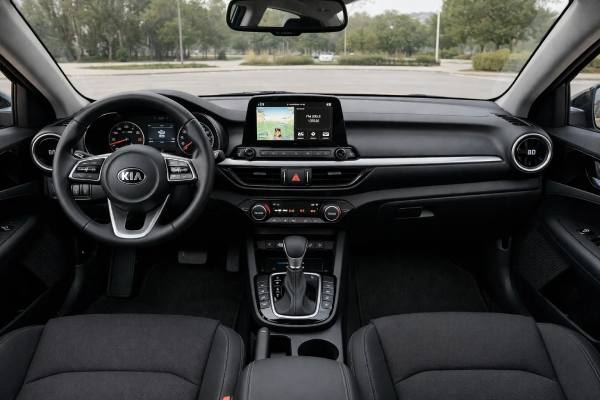
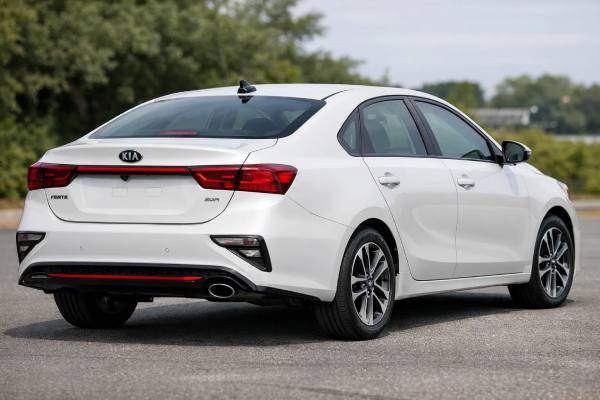
The 2019–2021 Kia Kia Forte (BD) with the 2.0-liter Nu MPI engine is the “quietly sensible” version of the Forte lineup: straightforward port injection, a high compression ratio tuned for efficiency, and widely available parts and service knowledge. In daily use, the appeal is balance. You get a roomy compact sedan with predictable handling, a large trunk, and fuel economy that can be excellent on the highway—without the added complexity of a turbo or direct injection on this engine variant.
For owners, the biggest wins are consistency and cost control: the 2.0 MPI is generally tolerant of regular fuel and typical commuting, and the platform is easy to keep on schedule if you stick to fluid and filter intervals. The main ownership “tells” are the transmission choice (manual vs i-CVT), the headlight and driver-assist equipment by trim, and whether prior service was done with the right fluids and software updates.
Owner Snapshot
- Strong highway economy is realistic at 100–120 km/h when tyres and alignment are in good shape.
- The 2.0 MPI avoids the common GDI carbon-buildup pattern, which helps long-term drivability.
- Cabin and trunk space are standout strengths for a compact sedan in this price class.
- Plan for i-CVT fluid service earlier than “lifetime” if you keep the car long-term.
- A practical baseline: engine oil and filter every 12,000 km (or 12 months), sooner in severe use.
Contents and shortcuts
- Kia Forte BD 2.0 MPI profile
- Kia Forte BD specs and capacities
- Kia Forte BD trims and safety tech
- Common faults and service bulletins
- Maintenance plan and buying tips
- Road manners and real economy
- Rival comparison for 2019-2021
Kia Forte BD 2.0 MPI profile
This BD-generation Forte (2019–2021) pairs a 2.0-liter naturally aspirated inline-four with multi-port injection (MPI) and either a 6-speed manual or an intelligent continuously variable transmission (i-CVT). The “Nu” family design leans toward efficiency: it uses a high compression ratio and modern valve timing control to pull good fuel economy from a simple, non-turbo layout. For most owners, that translates into easy cold starts, predictable throttle response, and fewer fuel-system surprises than some direct-injection setups when the car ages.
In the real world, the Forte’s strengths show up in the basics: stable straight-line behavior, composed ride quality for a compact sedan, and a genuinely useful back seat and trunk. It’s also a car that’s easy to live with in mixed climates because it does not require special fuel, warm-up rituals, or niche service procedures. If you’re shopping used, service history matters more than low mileage alone—especially proof of routine oil changes, correct filters, and any transmission or software updates.
The trade-offs are also straightforward. The 147 hp output is adequate rather than quick, so passing power depends on your transmission and your expectations. The i-CVT is tuned to keep revs low and smooth, which helps economy but can feel “elastic” under hard acceleration. Wind and tyre noise vary more by trim and tyre choice than by engine type; lower-profile tyres typically add more road noise, especially as they age.
Who is this specific variant best for?
- Daily commuters who want low drama ownership and predictable running costs
- Drivers who value cabin room and trunk space more than outright speed
- Buyers who plan to keep the car past 150,000 km and want a simpler powertrain
- Anyone who prefers an MPI engine for long-term fuel-system cleanliness and repairability
If you maintain it like a long-term asset—fluids, filters, tyres, alignment, and brakes—the Forte BD 2.0 MPI can be one of the more cost-stable compact cars in its class.
Kia Forte BD specs and capacities
Below are practical, ownership-focused specifications for the 2019–2021 Forte BD 2.0 MPI (147 hp). Some values vary by trim, market, wheels/tyres, and transmission, so treat this as a configuration guide and verify against your VIN-specific documentation.
Powertrain and efficiency
| Item | Specification |
|---|---|
| Code | Nu 2.0 MPI (Nu family; code naming varies by market) |
| Engine layout and cylinders | I-4, DOHC, 16-valve, dual CVVT (4 cyl) |
| Bore × stroke | 81.0 × 97.0 mm (3.19 × 3.82 in) |
| Displacement | 2.0 L (1,999 cc) |
| Induction | Naturally aspirated (NA) |
| Fuel system | MPI (multi-port fuel injection) |
| Compression ratio | 12.5:1 |
| Max power | 147 hp (110 kW) @ 6,200 rpm |
| Max torque | 179 Nm (132 lb-ft) @ 4,500 rpm |
| Timing drive | Chain |
| Rated efficiency (typical US trims) | ~6.7–7.1 L/100 km (35–33 mpg US combined) |
| Real-world highway @ 120 km/h | Often ~6.2–7.0 L/100 km depending on tyres, wind, and load |
Transmission and driveline
| Item | Specification |
|---|---|
| Transmission (common) | 6-speed manual or i-CVT |
| Drive type | FWD |
| Differential | Open |
Chassis and dimensions
| Item | Specification |
|---|---|
| Suspension (front/rear) | MacPherson strut / torsion beam |
| Steering | Electric power steering; typical ratio ~13.9:1 |
| Brakes (front/rear) | Disc / disc (size varies by trim) |
| Brakes diameter (typical) | Front ~280 mm (11.0 in); rear ~262 mm (10.3 in) |
| Wheels/tyres (popular sizes) | 205/55 R16, 225/45 R17, 225/40 R18 (by trim) |
| Ground clearance | ~135 mm (5.3 in) |
| Length / width / height | ~4,641 / 1,800 / 1,435 mm (182.7 / 70.9 / 56.5 in) |
| Wheelbase | 2,700 mm (106.3 in) |
| Turning circle (kerb-to-kerb) | ~10.6 m (34.8 ft) |
| Kerb weight (typical range) | ~1,260–1,330 kg (2,780–2,930 lb) |
| Fuel tank | 53 L (14.0 US gal / 11.7 UK gal) |
| Cargo volume | ~428 L (15.3 ft³) seats up (method varies) |
Performance and capability (typical)
| Item | Typical result (varies by trim and conditions) |
|---|---|
| 0–100 km/h (0–62 mph) | ~8.5–9.5 s (i-CVT often mid range; manual varies) |
| Top speed | ~190–205 km/h (118–127 mph) |
| Braking 100–0 km/h | ~38–41 m (tyres and pad compound matter most) |
| Towing capacity | Often not rated or very limited in many markets (verify locally) |
| Payload | Varies by trim; check door-jamb label |
Fluids and service capacities (decision-useful)
| Item | Specification |
|---|---|
| Engine oil | API SP / ILSAC GF-6 (common); 0W-20 or 5W-20 depending on market; 4.0 L (4.2 US qt) |
| Coolant | Ethylene glycol-based long-life coolant; mix ratio commonly 50/50; capacity varies by system and drain method |
| Transmission fluid (i-CVT) | Use the exact OEM CVT fluid spec for your market; capacity varies by service type |
| Brake fluid | DOT 3 or DOT 4 (market dependent) |
| A/C refrigerant | R-1234yf or R-134a depending on market and build (verify under-hood label) |
| Key torque specs (common decision points) | Typical range |
|---|---|
| Wheel lug nuts | Often ~88–108 Nm (65–80 lb-ft); verify by wheel type |
If you want one takeaway from the tables: the BD Forte is modern in calibration and safety equipment, but mechanically uncomplicated—ideal for owners who prioritize predictability over novelty.
Kia Forte BD trims and safety tech
Trim structure varies by country, but the 2019–2021 Forte BD usually follows a familiar ladder: an efficiency-focused base (often “FE” in the US), mainstream mid trims (LXS/S), and a more equipped top trim (EX or similar). The key for used buyers is not the badge alone—it’s the equipment combination that affects comfort, safety ratings, and ownership cost.
Trims and option patterns that matter
- FE-style trims (efficiency oriented): Often lighter wheels, narrower tyres, and calibration aimed at best fuel economy. Great for commuting, but check whether driver-assist features are included or optional.
- Mid trims (value sweet spot): These commonly bring better infotainment, upgraded upholstery, and more available safety tech without the highest tyre costs.
- Upper trims (comfort and convenience): Usually add larger wheels, more features, and sometimes better headlights—yet larger wheels can increase tyre replacement cost and road noise.
Quick identifiers when inspecting in person:
- Wheels/tyres: 16-inch packages usually ride quieter and cost less; 17/18-inch packages look better but can be louder and more sensitive to alignment.
- Headlights: Headlight type can affect both night visibility and third-party safety evaluations; confirm whether you have halogen or LED/projector units.
- ADAS buttons and cluster icons: Look for steering wheel and dash indicators for lane support, adaptive cruise (if fitted), and forward collision systems.
Safety ratings and what they mean in practice
This generation earned strong results in several crash-test categories, but it’s important to understand that tests evolve. Some later “updated” crash protocols can change how earlier model years are viewed. When you read safety ratings, focus on:
- Which test version was used (older vs updated side-impact or frontal protocols)
- Headlight performance (often rated separately and can vary by trim)
- Front crash prevention availability (standard vs optional packages)
Safety systems and ADAS checklist
Typical BD Forte safety and driver assistance features (varies by trim/market):
- Core safety: front, side, and curtain airbags; ABS; electronic stability control; traction control; brake assist
- Child-seat provisions: LATCH/ISOFIX anchors (confirm condition and access; check rear seatbelt retraction)
- Driver assistance (may be standard or optional):
- AEB (automatic emergency braking) for vehicle and sometimes pedestrian detection
- Lane keeping assist / lane following support (camera-based; sensitive to windshield replacements and calibration)
- Blind-spot monitoring and rear cross-traffic alert (radar-based; check for bumper repairs)
- Adaptive cruise control on some configurations (less common on basic trims)
Service implication: after windshield replacement, front camera alignment may require calibration. Likewise, bumper repairs can disturb radar alignment, causing warning lights or inconsistent AEB/ACC behavior. For a used car, a clean scan for driver-assist fault codes—and proof of proper calibration after bodywork—matters as much as the feature list itself.
Common faults and service bulletins
The Forte BD 2.0 MPI’s reputation is mainly about “normal car” problems rather than powertrain drama. Still, the used market rewards buyers who know where issues cluster by mileage, usage, and trim. Below is a practical map by prevalence and cost tier, with symptoms and remedies you can actually act on.
Common (low to medium cost)
- Tyre noise and steering shimmy (40,000–100,000 km):
- Symptoms: humming that rises with speed, mild steering vibration at 90–120 km/h
- Likely causes: uneven tyre wear, out-of-round tyre, alignment drift, or bent wheel
- Remedy: road-force balance, alignment, rotate tyres regularly; replace tyres in matched sets when wear is uneven
- Brake squeal or pulsation (30,000–80,000 km):
- Symptoms: squeal at low speed, steering shake under braking
- Likely causes: pad material glazing, rotor hot spots, or stuck slide pins
- Remedy: clean/lube caliper slides, measure rotor runout, replace pads/rotors with quality parts, bed-in properly
- Battery and charging complaints (3–5 years):
- Symptoms: slow cranking, start-stop behavior (if equipped), random warning lights
- Likely causes: ageing 12 V battery, poor terminal contact
- Remedy: battery test under load, clean terminals, verify alternator output
Occasional (medium cost)
- i-CVT shudder, flare, or “rubber band” feel (60,000–160,000 km):
- Symptoms: judder on takeoff, delayed engagement, rising revs without matching acceleration
- Likely causes: old CVT fluid, software calibration needs, driving on mismatched tyre diameters
- Remedy: verify correct CVT fluid spec, consider proactive drain-and-fill service, ensure tyres are matched, request dealer-level software checks
- A/C performance drop (hot climates, higher mileage):
- Symptoms: weak cooling at idle, intermittent cold air
- Likely causes: low refrigerant charge, condenser airflow restriction, fan issues
- Remedy: leak check and correct recharge per under-hood label; inspect condenser and fan operation
Rare (higher cost but important)
- Cooling system leaks or overheating events:
- Symptoms: coolant smell, low reservoir, temperature spikes
- Likely causes: hose seepage, radiator end tank leak, water pump seep (varies)
- Remedy: pressure test cooling system; fix leaks early to avoid head gasket risk
Recalls, service actions, and how to verify
Rather than memorizing recall headlines, treat this as a process:
- Run the VIN in the official recall database and print the results.
- Ask for dealer service history showing recall completion dates.
- Scan for warning lights and stored codes—especially ABS/ESC and driver-assist modules.
This approach is more reliable than relying on generic “year-based” lists, because recall applicability depends on build date, supplier batch, and market.
Maintenance plan and buying tips
A Forte BD 2.0 MPI will usually reward boring maintenance. The goal is to prevent the two big cost-creep patterns in compact cars: neglected fluids and neglected tyres/alignment. Below is a practical schedule suitable for long-term ownership; adjust to your climate and duty cycle.
Practical maintenance schedule (distance or time)
- Engine oil and filter: every 12,000 km or 12 months (severe use: 6,000–8,000 km or 6 months). Use the viscosity and spec listed for your market.
- Tyre rotation: every 8,000–10,000 km; check pressures monthly.
- Engine air filter: inspect every 15,000 km; replace around 30,000–45,000 km (dusty areas sooner).
- Cabin air filter: every 15,000–20,000 km or annually (easy comfort win).
- Brake fluid: every 2 years regardless of mileage (moisture control).
- Coolant: commonly around 160,000–200,000 km or 8–10 years for first change, then shorter intervals (verify your manual).
- Spark plugs: often long-life iridium; typically 150,000–160,000 km, but confirm for your exact VIN/market.
- i-CVT fluid (if equipped): if you plan to keep the car long-term, consider a preventive service around 60,000–100,000 km depending on use (heat and city driving shorten fluid life).
- Manual transmission gear oil (if equipped): inspect for leaks; consider service around 100,000–150,000 km based on feel and usage.
- Serpentine belt and hoses: inspect at every oil service once past 80,000 km; replace at first signs of cracking or glazing.
- Alignment: check yearly or anytime you replace tyres or hit major potholes.
Buyer’s guide: what to inspect on a used car
Bring a checklist and be systematic:
- Cold start behavior: smooth idle within seconds; no persistent ticking, no unstable rpm.
- Transmission feel:
- i-CVT should engage smoothly from stop and remain consistent under light throttle.
- Manual should shift cleanly without synchro crunch; clutch take-up should be predictable.
- Tyres and alignment clues: uneven inner-edge wear often signals alignment neglect.
- Brakes: test for pulsation; inspect pad thickness and rotor condition.
- Cooling system: look for dried coolant residue around hoses/radiator; confirm stable operating temperature.
- Electronics and ADAS: ensure warning lights illuminate at key-on and go out after start; test camera/radar features if equipped.
- Bodywork tells: mismatched paint texture, overspray, or non-OEM bumper clips can hint at prior repairs—important for radar and camera alignment.
Best value recommendation: for most buyers, a mid trim with 16- or 17-inch wheels and documented maintenance is the sweet spot. Avoid cars with mismatched tyres, patchy service history, or unresolved warning lights—even if the price looks attractive.
Road manners and real economy
On the road, the Forte BD feels engineered for calm commuting rather than excitement—and that’s a compliment if you drive it daily. The steering is light to moderate with quick-enough response for city lanes, and the chassis stays composed over typical broken pavement. The rear torsion-beam layout is space-efficient and generally durable, though it can feel a little busier over sharp bumps than an independent rear suspension. That said, the Forte’s overall balance is good: it tracks straight at highway speed, doesn’t feel twitchy in crosswinds, and remains easy to place in traffic.
Powertrain character (2.0 MPI)
The 2.0 MPI delivers its power progressively. Around-town torque is adequate, but it is not a “punchy” engine at low rpm. For passing, you’ll often need a firmer throttle input, especially with passengers or on long grades.
- With i-CVT: expect smooth acceleration and low cruising rpm. Under hard throttle, the i-CVT may hold higher rpm to stay in the power band, which can make the engine sound busy even if the car is accelerating normally.
- With 6-speed manual: the engine feels more responsive because you control rpm directly, and it can make the car feel quicker than the numbers suggest.
Ride, handling, and NVH
- Ride: Generally comfortable; smaller wheels tend to feel more settled and quieter.
- Handling: Predictable front-drive balance. It resists understeer reasonably well for a compact, but tyres make the biggest difference.
- Braking feel: Typically consistent. If the pedal feels soft, start with brake fluid condition and pad/rotor inspection.
- Noise: Wind noise is moderate; tyre pattern noise becomes the dominant factor as tyres age.
Real-world efficiency
For most owners, fuel economy depends more on speed and tyres than on minor engine differences:
- City: often around 7.5–8.8 L/100 km (27–31 mpg US) depending on traffic and warm-up time
- Highway (100–120 km/h): often around 6.2–7.0 L/100 km (34–38 mpg US)
- Mixed driving: commonly 6.7–7.6 L/100 km (31–35 mpg US)
Cold weather can raise consumption noticeably because warm-up time is longer and winter tyres add rolling resistance. If you want the best results, keep tyres properly inflated, avoid mismatched tyre brands/sizes, and keep alignment in spec.
Rival comparison for 2019-2021
In the compact segment, the Forte BD 2.0 MPI competes on value, practicality, and low operating stress. Here’s how it typically compares to key rivals in the same era, focusing on the factors that matter after the test drive.
Versus Honda Civic (1.5T or 2.0 NA)
A Honda Civic often feels more athletic, with sharper steering response and strong resale. If you shop a turbo Civic, you gain torque but add turbo-related complexity compared with a naturally aspirated MPI Forte. If you prioritize a calmer, simpler long-term powertrain, the Forte’s 2.0 MPI can be easier to budget. If you prioritize handling polish and a sportier drive, the Civic usually wins.
Versus Toyota Corolla (2.0 or 1.8, depending on market)
A Toyota Corolla tends to lead on long-term durability reputation and consistency. The Forte often counters with more cabin space for the money and a strong feature set in mid trims. Ownership cost differences frequently come down to tyres, insurance, and how well the previous owner maintained fluids—not just brand reputation.
Versus Mazda3 (2.0/2.5)
A Mazda3 is a benchmark for interior feel and driver engagement. It can also cost more to buy used in comparable condition. If you care about steering feel, cabin materials, and a more “premium compact” vibe, Mazda3 is compelling. If you care about a roomy back seat, a large trunk, and cost-stable commuting, the Forte looks better.
Versus Hyundai Elantra (related platform)
The Hyundai Elantra often shares similar engineering themes. Differences come down to trim packaging, availability of specific safety features, and local pricing. In either case, choose based on condition, service records, and the exact safety and lighting equipment—not just the badge.
The Forte BD 2.0 MPI advantage
If you want a compact car that is easy to own beyond 5–7 years, the Forte’s combination of port injection simplicity, practical space, and widely available service makes it a smart shortlist candidate. Shop with discipline: prioritize maintenance history, correct tyres, and a clean electrical scan over low mileage alone.
References
- 2021 Kia Forte Specifications 2021
- Gas Mileage of 2021 Kia Forte 2021
- 2019 Kia Forte 4-door sedan 2019 (Safety Rating)
- Check for Recalls: Vehicle, Car Seat, Tire, Equipment 2026 (Recall Database)
- Owners Manuals and Documents 2026 (Owner’s Manual)
Disclaimer
This article is for informational purposes only and is not a substitute for professional diagnosis, inspection, or repair. Specifications, torque values, fluid types, capacities, maintenance intervals, and procedures can vary by VIN, market, production date, and equipment. Always verify details using official service information for your exact vehicle and follow manufacturer procedures.
If this guide helped, consider sharing it on Facebook, X/Twitter, or your favorite forum to support our work.