
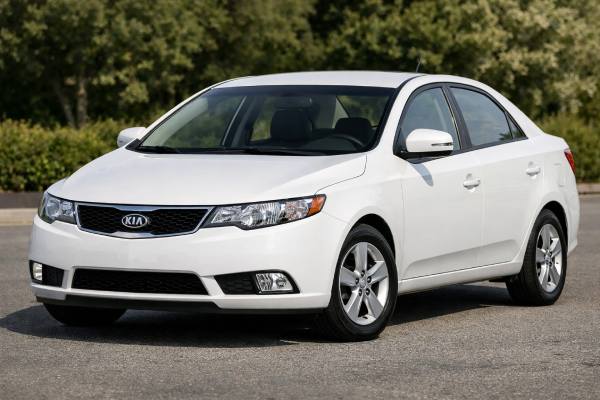
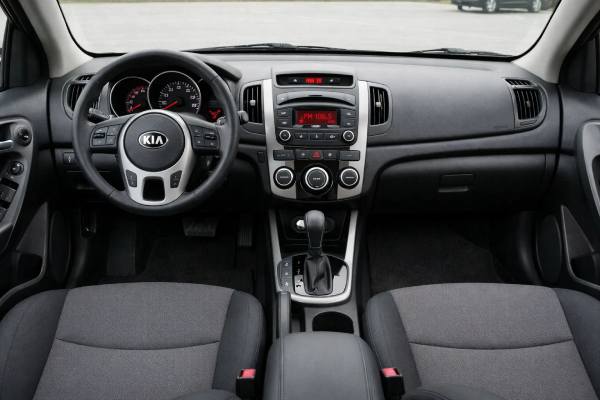
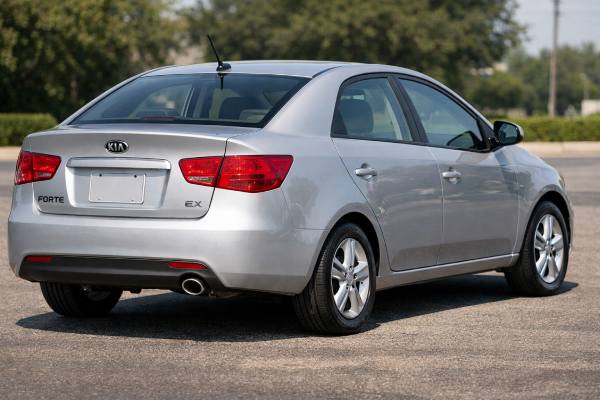
The 2012–2013 facelift Kia Forte (TD) with the 2.4-liter Theta II and 173 hp is the “sleeper” spec in the lineup: it looks like a compact commuter, but it carries mid-pack power and an honest, mechanical feel that many newer compacts have smoothed away. The core engineering story is simple—an aluminum-block inline-four, a conventional 6-speed manual or 6-speed automatic, and straightforward front-wheel drive. What matters for owners is how those choices age: the chassis is generally durable and inexpensive to keep tight, while the engine family has a known reputation that makes maintenance quality and recall history especially important. If you shop carefully and service it on time, it can be a rewarding daily driver with real passing power and a solid safety structure for its era.
What to Know
- Strong 2.4 l torque for merging and passing, especially with the 6-speed automatic.
- Simple, conventional drivetrain means fewer “high-tech” failure points than newer compacts.
- Sport-oriented SX equipment can add comfort and grip without a big weight penalty.
- Ownership caveat: confirm engine-related recalls and software updates were completed before purchase.
- Typical interval: change engine oil every 6,000–8,000 km (4,000–5,000 mi) in severe use, or follow the normal-service schedule if your driving truly qualifies.
Quick navigation
- Kia Forte TD facelift profile
- Kia Forte TD 2.4 specs and measurements
- Kia Forte TD SX trims and safety equipment
- Reliability hotspots and recall history
- Maintenance plan and smart buying checks
- Real-world driving and fuel use
- How it stacks up against compact rivals
Kia Forte TD facelift profile
This facelift-era Forte (TD) pairing—the 2.4 l Theta II with 173 hp—sits at the top of the non-turbo range for 2012–2013. In most markets that received it, the 2.4 was tied to sportier trims (often SX), which matters because the “engine upgrade” is usually bundled with bigger wheels/tires, firmer suspension tuning, and more convenience features. In other words, you are not just buying power; you are also buying a specific equipment philosophy.
From an engineering viewpoint, the layout is conventional: front engine, front-wheel drive, a transversely mounted inline-four, and either a 6-speed manual or a 6-speed electronically controlled automatic. That conventional formula is an advantage in long-term ownership because parts availability is broad and many repairs are familiar to independent shops.
Where this model needs a more careful owner is the engine family reputation. “Theta II” is a large umbrella that includes variants with different fuel systems and calibrations. On this 173 hp application, the 2.4 is typically a multi-port injected (MPI) setup, tuned for regular fuel and midrange response rather than headline numbers. The upside is predictable drivability; the downside is that engine health depends heavily on oil quality, oil level discipline, and whether official recall actions and software logic updates were performed.
As a daily driver, the 2.4 Forte’s real charm is how “complete” it feels for an early-2010s compact: hydraulic steering (in many builds) gives more natural feedback than some later electric systems, and the chassis is stable at highway speed. If you want a compact that still feels mechanical, and you are willing to verify history and maintain it proactively, this variant can be a strong value.
Kia Forte TD 2.4 specs and measurements
Below are the key specifications that define the 2012–2013 facelift Forte (TD) with the 2.4 l 173 hp output. Numbers can vary slightly by emissions certification (for example, SULEV versions), market, and body style, so treat these as a strong baseline and verify against your VIN-specific documentation.
Powertrain and efficiency (2.4 l / 173 hp)
| Item | Specification |
|---|---|
| Engine code/family | Theta II 2.4 l (MPI application in this output class) |
| Layout | Inline-4, aluminum block and head |
| Valvetrain | DOHC, 4 valves/cyl, CVVT |
| Displacement | 2.4 l (2,359 cc) |
| Induction | Naturally aspirated |
| Fuel system | MPI (multi-port injection) |
| Compression ratio | 10.5:1 |
| Max power | 173 hp (129 kW) @ 6,000 rpm |
| Max torque | 168 lb-ft (228 Nm) @ 4,000 rpm |
| Timing drive | Chain |
| Transmission | 6-speed manual or 6-speed automatic with manual mode |
| Drive type | FWD |
| Rated efficiency (EPA est., 2.4) | MT: 22/32 mpg (US) city/hwy; AT: 23/32 mpg (US) city/hwy |
| Rated efficiency (metric) | AT city ≈ 10.2 L/100 km; AT highway ≈ 7.4 L/100 km |
Chassis, dimensions, and capacities (sedan baseline)
| Item | Specification |
|---|---|
| Front suspension | Independent MacPherson strut, stabilizer bar |
| Rear suspension | Torsion beam, coil springs |
| Steering | Rack and pinion, hydraulic assist (typical for this generation) |
| Turning circle (kerb-to-kerb) | 35.4 ft (10.8 m) for SX spec shown |
| Brakes (front/rear) | 11.8 in vented disc / 10.3 in solid disc (SX) |
| Wheels/tires (popular 2.4 fitment) | 215/45 R17 |
| Wheelbase | 104.3 in (2,649 mm) |
| Length / width / height | 178.3 / 69.9 / 57.5 in (4,529 / 1,775 / 1,461 mm) |
| Track (front/rear) | 61.3 / 61.6 in (1,557 / 1,565 mm) |
| Ground clearance | 5.9 in (150 mm) |
| Passenger volume | 96.8 ft³ (2,741 L) |
| Cargo volume (seats up) | 14.7 ft³ (416 L) |
| Fuel tank | 13.7 US gal (51.9 L) |
Weight (2.4 l trim baseline)
| Transmission | Curb weight |
|---|---|
| 6MT | 2,849 lb (1,292 kg) |
| 6AT | 2,898 lb (1,314 kg) |
Performance (typical real-world expectations)
Because published acceleration varies by tire, transmission, and test method, the most realistic way to think about performance is as a range:
- 0–60 mph (0–97 km/h): commonly mid–7 to low–8 seconds (6AT usually a touch quicker than 6MT in casual launches).
- Passing (50–80 mph / 80–120 km/h): noticeably stronger than 2.0 l compacts of the era, especially at highway speeds.
- Top speed: typically in the ~115–120 mph (185–193 km/h) neighborhood, governed by gearing, power, and tire rating.
If you want the 2.4 Forte for its “effortless” feel, prioritize tires, brakes, and suspension condition; those determine whether the extra power feels controlled or merely fast in a straight line.
Kia Forte TD SX trims and safety equipment
For the facelift 2012–2013 period, most buyers encounter the 2.4 l 173 hp engine in the upper trims, often labeled SX (market naming can differ). The practical takeaway is that shopping “the engine” usually means shopping “the package,” because the 2.4’s ownership experience is shaped by wheel/tire size, brake hardware, and the options the trim brings along.
Trims and options that matter mechanically
Even if trim names vary, look for these functional identifiers:
- 2.4 l badge/trim association: Typically the top trim pairing.
- 17-inch wheel package: Common on 2.4 trims (often 215/45R17). This improves lateral grip and steering response but increases tire replacement cost and makes alignment condition more noticeable.
- Front brake size: The SX-spec front discs are larger than lower trims, which helps repeated stops and mountain driving.
- Sport-tuned suspension: Many 2.4 trims include firmer damping and spring rates. It is still a daily-driver setup, but it will feel more controlled than the softest trim on broken pavement.
Option packages tend to bundle comfort and convenience items rather than drivetrain changes. When comparing cars, focus on condition: a well-kept mid-trim car can be a better buy than a neglected “loaded” example.
Safety structure and ratings
This generation of Forte earned strong structural marks for its time. In the U.S., the model-year coverage commonly applies across 2010–2013 for several test results, but you should still confirm the body style and exact year applicability.
- IIHS crashworthiness: Often rated “Good” in key categories for the generation and recognized with Top Safety Pick criteria in certain configurations.
- Crash avoidance/mitigation: Modern automatic emergency braking (AEB) was generally not available in this era on this model, so don’t expect contemporary crash-avoidance capability.
Safety systems and driver assistance (what you actually get)
Expect a solid baseline of “passive and stability” safety, with limited ADAS:
- Airbags: Typically front, front-side, and side-curtain coverage (confirm exact count by market).
- ESC and traction control: Commonly standard, and important on 17-inch tire setups in wet or cold conditions.
- ABS: Standard on most trims, with electronic brake-force distribution integrated.
- Child seat anchors: LATCH/ISOFIX provisions are typically present; verify rear-seat anchor condition and that covers/clips are intact.
Because ADAS is minimal, the best safety upgrades for this car are simple: high-quality tires, fresh brake fluid, correct alignment, and headlights in good condition. Those four items often do more for real-world safety than chasing a rare option package.
Reliability hotspots and recall history
A well-kept 2.4 Forte can be reliable, but it rewards owners who pay attention to patterns. Below is a practical issue map by prevalence and cost severity. Mileage bands are broad because driving style and maintenance history dominate outcomes.
Common (plan for it)
- Wear-item suspension looseness (low–medium cost):
Symptoms: clunks over bumps, uneven tire wear, vague turn-in.
Likely causes: worn end links, control arm bushings, or tired dampers.
Remedy: replace worn joints/bushings; align afterward. On 17-inch tires, small geometry errors show up quickly. - Brake service sensitivity (low–medium cost):
Symptoms: steering shake under braking, squeal, or soft pedal.
Likely causes: warped rotors from overheating, cheap pad material, old brake fluid.
Remedy: quality pads/rotors, torque wheels evenly, flush brake fluid on schedule. - Ignition and sensor aging (low cost):
Symptoms: occasional misfire, hesitation, check engine light.
Likely causes: coil or plug wear, crank/cam sensor aging, vacuum leaks.
Remedy: replace plugs at the proper interval; address codes early to avoid catalyst damage.
Occasional (inspect carefully)
- Cooling system seepage (medium cost):
Symptoms: slow coolant loss, sweet smell, wet residue near hoses or radiator seams.
Likely causes: aging hose clamps, radiator end tank seep, thermostat housing seals.
Remedy: pressure test; fix leaks before overheating events. - Automatic transmission shift quality changes (medium cost):
Symptoms: delayed engagement, flare on upshift, harsh 2–3 shift when cold.
Likely causes: old fluid, adaptation drift, mount wear.
Remedy: correct-spec fluid service (not a universal ATF), verify mounts, consider dealer-level scan for adaptation updates if symptoms persist.
Rare but high impact (treat as a gatekeeper)
- Engine bearing/knock risk and fire-related recalls (high cost):
Symptoms: ticking that becomes knocking, low oil pressure warning, metal in oil, smoke or burning smell, sudden loss of power.
Likely causes: internal wear progressing to bearing damage; in some cases debris or lubrication issues.
Remedy: This is where recall and service history matter. Confirm recall completion, confirm any software logic updates were applied, and avoid examples with unknown oil-change history.
Recalls, service actions, and how to verify
For this generation and engine family, there have been safety recalls and field actions related to engine compartment fire risk and related components on certain production ranges. The most practical advice is:
- Run the official VIN recall check before money changes hands.
- Ask for dealer repair orders showing completion, not just a seller’s claim.
- During inspection: look for evidence of overheating, oil neglect (sludge), and warning lights.
A clean, consistent maintenance record is more valuable here than low mileage. A higher-mile car with documented oil services and completed recall work can be the safer bet.
Maintenance plan and smart buying checks
If you want this Forte to last, treat maintenance as a system: fluids, filtration, and early diagnosis. The 2.4 l’s long-term health depends heavily on oil quality and level, and the chassis rewards routine inspections—especially with the 17-inch tire package.
Practical maintenance schedule (distance/time)
Use the “severe service” schedule if you do frequent short trips, heavy traffic, hot weather idling, dusty roads, or aggressive driving.
- Engine oil and filter: every 6,000–8,000 km (4,000–5,000 mi) severe; up to ~12,000 km (7,500 mi) if genuinely normal use. Check oil level every fuel fill for the first month of ownership.
- Engine air filter: inspect every 12 months; replace every 24 months or sooner in dust.
- Cabin air filter: every 12 months (often overlooked, big comfort gain).
- Coolant: typically 5 years/100,000 km (60,000 mi) as a planning target, but verify the coolant type and service history; test freeze/boil protection if unknown.
- Spark plugs: commonly 160,000 km (100,000 mi) on long-life plugs, but earlier replacement can improve smoothness and protect coils if the history is unknown.
- Automatic transmission fluid: drain-and-fill intervals vary by usage; a conservative plan is every 50,000–80,000 km (30,000–50,000 mi) if you want long life. Use the correct spec fluid.
- Brake fluid: every 2 years regardless of mileage.
- Brake pads/rotors: inspect every tire rotation; replace based on thickness, not noise.
- Tire rotation: every 8,000–10,000 km (5,000–6,000 mi); align yearly or when you see uneven wear.
Fluid specs and service decision notes (verify by VIN)
Because exact capacities vary by transmission, cooler, and market, treat the numbers below as decision guidance:
- Engine oil: typically 5W-20 or 5W-30 depending on climate and manual; many owners use 5W-20 for economy and 5W-30 for heat margin. Capacity is commonly around 4.0–4.5 L (4.2–4.8 US qt) with filter.
- ATF: use the manufacturer-specified fluid family (commonly SP-IV era spec). A drain-and-fill often replaces ~3–4 L; total fill is higher.
- Coolant: use the correct long-life coolant type; never mix unknown chemistries.
Key torque specs (critical fasteners only)
These vary by wheel size, brake package, and market, so verify, but common “must get right” items include:
- Wheel lug nuts: tighten evenly with a torque wrench (most compacts land around 90–110 Nm / 66–81 lb-ft).
- Brake caliper bracket bolts: high-torque fasteners; improper torque causes noise and uneven pad wear.
Buyer’s guide: what to check before purchase
Bring this checklist to a pre-purchase inspection:
- Recall completion proof: VIN report plus dealer paperwork where possible.
- Cold start behavior: listen for ticking/knock; watch for smoke; confirm idle stability.
- Oil condition: pull the dipstick—look for metallic glitter, burnt smell, or very dark thick oil.
- Cooling system pressure: check for dried coolant residue, swollen hoses, or repeated top-offs.
- Transmission behavior: ensure smooth engagement from Park to Drive and consistent upshifts under light throttle.
- Tire wear pattern: uneven inner wear often points to alignment or worn rear bushings.
- Brake feel: vibration suggests rotor issues; a soft pedal suggests old fluid or air.
Best long-term outlook usually comes from cars with boring histories: regular oil changes, documented fluid services, and no “mystery overheating” stories.
Real-world driving and fuel use
The 2.4 l Forte’s driving personality is defined by usable midrange torque rather than a peaky top end. Around town, it feels more relaxed than many 2.0 l compacts because it needs less throttle to keep pace. On the highway, it’s the passing response—especially from 60–110 km/h (40–70 mph)—that makes this variant feel like the “right” engine for the platform.
Ride, handling, and NVH
With the common 17-inch tire package, the chassis is typically composed and stable, with a firmer edge over sharp impacts than lower trims on taller sidewalls. Steering feel is often more natural than many later electric systems, and straight-line tracking is good when the alignment is correct. Cabin noise is “early 2010s compact”: acceptable at city speeds, with noticeable tire and wind noise at 110–120 km/h (70–75 mph), especially on worn or aggressive tread patterns.
Braking feel depends heavily on maintenance. Fresh fluid and quality pads make a bigger difference than many owners expect. Because the 2.4 trim often carries larger front brakes, it tends to hold up better on long downhill grades—provided the rotors are not already heat-spotted.
Powertrain character
- Throttle response: generally linear and predictable; it feels strongest in the midrange.
- Automatic behavior: the 6-speed automatic is conventional and usually smooth; it may downshift readily for hills or passing, and old fluid can make it feel hesitant or abrupt.
- Manual behavior: the 6MT gives more direct control, but clutch feel and shift quality depend on usage and mount condition.
Real-world efficiency
EPA estimates for the 2.4 are in the low-to-mid 20s city and low 30s highway (mpg US), which is respectable for the power but not class-leading. In real life:
- City: 10–11 L/100 km (21–24 mpg US) depending on traffic and warm-up time.
- Highway (100–120 km/h / 60–75 mph): 7.0–8.0 L/100 km (29–34 mpg US) on flat roads with good tires.
- Cold weather: expect a meaningful drop if trips are short and the engine rarely warms fully.
If your goal is to maximize economy, the simplest wins are tire pressure, a clean air filter, fresh plugs when due, and avoiding cheap “sticky” tires that add rolling resistance.
Performance metrics that change the verdict
If you’re choosing between the 2.0 and the 2.4, the difference you actually feel is not 0–60 bragging rights—it’s how little effort it takes to merge, climb grades, and pass without planning. The 2.4 makes the Forte feel less stressed, which can improve everyday comfort and, for some drivers, reduce the temptation to floor it constantly.
How it stacks up against compact rivals
In the 2012–2013 compact class, this 2.4 Forte sits in an interesting spot: it’s quicker than many base-engine rivals, usually cheaper than the segment’s resale champions, and simple enough to keep running without specialty tooling. The trade is that some competitors deliver better fuel economy, quieter cabins, or a stronger long-term reputation without the same engine-family scrutiny.
Here’s how it typically compares:
- Honda Honda Civic (2012–2013 era): Often feels more refined and can hold value better. The Forte 2.4 fights back with stronger torque and often a lower purchase price for similar equipment. If you want the safest resale bet, Civic usually wins; if you want more power per dollar, the Forte can win.
- Toyota Toyota Corolla: Corolla is the “appliance” choice—smooth, efficient, and usually forgiving. The Forte 2.4 is more engaging and quicker, but demands more diligence on maintenance and recall verification.
- Mazda Mazda3: Mazda3 often leads for steering feel and handling balance. The Forte can be close in everyday stability, and the 2.4 gives satisfying shove, but the Mazda’s chassis polish is hard to beat.
- Hyundai Hyundai Elantra: Shares some platform-era thinking and can be a very rational alternative. Depending on exact engine and year, the shopping advice is similar: buy the best-maintained example with the cleanest records.
- Ford Ford Focus and Chevrolet Chevrolet Cruze: These can offer good road manners and features, but powertrain complexity and model-specific issues vary widely by engine/transmission. The Forte’s advantage is its conventional drivetrain layout and typically straightforward service path.
The Forte 2.4’s strongest “rival-proof” advantages
- Power without turbo complexity: a naturally aspirated 2.4 feels immediate and predictable.
- Simple mechanical package: easier independent-shop ownership than many later small cars.
- Equipment value: the 2.4 is often bundled with features that make the car feel a class up.
The main reason to choose a rival instead
If you want maximum peace-of-mind with minimal homework, some rivals make it easier: you may not need to think as much about recall campaigns, oil history, or engine-family reputations. With this Forte, doing that homework is the price of admission—and it can pay off if the car you find is a good one.
References
- 2013 Kia Forte Specifications 2013 (Specifications)
- 2013 Kia Forte Features & Options 2013 (Features and Options)
- 2013 Kia Forte 2013 (Safety Rating)
- Gas Mileage of 2013 Kia Forte 2013 (Fuel Economy Database)
- Part 573 Safety Recall Report 20V-750 2020 (Recall Report)
Disclaimer
This article is for informational purposes only and is not a substitute for professional inspection, diagnosis, or repair. Specifications, torque values, fluid types, capacities, maintenance intervals, and procedures can vary by VIN, market, production date, and installed equipment—always verify details using official manufacturer service documentation for your exact vehicle.
If you found this guide useful, please consider sharing it on Facebook, X (Twitter), or your favorite forum to help others find reliable ownership information.