
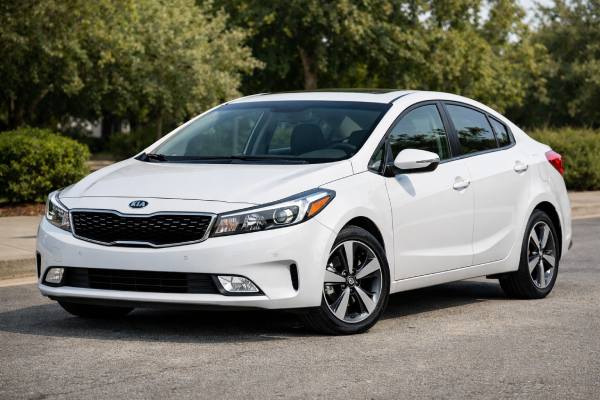
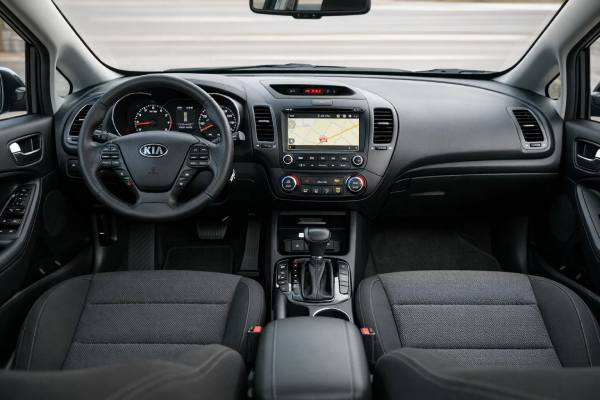
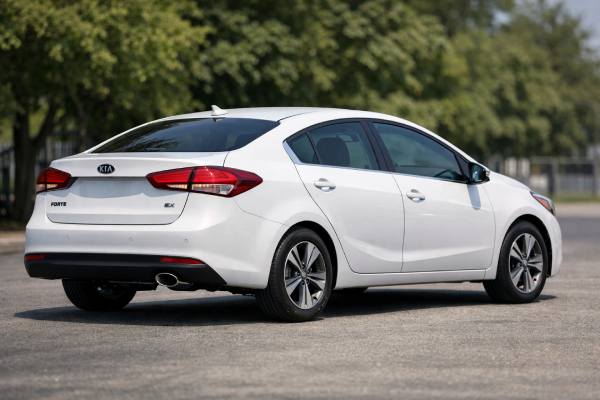
The 2017–2018 facelift version of the Kia Forte (YD) with the 2.0-liter Nu MPI engine is the “simple on purpose” compact sedan: naturally aspirated, port-injected, and paired with a conventional 6-speed gearbox. That combination matters for long-term ownership because it avoids the added complexity of turbocharging and direct injection while still delivering usable everyday performance. You also get a roomy cabin for the class, a straightforward chassis that’s easy on tires, and widely available parts.
Where owners should stay alert is less about headline horsepower and more about consistent basics: keeping oil level healthy, choosing the right service intervals for your usage (especially short trips), and confirming recall and software-update status by VIN. Buy the right trim and build-date, and this Forte can be a low-drama daily driver for many years.
At a Glance
- Strong value if you prioritize simple MPI fueling and a conventional 6-speed automatic
- Spacious rear-seat packaging for a compact, with practical trunk volume
- Optional driver-assistance features exist, but many cars on the market won’t have the full suite
- Check VIN history for recall completion and confirm no warning lights at key-on
- Typical oil change interval: 8,000–10,000 km or 12 months (sooner for severe use)
Explore the sections
- Kia Forte YD facelift essentials
- Kia Forte YD 2.0 specs and measurements
- Kia Forte YD trims and safety tech
- Reliability and known problems
- Maintenance plan and buying tips
- On-road performance and economy
- Rivals and value comparison
Kia Forte YD facelift essentials
Think of the 2017–2018 facelift Forte YD 2.0 MPI as a compact sedan engineered around repeatable, low-cost operation rather than cutting-edge power density. The Nu 2.0 MPI is a naturally aspirated inline-four with multi-point (port) injection. In practice, that means it’s generally tolerant of fuel quality, less prone to intake-valve carbon buildup than direct-injected engines, and easier to diagnose when something feels “off.” It also means the car’s character is linear: you get predictable throttle response and consistent performance in heat, cold, and stop-and-go traffic.
The facelift matters because it’s more than cosmetics. In many markets the 2017 refresh brought a revised base powertrain strategy (147 hp 2.0 replacing the older 1.8 in some regions), a reworked trim walk (often LX / S / EX in North America), and wider availability of driver-assistance options. That last part is key: you can find cars that are “just a basic sedan,” and others with meaningful safety tech—without changing the fundamental mechanical package.
Chassis design is conservative: front MacPherson struts and a torsion-beam rear. A torsion beam won’t deliver the same broken-pavement composure as the best multi-link setups, but it’s compact, durable, and typically easier on alignment costs. Steering is electric assist, tuned for low effort, and the turning circle is tight enough to make city life easy.
Ownership traits to keep in mind:
- The Forte is happiest when serviced on time and driven with steady warm-ups—short trips and infrequent oil checks are where small problems can grow.
- The best “buy” examples are the ones with clean warning-light behavior (no intermittent ABS/airbag lights) and complete documentation.
- Tire choice changes the car more than many expect: the common 16–17 inch packages sharpen response but also raise road noise.
Kia Forte YD 2.0 specs and measurements
Below are the core specs you’ll actually use when comparing cars, buying tires, planning service, or checking whether a part matches your trim. Values can vary slightly by market, build plant, and equipment, so treat them as a strong baseline and confirm by VIN where possible.
Powertrain and efficiency (Nu MPI 2.0)
| Item | Specification |
|---|---|
| Engine code / family | Nu 2.0 MPI (market labeling varies) |
| Layout | Inline-4 (I-4), DOHC, D-CVVT, 16 valves |
| Displacement | 2.0 L (1,999 cc) |
| Bore × stroke | 81 × 97 mm (3.19 × 3.82 in) |
| Induction | Naturally aspirated |
| Fuel system | Multi-Point Injection (MPI / PFI) |
| Compression ratio | 12.5:1 (reported for the MPI variant in some specs) |
| Max power | 147 hp (110 kW) @ 6,200 rpm |
| Max torque | 179 Nm (132 lb-ft) @ 4,500 rpm |
| Timing drive | Chain (typical for this engine family) |
| Rated efficiency (example, 6AT) | 29/38/32 mpg US city/hwy/combined (≈ 8.1 / 6.2 / 7.4 L/100 km) |
| Real-world highway @ 120 km/h | Often ~7.0–8.0 L/100 km (33–29 mpg US), depending on tires and wind |
Transmission and driveline
| Item | Specification |
|---|---|
| Drive type | Front-wheel drive (FWD) |
| Manual option | 6-speed manual (availability varies by trim/market) |
| Automatic option | 6-speed automatic (availability varies by trim/market) |
| Character | Conventional stepped gears; predictable kickdown and engine braking |
Dimensions, weights, and capacities (sedan baseline)
| Item | Value |
|---|---|
| Length | 4,560 mm (179.5 in) |
| Width | 1,781 mm (70.1 in) |
| Height | 1,430 mm (56.3 in) |
| Wheelbase | 2,700 mm (106.3 in) |
| Ground clearance | 135 mm (5.3 in) |
| Turning circle (kerb-to-kerb) | 10.6 m (34.8 ft) |
| Fuel tank | 50.0 L (13.2 US gal) |
| Cargo volume (trunk) | 422 L (14.9 ft³) |
| Curb weight (6AT, typical range) | ~1,295–1,350 kg (2,855–2,976 lb) |
| GVWR (varies) | ~1,760 kg (3,880 lb) range |
Chassis, brakes, and common tire sizes
| Item | Specification |
|---|---|
| Front suspension | MacPherson strut |
| Rear suspension | Torsion beam (CTBA) |
| Steering | Electric assist; ratio ~15.7:1 |
| Brakes (front/rear) | Ventilated disc / solid disc |
| Brake diameters | 279 mm (11.0 in) front; 262 mm (10.3 in) rear |
| Common tire sizes | 195/65 R15, 205/55 R16, 215/45 R17 |
Performance (realistic expectations)
Performance varies more with transmission, tire package, and altitude than most listings admit. For a healthy 2.0 MPI Forte:
- 0–100 km/h (0–62 mph): commonly in the mid-9 to ~10.5 s range
- Passing (80–120 km/h): plan around 7–9 s depending on gearbox behavior
- Top speed: typically in the ~190–200 km/h range (where legal)
- Braking 100–0 km/h: often ~38–41 m on quality tires
Fluids and service capacities (verify by VIN)
Because under-hood labels and service documentation can differ by market and revision, use these as planning guidance:
- Engine oil: API SN/SP class; commonly 5W-20 or 5W-30; capacity often around ~4.0 L (≈ 4.2 US qt) with filter
- Coolant: long-life ethylene-glycol coolant; many schedules treat it as a long interval (often years, not months)
- Automatic transmission fluid: Hyundai/Kia-spec ATF (often SP-IV family); service approach varies by market (see maintenance section)
- A/C refrigerant: confirm type and charge amount on the under-hood A/C label
Key “decision” torque values (typical guidance, confirm before wrenching):
- Wheel lug nuts: commonly ~90–110 Nm (66–81 lb-ft)
- Oil drain plug: often ~35–45 Nm (26–33 lb-ft) range
Kia Forte YD trims and safety tech
For the 2017–2018 facelift period, most buyers will encounter a trim structure that separates the “simple commuter” versions from the “technology and comfort” versions. In many North American listings, the walk is LX → S → EX, with the 2.0 MPI commonly tied to the lower and mid trims (LX/S) and a different 2.0 engine option on some top trims depending on emissions certification and market. In other regions you may see different naming (Cerato, K3) and different packaging, but the practical approach is the same: decode the equipment by features, not by badges.
Quick identifiers that help in the real world
- Wheels/tires: 15-inch wheels usually signal a lower trim; 16–17 inch packages often bring better infotainment and convenience features.
- Headlights: cars with HID-style projectors and more complex lighting controls tend to be the higher-option vehicles, and lighting matters for night safety and fatigue.
- Steering wheel buttons: advanced driver-assistance (where fitted) usually adds extra steering controls and cluster menus for lane and collision settings.
- Rear bumper sensors/camera: not a guarantee of full ADAS, but a good hint that the car was optioned beyond base.
Safety ratings and what they actually mean
The Forte’s safety story is strongest when you separate structure from equipment. The underlying crash structure can score well in major crash tests, but “top award” outcomes often depend on:
- front crash prevention (autonomous emergency braking / forward collision systems) being present, and
- headlight performance meeting the test criteria.
That’s why build date and option package can matter as much as model year. Some safety awards apply only to vehicles built after a certain point and equipped with specific headlights and collision-avoidance tech. When shopping, ask for a photo of the driver-assistance settings screen and the headlight type, not just the badge.
Airbags, child-seat anchors, and day-to-day protection
Most Forte YD sedans in this era provide the expected modern baseline: front airbags, side airbags, and side-curtain airbags, plus stability control and traction control. For child seats, you’re looking for LATCH/ISOFIX anchors that are easy to access and top tether points that are not buried under trim. Bring your child seat (or at least measure it) if you have a bulky base—compact sedans can vary a lot in how friendly the rear bench is for real installations.
Driver assistance and calibration implications
Common available systems (trim/market dependent) include:
- Forward collision warning and autonomous emergency braking
- Blind-spot detection and rear cross-traffic alert
- Lane departure warning and (on some cars) lane-keeping support
- Rear camera and parking sensors
If the car has camera- or radar-based safety features, keep two ownership realities in mind:
- Windshield replacement and front-end repairs may require ADAS calibration to restore correct operation.
- After alignment work, some systems benefit from a quick verification drive and a scan for stored codes—even if no warning lights are on.
Reliability and known problems
The 2.0 Nu MPI Forte is generally a “steady” car when maintained, but its reliability profile is best understood as a mix of low-cost wear items and a few issues that can become expensive if ignored. Below is a practical map by prevalence and cost tier, with symptoms you can actually recognize.
Common (low to medium cost)
- Ignition coils or plugs aging early (misfire under load):
Symptoms: light shaking at idle, hesitation during acceleration, flashing check-engine light in severe cases.
Likely cause: coil breakdown, worn plugs, or moisture intrusion at connectors.
Remedy: replace coils as needed, install correct-spec plugs, confirm no oil in plug wells. - EVAP purge valve issues (hard start after fueling):
Symptoms: extended cranking or stumble right after filling the tank; occasional fuel smell.
Likely cause: purge valve sticking or venting issue.
Remedy: diagnose with scan data; replace purge valve if confirmed. - Electric power steering coupler wear (clunk over small bumps):
Symptoms: dull knock in the steering column at low speeds, especially on rough pavement.
Likely cause: coupler/bushing wear in the column motor interface (common on many Hyundai/Kia EPS designs).
Remedy: coupler replacement; confirm no rack play before spending more. - Brake noise and rotor sensitivity (pulsation):
Symptoms: squeal at low speed, vibration during braking from highway speeds.
Likely cause: pad compound, rotor hotspots, or stuck slide pins.
Remedy: clean and lubricate caliper hardware; use quality pads/rotors; flush old brake fluid.
Occasional (medium to high cost if neglected)
- Oil pressure warning / abnormal engine noise (critical):
Symptoms: ticking/knock rising with rpm, oil pressure light flicker, reduced power.
Likely cause: lubrication problem—oil level low, oil aeration, or (in a limited production window) oil pump internal sticking.
Remedy: stop driving, verify oil level and pressure, and confirm recall status. Continued operation can damage bearings quickly. - Cooling system seepage (slow loss of coolant):
Symptoms: sweet smell after a hot shutdown, crusty residue near hose joints, rising temperature in traffic.
Likely cause: aging hoses/clamps, radiator cap weakness, or water pump seepage over time.
Remedy: pressure test and repair the leak source; don’t just “top up” repeatedly. - Transmission shift quality changes (6AT):
Symptoms: delayed engagement when cold, flare between gears, or harsh 2–3 shifts.
Likely cause: old fluid, adaptation drift, or solenoid wear in higher-mileage examples.
Remedy: verify fluid condition, scan for codes, and consider a service strategy appropriate to mileage (drain-and-fill vs more comprehensive service).
Rare but important (high cost / safety impact)
- Airbag system faults (warning light on):
Symptoms: airbag warning lamp illuminated; stored crash-safety module faults.
Likely cause: module or wiring issues; some vehicles have had safety campaigns related to airbag control components.
Remedy: treat as urgent—diagnose with the proper scan tool and confirm recall completion.
Recalls, service actions, and how to verify
Even if a problem is “known,” it doesn’t mean your exact car is affected. The correct workflow is:
- Run an official VIN check (government recall tools and dealer records).
- Ask for proof of completion (repair invoice or dealer printout).
- Confirm with a scan that no related codes remain.
When a listing says “all recalls done,” ask for the documentation. A well-maintained Forte usually comes with a folder.
Maintenance plan and buying tips
A Forte YD 2.0 MPI rewards boring consistency. The goal is to keep oil quality high, prevent heat-related aging, and catch small electrical issues before they turn into warning lights that are hard to chase. Use the schedule below as a practical baseline, then tighten it if you do short trips, heavy traffic, extreme temperatures, or lots of idling.
Practical maintenance schedule (distance/time)
| Item | Normal use | Severe use (short trips, heavy city, extreme temps) |
|---|---|---|
| Engine oil and filter | 8,000–10,000 km or 12 months | 5,000–7,500 km or 6 months |
| Tire rotation | 10,000–12,000 km | 8,000–10,000 km |
| Cabin air filter | 15,000–20,000 km or 12 months | 10,000–15,000 km |
| Engine air filter | 30,000–40,000 km | 20,000–30,000 km |
| Brake fluid | Every 2 years | Every 2 years (don’t stretch) |
| Coolant | Follow long-life interval; verify by market | Same, but inspect annually |
| Spark plugs (iridium typical) | 120,000–160,000 km | 100,000–140,000 km |
| Drive/serpentine belt | Inspect each service; replace by condition | Same |
| Automatic transmission fluid | Inspect; service strategy varies by market and mileage | Consider earlier drain-and-fill intervals |
| Alignment check | Annually or if tire wear shows | Annually, and after pothole impacts |
| 12 V battery test | Annually after year 3–4 | Annually after year 3 |
Fluid and parts selection tips that improve durability:
- Use the correct oil viscosity for your climate and the correct API/ILSAC class; don’t chase “thicker is safer” unless you have confirmed oil consumption.
- For higher-mileage cars, a conservative automatic transmission service approach (periodic drain-and-fill with the correct fluid) is often gentler than a single aggressive flush.
- If you hear steering clunks or feel front-end looseness, inspect tires and suspension bushings early—misalignment can destroy a set of tires quickly.
Buyer’s guide: what to inspect before purchase
Paperwork checks
- Full service history with dates and mileage (oil changes matter most).
- Recall completion proof by VIN (dealer printout or invoices).
- Any prior accident repair details—especially front-end work if the car has ADAS.
Hands-on checks (15 minutes that can save you money)
- Cold start: listen for brief timing-chain noise vs persistent knocking.
- Dash lights: confirm all warning lamps illuminate at key-on and then go out after start.
- Oil level and condition: low oil at viewing is a red flag for neglect.
- Brake feel: consistent pedal, no sinking, and no steering shake during a firm stop.
- Transmission behavior (6AT): smooth engagement from P→D and clean shifts during gentle and moderate throttle.
- Steering: no clunk over small bumps; wheel returns to center smoothly.
- AC performance: stable cold output; no loud compressor cycling noises.
Which versions to seek
- If safety tech matters, prioritize cars with the full driver-assistance package and the better headlight setup, and confirm build date and equipment in photos.
- If you want the lowest long-term cost, a simpler trim with fewer electronic features can be the sweet spot—provided it has been maintained well.
A clean, documented Forte is usually a better buy than a “newer, cheaper” one with mystery history.
On-road performance and economy
In daily driving, the Forte 2.0 MPI is defined by predictability rather than drama. Throttle response is linear, and the engine feels most comfortable in the midrange where it can pull without hunting for gears. You won’t get the low-rpm surge of a modern turbo compact, but you also avoid the heat and complexity that turbo systems add. For many owners, that trade is the entire point.
Ride, handling, and NVH
The front strut / torsion-beam rear setup is tuned for stability and easy control. Around town it’s light on its feet, with quick steering response and a turning circle that makes parking less stressful than some rivals. Over broken pavement, the torsion beam can send sharper impacts into the cabin than the best multi-link designs, especially on 17-inch tires with shorter sidewalls. If you want the most comfortable ride, the 15–16 inch wheel packages are often the sweet spot.
Cabin noise is typically the most noticeable “budget compact” trait:
- City speeds: road texture and suspension thumps are the main sounds.
- Highway speeds: tire roar and some wind noise dominate; changing tire model can make a bigger difference than people expect.
Powertrain character and transmission behavior
With the 6-speed automatic, you’ll feel the transmission prioritize smoothness and economy. Kickdown is usually decisive, but passing power is best planned—if you floor it at 80–100 km/h, expect a downshift and a rise in engine rpm before it pulls strongly. The manual (where available) can make the car feel more energetic simply because you can hold the engine in its stronger band.
A useful driving tip for longevity: avoid repeated full-throttle runs from low rpm when the engine is cold. Let coolant temperature stabilize before asking for maximum load.
Real-world efficiency you can plan around
Rated fuel economy can look excellent on paper for some versions, but your results will depend on speed and climate:
- Mixed commuting: many owners land in the 7.5–9.0 L/100 km range if traffic is heavy.
- Steady highway (100–110 km/h): 6.5–7.5 L/100 km is realistic in mild weather.
- Highway at 120 km/h: plan ~7.0–8.0 L/100 km, with winter tires and cold air nudging it higher.
- Winter short trips: fuel use can rise sharply because the engine spends more time warming up; expect a noticeable penalty.
The Forte’s efficiency is helped by reasonable gearing and modest weight, but it’s still a gasoline car without hybrid assistance—your right foot and trip length remain the biggest variables.
Braking feel and confidence
With standard disc brakes front and rear, pedal feel is typically easy to modulate. If you feel pulsation, don’t assume “warped rotors” immediately—sticking caliper hardware and uneven pad deposits are common culprits, and the fix can be simpler than replacing everything.
Rivals and value comparison
The facelift Forte 2.0 MPI lives in one of the toughest segments in the market: compact sedans where the best competitors are extremely refined. The Forte’s advantage is that it often delivers a lot of usable car for the money—especially on the used market—while keeping the mechanical formula simple.
How it stacks up against key rivals
- Toyota Corolla: The Corolla tends to win on long-run reputation and resale stability. The Forte often counters with more cabin space for the price and comparable day-to-day economy, depending on year and powertrain. If you want the safest “appliance car” bet, Corolla is hard to beat; if you want maximum features per euro, Forte can be compelling.
- Honda Civic: Civic usually leads on steering feel, chassis sophistication, and powertrain variety. The Forte is typically quieter in how it delivers power (less sporty, more calm) and can cost less to buy. Choose Civic for driving enjoyment; choose Forte for value and straightforward ownership.
- Mazda3: Mazda3 often feels more premium inside and can be more engaging on a twisty road. The Forte leans toward softer priorities—space, simplicity, and lower entry cost. If you care about interior finish and steering texture, Mazda3 is strong; if you care about affordable practicality, Forte plays well.
- Hyundai Elantra: These cousins overlap in parts and philosophy. Differences come down to trim packaging, suspension tuning, and which engine/transmission you’re buying. Shop the best-maintained example rather than obsessing over the badge.
- Volkswagen Jetta: Jetta can feel more “European” in ride and highway manners, and some versions have strong torque. The Forte is often cheaper to run and less sensitive to missed maintenance. If you want a relaxed highway cruiser, Jetta can fit; if you want low-drama service costs, Forte often wins.
Who should choose the Forte 2.0 MPI?
Pick this Forte if you want:
- A conventional gasoline compact with a simple fueling system (MPI) and a familiar 6-speed gearbox
- A roomy cabin footprint without moving up to a midsize car
- A car you can keep for years by doing the basics on time
You may prefer a rival if you prioritize:
- The most refined ride and interior materials (Mazda3 often shines)
- The sportiest driving feel (Civic tends to lead)
- The strongest resale story (Corolla is the benchmark)
The “right” answer comes down to what you value most. A well-kept Forte with verified recalls and clean warning-light behavior is a smart, rational buy—especially if you’re shopping with a budget ceiling.
References
- 2017 Kia Forte Specifications 2017 (Specifications)
- 2017 Kia Forte 4-door sedan 2017 (Safety Rating)
- Gas Mileage of 2017 Kia Forte 2017 (Fuel Economy)
- Part 573 Safety Recall Report 21V-260 2021 (Recall Database)
- Part 573 Safety Recall Report 22V-031 2022 (Recall Database)
Disclaimer
This article is for informational purposes only and is not a substitute for professional diagnosis, inspection, or repair. Specifications, torque values, service intervals, and procedures can vary by VIN, market, build date, and equipment, so verify all details against official service documentation for your exact vehicle before buying parts or performing work.
If this guide helped, please consider sharing it on Facebook, X (Twitter), or your favorite forum to support our work.