


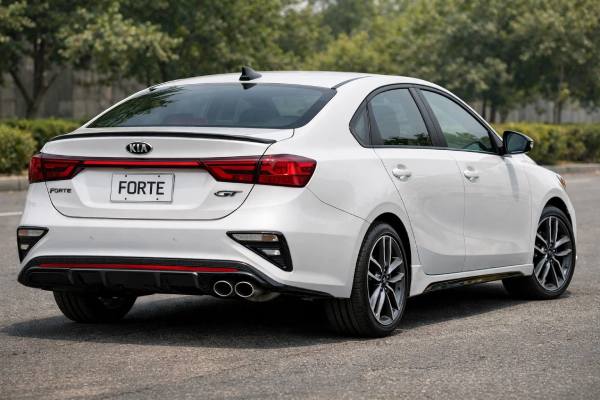
The 2020–2021 Kia Forte GT (BD) is the “warm” version of Kia’s compact sedan: a practical daily driver wrapped around a responsive 1.6-liter turbo engine and a chassis that’s more alert than the base models. You get real torque down low, stronger brakes, and a rear suspension upgrade that changes the car’s attitude in corners—without turning it into a harsh commuter. Owners typically choose it for the balance: it’s quick enough to feel special on an on-ramp, quiet enough for long motorway runs, and still reasonable to maintain if you stay disciplined with oil quality and cooling-system health. The key to a happy GT is understanding where the extra performance adds extra needs—especially turbo heat management, direct-injection fueling, and dual-clutch behavior in traffic.
Owner Snapshot
- Strong mid-range pull and quick passing response for a compact sedan
- More composed cornering than base trims thanks to the multi-link rear suspension
- Good feature value: sporty hardware plus modern infotainment and available driver assists
- Turbo DI engines reward frequent oil changes; don’t stretch intervals or ignore low-oil warnings
- Plan an engine-oil service about every 8,000 km (5,000 mi) or 6 months for mostly city use
Explore the sections
- Kia Forte GT BD turbo big picture
- Kia Forte GT BD specs and tech
- Kia Forte GT BD trims and driver assists
- Reliability and known weak spots
- Maintenance plan and buyer checks
- Driving character and real economy
- How the Forte GT stacks up
Kia Forte GT BD turbo big picture
Think of the Forte GT as the trim that fixes two common compact-car complaints: “it’s slow to respond” and “it feels nervous when pushed.” The 1.6-liter turbocharged Gamma T-GDi engine delivers a broad torque band, which means the car accelerates with less downshifting than a naturally aspirated 2.0. In daily driving, that translates to cleaner merges, shorter passing windows, and less pedal travel to maintain speed on rolling roads.
The chassis changes matter as much as the engine. On the GT, the rear suspension moves from a torsion beam to a multi-link layout (market-dependent but typical for the GT in this generation). A multi-link rear end better controls wheel movement over bumps and during cornering loads, so the car tends to track more cleanly mid-corner and feels less “hop” over broken pavement. You also get larger front brakes and wider performance-oriented tires, which improves repeated braking confidence and steering bite.
This is still a front-wheel-drive sedan with modest ground clearance and street-focused tires, so it’s not a snow weapon. But it does behave predictably: the stability control steps in smoothly, the steering is quick enough to place the car, and the GT’s tire package adds grip that base trims don’t have. In practical ownership terms, that means fewer surprises on wet roundabouts and less drama during emergency braking.
Where buyers should pause is in how the turbo powertrain adds heat and complexity. Direct injection (DI) can increase intake-valve deposits over time, and turbochargers prefer clean oil and sensible warm-up habits. If you’re the type to do short trips, frequent stop-start commuting, or long oil-change intervals, the GT’s engine will punish neglect faster than the non-turbo versions. If you drive it with mechanical sympathy—good oil, steady warm-up, and attention to cooling—it’s a well-judged blend of fun and sensible.
Kia Forte GT BD specs and tech
Below are the core technical details owners and buyers usually care about. Values can vary by market and equipment, so treat this as a practical reference and confirm against your VIN-specific documentation.
Powertrain and efficiency (1.6 turbo)
| Item | Kia Forte GT (BD) 2020–2021 |
|---|---|
| Code | Gamma T-GDi (commonly referenced as a Gamma II 1.6T family) |
| Engine layout and cylinders | Inline-4, DOHC, 4 valves/cyl |
| Bore × stroke | 77.0 × 85.4 mm (3.03 × 3.36 in) |
| Displacement | 1.6 L (1,591 cc) |
| Induction | Turbocharged |
| Fuel system | Direct injection (DI) |
| Compression ratio | ~10.0:1 |
| Max power | 201 hp (150 kW) @ 6,000 rpm |
| Max torque | 265 Nm (195 lb-ft) @ ~1,500–4,500 rpm |
| Timing drive | Chain |
| Rated efficiency (typical) | Around 7.8–8.4 L/100 km combined (28–30 mpg US) depending on gearbox |
| Real-world highway @ 120 km/h | Often ~6.8–7.6 L/100 km (31–35 mpg US) with light load and mild temperatures |
Transmission and driveline
| Item | Details |
|---|---|
| Transmission | 6-speed manual or 7-speed dual-clutch automatic (DCT) |
| Drive type | FWD |
| Differential | Open (traction managed by brake-based stability/traction control) |
Chassis, dimensions, and capacities
| Item | Typical GT figure |
|---|---|
| Suspension (front/rear) | MacPherson strut / multi-link rear (GT) |
| Steering | Electric assist rack-and-pinion; ~12.7:1 ratio |
| Brakes (front/rear) | Ventilated disc / solid disc; front ~305 mm (12.0 in), rear ~262 mm (10.3 in) |
| Wheels/tyres (popular size) | 225/40 R18 |
| Ground clearance | ~135 mm (5.3 in) |
| Length / width / height | ~4,640 / 1,801 / 1,435 mm (182.7 / 70.9 / 56.5 in) |
| Wheelbase | ~2,700 mm (106.3 in) |
| Turning circle (kerb-to-kerb) | ~10.6 m (34.8 ft) |
| Kerb weight | ~1,356–1,397 kg (2,989–3,079 lb) depending on transmission and equipment |
| GVWR | ~1,760–1,800 kg (3,880–3,968 lb) depending on transmission |
| Fuel tank | ~53 L (14.0 US gal) |
| Cargo volume (seats up) | ~433 L (15.3 ft³), method varies by market |
Performance and capability (realistic expectations)
| Metric | Typical outcome |
|---|---|
| 0–100 km/h (0–62 mph) | ~6.8–7.5 s (gearbox, tyres, and conditions matter) |
| Top speed | Typically in the ~210–225 km/h (130–140 mph) range, market-dependent |
| Braking 100–0 km/h | Often ~36–40 m on good tyres and dry pavement (test-dependent) |
| Towing | Generally not a focus for this model; check your market handbook |
| Payload | Roughly 400–500 kg depending on curb weight and GVWR |
Fluids and service capacities (typical, verify by VIN)
| Fluid | Practical guidance |
|---|---|
| Engine oil | Full-synthetic meeting the required API/ILSAC spec; common grades are 5W-30 or 0W-30 (climate-dependent) |
| Engine oil capacity | Typically ~4.5–5.0 L (4.8–5.3 US qt) with filter (verify) |
| Coolant | OEM long-life coolant; maintain correct mix ratio for freezing protection |
| Spark plugs | Turbo DI engines commonly use iridium plugs; replace by the official interval or earlier if misfire appears |
| DCT fluid | Use only the specified OEM fluid for the exact gearbox (do not “universal fluid” a DCT) |
Key torque specs (common decision points, verify)
| Fastener | Typical range |
|---|---|
| Wheel lug nuts | ~90–110 Nm (66–81 lb-ft) |
| Engine oil drain plug | ~35–45 Nm (26–33 lb-ft) |
Kia Forte GT BD trims and driver assists
For 2020–2021, the “GT” badge is the main shortcut: it generally means the 1.6 turbo engine, sport seats, larger wheels, stronger front brakes, and a sport-tuned feel. The easiest exterior identifiers are the 18-inch wheel/tire package, more aggressive lower bumper styling, and GT badging. Inside, you’ll usually find bolstered front seats, a thicker steering wheel, and trim details that look more performance-focused than the standard Forte.
Trims and options that matter in real ownership
Even within the GT label, two choices change the ownership experience:
- Manual vs DCT
- 6-speed manual: simpler hardware feel and fewer “robotic” low-speed moments, but you must be comfortable with clutch wear in traffic. It often feels more predictable pulling away on steep hills.
- 7-speed DCT: quicker shifts under throttle and convenient commuting, but it can feel hesitant or “busy” at parking-lot speeds. It also adds heat management concerns in heavy stop-and-go or when repeatedly creeping uphill.
- Infotainment and audio
- Many cars include a larger touchscreen and smartphone integration. When equipped, premium audio can be a nice daily win, but check for rattles in door panels and the parcel shelf—compact sedans can develop buzzes over time.
Safety ratings and what they mean
In this era, the Forte platform is generally well-regarded in US testing, but the outcome can depend on headlights and specific option packages. Some trims or equipment combinations score better because the lighting performance is stronger and because advanced crash-avoidance tech is fitted and calibrated to the tested configuration.
Airbags, child seats, and daily safety features
Expect a full suite of airbags for a modern compact (front, side, and curtain coverage), plus stability control, traction control, ABS, and brake-force distribution. For child seats, check for ISOFIX/LATCH lower anchors and top tethers; verify the rear seat condition (spilled drinks and crushed seat cushions can affect child-seat fit).
Driver assistance systems (ADAS) to prioritize
Depending on market and package, you may see:
- Forward collision avoidance (AEB): car and sometimes pedestrian detection; helpful in congested urban driving.
- Lane keeping and lane following support: reduces fatigue on long motorway runs, but alignment or windshield replacement can require recalibration.
- Blind-spot monitoring and rear cross-traffic alert: particularly valuable in tight parking areas.
- Adaptive cruise control (where available): a major comfort upgrade, but radar/sensor alignment becomes important after front-end repairs.
If you’re shopping used, confirm that warning lights illuminate briefly at startup and then go out. A disabled ADAS system can be as simple as a dirty sensor—or it can hint at an unresolved crash repair.
Reliability and known weak spots
The Forte GT’s reliability story is usually less about “it breaks all the time” and more about how it was treated. Turbocharged, direct-injected engines are sensitive to oil quality, heat, and fueling consistency. When these cars have problems, patterns tend to show up in predictable places.
Common (high prevalence) issues
- Carbon buildup on intake valves (DI trait)
- Symptoms: rough idle, hesitation, reduced efficiency, occasional misfire codes.
- Likely root cause: fuel doesn’t wash intake valves in DI engines, so deposits can accumulate—especially with short trips and extended oil intervals.
- Remedy: intake cleaning (often walnut blasting) when symptoms appear; reduce short-trip use where possible and keep PCV system healthy.
- Ignition coil or plug wear under boost
- Symptoms: misfires under load, flashing check-engine light, stumble during acceleration.
- Root cause: turbo cylinder pressures stress coils and plugs more than a naturally aspirated engine.
- Remedy: replace plugs at the correct interval with the correct heat range; replace coils as needed (often one fails first, but sets are sometimes preferred).
- DCT low-speed behavior (normal-but-annoying for some)
- Symptoms: slight shudder, hesitation creeping in traffic, abrupt engagement if you “feather” the throttle.
- Root cause: dual-clutch design acts more like automated manuals than a traditional torque-converter automatic.
- Remedy: adapt driving style—use smooth throttle, avoid constant inching, and use brake-hold techniques to reduce repeated clutch engagement.
Occasional issues (medium prevalence)
- Turbo plumbing or boost control leaks
- Symptoms: weak acceleration, whooshing noises, underboost codes.
- Root cause: hose clamp loosening, aging vacuum/boost hoses, or small leaks at charge piping joints.
- Remedy: smoke test and proper clamp replacement; don’t ignore small leaks—they can worsen fuel trims and heat.
- Cooling-system sensitivity
- Symptoms: rising temperatures in slow traffic, coolant smell, intermittent overheating.
- Root cause: neglected coolant service, weak radiator cap, or early leak points.
- Remedy: pressure test, correct coolant mix, and immediate repair of seepage before it becomes a major overheat.
Rare but higher-cost risks
- Chronic knock due to poor fueling or severe neglect
- Symptoms: persistent knocking noises, severe power reduction, warning lights.
- Root cause: low-octane fuel under high load, heavy deposit issues, or oil starvation.
- Remedy: prevention is the best strategy—use the recommended fuel grade for your market, keep oil at the proper level, and address misfires promptly.
Recalls, service campaigns, and software updates
Like most modern cars, updates can matter. Infotainment updates address connectivity issues, and ECU/TCU updates may improve shift logic or drivability. When buying used, request dealer service history and verify recall completion by VIN through official channels. A car can be “clean” mechanically but still need a software campaign to fix an annoying warning light or drivability quirk.
Maintenance plan and buyer checks
A Forte GT can be low-drama if you maintain it like a turbo car, not like a base commuter. The schedule below is practical and conservative for long-term ownership, especially with city driving or high ambient temperatures.
Practical maintenance schedule (distance/time)
- Engine oil and filter: every 8,000 km (5,000 mi) or 6 months for mixed or city-heavy driving; up to 12,000 km (7,500 mi) for mostly highway use if oil condition remains good.
- Engine air filter: inspect every 15,000 km (10,000 mi); replace around 30,000 km (20,000 mi) or earlier in dusty areas.
- Cabin air filter: every 15,000–20,000 km (10,000–12,000 mi) or annually.
- Spark plugs: commonly 60,000–100,000 km (40,000–60,000 mi) on turbo DI engines depending on plug type and driving; replace earlier if misfires start.
- Coolant: follow the official long-life interval, but consider a drain/fill around 5 years / 100,000–160,000 km if you plan to keep the car long-term.
- Brake fluid: every 2 years (moisture absorption is time-based).
- Brake pads/rotors: inspect at every tire rotation; the GT’s grip encourages harder braking, so pad life varies widely.
- Tire rotation and alignment: rotate every 8,000–10,000 km (5,000–6,000 mi); align annually or whenever you notice uneven wear.
- DCT service (if equipped): follow the exact gearbox service procedure and fluid spec; if you do heavy urban creeping or hot-climate driving, be stricter than the minimum interval.
- 12V battery: test annually after year 3; many batteries last 4–6 years depending on climate.
Fluids and parts choices that actually matter
- Oil: prioritize the correct spec and quality full-synthetic. Turbochargers depend on oil for cooling and bearing life.
- Coolant: use the correct OEM-compatible coolant; mixing “universal” coolants can reduce corrosion protection.
- Plugs: use the correct heat range and type; a wrong plug can cause misfire or pre-ignition under boost.
Buyer’s guide: what to check before purchase
Use this checklist in a test drive and inspection:
- Cold start: listen for abnormal ticking beyond normal DI noise; confirm idle settles quickly.
- Boost and acceleration: full-throttle pull should be smooth—no surging, no misfire, no flashing MIL.
- Transmission behavior:
- DCT: check for excessive shudder, delayed engagement, or warning lights.
- Manual: confirm clutch take-up is smooth and there’s no slipping in higher gears.
- Brakes: repeated stops should remain consistent without steering shake; vibration can indicate rotor issues.
- Tires: uneven wear can signal alignment problems or suspension bushing wear.
- Cooling system: check for coolant smell and dried residue around hoses and the radiator area.
- Electronics: verify camera, parking sensors, and driver-assist warnings are normal and not disabled.
Best ownership profile
The GT is ideal for someone who wants daily usability with occasional spirited driving and is willing to maintain it proactively. If you drive mostly short trips in heavy traffic and hate any transmission quirks, the manual gearbox can be the simpler, more predictable choice—if you’re comfortable with a clutch.
Driving character and real economy
The Forte GT’s defining trait is how “ready” it feels at normal speeds. The turbo torque arrives early, so you don’t need to rev the engine hard to make progress. In city traffic, that makes it easier to slip into gaps without a dramatic downshift. On the highway, passing from 80–120 km/h feels brisk for the class, especially with the DCT keeping the engine in its sweet spot.
Ride, handling, and NVH
Ride quality is firmer than non-GT trims, mostly because of the tire sidewall and the sport intent. It’s not punishing, but you’ll notice sharper impacts over pothole edges. The multi-link rear helps the car remain composed over mid-corner bumps, and it reduces the “rear hop” that some torsion-beam compacts show when pushed. Steering is quick and consistent, though feedback is more “modern electric” than old-school communicative. At motorway speeds, the car tracks straight and feels stable, with moderate wind and tire noise on the 18-inch package.
Powertrain character: manual vs DCT
- Manual: gives you a more natural connection to the engine, and you can manage turbo response with gear choice. It’s also easier to crawl smoothly in parking lots.
- DCT: shines when you’re accelerating hard; it can shift quickly and keep boost on tap. In creeping traffic, it may feel less smooth than a torque-converter automatic because the clutches engage and disengage rather than “slip” fluidly.
Real-world efficiency
Official economy numbers often look optimistic if your use is stop-start commuting. Realistically:
- City-heavy driving: roughly 8.5–10.0 L/100 km (24–28 mpg US) depending on traffic density and driving style.
- Highway cruising (100–120 km/h): often 6.8–7.6 L/100 km (31–35 mpg US) with steady throttle.
- Mixed use: commonly 7.8–8.8 L/100 km (27–30 mpg US).
Cold weather and short trips can raise consumption significantly, especially if the car never reaches full operating temperature. For best results, combine errands into one longer drive, keep tire pressures correct, and avoid repeated hard launches—turbo fuel enrichment under heavy boost will quickly erase economy gains.
Performance metrics that matter in the real world
The GT’s advantage is not just 0–100 km/h times; it’s the effortless mid-range. That’s what makes it feel more expensive than a typical compact. The braking hardware and tire footprint also increase confidence—important for a car that encourages you to carry a bit more speed.
How the Forte GT stacks up
The Forte GT lives in a crowded space: “quick compact car, but still daily-friendly.” Its closest rivals tend to split into three groups—sport compacts, warm compacts, and value-focused turbo sedans.
Versus traditional sport compacts
Cars like the VW Jetta GLI and Honda Civic Si (depending on year/market) often feel more performance-pure: stronger limited-slip behavior (where fitted), more sustained track stamina, and a deeper aftermarket. The Forte GT typically counters with value—strong standard equipment, modern infotainment, and a powertrain that feels punchy at everyday speeds. If you prioritize steering feel and chassis nuance above all, the more hardcore options may suit you. If you want “90% of the fun” with fewer compromises and often a lower purchase price, the Forte GT is compelling.
Versus warm turbo compacts
Against cars like the Hyundai Elantra Sport/GT-Line Turbo (market-dependent) or similar “warm” trims, the Forte GT’s advantage is coherence: the brakes, tires, and suspension changes feel like a package rather than a cosmetic upgrade. The multi-link rear in particular gives the GT a more settled feel when the road gets uneven.
Versus base engines with big option packages
Some shoppers cross-shop a fully loaded non-turbo compact against a mid-trim GT. The decision comes down to your priorities:
- Choose the GT if you care about passing power, stronger brakes, and a more planted cornering feel.
- Choose a non-turbo if you want the simplest long-term powertrain, a softer ride, and the lowest “risk of neglect” ownership profile.
Who should buy it?
The Forte GT is best for drivers who:
- want responsive performance without stepping into a harsher, more expensive hot hatch,
- value a feature-rich cabin and modern safety tech,
- can commit to turbo-friendly maintenance habits.
If you want a compact that feels lively every day but remains practical and predictable, the Forte GT is one of the most balanced choices in its niche—so long as you buy a well-maintained example and keep up that standard.
References
- 2021 Kia Forte Specifications 2021 (Manufacturer Specifications)
- Gas Mileage of 2021 Kia Forte 2021 (Fuel Economy Database)
- 2021 Kia Forte 4-door sedan 2021 (Safety Rating)
- Recalls 2026 (Recall Database)
Disclaimer
This article is for informational purposes only and is not a substitute for professional inspection, diagnosis, or repair. Specifications, torque values, fluid types, capacities, maintenance intervals, and procedures can vary by VIN, market, model year, and installed equipment. Always verify details using your official owner’s manual and service documentation for your exact vehicle.
If this guide helped, please consider sharing it on Facebook, X (Twitter), or your favorite forum to support our work and help other owners.