


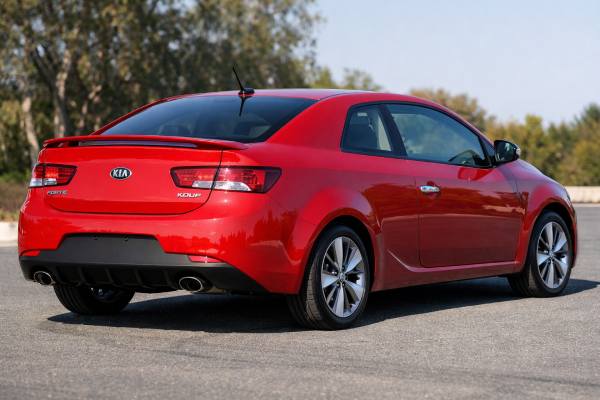
The 2012–2013 facelift Kia Forte Koup (TD) with the 2.4-liter Theta II and 173 hp is a compact coupe with a surprisingly grown-up drivetrain. You get a naturally aspirated four-cylinder with usable midrange torque, paired to a conventional 6-speed manual or 6-speed automatic—no complicated turbo hardware, no hybrid systems, and generally straightforward service access. That simplicity is a real advantage in long-term ownership, especially if you plan to keep the car past 150,000 km (90,000 mi). The flip side is that Theta II engines have a reputation that makes record-checking important: oil-change discipline, recall completion, and clean running conditions matter more here than they would on a “set-and-forget” commuter. If you buy the right example and maintain it proactively, the Forte Koup 2.4 can be a fun, practical daily with real passing power and reasonable running costs.
Quick Specs and Notes
- Strong naturally aspirated pull for a compact coupe, especially from 2,500–4,500 rpm.
- Conventional 6-speed manual or 6-speed automatic keeps the driving feel predictable and repairs familiar.
- Coupe body adds style without sacrificing day-to-day usability for two adults plus occasional rear passengers.
- Ownership caveat: verify recall work and watch oil level; maintenance history matters more than mileage alone.
- Typical interval: brake fluid every 2 years, regardless of distance.
Guide contents
- Kia Forte Koup TD facelift overview
- Kia Forte Koup TD 2.4 specs and dimensions
- Kia Forte Koup TD trims and safety features
- Reliability, common faults, and service actions
- Maintenance schedule and buyer’s checklist
- Driving feel, performance, and real economy
- Forte Koup vs compact coupe rivals
Kia Forte Koup TD facelift overview
The facelift 2012–2013 Forte Koup (TD) with the 2.4-liter Theta II is the “big-engine” version of Kia’s compact coupe formula. In most markets where the 2.4 appeared, it was tied to upper trims and sportier equipment—meaning you’re usually buying more than horsepower. Expect larger wheels and tires, upgraded brakes, and more comfort features than base models. That matters because the ownership experience is shaped as much by tire and suspension choices as by the engine itself.
The basic engineering layout is conventional and easy to understand: a transversely mounted inline-four driving the front wheels through either a 6-speed manual or 6-speed automatic. That conventional layout is a quiet advantage today. Parts availability is strong, independent shops tend to be comfortable with the platform, and you avoid the long list of “new-car-only” tech dependencies that can make modern compacts expensive to troubleshoot as they age.
What makes this exact variant worth discussing is how it blends two personalities. The Koup body is more personal and style-forward than the sedan, but the 2.4-liter engine gives it a more mature stride on the highway. The car doesn’t feel like it has to work hard to pass or climb grades. The power delivery is also predictable: it’s naturally aspirated, so you don’t get turbo lag or sudden torque spikes that can overwhelm front-wheel traction.
The caution flag is the engine family reputation. “Theta II” covers multiple configurations across many Hyundai and Kia models, and owner outcomes vary widely based on maintenance quality and whether factory campaigns were completed. For shoppers, that means the smart approach is not to fear the engine, but to treat history as a dealbreaker: consistent oil changes, documented recall completion, and clean running conditions are more important than unusually low mileage.
If you want a compact coupe that still feels mechanical—simple driveline, honest steering feedback, and a chassis you can refresh without exotic parts—this Forte Koup 2.4 can be a strong value when purchased carefully.
Kia Forte Koup TD 2.4 specs and dimensions
This section focuses on the 2012–2013 facelift Forte Koup (TD) equipped with the 2.4 l, 173 hp Theta II application. Exact numbers can vary by market, emissions certification, and options (especially wheel/tire packages), so use this as a practical baseline and verify against VIN-specific documentation.
Powertrain and efficiency
| Item | Specification |
|---|---|
| Engine family | Theta II 2.4 l |
| Layout and cylinders | Inline-4 (I-4), 4 cylinders |
| Valvetrain | DOHC, 4 valves/cyl (16-valve total), CVVT |
| Displacement | 2.4 l (2,359 cc) |
| Bore × stroke | 88.0 × 97.0 mm (3.46 × 3.82 in) |
| Induction | Naturally aspirated |
| Fuel system | MPI (multi-port injection) |
| Compression ratio | ~10.5:1 (typical for this application) |
| Max power | 173 hp (129 kW) @ 6,000 rpm |
| Max torque | 228 Nm (168 lb-ft) @ 4,000 rpm |
| Timing drive | Chain |
| Recommended fuel | Regular unleaded (market dependent) |
Transmission and driveline
| Item | Specification |
|---|---|
| Transmission (manual) | 6-speed manual (code varies by market) |
| Transmission (automatic) | 6-speed automatic (code family varies by market) |
| Drive type | FWD |
| Differential | Open (traction controlled via brake-based systems) |
Chassis and dimensions (coupe baseline)
Coupe dimensions typically differ slightly from the sedan (roofline, rear overhang, and cargo packaging). The values below reflect common coupe baselines in this generation.
| Item | Specification |
|---|---|
| Front suspension | MacPherson strut, stabilizer bar |
| Rear suspension | Torsion beam, coil springs |
| Steering | Rack and pinion; assist type varies by market/trim |
| Brakes | 4-wheel discs on upper trims; sizes vary with wheel package |
| Popular wheel/tire size | 215/45 R17 (common on 2.4 sport trims) |
| Wheelbase | 2,649 mm (104.3 in) |
| Length | ~4,480 mm (176.4 in) |
| Width | 1,775 mm (69.9 in) |
| Height | ~1,420–1,440 mm (56.0–56.7 in) |
| Turning circle | ~10.8 m (35.4 ft) (trim-dependent) |
| Ground clearance | ~150 mm (5.9 in) (approx., trim-dependent) |
Weights and capacities
| Item | Specification |
|---|---|
| Curb weight | ~1,300–1,340 kg (2,870–2,950 lb) depending on transmission and equipment |
| Fuel tank | ~52 L (13.7 US gal / 10.8 UK gal) |
| Cargo volume (coupe) | ~350 L (12.3 ft³) seats up (method varies) |
Performance and capability (realistic expectations)
For a 173 hp front-drive compact coupe, performance depends strongly on traction, tires, and transmission choice.
| Metric | Typical range (stock) |
|---|---|
| 0–100 km/h (0–62 mph) | ~7.5–8.5 s |
| Passing (80–120 km/h) | Strong for class; typically a gear-down in 6AT |
| Top speed | ~185–195 km/h (115–121 mph) (governed by power, gearing, and tire rating) |
| Towing | Generally not rated for meaningful towing; treat as “no tow” unless your manual specifies otherwise |
Fluids and service capacities (planning values)
Always confirm exact capacities by VIN and transmission.
| Item | Specification (typical) |
|---|---|
| Engine oil | 5W-20 or 5W-30 (climate dependent); ~4.0–4.5 L (4.2–4.8 US qt) with filter |
| Coolant | Long-life coolant; mix ratio per manual; capacity varies |
| Automatic transmission fluid | Manufacturer-specific ATF (often SP-IV family); drain-and-fill replaces only part of total |
| A/C refrigerant | R-134a (common for era); charge amount varies by label |
Key torque specs (decision-making only)
| Fastener | Typical range (verify) |
|---|---|
| Wheel lug nuts | ~90–110 Nm (66–81 lb-ft) |
| Front caliper bracket bolts | High-torque fasteners (varies by brake package) |
The takeaway from the spec sheet is practical: this is a simple, torque-forward compact coupe. If you keep tires, brakes, and fluids fresh, it feels “bigger” than its class suggests.
Kia Forte Koup TD trims and safety features
For 2012–2013 facelift models, the 2.4-liter engine usually appears in the sportier, higher equipment grades. Names differ by market, but the shopping logic is the same: confirm the drivetrain, then confirm the supporting hardware—wheels, brakes, suspension, and safety equipment—because those items shape both running costs and how the car feels.
Trims and options (what matters in the real world)
Look for these practical identifiers when you’re standing next to the car:
- Wheel and tire package: 17-inch wheels are common with the 2.4. The advantage is grip and steering response; the trade is higher tire cost and more sensitivity to alignment and worn bushings.
- Brake hardware: upper trims often receive larger front discs and calipers. That matters if you drive fast roads, hills, or hot climates where brakes see repeated heat cycles.
- Interior and convenience equipment: leather or leatherette seating, premium audio, and keyless features are common in upper trims. None of these are essential, but they can change how “modern” the car feels day-to-day.
- Infotainment era reality: even the best factory systems here are early-2010s tech. If hands-free calling and audio reliability matter, test it thoroughly, and don’t be surprised if you prefer a quality aftermarket head unit.
Year-to-year changes in the facelift period are usually modest—feature packaging, wheel designs, and small interior updates—rather than mechanical redesigns. For buyers, condition and history beat “one-year-only” details almost every time.
Crash ratings (how to interpret them)
This is where coupes can be confusing. Many official crash ratings are published for the sedan body style because it sells in higher volume and is the primary test target. The Koup shares the same platform and much of the structure, but it may not always have a separate, body-style-specific rating entry.
A practical way to interpret safety information is:
- Use sedan test results as structural context, not a guarantee. Platform commonality suggests similarities, but ratings are technically specific to the tested configuration.
- Confirm your car’s equipment. Airbag count, stability control, and headlight performance matter as much as the underlying structure.
- Treat tires and brakes as safety equipment. For a car without modern crash-avoidance tech, stopping and stability are your “active safety.”
Safety systems and ADAS (what you can expect)
On a 2012–2013 compact coupe, “driver assistance” is mostly stability and braking control rather than camera or radar systems.
- Airbags: typically front airbags, front side airbags, and side-curtain airbags. Confirm presence and warning light function at startup.
- ABS and electronic brake-force distribution: common and important for emergency stops.
- ESC (electronic stability control) and traction control: common on most trims and worth verifying, especially if you drive in rain, snow, or mixed-grip conditions.
- Child seat anchors: LATCH/ISOFIX is typically present, but coupe access is more difficult. Check anchor covers and ensure the rear seats latch securely after folding.
ADAS features like automatic emergency braking, adaptive cruise control, or lane-keeping are generally not part of this era’s Forte Koup. If you want modern crash-avoidance, you’re looking at a newer generation or a different car. If you want straightforward safety fundamentals—solid structure for its era, multiple airbags, and stability control—this Koup can still be a sensible choice when maintained well.
Reliability, common faults, and service actions
Reliability on the Forte Koup 2.4 is less about exotic failure modes and more about avoiding neglect. The chassis and driveline are generally straightforward, but the Theta II family’s reputation means you should treat maintenance and campaign history as essential. Below is a practical map by prevalence and cost severity, with symptoms and the most likely next step.
Common (low to medium cost)
- Suspension wear and tire wear patterns
Symptoms: clunks over bumps, steering that feels loose on-center, uneven tire wear (especially inside edges).
Likely causes: worn stabilizer links, tired struts, rear axle bushings, or alignment drift.
Remedy: refresh worn links/bushings, then align. With 17-inch tires, small issues become obvious quickly. - Brake vibration or noise after repeated heat cycles
Symptoms: steering wheel shake under braking, squeal, inconsistent pedal feel.
Likely causes: rotor runout/warping, cheap pads, uneven wheel torque, old brake fluid.
Remedy: quality pads and rotors, torque wheels correctly, flush brake fluid every 2 years. - Ignition-related roughness as mileage rises
Symptoms: misfire under load, hesitation, check engine light for misfire codes.
Likely causes: worn plugs, aging coils, vacuum leaks.
Remedy: replace plugs on schedule and address misfires early to protect the catalytic converter.
Occasional (medium cost)
- Cooling system seepage and aging hoses
Symptoms: slow coolant loss, sweet smell, damp residue around radiator end tanks or hose joints.
Likely causes: hose clamp fatigue, radiator seam seepage, thermostat housing seal wear.
Remedy: pressure test and repair before overheating occurs. - Automatic transmission shift quality changes
Symptoms: delayed engagement, harsh shift when cold, flare on upshift.
Likely causes: old fluid, mount wear, adaptation drift.
Remedy: correct-spec fluid service (often drain-and-fill), inspect mounts, scan for stored transmission codes.
Rare but high impact (high cost)
- Engine knock/bearing risk and fire-related campaign relevance
Symptoms: ticking progressing to knock, oil pressure warning, metallic debris in oil, burning smell or smoke.
Likely causes: internal wear progressing to bearing damage; in some cases, debris or lubrication-related issues.
Remedy: verify campaign and recall completion by VIN, maintain strict oil discipline, and avoid cars with unknown oil history.
Software updates and calibrations (why they matter)
Even in a “simple” early-2010s car, software can matter for reliability. Engine and transmission control modules may have updates that address drivability issues, detection logic, or warning strategies. You don’t need to chase updates obsessively, but you should confirm:
- The car has no unresolved warning lights.
- A dealer scan shows no outstanding safety-related campaigns.
- Idle quality and shift behavior are consistent in hot and cold conditions.
How to verify recalls and service actions before buying
Use a three-step approach:
- VIN check: confirm whether recalls are open or completed.
- Paper trail: ask for dealer repair orders or service invoices.
- Inspection reality: a clean report should match a clean car—no oil sludge, no chronic overheating signs, and no persistent warning lights.
A good Forte Koup 2.4 is usually “boringly maintained,” not “rarely driven.” Prioritize maintenance evidence and campaign completion over odometer bragging rights.
Maintenance schedule and buyer’s checklist
Owning this Forte Koup well means following a simple rule: don’t stretch fluids, and don’t ignore small symptoms. The 2.4 l can run a long time when oil is kept clean and full, and the chassis stays pleasant when you refresh wear items before they become tire-destroyers.
Practical maintenance schedule (distance and time)
Use severe-service intervals if you do frequent short trips, heavy traffic, hot-weather idling, dusty roads, or spirited driving.
- Engine oil and filter: every 6,000–8,000 km (4,000–5,000 mi) severe; up to ~12,000 km (7,500 mi) for true normal use. Check oil level monthly (or every 1,000 km) on a new-to-you car until you know its habits.
- Engine air filter: inspect every 12 months; replace every 24 months (sooner in dust).
- Cabin air filter: every 12 months for HVAC performance and defogging.
- Spark plugs: plan around 100,000–160,000 km (60,000–100,000 mi) depending on plug type and history; earlier is reasonable if you bought the car with unknown records.
- Coolant: treat 5 years / 100,000 km (60,000 mi) as a conservative planning point if history is unknown; verify coolant type and condition.
- Automatic transmission fluid: a conservative approach is 50,000–80,000 km (30,000–50,000 mi) for long life, using the correct spec fluid. Avoid universal fluids unless explicitly approved.
- Brake fluid: every 2 years, regardless of mileage.
- Tire rotation and inspection: every 8,000–10,000 km (5,000–6,000 mi). Align yearly or any time you see uneven wear.
- 12 V battery: test annually after 4 years; many last 4–6 years depending on climate.
Fluid specs and capacities (verify by VIN)
These are common planning values, not a substitute for your official documentation:
- Engine oil viscosity: often 5W-20 for economy and cold-start performance; 5W-30 is commonly used in hotter climates or higher-load use when allowed by the manual.
- Oil capacity: often around 4.0–4.5 L with filter.
- ATF: manufacturer-specific; drain-and-fill replaces only part of total capacity.
- Coolant: use the correct long-life type; don’t mix unknown chemistries.
Essential torque values (why you care)
You don’t need every torque spec to own this car, but you do need the “high risk” ones:
- Wheel lug nuts: tighten evenly with a torque wrench; uneven torque can cause brake vibration and warped rotors.
- Brake hardware fasteners: improper torque can cause noise, uneven pad wear, or worse.
Buyer’s checklist (fast, effective, and specific)
Bring this list to a pre-purchase inspection:
- Recall completion proof: confirm by VIN and request documentation.
- Cold start test: listen for abnormal ticking or knock; watch for smoke; confirm stable idle.
- Oil condition and level: check dipstick for level, burnt smell, or metallic shimmer.
- Cooling system check: look for dried coolant residue, mismatched coolant color, or signs of overheating.
- Transmission behavior: smooth engagement, consistent shifts, no flare, no harsh slam.
- Brake test: straight stops, no steering shake, firm pedal feel.
- Tire wear pattern: inner-edge wear suggests alignment or bushing issues—budget accordingly.
- Electronics scan: verify no persistent warning lights; if possible, scan for stored codes.
A well-bought Forte Koup 2.4 is usually a satisfying long-term car. A poorly documented one can become expensive quickly, so let history and inspection results drive your decision.
Driving feel, performance, and real economy
The Forte Koup 2.4’s driving personality is defined by usable torque and conventional controls. It’s not a high-revving sports coupe, but it feels stronger and less strained than many 2.0-liter compacts of the same era. That matters in daily life: you merge with less drama, pass with fewer downshifts, and climb grades without the engine sounding constantly busy.
Ride, handling, and NVH
With the common 17-inch wheel setup, the coupe tends to feel tied-down and stable, but not plush. Sharp-edged bumps and broken pavement come through more clearly than they would on a smaller wheel and taller tire. On smoother roads, the payoff is a confident, planted feel. Steering feedback varies by exact steering system and tire choice, but the platform generally communicates well enough that you can place the front end accurately in corners.
Noise levels are typical for an early-2010s compact: tire noise is the biggest factor, especially if the car is on aggressive tread patterns or cheap tires. Wind noise is usually acceptable, but coupes can have slightly different sealing behavior than sedans as doors age. If the cabin is louder than expected, check door seals and listen for wheel bearing hum.
Powertrain character
- Throttle response: generally linear and predictable, with strongest real-world pull in the midrange.
- Manual transmission: gives you the most control over the torque band; clutch condition and mounts strongly affect feel.
- Automatic transmission: typically smooth and sensible; old fluid or adaptation drift can make it feel hesitant or abrupt, especially when cold.
Traction is the limiting factor in wet conditions. With front-wheel drive and a torquey engine, good tires are not optional if you want the car to feel secure.
Real-world fuel use (what owners tend to see)
Official ratings vary by transmission and market, but real driving usually lands in these bands:
- City: 10–11.5 L/100 km (20–24 mpg US) depending on traffic, trip length, and warm-up time.
- Highway (100–120 km/h / 60–75 mph): 7.0–8.2 L/100 km (29–34 mpg US) on flat routes with good tires.
- Mixed: 8.5–10.0 L/100 km (24–28 mpg US) for most owners.
- Cold weather penalty: short trips can raise consumption sharply; expect a meaningful drop in winter efficiency if the car doesn’t warm fully.
If you want better economy without changing the car’s character, the best upgrades are simple: keep tire pressures correct, use quality low-rolling-resistance tires if you prioritize mpg, replace a dirty air filter, and keep alignment within spec.
Performance metrics that actually matter
The headline 0–100 km/h number is less important than passing and stability. The 2.4 makes highway passing feel easy, but only if the chassis is healthy. Worn dampers, tired bushings, and cheap tires can make the car feel nervous at speed. A sorted example—fresh tires, good brakes, tight suspension—feels more “fast” than a neglected one, even if they have the same horsepower.
Forte Koup vs compact coupe rivals
In the compact coupe landscape of the early 2010s, the Forte Koup 2.4 competes more on value and usable power than on brand prestige. It’s quick enough to feel special compared with base-engine rivals, yet simple enough to maintain without specialized tools. The question is whether you prefer that value proposition, or you’d rather pay more for a rival with stronger resale strength or a quieter, more refined cabin.
Where the Forte Koup 2.4 wins
- Power without turbo complexity: naturally aspirated torque gives predictable response and fewer high-heat components to manage long term.
- Conventional drivetrain: the 6-speed manual and 6-speed automatic are familiar units, and many repairs are straightforward for independent shops.
- Equipment-per-dollar: upper trims commonly bundle wheels, brakes, and comfort features that make the car feel a step above its price point.
- Everyday passing confidence: this is the “feel” advantage that doesn’t show up in spec sheets but matters constantly in real traffic.
Where rivals often do better
- Refinement and noise control: some competitors feel more polished at highway speed, with quieter cabins and more compliant ride tuning.
- Resale and reputation: certain rival badges carry more confidence for buyers who don’t want to think about recalls, oil history, or campaign status.
- Chassis sophistication: torsion-beam rear suspension is durable and predictable, but a well-tuned multi-link rival can feel more composed on uneven corners.
Practical rival comparison notes
- Sporty compact coupes: some rivals offer sharper steering or more playful handling, but may also carry their own model-specific risks (powertrain complexity, higher part costs, or harder-to-find trim pieces).
- Compact sedans/hatches as alternatives: if you’re not committed to a coupe, the best “rival” might be a sedan or hatchback in the same price bracket with more rear-seat access and sometimes better ride comfort.
The deciding question to ask yourself
Do you want a coupe that feels strong and straightforward, and are you willing to shop carefully? If yes, the Forte Koup 2.4 can be a smart buy. If you want a car that demands the least homework and has the broadest buyer confidence at resale time, a more reputation-heavy rival may be the calmer choice.
The best strategy is to compare the specific cars in front of you, not the nameplates. A well-maintained Forte Koup with documented service and recall completion can be a better ownership experience than a neglected “more famous” alternative.
References
- Gas Mileage of 2013 Kia Forte Koup 2013 (Fuel Economy Database)
- NHTSA Recall Lookup 2026 (Recall Database)
- Vehicle ratings 2026 (Safety Rating)
- Owner’s Manuals 2026 (Owner’s Manual)
Disclaimer
This article is for informational purposes only and is not a substitute for professional inspection, diagnosis, or repair. Specifications, torque values, fluid types, capacities, maintenance intervals, and procedures vary by VIN, market, production date, and installed equipment—verify details using official manufacturer service and owner documentation for your exact vehicle.
If this guide helped you, please consider sharing it on Facebook, X (Twitter), or your preferred community to support our work.