
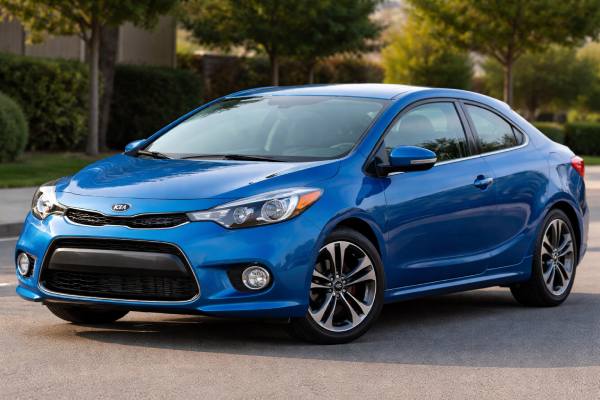
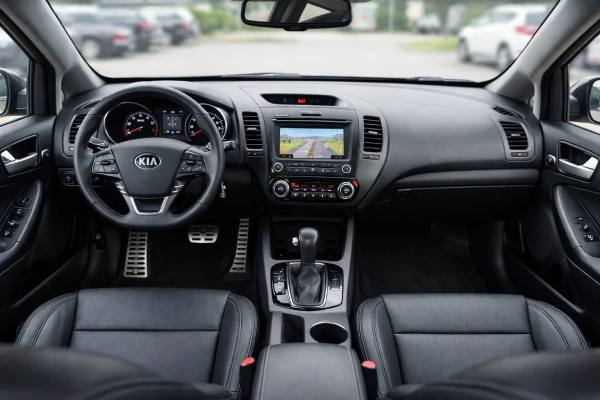
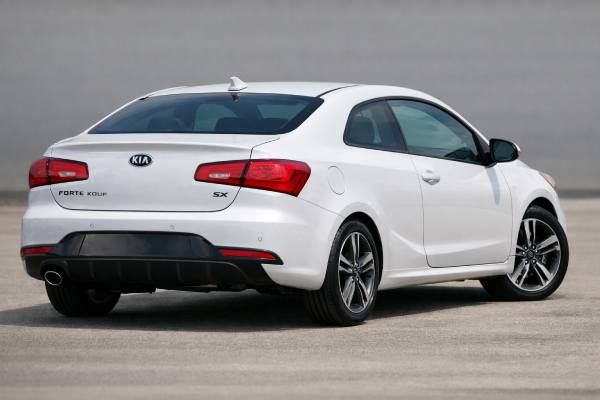
The 2014–2016 Kia Forte Koup (YD) with the 2.0-liter Nu GDI is the “simple-fast” version of Kia’s compact coupe: naturally aspirated power, predictable drivability, and a chassis that’s more composed than most buyers expect at this price point. The direct-injection (GDI) Nu engine rewards steady maintenance—especially clean oil and a healthy PCV system—because it relies on precise fuel spray and tight combustion control to make its 173 hp without a turbo. The Koup body is also a bit stiffer-feeling than the sedan in everyday driving, with a shorter roofline that changes rear visibility and cabin access, not the core mechanicals. If you want a compact that’s easy to live with, quick enough for modern traffic, and generally straightforward to service, this configuration is one of the most sensible picks in the Forte family.
Owner Snapshot
- Strong midrange pull for a non-turbo compact and easy daily drivability
- Good balance of ride comfort and cornering for a small coupe
- Cabin controls are simple and durable, with practical real-world ergonomics
- Plan for intake-valve deposit prevention (GDI trait) and watch for oil seepage as mileage rises
- Change engine oil about every 8,000–10,000 km (5,000–6,000 mi) or 6 months in mixed city use
Quick navigation
- Kia Forte Koup YD profile
- Kia Forte Koup Nu GDI specs
- Kia Forte Koup trims and ADAS
- Known problems and recalls
- Maintenance schedule and buying tips
- Road manners and real economy
- Koup versus compact rivals
Kia Forte Koup YD profile
The Forte Koup is the two-door branch of the YD-generation Forte family—same basic platform idea, but tuned around a coupe body and a slightly sportier customer. In 2014–2016 form with the 2.0 Nu GDI, it lands in a sweet spot: enough power to feel lively without adding turbo heat or boost complexity, and a powerband that stays usable even with the automatic. The direct-injection setup helps it make strong output for its era, but it also means the engine’s cleanliness depends heavily on oil quality, crankcase ventilation health, and driving patterns.
From an ownership perspective, the Forte Koup’s strengths show up in consistency. Steering, brakes, and throttle mapping are easy to learn, which makes the car feel “right” quickly. You don’t have to fight the controls to drive smoothly, and you don’t have to drive aggressively to make it feel responsive. The Koup’s lower roofline and longer doors are the biggest day-to-day trade: it looks cleaner than the sedan, but rear-seat access is obviously worse and tight parking spaces demand more care.
Underneath, it’s a conventional front-wheel-drive compact layout. The car’s basic service needs are familiar: fluids, filters, plugs, and brake wear items are all normal jobs with good parts availability. Where owners get caught is usually not “hard” failures but small compounding issues—deferred oil changes, ignored misfire symptoms, overdue brake fluid, or bargain ignition parts that don’t play well with a GDI calibration.
Who is this model best for?
- Commuters who want a compact that feels quicker than its size suggests, without going full sport compact.
- First-time owners who value simple controls and straightforward maintenance.
- Buyers avoiding turbos but still wanting real passing power.
Who should think twice?
- Drivers doing mostly short trips in cold weather (harder on oil, PCV, and GDI intake cleanliness).
- Anyone needing frequent rear-seat access or maximum cargo utility.
Kia Forte Koup Nu GDI specs
Below are practical specs for the 2014–2016 Forte Koup with the 2.0-liter Nu GDI (commonly referenced as the 2.0 GDI “Nu” family). Exact figures can vary by market, emissions spec, wheels/tires, and transmission.
Powertrain and efficiency
| Item | Specification |
|---|---|
| Code | Nu 2.0 GDI (commonly G4NC family) |
| Engine layout and cylinders | Inline-4, DOHC, 4 valves/cyl |
| Displacement | 2.0 L (1999 cc) |
| Induction | Naturally aspirated |
| Fuel system | GDI (direct injection) |
| Max power | 173 hp (129 kW) @ ~6,500 rpm |
| Max torque | 205 Nm (151 lb-ft) @ ~4,700 rpm |
| Timing drive | Chain |
| Rated efficiency (typical) | ~6.9–9.8 L/100 km (24–34 mpg US; 29–40 mpg UK) depending on trans/route |
| Real-world highway @ 120 km/h | Often ~7.2–8.2 L/100 km if tires/alignment are healthy and speeds are steady |
Notes that matter: the Nu GDI likes clean oil and correct spark plugs. Because fuel is injected directly into the cylinder, the intake valves don’t get “washed” by fuel like port-injection engines. That’s why PCV health, oil vapor control, and driving style affect long-term cleanliness.
Transmission and driveline
| Item | Specification |
|---|---|
| Transmission | 6-speed manual (where offered) or 6-speed automatic |
| Drive type | FWD |
| Differential | Open (traction control manages wheelspin) |
Chassis and dimensions
| Item | Typical specification |
|---|---|
| Suspension (front/rear) | MacPherson strut / torsion beam |
| Steering | Electric power steering |
| Brakes | 4-wheel discs (rear disc availability varies by trim/market) |
| Wheels/tires (common) | 205/55 R16, 215/45 R17, or 225/40 R18 (trim-dependent) |
| Length / width / height | ~4,530 mm / 1,780 mm / 1,410 mm (varies by wheel/tire and market) |
| Wheelbase | ~2,700 mm |
| Turning circle | ~10.6–11.0 m (typical compact range) |
| Kerb weight | ~1,250–1,360 kg (trim/trans dependent) |
| Fuel tank | ~50 L |
Performance and capability
| Metric | Typical result (condition-dependent) |
|---|---|
| 0–100 km/h (0–62 mph) | ~8.0–9.0 s |
| Top speed | ~200–210 km/h (125–130 mph) |
| Braking 100–0 km/h | Often ~38–41 m on good tires |
| Towing capacity | Usually not rated for heavy towing in many markets; treat as “light duty only” |
Fluids and service capacities (decision-making level)
These are “what owners actually need” items; verify your exact VIN/service literature before torque-sensitive work.
| Fluid/item | Specification (typical) |
|---|---|
| Engine oil | API SN / ILSAC GF-5 class oil; 5W-20 or 5W-30 depending on climate; ~4.0–4.5 L with filter |
| Coolant | Phosphate-OAT type long-life coolant (50/50 mix typical) |
| Automatic transmission fluid | Hyundai/Kia SP-IV type (service method affects quantity) |
| Brake fluid | DOT 3 or DOT 4 (follow cap/owner guidance) |
| A/C refrigerant | R-134a (charge varies by market; check under-hood label) |
Key torque specs (common “critical fasteners” you’ll encounter):
- Wheel lug nuts: typically 90–110 Nm (66–81 lb-ft) depending on wheel type
- Spark plugs: typically 18–25 Nm (13–18 lb-ft) on aluminum heads (use correct plug seat type)
- Engine oil drain plug: commonly 30–40 Nm (22–30 lb-ft)
Kia Forte Koup trims and ADAS
Trims vary widely by country, but the 2014–2016 Forte Koup lineup usually follows a familiar structure: a value-oriented base trim, a mid trim with convenience features, and a sportier appearance or equipment grade (often wearing “EX” or “SX” naming in some markets). For the Nu GDI 2.0 specifically, the most important differences are not the engine itself, but the supporting hardware: wheel/tire sizes, brake equipment, and the infotainment and lighting packages that can meaningfully change day-to-day satisfaction.
Trims and options that change how the car feels
- Wheel and tire package: Going from 16-inch to 17/18-inch wheels sharpens steering response but typically increases road noise and makes the ride less forgiving on broken pavement. Larger wheels also make alignment and tire quality more critical.
- Brakes: Some trims/markets offer stronger brake feel through pad compound and rear disc fitment; it’s worth confirming rear brake type when you inspect a used example.
- Interior and tech: Higher trims often bring better seat materials, a stronger audio system, and convenience features that make the coupe easier to live with (camera, smart key, automatic climate, etc.).
Quick identifiers when shopping used:
- Badging and wheel style usually reveal the grade faster than seller descriptions.
- Headlight housings and fog lamps can indicate package level.
- Steering wheel controls and infotainment screen size help confirm whether you’re looking at the “base” electrical system or the upgraded one.
Safety ratings and what they mean for this model
Safety results depend on test body, market, and exact configuration. In the U.S., rating organizations often test the sedan body style most heavily; the coupe may share structure but isn’t always tested as a separate entry. In Australia/New Zealand, the equivalent model family is often listed as “Cerato/Cerato Koup,” and the coupe rating can be explicitly tied to sedan crash tests.
Practical takeaway: treat published crash ratings as a strong signal about platform-level engineering, but still verify your exact car’s equipment—airbag count, ESC presence, and seat belt reminders—because base trims in some markets omit “nice to have” safety aids.
Driver assistance and active safety (2014–2016 reality check)
This era sits before today’s “everything standard” ADAS approach. Many Forte Koup examples rely on:
- Core stability and braking systems: ABS, ESC, traction control, brake-force distribution.
- Passive safety: multiple airbags (front, side torso, curtains), strong belt pretensioners, and head restraints designed for whiplash performance.
- Limited ADAS availability: features like autonomous emergency braking, lane keeping, or adaptive cruise are often not present or are market/trim dependent.
If the car has a forward camera or radar-based system (rare in many 2014–2016 Koups), remember that windshield replacement, alignment changes, and front-end repairs may require recalibration.
Known problems and recalls
A well-kept Nu GDI Forte Koup can be dependable, but it has a predictable set of weak points. The key is separating “annoying but manageable” from “expensive if ignored.”
Common (high frequency, usually low-to-medium cost)
- GDI intake-valve deposits
- Symptoms: rough cold idle, occasional misfire, reduced fuel economy.
- Likely cause: oil vapor and blow-by residues baking on intake valves over time.
- Remedy: keep oil changes consistent, confirm PCV operation, consider periodic intake cleaning if symptoms appear.
- Ignition coil and plug sensitivity
- Symptoms: misfire under load, check-engine light, hesitation.
- Cause: worn plugs, weak coils, or incorrect aftermarket parts.
- Remedy: use correct heat range plugs and quality coils; don’t stretch plug intervals when drivability starts to change.
- Brake wear and pedal feel drift
- Symptoms: vibration, longer stops, soft pedal.
- Cause: cheap pads/rotors, old brake fluid, sticking caliper slide pins.
- Remedy: quality friction parts, brake fluid flush on schedule, and clean/lube slide pins.
Occasional (medium frequency, medium-to-high cost if delayed)
- Oil seepage from gaskets and seals
- Symptoms: oil smell, small drips, oily residue near the engine.
- Cause: age and heat cycling; sometimes overfilled oil worsens it.
- Remedy: fix leaks before they contaminate belts, mounts, or sensors; monitor oil level closely.
- Cooling system aging
- Symptoms: slow coolant loss, temperature swings, heater performance changes.
- Cause: hoses, radiator end tanks, thermostat sticking (age-driven).
- Remedy: pressure test, replace weak components proactively, and keep correct coolant type.
Rare (lower frequency, can be high cost)
- Catalytic converter efficiency failures
- Symptoms: loss of power, catalyst efficiency codes, rattles.
- Cause: long-term misfires, oil burning, or thermal stress.
- Remedy: address root cause first (misfire/oil control) before replacing the converter.
Recalls, service actions, and how to verify
Recalls vary by market and production date. For U.S. cars, the safest approach is to run the VIN through official recall databases and confirm completion with a dealer record. When inspecting a used Koup, ask for:
- Proof of recall completion (repair order or dealer printout).
- A scan report showing no active powertrain or airbag-related faults.
- Evidence of consistent oil service (dates and mileage, not just “I changed it”).
If you’re shopping in a region where immobilizer or security upgrades were offered later, confirm whether the car received any applicable updates based on its build and equipment.
Maintenance schedule and buying tips
A Nu GDI Forte Koup responds well to “boring” maintenance. If you keep fluids fresh and address small drivability symptoms early, it tends to stay inexpensive.
Practical maintenance schedule (distance or time, whichever comes first)
Every 8,000–10,000 km (5,000–6,000 mi) or 6 months
- Engine oil and filter (short-trip city driving benefits from the shorter end)
- Check oil level between changes (GDI engines can be sensitive to neglect)
- Inspect tires, brakes, and coolant level
Every 15,000–20,000 km (9,000–12,000 mi)
- Rotate tires; check alignment if wear is uneven
- Replace cabin air filter (sooner in dusty cities)
Every 30,000–40,000 km (18,000–25,000 mi)
- Engine air filter
- Brake fluid inspection; flush if dark or moisture is high
- Inspect serpentine belt and tensioner condition
Every 60,000–80,000 km (37,000–50,000 mi)
- Spark plugs (use correct specification; don’t gamble with off-brand plugs)
- Automatic transmission fluid service (interval depends on use; heavy city use benefits from earlier service)
- Coolant condition check; replace by time if the car is aging out
Every 120,000–160,000 km (75,000–100,000 mi)
- Coolant replacement if not already done by time schedule
- Inspect engine mounts, suspension bushings, and wheel bearings
Buyer’s guide: what to check on a test drive
- Cold start quality: listen for rough idle or repeated stumbling (can hint at deposits or ignition issues).
- Transmission behavior: smooth upshifts, no flare, no harsh engagement into gear (especially after a warm-up).
- Brake feel: consistent pedal, no steering shake during medium braking.
- Steering and front end: no clunks over bumps (control arm bushings and links are common wear items).
- Undercarriage and seams: check for corrosion hotspots in wheel arches, subframe edges, and rocker seams (varies heavily by climate).
- Electronics: verify camera, steering-wheel controls, window regulators, and HVAC fan speeds.
Which years and options to prioritize
- Choose the cleanest service history over the “best” year on paper.
- Favor trims with ESC, curtain airbags, and rear disc brakes where applicable.
- If you drive mostly highway, the automatic can be perfectly fine; if you want maximum control and slightly simpler long-term service, a manual (where available) is attractive—assuming the clutch engagement is healthy and smooth.
Long-term durability outlook: the Nu GDI can age well when oil service is consistent and misfires are not ignored. Most “big bills” come from running it too long with warning lights on or skipping fluid maintenance until something feels broken.
Road manners and real economy
The Forte Koup’s driving character is defined by predictability. It’s not a razor-edged hot hatch, but it has enough grip and damping control to feel confident in everyday corners—and the coupe body gives the car a tighter, more “together” impression over broken pavement.
Ride, handling, and NVH
- Ride quality: generally composed at city speeds, with sharper impacts on larger wheels. If a used example feels crashy, it may be running overinflated tires or worn dampers.
- Handling balance: safe front-drive tuning—mild understeer at the limit, with stability control stepping in smoothly. Good tires make a bigger difference here than most owners expect.
- Steering feel: light-to-medium effort with decent on-center stability. If it wanders on the highway, suspect alignment or mismatched tires.
- Cabin noise: typical compact coupe levels—tire noise rises notably with low-profile tires and coarse asphalt.
Powertrain character: what it feels like
The 2.0 Nu GDI is responsive for a naturally aspirated 2.0. You get clean throttle response, and the engine builds power in a linear way. It doesn’t have turbo “punch,” but it also avoids turbo lag and tends to feel consistent across temperatures.
- Low rpm: adequate torque for commuting; you won’t need to floor it constantly.
- Midrange: the sweet spot for passing; a well-maintained engine feels eager here.
- High rpm: willing, but it’s not an engine you rev for drama—more “effective” than “emotional.”
Automatics from this era can sometimes hunt on hills if the car is lightly loaded and cruise control is set aggressively. The remedy is often simple: clean throttle body (if needed), ensure correct fluid service history, and keep tires matched.
Real-world efficiency (what owners actually see)
Expect consumption to depend heavily on speed and tire choice:
- City-heavy use: often around 9.0–10.5 L/100 km if traffic is dense and trips are short.
- Highway steady 100–120 km/h: often 7.2–8.2 L/100 km with good alignment and tires.
- Mixed driving: commonly 8.0–9.2 L/100 km.
Cold weather and short trips can add a meaningful penalty because the engine spends more time warming up, and GDI engines tend to run richer during warm-up for emissions and stability.
Performance metrics that matter most
If you care about “usable quickness,” focus on two things during a test drive:
- Passing response at 60–100 km/h (or 40–60 mph): does it pull smoothly without hesitation?
- Brake consistency: does repeated braking feel stable, or does the pedal change noticeably?
Those two checks reveal more about real condition than a headline 0–100 time.
Koup versus compact rivals
Shopping a 2014–2016 Forte Koup 2.0 GDI usually overlaps with compact coupes and sport-leaning compacts from the same era. The Koup’s competitive advantage is that it blends “normal-car” ownership with enough power to feel modern—without the turbo complexity that many rivals adopted.
Where the Forte Koup tends to win
- Value-per-performance: 173 hp is strong for an older naturally aspirated compact, and parts/service are typically approachable.
- Everyday friendliness: visibility is decent for a coupe, controls are simple, and the car doesn’t demand special driving habits.
- Predictable chassis tuning: it feels stable and easy to place on the road, especially on a good tire set.
Where rivals can be better
- Handling sharpness: cars like the Civic Si (where available) or dedicated sport compacts may feel more precise at the limit and offer a stronger enthusiast aftermarket.
- Fuel economy at high speeds: some rivals with taller gearing or newer efficiency tech may do slightly better on steady highway runs.
- Advanced safety tech: many 2014–2016-era vehicles lacked modern ADAS, but certain competitors introduced driver aids earlier or offered more robust options depending on region.
Smart comparison approach (so you don’t miss the best car)
When cross-shopping, compare these “ownership fundamentals” first:
- Evidence of consistent oil service and correct spark plug intervals
- Transmission behavior (especially smoothness when warm)
- Tire matching and alignment health (a huge hidden cost lever)
- Recall completion and clean diagnostic scans
If the Forte Koup you’re looking at is clearly better maintained than a “sportier” competitor, it will usually be the better buy—even if the rival looks better on paper.
If you want the best version of this Koup experience, prioritize:
- Complete service records
- A trim with the safety and brake equipment you want
- A car that drives cleanly from cold start through full warm-up, with no hesitation under load
References
- Kia Cerato | Safety Rating & Report | ANCAP 2013 (Safety Rating)
- 2014 Kia Forte 4-door sedan 2014 (Safety Rating)
- Gas Mileage of 2016 Kia Forte 2016 (Fuel Economy Database)
- 2015 Kia Forte Koup Press Release 2014 (Manufacturer Publication)
- Vehicle Detail Search – 2014 KIA FORTE KOUP 2014 (Recall Database)
Disclaimer
This article is for informational purposes only and is not a substitute for professional inspection, diagnosis, or repair. Specifications, torque values, fluid capacities, service intervals, and procedures can vary by VIN, market, production date, and equipment; always verify details using your official owner’s manual and service documentation for the exact vehicle you are working on.
If this guide helped, please consider sharing it on Facebook, X (Twitter), or your favorite forum to support our work.