
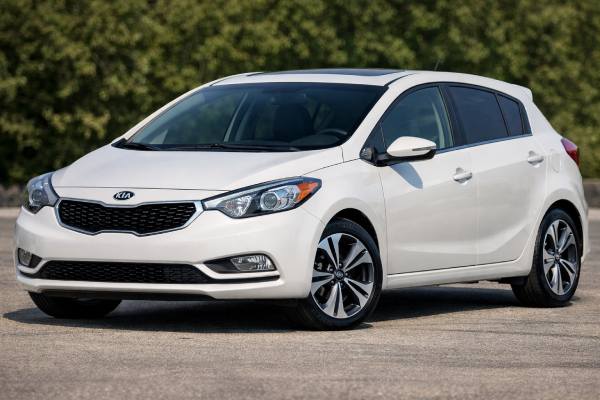
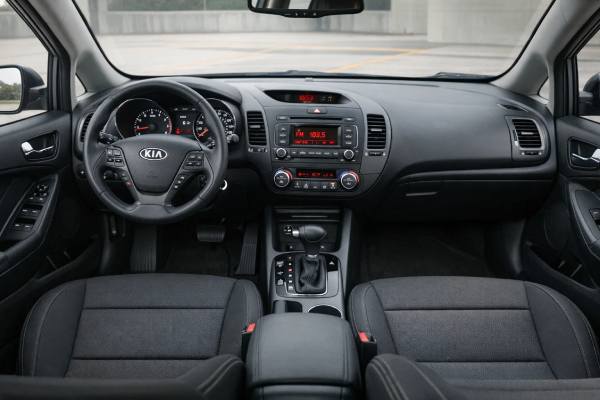
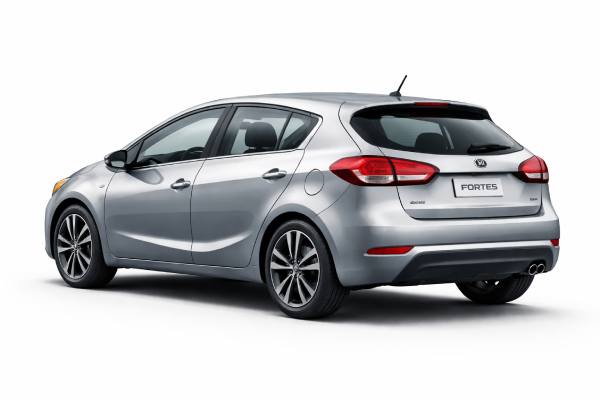
The 2014–2016 Kia Forte5 (YD) with the 1.6 turbocharged Gamma T-GDi is the “warm hatch” in the lineup: quick enough to feel special, but still sized, priced, and tuned for everyday use. Its appeal comes from a strong midrange punch (where you actually drive), a practical cargo area, and straightforward mechanicals—front-wheel drive, conventional suspension, and a simple turbo four-cylinder without complicated hybrid hardware. The trade-off is that this engine’s direct injection and turbo heat demand more discipline from the owner: oil quality matters, intake deposits are a real-world concern, and neglected cooling or PCV issues can snowball. When maintained on a sensible schedule, the Forte5 1.6T can be an easy car to live with and a genuinely enjoyable commuter, especially for drivers who want hatchback flexibility without moving up to a larger class.
What to Know
- Strong midrange pull makes it feel faster than the numbers suggest, especially from 30–90 km/h.
- Practical hatch cargo and a low lift-over height suit daily errands and travel.
- Direct injection can mean intake-valve deposits over time; plan for periodic inspection/cleaning.
- Turbo engines reward shorter oil intervals in city use and hot climates (8,000–10,000 km is a common “severe” target).
- Rotate tires every 8,000–10,000 km to keep steering feel sharp and reduce uneven wear.
Explore the sections
- Kia Forte5 YD 1.6T profile
- Kia Forte5 turbo specs tables
- Kia Forte5 trims and safety gear
- Reliability and known weak points
- Maintenance schedule and costs
- Driving feel and mpg reality
- Competitors and ownership choice
Kia Forte5 YD 1.6T profile
Think of the Forte5 1.6T as a sensible hatch that learned one fun trick: boost. In daily driving, the turbo engine’s biggest advantage isn’t peak horsepower—it’s how willingly the car surges forward in the midrange. That matters because it reduces downshifts, makes merging less stressful, and gives the car a more “effortless” character than many naturally aspirated small hatches of the same era.
The chassis is tuned for broad appeal. You get predictable front-end grip, a stable rear, and a ride that stays composed over broken pavement without feeling floaty. It is not a razor-edged hot hatch, but it also does not punish you on rough roads or long trips. Steering is light-to-medium effort with a modern, slightly isolated feel—good for commuting, less communicative when pushed hard.
Where ownership gets more nuanced is under the hood. A direct-injected turbo four runs hotter than a basic port-injected engine. That heat and pressure show up in real-world maintenance needs: oil condition becomes more important, coolant health matters, and PCV (positive crankcase ventilation) performance can influence oil consumption and intake cleanliness. Direct injection also means the fuel does not wash the backs of intake valves, so carbon deposits can build over time, especially with lots of short trips.
The Forte5 body style itself is a practical win. The hatch opening is wide, the load floor is useful, and the car’s exterior dimensions remain city-friendly. For many owners, that’s the “secret sauce”: you get compact-car maneuverability with the flexibility to haul bulky items without stepping up to a crossover.
Bottom line: the Forte5 1.6T is best for drivers who want a quick, usable hatchback and are willing to maintain it like a turbo car—warm-up discipline, high-quality oil, and proactive inspections—rather than treating it like an appliance.
Kia Forte5 turbo specs tables
Below are practical, trim-relevant specs for the 2014–2016 Forte5 (YD) 1.6T. Some values vary by market and option (wheels, brakes, and curb weight in particular), so use these as a baseline and verify by VIN when ordering parts.
Powertrain and efficiency
| Item | Specification |
|---|---|
| Code | Gamma T-GDi (commonly referenced as G4FJ in many markets) |
| Engine layout and cylinders | Inline-4, DOHC, 4 valves/cyl |
| Bore × stroke | 77.0 × 85.0 mm (3.03 × 3.35 in) |
| Displacement | 1.6 L (1,591 cc) |
| Induction | Turbocharged |
| Fuel system | Direct injection (GDI) |
| Compression ratio | 9.5:1 |
| Max power | 201 hp (150 kW) @ 6,000 rpm |
| Max torque | 264 Nm (195 lb-ft) @ 1,750–4,500 rpm |
| Timing drive | Chain |
| Rated efficiency (typical) | ~9.8 L/100 km (24 mpg US / 29 mpg UK) combined (automatic); ~8.7–9.0 L/100 km combined range is common for manual depending on rating method |
| Real-world highway @ 120 km/h | ~7.5–8.5 L/100 km (31–27 mpg US), depending on wind, tires, and load |
Transmission and driveline
| Item | Specification |
|---|---|
| Transmission | 6-speed manual (where offered) or 6-speed automatic (market-dependent) |
| Drive type | FWD |
| Differential | Open (traction control manages wheelspin) |
Chassis and dimensions
| Item | Specification |
|---|---|
| Suspension (front/rear) | MacPherson strut / torsion beam (typical YD layout) |
| Steering | Electric power steering |
| Brakes | Front disc ~300 mm (11.8 in) / rear disc ~262 mm (10.3 in) (typical 1.6T spec) |
| Wheels and tires (popular) | 225/40 R18 (common performance-oriented fitment on turbo trims) |
| Length / width / height | 4,359 / 1,781 / 1,451 mm (171.6 / 70.1 / 57.1 in) |
| Wheelbase | 2,701 mm (106.3 in) |
| Turning circle (kerb-to-kerb) | ~10.6 m (34.8 ft) |
| Curb weight (typical) | ~1,300–1,350 kg (2,870–2,980 lb), varies by transmission and equipment |
| Fuel tank | 50 L (13.2 US gal / 11.0 UK gal) |
| Cargo volume | ~657 L (23.2 ft³) behind rear seats (method varies by market) |
Performance and capability
| Metric | Typical real-world expectation |
|---|---|
| 0–100 km/h (0–62 mph) | ~7.2–7.8 s (traction and transmission dependent) |
| Top speed | ~210–225 km/h (130–140 mph), market-limited |
| Braking 100–0 km/h | ~36–41 m (tire and pad dependent) |
| Towing capacity | Often not rated or kept low for small turbo FWD hatches; follow your market’s homologation limits |
| Payload | Check door-jamb label; varies heavily with trim and options |
Fluids and service capacities (verify by VIN)
These values are intentionally shown as ranges because published capacities vary by oil pan, cooler, and regional components.
| Fluid | Specification | Typical capacity |
|---|---|---|
| Engine oil | API SN/SN+ or SP; quality full-synthetic recommended for turbo; 5W-30 common (climate dependent) | ~3.6–3.9 L (3.8–4.1 US qt) |
| Coolant | Phosphate OAT / long-life coolant (regional spec varies) | ~5.5–6.5 L (5.8–6.9 US qt) |
| Automatic transmission fluid | Hyundai/Kia-spec ATF for 6-speed auto | ~6.5–7.5 L total fill (service fill is usually less) |
| Manual transmission fluid | GL-4 gear oil (often 75W-85/75W-90 depending on region) | ~1.8–2.2 L |
| A/C refrigerant | R-134a (typical for these years) | Charge varies by label |
Key torque specs (decision-level, verify before final assembly)
| Fastener | Typical torque range |
|---|---|
| Wheel lug nuts | ~88–108 Nm (65–80 lb-ft) |
| Engine oil drain plug | ~35–45 Nm (26–33 lb-ft) |
| Spark plugs (if serviced) | ~18–25 Nm (13–18 lb-ft) |
Kia Forte5 trims and safety gear
For the 2014–2016 Forte5, the 1.6T is usually paired with higher trims (often branded as SX or an equivalent “sport” grade, depending on market). The easiest way to identify the turbo model is the combination of badging and hardware: larger wheels (often 18-inch), more aggressive front fascia details, and—under the hood—a compact turbocharger and charge piping that you can spot quickly near the exhaust side of the engine.
Trims and options that actually change ownership
Not every option matters long-term. Focus on the ones that affect wear parts, comfort, and resale:
- Wheel and tire packages: 18-inch wheels sharpen steering response but increase tire cost and make pothole damage more likely. If your roads are rough, a smaller wheel package (where available) can be a durability upgrade.
- Infotainment and audio tiers: Higher trims often carry more complex head units and amplifiers. They can be excellent when working, but they raise replacement costs if water intrusion or electrical faults happen.
- Seats and interior materials: Leather or leatherette can improve resale, but check for bolster wear and heater function; seat repairs are not cheap.
- Sunroof: Nice to have, but inspect drains and headliner staining. Sunroof leaks are less common than on some rivals, yet any leak can create expensive electrical gremlins.
Safety ratings and what they mean here
Safety ratings can be confusing because some testing organizations evaluate the sedan more often than the hatch. The good news is that the Forte5 and the sedan share core structure and restraint philosophy, so the sedan results still provide useful insight for the platform.
On this generation, IIHS results for the related Forte sedan show strong scores in several crash modes (moderate overlap, side, roof strength, and head restraints), with a weaker spot in the small-overlap front test for 2015–2016 applications. That pattern matters: it suggests the car is broadly competent in common crash scenarios but not class-leading in the most demanding offset frontal case of that era.
Driver assistance and everyday safety tech
Do not expect modern ADAS across this period. Many 2014–2016 trims rely on:
- Core systems: ABS, stability control, traction control, and brake assist.
- Airbags: Front, side torso, and curtain airbags are typical; confirm exact count by trim and market.
- Child-seat provisions: LATCH/ISOFIX anchors are present; verify that anchor access is not blocked by stiff seat cushions or trim pieces.
- Optional sensors: Rear parking sensors and a rear camera are common in higher trims, but their presence varies by year and package.
A practical service note: if your Forte5 has a steering angle sensor, yaw sensor, or a camera-equipped windshield (rare in these years), alignment work and windshield replacement may require calibration steps. Even without full ADAS, stability control relies on accurate sensor inputs, so fix warning lights promptly rather than clearing codes and hoping for the best.
Reliability and known weak points
The Forte5 1.6T can be reliable, but it has a narrower “neglect tolerance” than a basic naturally aspirated port-injected engine. The turbocharger, direct injection, and higher cylinder pressures raise the stakes for oil quality and cooling health. Use the guide below as a prevalence-and-severity map, then match it to the car you are inspecting.
Common (plan for it)
- Intake-valve carbon buildup (medium cost, medium annoyance):
Symptoms: Rough idle, hesitation, reduced fuel economy, occasional misfire codes.
Likely cause: Direct injection does not wash intake valves; short trips accelerate deposit formation.
Remedy: Inspection and cleaning (often walnut blasting or equivalent) when symptoms appear; improve oil change discipline and reduce extended idling. - PCV and crankcase ventilation wear (low–medium cost, medium risk):
Symptoms: Oil consumption creep, oily intake plumbing, occasional smoke on startup.
Likely cause: PCV valve aging and increased blow-by under boost.
Remedy: Replace PCV components at sensible intervals; inspect hoses and intake tract for oil pooling. - Ignition coil and plug sensitivity (low–medium cost, low risk if handled early):
Symptoms: Misfires under load, flashing MIL, poor acceleration.
Likely cause: Heat cycling and boost load stress; incorrect plug heat range/gap after a DIY tune-up.
Remedy: Use correct plugs, replace coils as needed, and avoid bargain ignition parts.
Occasional (inspect before buying)
- Turbo control issues (medium–high cost, higher risk when ignored):
Symptoms: Boost lag, underboost codes, rattles, inconsistent power.
Likely cause: Wastegate actuator wear, boost leaks, or diverter/bypass valve issues (design varies by year/market).
Remedy: Smoke test the intake system, check actuator movement, and repair leaks before assuming the turbo itself is bad. - Cooling system weak spots (medium cost, high risk if overheated):
Symptoms: Coolant smell, low coolant, temperature swings.
Likely cause: Aging hoses, thermostat issues, or small seepage that becomes chronic.
Remedy: Pressure test, replace suspect components proactively, and never “top up forever” without finding the leak.
Rare (but expensive)
- Oil starvation or severe oil consumption (high cost):
Symptoms: Low oil level between services, turbo noise, bearing wear, timing chain noise.
Likely cause: Long drain intervals, wrong oil viscosity, or a past overheating event.
Remedy: Compression/leak-down test, borescope when needed, and walk away from neglected examples.
Recalls, TSBs, and software updates
Campaigns vary by market and VIN range. Your safest approach is procedural: run the VIN through an official recall portal, ask the seller for dealer service printouts, and confirm any open actions are completed before purchase. If a seller cannot document recall completion, assume you will need a dealer visit and build that time and cost into the deal.
Maintenance schedule and costs
A strong maintenance plan for the Forte5 1.6T is less about doing exotic work and more about doing ordinary work on time—especially fluids and filters. The schedule below balances factory-style intervals with “real life” turbo ownership.
Practical maintenance schedule (distance or time, whichever comes first)
- Engine oil and filter:
- Normal use: every 12,000 km or 12 months
- Severe use (short trips, heavy traffic, heat, spirited driving): every 8,000–10,000 km or 6–9 months
Use a high-quality full-synthetic oil that meets the correct API spec for your region. - Engine air filter: every 24,000–30,000 km; sooner in dusty areas.
- Cabin air filter: every 15,000–20,000 km or annually (cheap comfort upgrade).
- Spark plugs: typically every 60,000–100,000 km depending on plug type and tune; on a turbo, err toward the earlier end if you drive hard.
- Coolant: inspect annually; replace on a long-life schedule (commonly 5 years / 100,000+ km) unless contamination or overheating history exists.
- Brake fluid: every 2 years (moisture control matters more than mileage).
- Transmission fluid:
- Automatic: consider a drain-and-fill every 60,000–90,000 km for longevity, especially in city use.
- Manual: gear oil change often lands around 60,000–100,000 km depending on feel and contamination.
- Belts and hoses: inspect at every oil service; replace at the first sign of cracking or coolant seepage.
- Tires: rotate every 8,000–10,000 km; align if wear is uneven or after suspension work.
- 12 V battery: test yearly after year 4; many last 4–6 years depending on climate.
Buyer’s guide checklist (turbo-specific)
- Cold start behavior: Listen for timing chain rattle beyond a brief start-up moment and confirm idle smoothness.
- Boost delivery: In a safe pull from ~2,000 rpm, power should build cleanly without fluttering sounds (boost leak) or sudden cut (over/underboost protection).
- Oil condition: Check level and smell. Burnt odor or very dark oil shortly after a “fresh service” can signal neglect.
- Cooling system: Look for dried coolant residue near hose joints and the radiator end tanks; verify the heater works (air trapped or low coolant can show up here).
- Brakes and tires: Uneven inner-edge tire wear suggests alignment or worn bushings; pulsing brakes suggest rotor thickness variation.
- Service records: Prioritize cars with frequent oil services and documented spark plug and coolant work.
Long-term durability outlook
With consistent oil changes, clean air filtration, and prompt fixes for boost and coolant leaks, the Forte5 1.6T can be a dependable long-term hatch. The biggest predictors of a “good one” are boring: maintenance history, sensible warm-up habits, and evidence that the owner addressed small issues early instead of driving through warning lights.
Driving feel and mpg reality
On the road, the Forte5 1.6T’s personality is defined by usable torque. Around town, it responds well to small throttle inputs, and it can ride a higher gear without feeling asleep. That makes it relaxing in traffic and satisfying on short highway merges. The turbo’s delivery is typically strongest in the midrange; near redline it feels more like a brisk commuter than a track tool.
Ride, handling, and NVH
- Ride quality: Firm but not harsh, with good control over repeated bumps. On 18-inch tires, sharp edges and potholes are more noticeable, and road noise increases on coarse surfaces.
- Handling balance: Predictable front-drive behavior—lean on the front tires, and the car will understeer progressively. Lift-off rotation is limited, which is reassuring for most drivers.
- Steering and braking feel: Steering is accurate for the class, though feedback is muted. Brakes tend to be easy to modulate; pad choice can strongly influence bite and fade resistance.
- Cabin noise: Expect moderate tire noise at highway speeds, especially with performance-oriented tires. Wind noise is usually well controlled for a small hatch.
Powertrain character and transmission behavior
- Throttle response: Good once on boost; slightly softer below the turbo’s sweet spot, especially with an automatic.
- Automatic logic: Generally tuned for efficiency in gentle driving. In rolling hills, it may downshift more than you expect; that is normal, but harsh shifts or flare under load suggests fluid or mechanical issues.
- Manual feel (where offered): A manual can make the car feel more energetic and helps you keep the engine in its strongest range; clutch condition matters—test for slip in a higher gear at low rpm with a moderate throttle roll-on.
Real-world efficiency (what owners typically see)
Fuel economy varies widely with speed and tire choice. As a practical expectation:
- City-heavy driving: ~9.5–11.0 L/100 km (25–21 mpg US)
- Highway at 100–110 km/h: ~7.0–8.0 L/100 km (34–29 mpg US)
- Highway at 120 km/h: ~7.5–8.5 L/100 km (31–27 mpg US)
Cold weather often adds a noticeable penalty because the engine spends more time in warm-up enrichment and because winter tires raise rolling resistance.
Practical performance metrics that matter
- Passing power (80–120 km/h): Strong for the class when already in the boost band; weaker if the transmission holds too tall a gear.
- Turning circle: Compact enough for tight parking and U-turns in city streets, which is a real daily advantage.
- Tires as a “performance mod”: A good set of tires can transform the Forte5 more than many bolt-on parts—shorter braking distances, quieter cruising, and better wet stability.
If your goal is a fun daily driver, the Forte5 1.6T hits a sweet spot: quick responses, practical space, and manageable running costs—provided you respect the maintenance needs of a turbo direct-injection engine.
Competitors and ownership choice
The Forte5 1.6T sits in a crowded class, but it has a clear value angle: you get strong torque, hatch practicality, and a typically generous equipment list for the money. The best rival depends on what you value most.
If you want the sharpest driving feel
Mazda3 (hatch) is often the driver’s pick: steering feel and chassis polish stand out, and the cabin can feel a class above. The trade-off is that many trims are naturally aspirated in this era, so you may not get the same low-rpm punch without stepping into higher-output variants.
If you want refinement and highway composure
Volkswagen Golf tends to deliver a solid, quiet cruise and a mature cabin layout. Depending on engine choice, it can be very efficient. Long-term costs can be higher if parts pricing and specialized service are factors in your area, so it rewards buyers who have good local support.
If you want simple and durable ownership
Honda Civic from this period is a strong all-rounder with broad parts availability and resale strength. Hatch availability depends on market and year, but as an ownership proposition it is consistently competitive.
If you want a bargain with space
Ford Focus can offer good dynamics and a roomy feel, but ownership experience depends heavily on the exact powertrain and transmission. Choose carefully and prioritize documented maintenance.
Where the Forte5 1.6T fits best
Pick the Forte5 1.6T if you want:
- Boosted midrange performance without stepping into a more expensive performance hatch category.
- A practical hatch format with compact parking manners.
- Good value per feature in higher trims.
Think twice (or budget extra) if you:
- Prefer a “set it and forget it” engine with minimal sensitivity to oil interval discipline.
- Drive mostly short trips in cold conditions and do not want to manage the carbon and moisture realities of a turbo GDI engine.
- Live in an area where quality turbo-compatible oil and good independent service support are hard to find.
A well-maintained Forte5 1.6T is a satisfying daily hatch that still feels lively years later. The smartest buys are the ones with boring service histories, stock or lightly modified setups, and owners who can explain what oil they used and how often they changed it.
References
- 2016 Kia Forte5 Specifications 2016 (Manufacturer Specifications)
- Gas Mileage of 2016 Kia Forte 2016 (Fuel Economy Data)
- 2016 Kia Forte 4-door sedan 2016 (Safety Rating)
- Check for Recalls: Vehicle, Car Seat, Tire, Equipment 2026 (Recall Database)
Disclaimer
This article is for informational purposes only and is not a substitute for professional inspection, diagnosis, or repair. Specifications, torque values, service intervals, and procedures can vary by VIN, market, production date, and equipment. Always confirm details using your official owner’s manual and service documentation for the exact vehicle you are working on.
If this guide helped, please consider sharing it on Facebook, X (Twitter), or your favorite forum to support our work.