


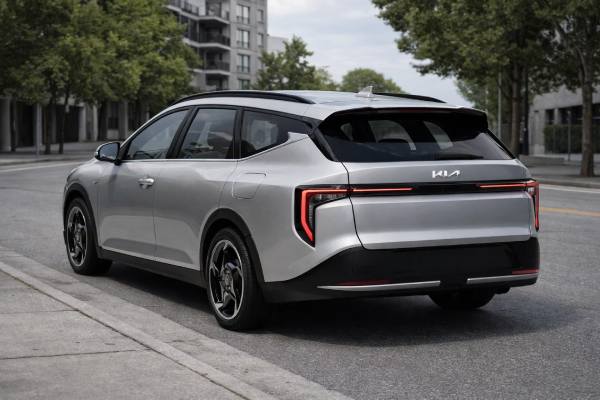
The Kia K4 Sportswagon (CL4) with the 1.6 T-GDi is the “do-it-all” take on the K4 idea: compact footprint, wagon utility, and a torque-rich turbo engine that doesn’t need high revs to feel lively. In German-market form, the 1.6 makes 132.4 kW (180 PS) and 265 Nm, paired with a 7-speed dual-clutch automatic and front-wheel drive—an efficient, modern layout aimed at long trips and daily commuting alike. The chassis mixes MacPherson struts up front with a multi-link rear, a combination that typically balances ride comfort with stable cornering. If you want one wagon that can handle school runs, motorway cruising, and weekend cargo without feeling underpowered, this configuration is the sweet spot—provided you keep up with fluid service and treat the turbo/DCT drivetrain with a bit of mechanical sympathy.
Top Highlights
- Strong mid-range pull (265 Nm) makes passing easier without constant downshifts.
- Big wagon practicality: up to 604 L cargo volume (VDA) with seats up on non-48V versions.
- Multi-link rear suspension is a plus for stability and ride quality versus torsion-beam rivals.
- Dual-clutch automatics reward regular fluid service and gentle low-speed driving in traffic.
- Plan oil changes about every 10,000–15,000 km or 12 months (market and usage dependent).
Explore the sections
- K4 Sportswagon 1.6T: what it is
- K4 Sportswagon 1.6T specs and measurements
- K4 Sportswagon trims, ADAS, and safety
- Reliability watchlist and known patterns
- Maintenance plan and buying checklist
- Real driving feel and fuel use
- Rivals and alternatives to cross-shop
K4 Sportswagon 1.6T: what it is
Think of this version of the K4 Sportswagon as the “balanced” powertrain for drivers who want more than a basic commuter engine but aren’t chasing hot-hatch performance. In German-market data, the 1.6 T-GDi is rated at 132.4 kW (180 PS) at 6,000 rpm with 265 Nm from 1,500–4,500 rpm, which tells you a lot about its character: it’s built to deliver useful thrust at everyday speeds, not just at the top end. That wide torque plateau is also what helps a wagon feel relaxed when loaded with passengers or luggage.
The layout is straightforward and modern. You get front-wheel drive, a 7-speed dual-clutch gearbox (DCT), direct injection, a single-scroll turbocharger, and an Otto particulate filter (OPF) to meet Euro 6e emissions requirements. The practical upside is easy highway cruising and good drivability in rolling terrain. The “watch-out” is that a DCT behaves differently from a traditional torque-converter automatic: it can feel a bit more eager at low speeds, and it’s sensitive to heat when you creep uphill or inch forward in traffic for long periods.
As a chassis package, the Sportswagon leans into stability and predictability. A MacPherson front and multi-link rear suspension is a strong foundation in this class, especially for maintaining composure over mid-corner bumps and when towing small trailers. Ground clearance is listed at 140 mm, which is normal for a road-focused wagon—fine for winter ruts and steep driveways, but not intended for rough tracks.
Ownership-wise, this model should appeal to buyers who want one car to cover many roles: daily commuting, long trips, and cargo hauling. The best results come from treating it like a modern turbo car—warm it up gently, keep oil fresh, and don’t ignore software updates or driveline service just because it “still feels fine.”
K4 Sportswagon 1.6T specs and measurements
Below is a spec-focused snapshot for the Kia K4 Sportswagon (CL4) 1.6 T-GDi 180 PS configuration as published for the German market.
Powertrain and efficiency
| Item | Specification |
|---|---|
| Code | 1.6 T-GDi (gasoline turbo, GDI) |
| Engine layout and cylinders | Inline-4, DOHC, 4 valves/cyl, dual variable valve timing |
| Bore × stroke | 75.6 × 89.0 mm |
| Displacement | 1.598 L (1,598 cm³) |
| Induction | Single-scroll turbocharger |
| Fuel system | Direct injection (GDI) |
| Compression ratio | 11.0:1 |
| Max power | 132.4 kW (180 PS) @ 6,000 rpm |
| Max torque | 265 Nm @ 1,500–4,500 rpm |
| Emissions | Euro 6e (with OPF) |
| Fuel | RON 95 (Super) |
| Tank | 47 L |
| WLTP combined | 7.1 L/100 km; 161 g/km CO₂ |
Transmission and driveline
| Item | Specification |
|---|---|
| Transmission | 7-speed dual-clutch automatic (DCT) |
| Drive type | FWD |
| Differential | Open (traction handled by brake-based systems/ESC) |
Chassis and dimensions
| Item | Specification |
|---|---|
| Suspension (front/rear) | MacPherson struts / multi-link with stabilizers |
| Steering | Electric power steering, rack-and-pinion |
| Steering turns lock-to-lock | 2.41 |
| Turning circle (kerb-to-kerb) | 10.72 m |
| Brakes (front/rear) | Ventilated discs / discs |
| Brake diameters | Front 325 × 30 mm; Rear 284 × 10 mm |
| Popular tyre sizes | 225/45 R17 91W or 235/40 R18 91W |
| Ground clearance | 140 mm |
| Length / width / height | 4,695 / 1,850 / 1,435 mm |
| Wheelbase | 2,720 mm |
| Cargo volume (VDA) | 604 / 1,439 L (min/max) |
Performance and capability
| Item | Specification |
|---|---|
| 0–100 km/h | 8.4 s |
| Top speed | 210 km/h |
| Towing capacity (12% grade) | 1,410 kg braked; 600 kg unbraked |
| Max payload (listed) | 440 kg |
Fluids and service capacities (what you should verify)
Kia price lists often don’t publish full service-fill capacities (oil, coolant, DCT fluid quantity, A/C charge). Treat the following as a checklist rather than confirmed numbers:
- Engine oil: confirm viscosity and spec in the owner’s manual for your VIN and climate (many modern turbo-GDI engines specify low-ash oils).
- Coolant: verify type and interval; mixed coolants can cause corrosion or deposit issues.
- DCT fluid: confirm whether the gearbox is “filled for life” in your market or has an official change interval—real-world durability improves when fluid is serviced.
K4 Sportswagon trims, ADAS, and safety
Trims and options (typical German-market structure)
Kia commonly groups equipment into a few “lines” plus option packs. In the German K4 Sportswagon material, you’ll see trims such as Vision, Spirit, and GT-Line, with wheel sizes stepping up from 16–17 inches to 18 inches as you move higher.
Practical trim differences usually fall into these buckets:
- Wheels and tyres: moving to 18-inch wheels can sharpen steering response but may increase road noise and impact harshness over broken pavement. If your roads are rough or winters are harsh, the 17-inch package is often the comfort sweet spot.
- Lighting and visibility: higher trims typically add upgraded headlamps and convenience features; these can matter as much as horsepower for daily safety.
- Interior and seating: upholstery material, seat heating/ventilation availability, and driver-seat adjustments often split trims more than mechanical hardware does.
- Infotainment and audio: expect a base system that’s fully functional, with premium audio/navigation and larger screens appearing in higher trims or option packs.
Quick identifiers you can use when shopping:
- GT-Line exterior cues (sportier bumpers, gloss-black details, and often larger wheels) are easier to verify than a seller’s written description.
- Tyre size on the sidewall is a fast way to confirm wheel package without decoding paperwork.
Safety systems and driver assistance (ADAS)
The published equipment descriptions highlight a modern ADAS set designed to reduce fatigue on long drives and add braking and lane support in everyday traffic. Key functions called out include:
- Forward Collision Avoidance Assist (FCA): detects vehicles and vulnerable road users and can brake if the driver doesn’t respond.
- Adaptive cruise control with Stop and Go (and navigation-based support in some descriptions).
- Lane Follow Assist (LFA) and Lane Keeping Assist (LKA): lane centering/steering support within defined speed ranges.
- Intelligent Speed Limit Assist (ISLA): reads speed signs and can prompt or help set cruise speed.
- Driver Attention Warning (DAW): monitors driving patterns for fatigue/distraction cues.
Safety ratings: what to expect
Because ratings can differ by region and test protocol, treat them as “trim-and-market specific,” not a universal truth. If/when this model is assessed, you may see results from IIHS (U.S.-market vehicles) or Euro programs for European-market cars. The important shopping tip is to verify the exact year, body style, and headlight configuration in any rating database—headlamp performance and optional safety packs can change the final score.
Reliability watchlist and known patterns
The K4 Sportswagon is still new in 2026 terms, so long-term fleet data will lag behind the marketing materials. A smart reliability approach is to separate (1) issues that commonly affect modern turbo-GDI engines and DCTs in general from (2) model-specific campaigns that may appear as the vehicle ages.
Common (likely) items to watch
- Turbo-GDI carbon build-up (medium cost, gradual): Direct injection can allow deposits on intake valves over time, especially with lots of short trips.
Symptoms: rough idle, misfires under load, reduced fuel economy.
Remedy: diagnostic confirmation, then intake cleaning if needed; adjust driving pattern (regular long runs help). - Oil dilution and fuel smell (low to medium, usage-dependent): Short cold runs can leave extra fuel in the oil on some turbo-GDI engines.
Symptoms: rising oil level, fuel smell on dipstick.
Remedy: shorten oil interval, ensure full warm-up drives, use the correct oil spec. - DCT low-speed shudder or hesitation (low to medium, sometimes normal): DCTs can feel different in creeping traffic because they manage clutch engagement rather than fluid coupling.
Symptoms: slight shudder when inching forward, hesitant take-up on steep ramps.
Remedy: software updates, correct driving technique (avoid constant feathering), and—if persistent—dealer diagnosis for clutch adaptation or hardware issues.
Occasional items (worth checking on any test drive)
- Cooling system seepage (medium): modern cooling modules have many junctions; minor leaks can show up early.
Symptoms: sweet smell, low coolant level, residue at hose joints.
Remedy: pressure test, replace clamps/hoses or components as needed. - Sensor or emissions system faults (low to medium): OPF/oxygen sensors and related controls can trigger warning lights if the car is driven mostly on short trips.
Symptoms: check-engine light, reduced performance mode.
Remedy: scan for codes, apply calibration updates, verify correct fuel and driving cycle.
Recalls, service actions, and software updates
With any first-year platform, software refinement is normal. Ask the seller (or dealer) for proof of completed updates affecting:
- Powertrain calibration (idle quality, shift logic, start-stop behavior if equipped)
- ADAS camera/radar calibration revisions
- Infotainment stability patches
For U.S.-market recall searches, NHTSA provides a central lookup tool (note: it may not cover your EU-market VIN).
Maintenance plan and buying checklist
A wagon like this is often bought for long service life, so the maintenance goal is simple: keep the turbo engine clean, keep fluids fresh, and prevent small driveline issues from turning into expensive ones.
Practical maintenance schedule (distance/time)
Use this as a conservative baseline and adjust to your market’s official schedule and your driving pattern:
- Engine oil and filter: every 10,000–15,000 km or 12 months (shorten if mostly city, cold starts, or towing).
- Cabin air filter: every 15,000–30,000 km or yearly if you drive in dusty/urban areas.
- Engine air filter: inspect every 30,000 km, replace as needed (more often in dust).
- Spark plugs: typically 60,000–100,000 km for modern turbo engines (confirm exact type and interval).
- Brake fluid: every 2 years regardless of mileage.
- Coolant: often 5–10 years depending on chemistry (confirm; don’t mix types).
- DCT service: if your market allows it, a 50,000–80,000 km fluid service is a durability-friendly practice even when the official schedule is longer.
- Tyre rotation: every 8,000–12,000 km; align yearly or when tyres show uneven wear.
- 12 V battery test: yearly after year 3; replace proactively around 4–6 years in harsh climates.
A few “decision-making” torque values (verify for your VIN)
- Wheel lug nuts/bolts: commonly around 100–120 Nm for passenger cars (confirm exact spec for your wheels).
- Trailer hitch fasteners: always use the hitch maker’s torque chart and re-check after the first 500–1,000 km of towing.
Buyer’s guide: what to inspect
Paperwork checks
- Confirm the exact engine and transmission on the build sheet (1.6 T-GDi 180 PS + 7-DCT in the German listing).
- Verify completion of all service actions/updates with dealer records.
- Check tyres: matching brand/model and even wear tells you a lot about alignment and driving style.
Physical checks (10-minute walkaround)
- Look for coolant residue around the front of the engine bay and under the car after a test drive.
- Check for DCT behavior: smooth take-off, no persistent shudder, and predictable low-speed control.
- Test all ADAS functions that can be safely verified (lane assist alerts, cruise behavior, camera clarity), then confirm no warning lights.
Long-term durability outlook
If you treat this as a modern turbo wagon—not a “neglect it until it breaks” appliance—there’s a good chance of a long, low-drama ownership experience. The biggest durability wins usually come from oil discipline, cooling system vigilance, and not skipping driveline service just because the car is new.
Real driving feel and fuel use
Ride, handling, and NVH (noise and vibration)
With a multi-link rear suspension, the K4 Sportswagon is set up like a mature long-distance car rather than a bare-bones cargo hauler. Expect good straight-line stability at motorway speeds, and a planted feel through sweepers—especially on 17-inch tyres that provide a little sidewall compliance. On 18s, steering response usually sharpens, but you may hear more impact noise over patched asphalt.
Cabin noise at speed will depend heavily on tyre choice (brand and tread design) and wheel size. If you prioritize quiet, choose touring-focused tyres and don’t automatically jump to the largest wheel option.
Powertrain character: where the 1.6T shines
The key to this engine is its torque band. With 265 Nm available from 1,500 rpm, it should feel strong in everyday roll-on acceleration—merging, overtakes, and climbing grades without needing to “wind out” the engine.
The 7-speed DCT tends to feel direct once you’re moving, with quick ratio changes under light-to-moderate throttle. Where you may notice its personality is:
- Parking and creeping: you can feel clutch engagement more than in a torque-converter automatic.
- Stop-start hills: sustained creeping can add heat; a decisive throttle input and brief pauses are often kinder than constant inching.
Drive modes (if equipped in your trim) typically adjust throttle mapping and shift logic. In practice, the “normal” mode is often the smoothest; sport modes can feel more responsive but may increase fuel use in city driving.
Real-world efficiency
WLTP combined is listed at 7.1 L/100 km for the 1.6 T-GDi 180 PS version in the German data. Real-world results usually vary with speed:
- City-heavy commuting: expect higher consumption, especially with cold starts and traffic.
- Steady 120 km/h cruising: typically close to or slightly above the combined figure, depending on wind, load, and tyres.
- Fast autobahn running: consumption rises quickly above 130–140 km/h due to aerodynamic drag.
Towing and load behavior
With 1,410 kg braked towing capacity listed, this K4 Sportswagon can handle small campers or utility trailers if properly equipped. Expect a noticeable fuel penalty under tow—often 15–35% depending on trailer shape and speed—and plan extra braking distance. A conservative towing setup (correct tongue load, good tyre pressures, and stable loading) matters more than chasing maximum rated numbers.
Rivals and alternatives to cross-shop
The K4 Sportswagon 1.6 T-GDi 180 PS sits in the heart of the European “practical enthusiast” wagon market. Here’s how to cross-shop it intelligently.
If you want maximum cargo and back-seat space
- Skoda Octavia Combi (turbo petrol or mild hybrid): often the class benchmark for rear space and luggage shape. If you routinely carry tall cargo or adult passengers, this is the “space first” pick.
- Peugeot 308 SW: stylish interior and good efficiency options; check rear space and visibility to ensure it fits your needs.
If you want a familiar, conservative driving feel
- Volkswagen Golf Variant: typically refined, predictable, and easy to place on the road; option pricing can climb quickly.
- Toyota Corolla Touring Sports (hybrid): smooth and efficient in city driving; less of a “turbo punch” feel, more of a calm commuter character.
If you want the best value-per-equipment
This is where the K4 Sportswagon can shine, especially if trims bundle ADAS features that rivals charge extra for. Focus your comparison on:
- Standard ADAS content (AEB, adaptive cruise with stop-and-go, lane centering support)
- Wheel size vs ride comfort
- Warranty terms in your market
- Real purchase price after incentives
If you do lots of short trips or urban traffic
A full hybrid rival may make ownership easier and cheaper in dense city use. The 1.6 turbo wagon can still work well, but it benefits from regular longer drives to keep oil condition and emissions hardware happier.
A simple decision rule
- Choose the K4 Sportswagon 1.6T if you want a strong mid-range engine, modern ADAS availability, and wagon practicality in one package.
- Choose a hybrid wagon if most of your mileage is stop-and-go city driving and you value smooth low-speed operation over turbo response.
- Choose a larger wagon (Octavia-class) if cabin and cargo volume are your top priorities and parking size matters less.
References
- Kia-Germany-K4-Sportswagon-Preisliste.pdf 2026 (Price List)
- Vehicle ratings 2026 (Safety Rating)
- Check for Recalls: Vehicle, Car Seat, Tire, Equipment | NHTSA 2026 (Recall Database)
Disclaimer
This article is for informational purposes only and is not a substitute for professional inspection, diagnosis, or repair. Specifications, torque values, fluid types, capacities, service intervals, and procedures can vary by VIN, market, model year, and equipment. Always verify details using official Kia documentation for your exact vehicle and follow approved service procedures.
If you found this guide useful, consider sharing it on Facebook, X (Twitter), or your favorite forum to help others find reliable ownership information.