
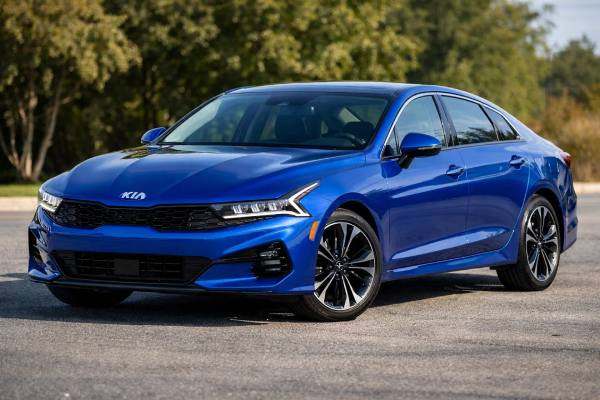
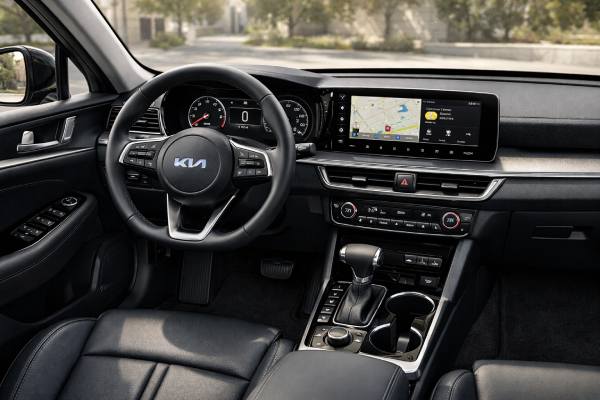

The 2021–2024 Kia K5 (DL3) with the 1.6-liter turbo (engine family commonly referenced as G4FP in many markets) aims at buyers who want midsize comfort with compact-like efficiency. The headline is balance: a broad torque band for everyday driving, a conventional 8-speed automatic that feels familiar, and a chassis tuned more for stable highway manners than edgy sport-sedan sharpness. This version also tends to be the “sweet spot” for ownership costs, because it avoids the higher tire and brake appetite of the 2.5T trims while still delivering confident passing power.
Where owners should pay attention is the modern turbo-GDI reality: it rewards clean oil, good fuel, and consistent warm-up habits—especially if you do short trips. Safety tech is a strong point, but equipment can change by trim and year, so verifying the exact driver-assist suite matters as much as checking mileage.
Essential Insights
- Strong low-rpm torque makes city driving and merging easy without needing high revs.
- Efficient for a midsize sedan, especially on steady-speed highways with sensible tires.
- Comfortable, planted ride suits long commutes; cabin is generally quiet at cruising speeds.
- Ownership caveat: turbo-GDI engines dislike neglected oil changes and repeated cold short trips.
- Typical interval: change engine oil and filter every 12,000 km (7,500 mi) or 12 months (severe use often 8,000 km / 5,000 mi).
Explore the sections
- Kia K5 DL3 ownership overview
- Kia K5 DL3 1.6T specs
- Kia K5 DL3 trims and safety tech
- Reliability and known problems
- Maintenance plan and buyer tips
- Real-world driving and economy
- Rivals and value comparison
Kia K5 DL3 ownership overview
The Kia K5 (DL3) 1.6T is best understood as a “daily-driver first” midsize sedan that happens to be quick enough to feel lively. The turbocharged 1.6 delivers its torque early, so the car feels responsive in normal traffic—rolling starts, short on-ramps, and passing at 80–120 km/h (50–75 mph) are where it makes the most sense. Instead of chasing peak horsepower, this setup targets usable pull and relaxed cruising.
For commuting and family use, the biggest advantage is consistency. The 8-speed automatic behaves like a traditional torque-converter unit (not a dual-clutch), which usually means smoother low-speed creep and fewer awkward parking-lot moments. The chassis is tuned for stability: it tracks straight on highways, handles crosswinds well for the class, and doesn’t punish passengers over broken pavement. On trims with larger wheels, you may feel sharper impacts on potholes, but the basic suspension tuning remains comfort-leaning.
From an ownership standpoint, the car’s “modern engine rules” are what separate easy years from annoying ones. Turbo + gasoline direct injection (GDI) creates heat and soot, and short cold trips can dilute oil and speed up intake-valve deposits. None of that is exotic—just predictable. If you do mostly city errands, treat “severe service” as your default and keep up with oil changes, filters, and spark plug intervals. If you do longer commutes, the same engine often feels low-effort and durable.
Safety and tech are also part of the K5’s identity. Many cars in this segment offer driver assistance, but the K5 tends to bundle a generous set early in the range. The catch is trim packaging: features like adaptive cruise or upgraded collision-avoidance functions may be standard on some trims and optional on others, and headlight performance can vary by hardware. This is why a trim-accurate check matters more than year alone.
Kia K5 DL3 1.6T specs
The tables below focus on the 1.6-liter turbo K5 (DL3) rated around 180 hp. Specs can vary by market, emissions certification, and drivetrain (FWD vs optional AWD on select trims). Use these as a practical baseline, then confirm by VIN and build sheet for exact service capacities and option hardware.
Powertrain and efficiency
| Item | Specification |
|---|---|
| Code | G4FP family (market-dependent labeling) |
| Engine layout and cylinders | Inline-4, DOHC, 4 valves/cyl |
| Bore × stroke | 75.6 × 89.0 mm (2.98 × 3.50 in) |
| Displacement | 1.6 L (1,598 cc) |
| Induction | Turbocharged |
| Fuel system | Gasoline direct injection (GDI) |
| Compression ratio | ~10.5:1 (varies by calibration) |
| Max power | 180 hp (134 kW) @ ~5,500 rpm |
| Max torque | 265 Nm (195 lb-ft) @ ~1,500–4,500 rpm |
| Timing drive | Chain |
| Rated efficiency (typical) | ~6.9–8.4 L/100 km (34–28 mpg US / 41–34 mpg UK), depending on FWD/AWD and test cycle |
| Real-world highway @ 120 km/h | ~7.2–8.2 L/100 km (33–29 mpg US / 39–34 mpg UK), tire and wind dependent |
Transmission and driveline
| Item | Specification |
|---|---|
| Transmission | 8-speed automatic (torque-converter type) |
| Drive type | FWD common; AWD optional on specific trims/markets |
| Differential | Open (traction managed by brake-based stability system) |
Chassis and dimensions
| Item | Specification |
|---|---|
| Suspension (front/rear) | MacPherson strut / multi-link (market-dependent details) |
| Steering | Electric power steering; quick, light-to-medium effort |
| Brakes | 4-wheel discs (front ventilated); diameters vary by trim |
| Wheels and tyres (common) | 215/55 R17 or 235/45 R18 (popular sizes) |
| Ground clearance | ~135 mm (5.3 in) |
| Length / width / height | ~4905 / 1860 / 1445 mm (193.1 / 73.2 / 56.9 in) |
| Wheelbase | ~2850 mm (112.2 in) |
| Turning circle (kerb-to-kerb) | ~11.0–11.4 m (36–37 ft) |
| Kerb weight | ~1,470–1,590 kg (3,240–3,505 lb), trim and AWD dependent |
| Fuel tank | ~60 L (15.9 US gal / 13.2 UK gal) |
| Cargo volume | ~453 L (16.0 ft³), method varies by market |
Performance and capability (typical)
| Item | Specification |
|---|---|
| 0–100 km/h (0–62 mph) | ~7.3–8.2 s (traction, tires, and AWD influence results) |
| Top speed | ~210–220 km/h (130–137 mph), market limited |
| Braking 100–0 km/h | ~36–40 m (118–131 ft), tire dependent |
| Towing capacity | Often not rated in some markets; where rated, typically modest for this powertrain |
| Payload | Varies widely by market and trim; check door-jamb label |
Fluids and service capacities (verify by VIN)
| Item | Specification |
|---|---|
| Engine oil | API SP / ILSAC GF-6 commonly; 0W-20 or 5W-30 by climate; ~4.5–5.0 L (4.8–5.3 US qt) |
| Coolant | Phosphate OAT-type common for Hyundai/Kia; 50/50 mix; ~6.5–7.5 L (6.9–7.9 US qt) |
| Automatic transmission fluid | Manufacturer-specific ATF; service method matters; total fill varies (~7–8 L) |
| A/C refrigerant | R-1234yf common on newer models; charge varies by market |
| Key torque specs | Wheel lug nuts commonly 90–110 Nm (66–81 lb-ft) depending on wheel; verify for your wheels/region |
Safety and driver assistance (trim-dependent)
| Item | Specification |
|---|---|
| Crash ratings | Often strong results from IIHS in key categories; NHTSA ratings vary by exact configuration and year |
| Headlight rating (IIHS) | Can range by headlight type; projector vs reflector matters |
| ADAS suite | AEB (car/ped), lane support, blind-spot monitoring often available; adaptive cruise and higher-level functions depend on trim/package |
Kia K5 DL3 trims and safety tech
Trim names differ by region, but the ownership decision is usually the same: choose the trim that gives you the safety and comfort hardware you actually want, not just the appearance package. For many buyers, that means aiming for a mid-trim with the best balance of lighting, driver assistance, and wheel size—because those three items affect real daily satisfaction.
Common trims (U.S.-style example, varies by year):
- LXS / base-style trims: Typically the value leader for the 1.6T. You often get core safety tech (automatic emergency braking, lane keeping support, driver attention warning) plus basic infotainment. Wheels are usually smaller (better ride, cheaper tires).
- GT-Line (often 1.6T): Adds sport styling, larger wheels, and sometimes AWD availability depending on market. The most important difference is package access: some years offer premium options that upgrade headlights, cameras, and advanced driver assist.
- EX (often 1.6T): Leans comfort—more convenience features, seating materials, and sometimes better audio/infotainment options. It can be a better long-term “daily” choice if the package includes the safety tech you want.
- GT (2.5T in many markets): Not the focus here, but worth mentioning because shoppers cross-shop it. It typically brings bigger brakes and stickier tires, which can raise running costs.
Quick identifiers to verify on a used car
- Headlight hardware: projector units typically perform better than reflector-style LEDs.
- Wheel size: 17-inch packages usually ride better and cost less to maintain than 18-inch.
- Cruise control type: adaptive cruise uses radar/camera and usually adds steering-lane support features.
- Camera count: a surround-view setup (if equipped) is a practical upgrade for tight parking.
Safety ratings and what they mean in real life
Safety ratings are not a single “safe/unsafe” verdict. They reflect a specific trim, a specific headlight configuration, and sometimes a specific optional safety package. For the K5, two practical takeaways matter most:
- Headlights are part of safety. Lighting performance can vary by trim and package, affecting night visibility and glare.
- Front crash prevention systems differ. Some versions add cyclist detection or junction-turning logic, and those differences matter in urban driving.
ADAS service and calibration notes
If the car has radar-based adaptive cruise or camera-based lane support, windshield replacement and front-end repairs may require calibration. This is normal, but it changes the “true cost” of a front bumper scrape or glass claim. When buying used, look for clean, centered panel gaps and ensure no warning lights are present. During a test drive, verify lane support behaves smoothly and that forward-collision warnings don’t trigger falsely over mild road crests.
Reliability and known problems
Overall, the 1.6T K5 can be a dependable car when maintained on time, but its reliability story is shaped by predictable turbo-GDI patterns and a few vehicle-level issues. The best way to think about it is risk management: keep small problems small by recognizing early symptoms, staying current with service actions, and treating software updates as part of modern ownership.
Common, usually low-to-medium cost
- Ignition coils and plugs (misfire under load):
Symptoms: stumble on acceleration, flashing check-engine light, rough idle.
Likely cause: worn plugs (often overdue), weak coil, or oil contamination in plug wells.
Remedy: replace plugs at the correct interval (often earlier under severe use), replace coil(s) as needed, and ensure correct plug heat range and gap for the turbo engine. - PCV and intake tract oiling (smoke on startup, oily intercooler piping):
Symptoms: occasional puff of smoke, higher oil usage, oily charge pipes.
Likely cause: PCV valve behavior and blow-by common to turbo engines.
Remedy: inspect PCV system, check for leaks, and keep oil change intervals conservative. - Brake vibration (warped-feeling rotors):
Symptoms: steering shake under braking from highway speeds.
Likely cause: pad material transfer from repeated hot stops; can be worsened by aggressive pads or heavy wheels.
Remedy: proper bedding procedure, rotor resurfacing/replacement with quality pads, and ensuring caliper slides move freely.
Occasional, medium cost
- Carbon buildup on intake valves (direct injection behavior):
Symptoms: rough idle, reduced low-speed smoothness, mileage drop.
Likely cause: fuel doesn’t wash intake valves in GDI engines. Short trips accelerate buildup.
Remedy: periodic intake cleaning (walnut blasting on severe cases), plus driving habits that allow full warm-up. - Turbo control noises (wastegate rattle):
Symptoms: metallic rattle at certain RPM or lift-off.
Likely cause: actuator or wastegate play, sometimes “normal-ish” but worth monitoring.
Remedy: confirm no boost leaks; replace worn components if performance or codes appear.
Rare but high impact
- Fuel-system related recall or service action risk:
A notable recall action for some 2021–2024 vehicles relates to fuel tank expansion risk tied to a purge/check valve issue.
Best practice: run a VIN check, confirm the repair was performed, and keep recall paperwork with the service file.
Software and calibration realities
Modern drivetrains often receive ECU and transmission logic updates that improve cold-start behavior, shift quality, or diagnostic sensitivity. If a car has intermittent hesitation, odd shift timing, or recurring sensor codes without a clear hardware failure, ask a dealer to check for available updates. After collision repair, ADAS recalibration can also resolve false warnings and restore proper adaptive cruise behavior.
Maintenance plan and buyer tips
A K5 1.6T that feels “tight” at 150,000 km usually has one thing in common: it followed severe-service intervals even when the owner didn’t think they were necessary. Turbo heat, GDI soot, and frequent cold starts are what turn long factory intervals into a gamble. A practical schedule keeps costs predictable and prevents the expensive domino effect (misfires, clogged intake, overheated oil, turbo stress).
Practical maintenance schedule (distance or time, whichever comes first)
- Engine oil and filter: every 12,000 km (7,500 mi) or 12 months; severe use every 8,000 km (5,000 mi) or 6 months. Use the correct spec oil (often API SP / ILSAC GF-6). Let the engine warm fully on a weekly basis if you do short trips.
- Engine air filter: inspect every 12,000–15,000 km; replace around 24,000–30,000 km (15,000–20,000 mi) depending on dust.
- Cabin air filter: replace every 12 months or 15,000–20,000 km for HVAC performance.
- Spark plugs: many turbo-GDI engines want plugs around 60,000–100,000 km depending on type and market; if you tow (where rated), drive hard, or see misfire counts, shorten the interval.
- Coolant: typically 5 years / 100,000–160,000 km initial, then shorter intervals; confirm the exact coolant type and service interval in your market documentation.
- Automatic transmission fluid: many “lifetime fill” claims age poorly in hot urban use. Consider a drain-and-fill around 60,000–100,000 km if you plan to keep the car long-term (avoid power flushing on neglected units).
- Brake fluid: every 2 years, regardless of mileage.
- Brake pads and rotors: inspect every 15,000–20,000 km; earlier if you run larger wheels or drive mountainous routes.
- Tires: rotate every 10,000–12,000 km; align annually or after major pothole impacts.
- 12 V battery: test yearly after 3 years; typical replacement window 4–6 years depending on climate.
Buyer’s guide checklist (used K5 1.6T)
- Service history: look for consistent oil intervals and documented recall completion. Gaps matter more on turbo engines than on older naturally aspirated designs.
- Cold start behavior: listen for extended cranking, rough idle, or ticking that doesn’t settle quickly.
- Boost and drivability: during a test drive, do a gentle 60–100 km/h pull. It should feel smooth, without surging or misfire.
- Brake feel: a firm pedal and smooth stops suggest healthy rotors and calipers.
- ADAS sanity check: confirm adaptive cruise (if equipped), lane support, blind-spot monitoring, and cameras all work without warnings.
- Tire strategy: if you want comfort and low cost, prioritize 17-inch wheels over 18-inch.
Long-term durability outlook: with conservative oil intervals and timely plugs/filters, the 1.6T K5 can age well. Neglect typically shows up as drivability nuisances first—exactly the kind that become expensive if ignored.
Real-world driving and economy
On the road, the K5 1.6T feels engineered for the middle of the speedometer—the speeds you use every day. Throttle response is tuned to be easy to meter in traffic, and the turbo’s torque arrives early enough that the car doesn’t feel strained. You won’t confuse it with a performance sedan, but you also don’t need to “work” the engine to keep pace.
Ride, handling, and NVH
- Ride: The car is generally composed over highway expansion joints and imperfect pavement. With 17-inch tires, impacts are muted and the suspension feels more fluid. With 18-inch packages, the car can feel sharper over potholes, and tire noise can increase on coarse asphalt.
- Handling balance: Steering is light and accurate rather than talkative. The front end stays predictable, and stability control is tuned conservatively—good for safety, slightly limiting for aggressive cornering.
- Braking feel: Pedal tuning is typically progressive, but some owners notice sensitivity to rotor condition. If you feel vibration, it’s often a pad/rotor issue rather than a fundamental brake design flaw.
- Cabin noise: Wind noise is usually well managed at cruising speeds. Tire choice has the biggest effect; touring tires keep it calm, aggressive all-seasons can add hum.
Powertrain character and transmission behavior
The 8-speed automatic suits the engine’s torque band. In normal mode it upshifts early, keeping revs low. Kickdown is competent rather than instant—passing performance improves if you pre-load the throttle slightly rather than stabbing it. In sportier modes (where equipped), the car holds gears longer and can feel more responsive in rolling hills, but it’s still tuned to protect the drivetrain and maintain comfort.
Real-world efficiency expectations
Your results depend more on speed and trip length than on driving “style.”
- City-heavy, short trips: often ~8.5–10.5 L/100 km (28–22 mpg US / 33–27 mpg UK), especially in winter.
- Mixed driving: often ~7.5–8.8 L/100 km (31–27 mpg US / 38–32 mpg UK).
- Steady highway 100–120 km/h: often ~7.0–8.2 L/100 km (34–29 mpg US / 40–34 mpg UK).
Cold weather matters: turbo engines warm slower on short trips, and winter fuel blends plus cabin heat can push consumption up noticeably. If you do frequent highway runs, the K5 rewards that pattern with stable economy and less carbon buildup risk than stop-and-go schedules.
Rivals and value comparison
The K5 1.6T competes in a tough midsize field, and its best argument is “most of what people want, with few surprises.” It leans into style, features, and a torque-rich engine rather than chasing class-leading cabin space or the softest ride. Choosing it over rivals usually comes down to how you value tech packaging and driving feel.
Versus Toyota Camry (2.5 NA)
- K5 advantage: stronger low-end pull from the turbo at everyday RPM; often more aggressive styling and modern cockpit layout.
- Camry advantage: naturally aspirated simplicity can be more tolerant of short-trip neglect; long-term durability reputation is strong.
- Decision tip: If your driving is mostly short, cold trips and you dislike strict maintenance discipline, the Camry’s NA engine can be a calmer ownership fit.
Versus Honda Accord (1.5T/2.0T by year)
- K5 advantage: often more available driver-assist features at lower trims; stable highway demeanor.
- Accord advantage: typically sharper steering feel and a roomy, airy cabin; strong powertrain options depending on year.
- Decision tip: If you prioritize steering feedback and open-feeling interior space, the Accord tends to deliver. If you want tech-per-dollar and bold design, the K5 is compelling.
Versus Hyundai Sonata (platform cousin)
- K5 advantage: sportier outward design and trim identity; often feels a touch more “planted.”
- Sonata advantage: can offer different feature packaging and comfort tuning depending on trim.
- Decision tip: Shop them as equipment lists, not as badges. On a used purchase, condition and service history will matter more than small tuning differences.
Versus Mazda Mazda6 (where available used)
- K5 advantage: newer tech, broader ADAS availability, and often better fuel economy.
- Mazda6 advantage: steering and chassis feel can be more engaging; interior materials are often premium for the class.
- Decision tip: If you want the most engaging midsize driving dynamics and don’t mind older infotainment, the Mazda is attractive; for newer safety tech and efficiency, the K5 wins.
Bottom line: The K5 1.6T is a strong value when you pick the right trim and maintain it like a turbo-GDI engine expects. If you want a comfortable, modern midsize sedan with confident torque and a generous safety-tech story, it belongs near the top of the list.
References
- 2024 Kia K5 Overview 2024 (Manufacturer Specs)
- 2022 Kia K5 Specifications 2022 (Manufacturer Specs)
- 2023 Kia K5 2023 (Safety Rating)
- Part 573 Safety Recall Report 25V794 2025 (Recall Database)
Disclaimer
This article is for informational purposes only and is not a substitute for professional inspection, diagnosis, or repair. Specifications, torque values, fluid types, service intervals, and procedures vary by VIN, market, and equipment, so always verify details using official owner and service documentation for your exact vehicle.
If you found this guide useful, please consider sharing it on Facebook, X (Twitter), or your favorite forum to support our work.