

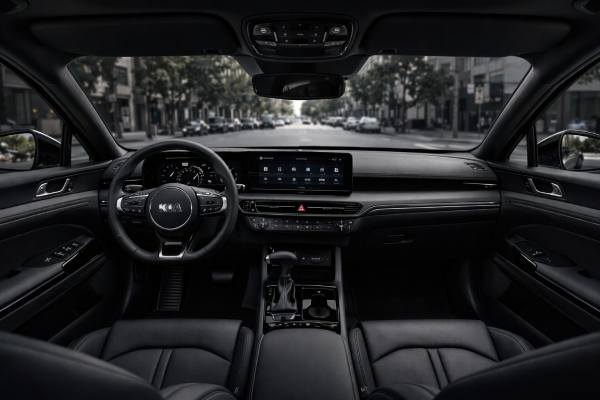

The 2025-present facelift Kia K5 (DL3) with the 2.5-liter Smartstream is the “daily driver” configuration of the range: a naturally aspirated four-cylinder tuned for smoothness, low-stress commuting, and predictable upkeep. In most markets it pairs with a conventional automatic transmission and front-wheel drive, which keeps the drivetrain simple and reduces long-term complexity compared with turbo or AWD variants. The facelift refresh focuses more on tech, lighting, and cabin upgrades than major mechanical change—good news if you want parts availability and familiar service procedures.
Ownership satisfaction tends to hinge on two things: keeping to the oil schedule (especially if you do short trips) and making sure driver-assistance sensors and cameras stay clean, aligned, and properly calibrated after windshield or bumper work. Done right, this K5 setup rewards you with quiet highway manners, a roomy cabin, and sensible operating costs for the class.
What to Know
- Smooth, low-drama power delivery that suits commuting and long highway runs.
- Spacious cabin and strong cargo practicality for a midsize sedan.
- Simple drivetrain layout (typically FWD + conventional automatic) helps keep servicing straightforward.
- Expect higher wear on tires and front brakes if you do heavy city driving or aggressive turn-in on 18-inch wheels.
- Plan on engine oil and filter about every 12,000 km (7,500 mi) or 12 months (more often under severe use).
Guide contents
- Kia K5 facelift 2025 at a glance
- Kia K5 2.5 specs and dimensions
- Kia K5 trims, safety, and ADAS
- Reliability issues, recalls, and TSBs
- Maintenance schedule and buying tips
- Real-world driving and efficiency
- How the K5 stacks up to rivals
Kia K5 facelift 2025 at a glance
Think of the 2025-present K5 facelift as a matured, tech-forward midsize sedan rather than a reinvention. The platform (DL3) stays familiar, while the exterior refresh and cabin updates aim to keep the K5 competitive against newer rivals. For shoppers, the key is choosing the right powertrain: the 2.5-liter 191 hp version is the calm, predictable option—less punch than a turbo, but also fewer heat-and-pressure stressors and typically lower long-term risk.
In everyday use, the 2.5’s value is in how it delivers power. It’s built to feel responsive in normal traffic without needing high rpm. A naturally aspirated engine also tends to be more tolerant of varying fuel quality and short, stop-start driving—provided you keep oil changes on time. Where owners can get caught out is assuming “simple engine” means “ignore maintenance.” Modern direct injection and tight emissions control still demand clean oil, healthy PCV (positive crankcase ventilation) flow, and attention to coolant and ignition components over time.
The facelift’s ownership personality is also shaped by software and sensors. Modern K5 trims can include forward collision avoidance, lane support, blind-spot monitoring, and adaptive cruise control. These systems are helpful, but they can be expensive to diagnose if a radar sensor gets misaligned after a bumper repair or a windshield camera is not calibrated correctly after glass replacement.
If you want an “easy” K5, look for: complete service history, clean underbody (no hard curb hits), even tire wear, and a driver-assistance system that behaves consistently in rain and at night. That combination usually signals a car that has lived a gentle life.
Kia K5 2.5 specs and dimensions
Below are typical specifications for the facelift-era K5 body (DL3) paired with the 2.5-liter 191 hp setup. Always verify by VIN and market, because calibration, equipment, and even brake sizes can change by trim and region.
Powertrain and efficiency (2.5 NA focus)
| Item | Specification |
|---|---|
| Engine family | Smartstream 2.5 (inline-4) |
| Displacement | 2.5 L (≈ 2,497 cc, market dependent) |
| Induction | Naturally aspirated |
| Fuel system | Gasoline direct injection (may be dual-injection in some markets) |
| Max power | 191 hp (≈ 142 kW) @ rpm (varies by market calibration) |
| Max torque | ≈ 246 Nm (≈ 181 lb-ft) @ rpm (varies) |
| Timing drive | Chain (typical for this family) |
| Transmission | Conventional automatic (commonly 8-speed, market dependent) |
| Drive type | FWD in most 2.5 configurations |
| Rated efficiency | Varies widely by market/trim; use your local test cycle (EPA/WLTP) |
Real-world highway @ 120 km/h (75 mph): Expect best results on stock tire sizes, correct pressures, and steady throttle. Roof racks, winter tires, or heavy crosswinds can noticeably increase consumption.
Chassis and dimensions (DL3 body)
| Item | Typical value |
|---|---|
| Overall length | 4,905 mm (193.1 in) |
| Overall width | 1,860 mm (73.2 in) |
| Overall height | 1,445 mm (56.9 in) |
| Wheelbase | 2,850 mm (112.2 in) |
| Track (front/rear) | Around 1,618 / 1,625 mm (varies) |
| Turning circle | Market dependent; typically around 11–12 m class |
| Cargo volume | Around 510 L (≈ 18.0 ft³), depending on measurement standard |
Wheels, tires, and braking hardware
| Item | Typical setups |
|---|---|
| Popular tire sizes | 205/65 R16, 215/55 R17, 235/45 R18 (trim dependent) |
| Brakes | 4-wheel discs common; rotor sizes vary by trim |
| Suspension | Front MacPherson strut; rear multi-link (typical for the platform) |
| Steering | Electric power steering; ratio varies by trim |
Fluids and service capacities (decision-grade guidance)
Capacities and fluids can differ by VIN and market, but these are the things that matter when you’re planning ownership:
| System | What to confirm |
|---|---|
| Engine oil | Viscosity grade approved for your climate (commonly 0W-20 or 5W-20/5W-30), plus the oil quality standard listed in the manual |
| Coolant | Long-life ethylene glycol mix (often 50/50); confirm spec and interval |
| Automatic transmission fluid | Use only the exact Kia/Hyundai ATF specification listed for your transmission code |
| A/C refrigerant | Type and charge amount vary by market; confirm before service |
| Critical torque specs | Drain plugs and wheel lug torque should be taken from official service data for your VIN |
If you’re comparing trims, tire size is a sneaky cost lever: 18-inch packages look great but tend to cost more in tires and can transmit more sharp impacts over potholes.
Kia K5 trims, safety, and ADAS
Trim naming differs by region, but the facelift-era K5 line generally follows a familiar pattern: value-focused base trims, a sport-appearance mid trim with larger wheels and more tech, and a comfort-oriented upper trim with more convenience features. The 2.5-liter model is usually spread across those everyday trims, while performance variants (like the 2.5 turbo in some markets) sit above.
Trims and options that matter mechanically
When you’re trying to understand what you’re actually buying, prioritize options that change maintenance cost or repair complexity:
- Wheel and tire package: Moving from 16″ to 18″ usually increases tire replacement cost and can make the ride more brittle on rough roads.
- Brake package differences: Some trims use different rotor sizes or pad compounds; that affects brake service pricing.
- Lighting system: Projector LEDs and adaptive-style lighting can be excellent, but headlamp assemblies are expensive after a minor front-end hit.
- Seat and cabin upgrades: Heated/ventilated seats and premium audio don’t change reliability much, but they can raise used-car value and improve daily comfort.
Quick identifiers (practical checks):
- Check the door-jamb label for tire size and pressure spec (it often reflects the original wheel package).
- In the infotainment “settings” screens, look for ADAS menus (lane support modes, driver attention warnings, etc.)—that’s a clue to the sensor suite installed.
- Inspect the windshield area behind the rear-view mirror: a camera module suggests lane and forward sensing features.
Safety ratings: how to read them
Safety results can vary by year and equipment (especially headlights and crash-avoidance tech). For the K5 family, published test results often show that structure and restraints perform well, while specific test updates and headlight performance can change the overall impression. The most honest way to shop is to match your exact model year and equipment to the rating pages, then verify your car’s lights and driver-assist features.
ADAS: what you get, and what it implies
Common systems you may see on the facelift K5 include:
- AEB (automatic emergency braking): Can detect vehicles and, on some trims, pedestrians/cyclists.
- ACC (adaptive cruise control): Great for highways; radar sensor alignment matters after bumper work.
- Lane keeping / lane centering support: Camera-based; windshield replacement often requires recalibration.
- Blind-spot monitoring and rear cross-traffic alert: Helpful in parking lots; sensor faults can trigger warnings.
Service implication: If the car has radar/camera systems, budget time and money for proper calibration after repairs. A “cheap” windshield replacement can become expensive if the camera is not set up correctly and the car starts drifting between lane lines or giving false warnings.
Reliability issues, recalls, and TSBs
The facelift K5 with the 2.5 NA engine is not known for exotic failure modes, but it is a modern car with direct injection, tight emissions controls, and a lot of software. The most useful way to think about reliability is by prevalence and cost tier, plus when issues tend to appear.
Common (low to medium cost) patterns
- Battery and charging system sensitivity (12 V): Lots of short trips and accessory use can age the 12 V battery quickly.
Symptoms: slow crank, intermittent infotainment resets, random warning lights.
Remedy: test battery and charging output; replace battery if weak; check for software updates if parasitic draw is suspected. - Brake noise and uneven wear (especially city use):
Symptoms: squeal, vibration, uneven pad thickness.
Root cause: stop-start use, pad compound, or neglected slide pin lubrication.
Remedy: clean/lube hardware, replace pads/rotors as needed; bed pads correctly. - Tire wear and alignment drift: 18″ packages can wear faster and show alignment issues sooner.
Symptoms: inner-edge wear, steering pull, vibration.
Remedy: alignment check, rotate on schedule, inspect suspension bushings.
Occasional (medium cost) issues to watch
- Direct-injection deposits and PCV-related oil contamination (usage dependent):
Symptoms: rough idle, reduced mpg, occasional misfire codes.
Root cause: short trips, low oil temperature time, and intake valve deposit buildup (varies by injection strategy).
Remedy: strict oil-change discipline; consider periodic intake cleaning if symptoms appear; keep PCV system healthy. - Cooling system seepage (age/mileage dependent):
Symptoms: slow coolant loss, dried residue near joints.
Root cause: hose clamps, thermostat housing seals, or water pump weep paths.
Remedy: pressure test, replace affected component early to prevent overheating events.
Rare (high cost) events—how to reduce risk
- Overheating or oil starvation events due to neglected maintenance:
These are preventable. Check oil level between changes, don’t stretch intervals, and fix coolant loss quickly. - ADAS sensor faults after repairs:
Symptoms: persistent warnings, disabled cruise or lane functions.
Root cause: misalignment or missing calibration.
Remedy: calibration at a shop with the correct targets and scan tools.
Recalls, TSBs, and extended coverage—how to handle it
Even reliable cars can have recalls. For any facelift K5 you own or plan to buy:
- Run the VIN through an official recall database and confirm completion.
- Ask for dealer service records showing recall remedies were performed.
- If you notice a repeatable drivability or infotainment issue, ask a dealer about software updates and technical service bulletins (TSBs) before you pay for parts.
A good pre-purchase test is a 20–30 minute mixed drive: include a highway stretch with lane support and cruise, then a rough road segment to listen for suspension knocks. Problems that don’t show up on a five-minute loop often appear here.
Maintenance schedule and buying tips
A practical maintenance plan for the 2.5 K5 should assume “real life”: short trips, traffic, temperature swings, and occasional hard acceleration. The goal is to keep oil clean, temperatures stable, and wear items rotating predictably.
Practical maintenance schedule (distance/time)
Every 8,000–12,000 km (5,000–7,500 mi) or 6–12 months
- Engine oil and filter (use the exact viscosity and quality standard in your manual)
- Tire rotation; check pressures and tread depth
- Inspect brakes (pad thickness, rotor condition, slide pins)
- Inspect fluids (coolant level, brake fluid level, washer fluid)
- Quick scan for stored fault codes (helps catch small sensor issues early)
Every 24,000–30,000 km (15,000–20,000 mi)
- Engine air filter (earlier in dusty areas)
- Cabin air filter (often yearly for comfort and HVAC performance)
- Alignment check if tire wear suggests drift
Every 48,000–60,000 km (30,000–40,000 mi)
- Brake fluid (time-based is common: every 2–3 years is a good rule)
- Inspect accessory belt(s), coolant hoses, and PCV-related lines
- Transmission fluid service if your usage is severe (heavy city driving, mountains, hot climates). Some markets call ATF “lifetime,” but owners keeping cars long-term often choose a preventive service interval.
Every 96,000–120,000 km (60,000–75,000 mi)
- Spark plugs (confirm interval and plug type)
- Coolant service (confirm interval and coolant specification)
Timing components: This engine family typically uses a chain, so you don’t “replace on schedule” the way you would a belt. Instead, you inspect for noise, correlation faults, and oil neglect. Clean oil is chain life.
Fluids: what to be strict about
- Oil: Don’t bargain-shop the wrong spec. The right oil protects timing hardware, reduces deposit formation, and supports emissions systems.
- ATF: Only the correct specification; wrong fluid can cause shift quality issues and accelerated wear.
- Coolant: Mix ratio and type matter. Mixing incompatible coolants is a common long-term problem.
Buyer’s guide: what to inspect
Service history and records
- Evidence of on-time oil changes (not just “once a year,” but appropriate for the mileage and usage)
- Any ADAS calibration records after windshield or bumper repair
- Confirmation that open recalls were completed
Mechanical and chassis checks
- Even tire wear across all four corners (alignment and suspension health clue)
- No clunks over bumps (listen for sway bar links and bushings)
- Consistent braking with no steering shake
Electronics and ADAS
- No persistent warning lights
- Lane and cruise functions operate smoothly on a clear highway
- Backup camera image is clean and stable; parking sensors behave consistently
Which trims to seek (typical logic)
- If roads are rough: prefer smaller wheels (16–17″) for comfort and lower tire costs.
- If you drive long highway trips: ACC and lane support can be worth paying for.
- If you keep cars a long time: prioritize documented maintenance over cosmetic upgrades.
Overall durability outlook: with routine servicing and careful repair practices for sensor-equipped bumpers and windshields, the 2.5 facelift K5 should be a steady long-term ownership choice in the midsize segment.
Real-world driving and efficiency
The 2.5-liter K5 is tuned to feel “easy” rather than urgent. In real driving, it’s less about a hard punch and more about smooth, predictable acceleration that fits traffic gaps without drama.
Ride, handling, and NVH (noise, vibration, harshness)
- Ride: Generally composed at speed, with the biggest difference coming from wheel size. The 18″ setup can feel sharper over broken pavement, while 16–17″ setups usually deliver a calmer ride.
- Handling balance: The chassis favors stability. Turn-in is tidy for a midsize sedan, but the limits are set more by front-drive traction and tires than by suspension sophistication.
- Steering feel: Light to moderate effort, with more emphasis on ease than feedback. Expect accurate tracking on highways rather than sports-sedan communication.
- Cabin noise: Tire choice matters. Aggressive all-season tires can raise highway noise more than you’d expect.
Powertrain character
- Throttle response: Clean and linear. You don’t get the “surge” of a turbo, but you also avoid turbo lag and heat soak behavior in stop-and-go traffic.
- Automatic behavior: Most versions use a conventional torque-converter automatic, so low-speed creep and parking maneuvers feel natural. Downshifts for passing are typically smooth, though the car may kick down more than a turbo variant would because it needs rpm to access peak power.
- Drive modes: Eco modes usually soften throttle and encourage earlier upshifts; Sport modes sharpen response and hold gears longer. Use Eco for steady commuting and Sport for merging or hilly terrain.
Real-world efficiency expectations
Fuel consumption depends heavily on speed, wheels, and climate:
- City: Short trips in cold weather can raise consumption significantly because the engine spends more time warming up.
- Highway (100–120 km/h / 60–75 mph): This is where the 2.5 tends to feel efficient and relaxed, especially on smaller wheels.
- Mixed driving: Expect results to sit between the two, with a clear penalty for lots of idle time or aggressive acceleration.
A practical tip: if your driving is mostly short trips, consider one longer drive weekly to fully warm the oil and evaporate moisture—this can help reduce sludge and deposit risks over the long haul.
Selective performance metrics (what matters)
Numbers vary by trim and test method, but the ownership-relevant takeaway is simple: the 2.5 is quick enough for modern traffic, especially once rolling, but it’s not built to chase sport-sedan acceleration figures. If frequent high-speed passing is your normal use case, you may prefer the turbo variant; if you value calm, predictable behavior, the 2.5 is the sweet spot.
How the K5 stacks up to rivals
In the midsize sedan space, the K5 competes on design, value, and tech—while rivals often compete on hybrid efficiency, brand reputation, or ride comfort. Here’s how the facelift 2.5 K5 typically compares.
Versus Toyota Camry (including hybrid-focused trims)
- K5 advantage: More extroverted styling and often strong feature value for the money.
- Camry advantage: Hybrid availability and a long-standing reputation for fuel efficiency and resale strength.
- Decision point: If you want maximum mpg and plan to keep the car forever, hybrid options are compelling. If you want a well-equipped non-hybrid with modern tech and a quieter highway feel, the K5 holds its own.
Versus Honda Accord
- K5 advantage: Often a more “tech for the price” play, with strong infotainment and driver-assistance availability.
- Accord advantage: Historically strong driving refinement and efficiency in many trims.
- Decision point: If steering feel and a roomy, airy cabin are top priorities, Accord is attractive. If you want a balanced package with a simpler NA engine feel, K5 is appealing.
Versus Hyundai Sonata (platform cousin)
- K5 advantage: Different tuning and design choices; sometimes more assertive styling and trim packaging.
- Sonata advantage: Similar underlying engineering; availability and pricing may vary by market.
- Decision point: Shop both and compare equipment lists closely—your best deal is often determined by local incentives and inventory.
Versus Mazda6 (used market) or sport-leaning alternatives
- K5 advantage: Newer tech ecosystem and modern ADAS on recent model years.
- Sport-leaning rivals advantage: Often more tactile steering feel.
- Decision point: If you prioritize feel over features, a sport-leaning sedan may satisfy more. If you prioritize comfort + tech + predictable costs, the K5 fits well.
Bottom line: The facelift K5 2.5 is best for drivers who want a modern, comfortable sedan without the extra complexity of turbocharging or hybrid systems, and who are willing to maintain it like a modern direct-injected engine—clean oil, sensible intervals, and careful repair practices around sensors.
References
- 2025 Kia K5 2025 (Safety Rating) ([IIHS][1])
- Vehicle Detail Search – 2025 KIA K5 4 DR FWD | NHTSA 2025 (Recall Database) ([NHTSA][2])
- Kia K5 | Specifications | 4 Door Sedan | Kia Saudi Arabia NMC 2025 (Specifications) ([Kia][3])
- 2026 Kia K5 – Pricing and Features 2026 (Manufacturer Model Page) ([IIHS][4])
Disclaimer
This article is for informational purposes only and is not a substitute for professional diagnosis, inspection, or repair. Specifications, torque values, fluid types, capacities, service intervals, and procedures can vary by VIN, market, model year, and equipment. Always verify details using your vehicle’s official owner’s manual and service documentation, and follow manufacturer procedures for safety systems and calibrations.
If you found this guide useful, consider sharing it on Facebook, X (Twitter), or your favorite forum to help others find practical ownership information.