
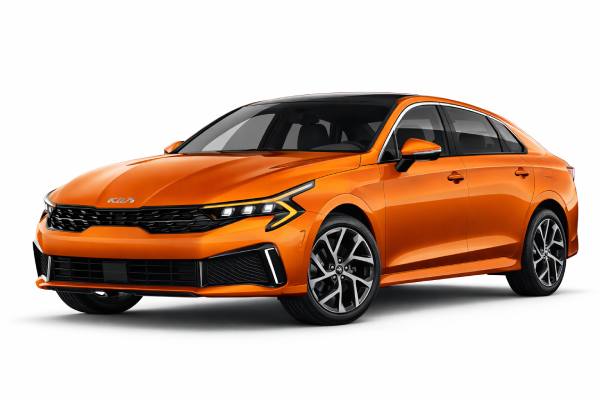
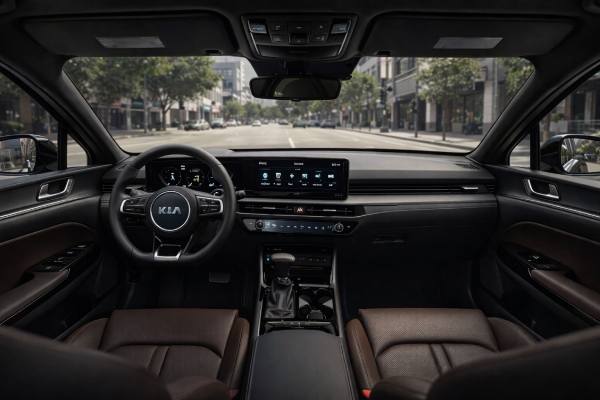
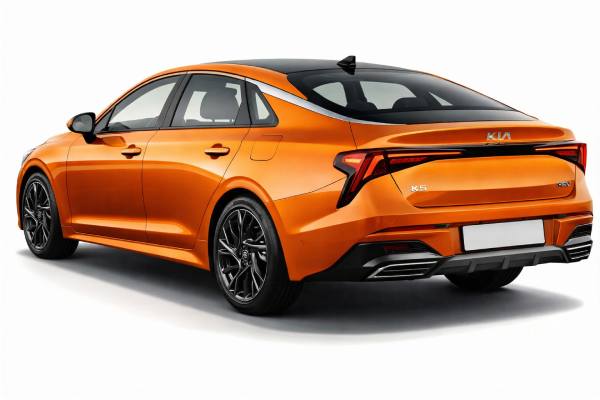
The facelifted Kia K5 (DL3) with the Smartstream 2.5T is the “driver’s” version of the lineup: a strong turbo four, an 8-speed dual-clutch transmission, and chassis tuning that feels closer to a sport sedan than a typical mid-size commuter. It’s quick enough to make passing effortless, but still practical—four real doors, a usable trunk, and modern driver assistance that reduces fatigue on long trips.
Ownership tends to be straightforward if you treat it like a high-output turbo car instead of an appliance. That means consistent oil quality, careful warm-up habits, and being proactive with drivetrain software updates. The payoff is a sedan that blends everyday comfort with genuine punch, without moving into full premium-brand running costs.
Quick Specs and Notes
- Strong midrange pull and quick passing performance, especially from 60–120 km/h (40–75 mph).
- Sport-oriented chassis tuning and tire packages deliver confident braking and stable highway manners.
- Dual-clutch behavior is smooth when driven consistently, but can feel abrupt in stop-and-go if you “creep” like a torque-converter automatic.
- Plan on shorter oil intervals than a non-turbo commuter—8,000–10,000 km (5,000–6,000 mi) is a sensible target for mixed use.
- Brake fluid service every 2 years helps preserve pedal feel and ABS/ESC reliability in humid climates.
What’s inside
- Kia K5 DL3 facelift focus
- Kia K5 DL3 2.5T specs tables
- Kia K5 DL3 trims and safety tech
- Reliability, known issues and recalls
- Maintenance plan and buying tips
- Real-world driving and efficiency
- K5 2.5T vs key rivals
Kia K5 DL3 facelift focus
The 2025–present facelift keeps the K5’s core strengths—space, value, and a clean platform—but sharpens the “GT” identity of the 2.5T model. The Smartstream 2.5T is a high-output, direct-injected turbocharged four-cylinder designed to deliver torque early and hold it through the midrange. In real driving, that matters more than peak horsepower: it makes the car feel responsive in the exact speeds where you merge, pass, and climb grades.
This version also leans into a modern sport-sedan recipe: a quick-shifting dual-clutch transmission (DCT), wider wheel and tire packages on performance trims, and brake hardware sized for repeated hard stops. The result is a sedan that stays composed at highway speed, doesn’t get flustered in crosswinds, and can handle a twisty road without the front end feeling vague.
Where owners need to calibrate expectations is driveline character. A DCT isn’t a traditional automatic with a fluid torque converter. It uses clutches, so low-speed “creep,” parking maneuvers, and stop-and-go traffic can reveal small quirks: a slight pause when you roll back onto throttle, a firmer engagement when the clutch takes up, or occasional hesitation if you feather the pedal indecisively. Most drivers adapt quickly—smooth inputs and a deliberate brake-to-throttle transition make the car feel refined.
The facelift’s broader appeal is how it packages performance. You get a practical cabin layout, current infotainment and driver assistance, and a trunk that still works for travel. For someone who wants one car to do commute duty, family errands, and the occasional spirited drive, the K5 2.5T makes a strong case—provided you’re willing to maintain it like the performance-oriented turbo sedan it is.
Kia K5 DL3 2.5T specs tables
Below are practical, ownership-relevant specifications for the facelifted K5 DL3 with the Smartstream 2.5T (290 hp). Exact figures can vary by market, tire package, and equipment, so treat these as a “decision-making” baseline and verify by VIN when ordering parts or fluids.
Powertrain and efficiency
| Item | Specification |
|---|---|
| Code | Smartstream G2.5T (commonly referenced as G4KP family) |
| Engine layout and cylinders | Inline-4, DOHC, 4 valves/cyl |
| Displacement | 2.5 L (2,497 cc) |
| Induction | Turbocharged |
| Fuel system | Direct injection (GDI) |
| Max power | 290 hp (216 kW) @ rpm (market dependent) |
| Max torque | ~422 Nm (311 lb-ft) @ rpm (market dependent) |
| Timing drive | Chain |
| Rated efficiency | Typically mid-to-high 20s mpg combined (US) depending on wheels/tires |
| Real-world highway @ 120 km/h (75 mph) | Often ~8.0–9.0 L/100 km (26–29 mpg US) with steady cruising |
Transmission and driveline
| Item | Specification |
|---|---|
| Transmission | 8-speed dual-clutch (wet-type DCT in most applications) |
| Drive type | FWD (most markets for 2.5T) |
| Differential | Open (traction managed via brake-based systems) |
Chassis and dimensions
| Item | Specification |
|---|---|
| Suspension (front/rear) | MacPherson strut / multi-link (typical DL3 layout) |
| Steering | Electric power steering |
| Brakes | 4-wheel discs (performance trims use larger rotors) |
| Wheels/Tyres (common performance fitment) | 235/40 R19 or similar (varies by trim/market) |
| Ground clearance | Typically ~135–145 mm (5.3–5.7 in), equipment dependent |
| Length / Width / Height | ~4,905 mm / ~1,860 mm / ~1,445 mm (approx.) |
| Wheelbase | ~2,850 mm (approx.) |
| Turning circle (kerb-to-kerb) | ~11.0–11.3 m (approx.) |
| Kerb weight | Often ~1,550–1,650 kg (3,420–3,640 lb), equipment dependent |
| Fuel tank | Often ~60 L (15.9 US gal / 13.2 UK gal), market dependent |
| Cargo volume | Typically ~445 L (~15.7 ft³), method varies |
Performance and capability
| Metric | Typical value (varies by test/tires) |
|---|---|
| Acceleration | 0–100 km/h (0–62 mph): ~5.5–6.2 s |
| Top speed | Often limited around ~240 km/h (149 mph), market dependent |
| Braking distance | 100–0 km/h: commonly mid-30 m range with performance tires |
| Towing capacity | Usually not rated or limited in many markets for this trim |
| Payload | Market dependent; check door-jamb placard |
Fluids and service capacities (practical guidance)
Because Kia/market variations exist, use these as checkpoints before purchase or service, then confirm by VIN/service manual.
| System | Typical spec (verify for VIN) |
|---|---|
| Engine oil | Full-synthetic meeting API SP / ILSAC GF-6; common viscosities 0W-30 or 5W-30 depending on climate |
| Engine oil capacity | Often ~5.0–5.5 L (5.3–5.8 US qt) with filter |
| Coolant | Long-life ethylene glycol (PHOAT-type in many Hyundai/Kia applications); 50/50 mix unless specified otherwise |
| Transmission fluid | DCT fluid per Kia spec (wet DCT formulations differ from ATF) |
| A/C refrigerant | R-1234yf in many newer markets (verify under-hood label) |
Key torque specs (owner-useful checks):
- Wheel lug nuts: commonly 90–110 Nm (66–81 lb-ft)
- Engine oil drain plug: commonly 30–40 Nm (22–30 lb-ft)
(Always confirm for the exact engine and oil pan design.)
Kia K5 DL3 trims and safety tech
Trim names vary by region, but the facelifted K5 2.5T is usually sold as a performance-oriented flagship (often “GT” in North America). The biggest functional differences between trims are not cosmetic—they’re the parts that affect how the car drives, stops, and wears over time.
Trims and options that change ownership
Key areas to check on the build sheet or in-person:
- Wheel and tire size: Larger wheels look great and sharpen turn-in, but they increase tire cost and can reduce ride compliance on broken pavement. If you live where roads are rough, a smaller wheel option (when available) can be a durability win.
- Brakes: Performance trims typically get larger rotors and sometimes different pad compounds. That improves repeated-stop confidence but can dust more and cost more at replacement time.
- Cooling hardware: Turbo models may have additional cooling capacity (radiator/intercooler package differences). This is a plus for durability in hot climates.
- Seats and interior trim: Sport seats can be more supportive, but check bolsters for wear on higher-mileage cars.
- Infotainment and audio: Higher trims may add premium audio and larger displays. These are expensive to replace; confirm all speakers and USB ports work.
Quick identifiers in the real world
- A 2.5T/GT-style K5 often has larger exhaust outlets, bigger wheels, and more aggressive front fascia.
- Inside, look for sport seat stitching, drive mode controls, and larger brake calipers peeking through the wheels (depending on market).
Safety ratings and what they mean here
Crash ratings can change by model year due to test updates, equipment changes, or new headlight/ADAS evaluations. For the facelift generation, verify the exact year and body configuration:
- NHTSA (US): provides star ratings by year and configuration when tested.
- IIHS (US): evaluates crash protection and also places heavy weight on headlights and crash prevention.
If you’re shopping used or cross-border importing, don’t assume a 2024 rating automatically applies to a 2025 facelift. Use VIN-based lookups where possible.
Safety systems and driver assistance (ADAS)
Most facelift K5 models offer a broad suite commonly branded under Kia’s driver assistance umbrella, typically including:
- Automatic emergency braking (AEB) with vehicle and pedestrian detection (and cyclist detection in some configurations)
- Lane keeping and lane centering functions for highway comfort
- Adaptive cruise control (ACC) with stop-and-go capability on many trims
- Blind-spot monitoring and rear cross-traffic alert
- Rear parking sensors and camera, with 360° systems on higher trims in some markets
A practical note for owners: after windshield replacement, bumper repairs, wheel alignment changes, or suspension work, ADAS calibration may be required. Budget for that if you’re buying a repaired vehicle or doing major front-end work.
Reliability, known issues and recalls
The Smartstream 2.5T K5 can be a durable package when maintained, but it has the same truth as any modern high-output turbo sedan: heat management, oil quality, and software calibration matter. Below are issue patterns to watch for, grouped by prevalence and cost impact.
Common (low to medium cost if caught early)
- GDI intake valve carbon buildup (mileage-dependent):
Symptoms: rough idle, cold-start stumble, reduced efficiency.
Root cause: direct injection doesn’t wash intake valves with fuel.
Remedy: periodic intake cleaning (chemical or walnut blasting), plus high-quality oil and consistent highway operation when possible. - PCV system and oil vapor management:
Symptoms: oil consumption trends, oily intercooler piping, occasional smoke after idling.
Root cause: turbo engines move more crankcase vapor under load.
Remedy: inspect PCV operation and hoses, keep oil change intervals sensible, and avoid extended idling. - Turbo heat soak and coolant/oil stress in short-trip use:
Symptoms: none at first; later, oil darkening and sludge risk if neglected.
Root cause: repeated short trips don’t fully evaporate fuel and moisture from oil.
Remedy: shorten oil intervals and aim for at least one full warm-up drive weekly.
Occasional (medium cost)
- Dual-clutch “creep” behavior and low-speed shudder:
Symptoms: slight judder when inching forward, abrupt engagement in traffic, hesitation when reapplying throttle.
Root cause: DCT clutch control strategy and driver input style.
Remedy: confirm software updates are current; adapt driving style (smooth, deliberate pedal transitions). If persistent, have clutch adaptation procedures performed. - Engine mount wear (NVH increase):
Symptoms: vibration at idle, thump on gear changes, drivetrain movement under load.
Root cause: higher torque loads mounts more than a base engine.
Remedy: inspect mounts; replace worn pieces to protect exhaust flex joints and driveline.
Rare but higher-cost
- Cooling system leaks or thermostat/control issues (age/heat related):
Symptoms: coolant smell, rising temps in traffic, intermittent heater output.
Root cause: seals, housings, or electronic controls depending on configuration.
Remedy: pressure test early; overheating a turbo engine is expensive. - Turbocharger actuator or wastegate-related noises:
Symptoms: rattle under light load, inconsistent boost feel, occasional underboost codes.
Root cause: actuator wear or linkage play.
Remedy: diagnosis before replacing major components; sometimes hardware is fine and calibration is the fix.
Recalls, TSBs, and software actions
For modern Kia vehicles, updates and service actions can address drivability, lighting logic, infotainment stability, and driver-assist behavior. Best practice is to:
- Run the VIN through the official recall portal.
- Ask the selling dealer for a printout showing completed recall and service campaigns.
- Confirm ECU/TCU updates during a pre-purchase inspection, especially for DCT shift quality complaints.
Maintenance plan and buying tips
A strong maintenance plan for the K5 2.5T focuses on three priorities: oil quality, heat management, and keeping the DCT happy. Even if the factory schedule allows long intervals, owners who want long-term durability usually adopt a slightly more conservative rhythm.
Practical maintenance schedule (distance/time)
Use the conservative end if you drive short trips, heavy city traffic, high heat, or spirited runs.
- Engine oil and filter: every 8,000–10,000 km (5,000–6,000 mi) or 12 months
- Severe use: 5,000–8,000 km (3,000–5,000 mi)
- Engine air filter: inspect every oil service; replace roughly 20,000–30,000 km (12,000–18,000 mi) depending on dust
- Cabin air filter: every 12 months (or sooner for urban/pollen-heavy areas)
- Brake fluid: every 2 years regardless of mileage
- Coolant: often 5–10 years depending on the factory fill; many owners target 5 years as a practical midpoint
- Spark plugs: turbo engines are harder on plugs—plan 45,000–100,000 km (30,000–60,000 mi) depending on the exact plug spec and driving style
- DCT fluid: verify the official interval for your VIN; a cautious target is 60,000–100,000 km (40,000–60,000 mi) for mixed use
- Tire rotation and alignment: rotate every 8,000–10,000 km (5,000–6,000 mi); align annually or with any abnormal wear
- 12 V battery: test yearly after year 3; many batteries last 3–5 years depending on climate and accessory load
Fluids to insist on (and why)
- Correct oil specification: turbo engines are sensitive to deposit control and LSPI (low-speed pre-ignition) protection—use the oil grade and spec recommended for your market.
- Correct DCT fluid: DCTs are not forgiving of “close enough” fluids. Wrong fluid can change clutch behavior and increase wear.
Buyer’s guide checklist (what to inspect)
- Cold start behavior: listen for timing chain rattle, rough idle, or exhaust leaks.
- DCT engagement: in a safe area, test smooth takeoff, creeping in traffic, and a firm acceleration pull. Any repeated shudder should be investigated.
- Cooling system: confirm stable temperature in stop-and-go; check for coolant smell after the drive.
- Brakes and tires: uneven tire wear can signal alignment or suspension bushing issues; soft brake pedal can indicate old fluid.
- Electronics: verify all cameras, parking sensors, adaptive cruise, and lane functions work—ADAS repairs can be costly.
- Service history: look for consistent oil services and documentation of recall/service campaign completion.
Long-term durability outlook: With conservative oil intervals, proper warm-up habits, and correct DCT service, the K5 2.5T can age well. Most “big bills” come from neglected fluids, ignored cooling problems, or buying a car with unresolved driveline complaints.
Real-world driving and efficiency
The K5 2.5T’s personality is defined by torque delivery and the way the DCT keeps the engine in its sweet spot. At moderate throttle, it feels effortless—especially in rolling highway terrain where many naturally aspirated sedans need a downshift and noise to maintain speed.
Ride, handling, and NVH
- Ride: Firmed up compared with non-performance trims, especially on larger wheels. On smooth highways it’s composed; on broken city pavement, sharp impacts are more noticeable.
- Handling balance: Predictable front-drive behavior with good mid-corner stability. With the right tires, it resists understeer better than you might expect for a mid-size sedan.
- Steering: Typically light-to-medium effort with accurate response; feedback is more “clean and controlled” than “chatty.”
- Braking feel: Performance-oriented brakes tend to feel confident with repeated stops, though pad choice can influence initial bite and dust.
Powertrain character and DCT behavior
- Throttle response: Strong once the turbo is on boost; in normal driving, it’s quick enough that you rarely need full throttle.
- Turbo lag: Present but modest; most noticeable if you stab the pedal at low rpm, less noticeable if you roll on smoothly.
- DCT logic: Quick, decisive shifts under acceleration. At low speed, it rewards smooth inputs. If you alternate brake/throttle rapidly in traffic, you can feel clutch take-up more than in a traditional automatic.
Real-world efficiency (what to expect)
Your actual fuel use will swing more than on a base engine because boost is addictive and tires are often wider:
- City: typically 10–12 L/100 km (20–24 mpg US) depending on traffic and warm-up time
- Highway (100–120 km/h / 60–75 mph): often 8–9 L/100 km (26–29 mpg US) with steady cruising
- Mixed: commonly 9–11 L/100 km (21–26 mpg US)
Cold weather can add a meaningful penalty due to longer warm-up and denser air increasing drag.
Selective performance metrics that matter
- Passing (80–120 km/h / 50–75 mph): a real strength—short bursts happen quickly, which improves safety in two-lane passing.
- Traction: With FWD, launch traction depends heavily on tire compound and temperature. Good all-seasons can spin; quality performance summers (where appropriate) make the power easier to use.
K5 2.5T vs key rivals
The K5 2.5T sits in a niche that’s getting smaller: a mid-size sedan with real power that isn’t a premium badge. Here’s how it typically stacks up.
Versus mainstream mid-size sedans (Camry, Accord, Malibu-class)
- Performance advantage: The 2.5T K5 generally out-accelerates most non-performance trims in the segment. If you care about effortless passing and a sportier feel, this is its strongest card.
- Tradeoff: Some rivals prioritize softness and isolation. If you want the calmest ride on rough pavement, a less performance-focused configuration may feel better day-to-day.
Versus “sport trims” (Sonata N Line, other turbo sedans)
- Similar mission: These cars often share a formula: turbo power, firm suspension, and more aggressive tire setups.
- Decision points: transmission behavior, seat comfort, and how refined the chassis feels at low speed. The K5’s DCT can feel very sharp; some drivers love it, others prefer a torque-converter automatic’s smooth creep.
Versus compact sport sedans (Jetta GLI, WRX, etc.)
- Space and comfort: The K5 is roomier and often quieter on the highway.
- Handling edge: Compact sport sedans may feel lighter and more playful, especially with LSD-equipped front-drive setups or AWD performance platforms. If back-road agility matters more than cabin space, smaller sport sedans can win.
Who the K5 2.5T is best for
- Drivers who want one car that can commute comfortably but still feel genuinely quick.
- Owners who are willing to follow a turbo-friendly maintenance plan and understand DCT quirks.
- Buyers who want a strong feature set and modern ADAS without stepping up to premium-brand pricing.
If your priority is the smoothest low-speed behavior in heavy traffic, consider test-driving back-to-back with a conventional automatic competitor. If your priority is punchy performance in a practical sedan shape, the K5 2.5T remains one of the most compelling options.
References
- 2026 Kia K5 – Compare Trim Levels 2026 (Specifications)
- Parking Lamp Control Logic Update – Kia K5 and K5 GT 2025 (Service Update)
- Check for Recalls: Vehicle, Car Seat, Tire, Equipment | NHTSA 2026 (Recall Database)
Disclaimer
This article is for informational purposes only and is not a substitute for professional diagnosis, inspection, or repair. Specifications, torque values, service intervals, and procedures can vary by VIN, market, model year, and equipment. Always verify details using official Kia service documentation for your specific vehicle.
If this guide helped, please consider sharing it on Facebook, X (Twitter), or your favorite forum to support our work.