
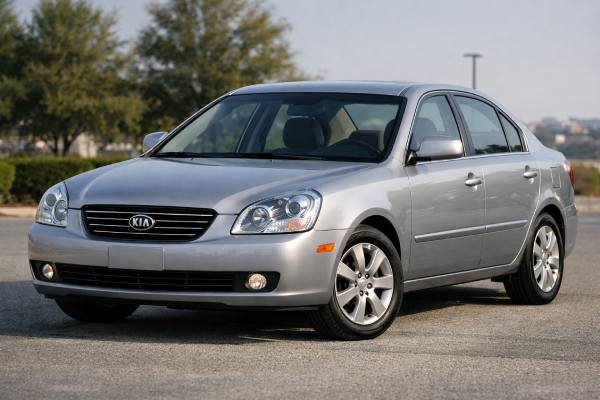
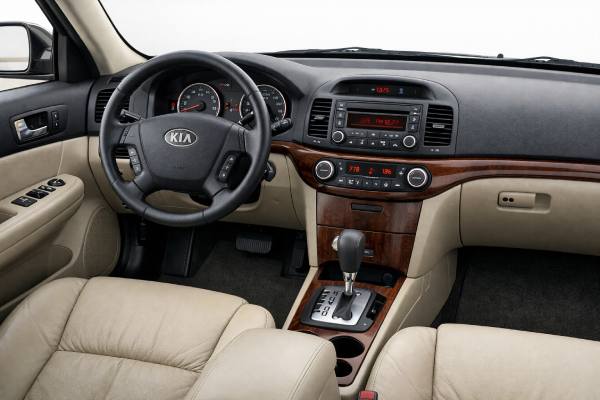
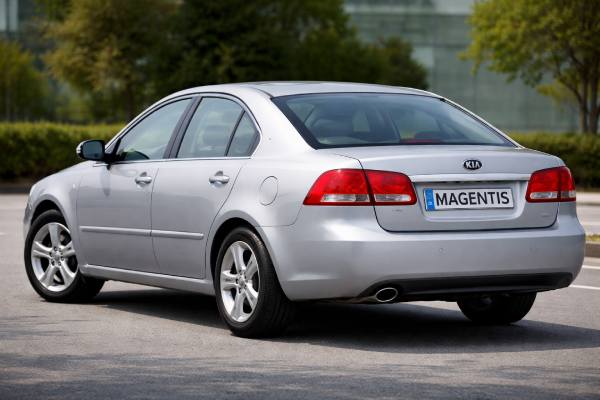
The 2006–2008 Kia Magentis (MG) with the 2.0-liter G4KA is the kind of midsize sedan that wins owners over with calm, predictable engineering. You get a naturally aspirated inline-four, simple multi-port injection, and a timing chain—ingredients that typically age better than early direct-injection or highly boosted setups. Performance is adequate rather than sporty, but the chassis is tuned for stability and comfort, and parts availability tends to be straightforward in many markets because the platform and components are widely shared.
Where this Magentis demands respect is in “ordinary car” maintenance: oil quality, cooling-system health, and timely fluid services matter more than chasing upgrades. If you approach it with a routine-first mindset, it can be a dependable, low-drama daily—especially for drivers who value a spacious cabin and easy highway manners over sharp handling flair.
Fast Facts
- Comfortable, stable ride with a roomy cabin that suits commuting and family use.
- Simple NA 2.0 layout (chain-driven, multi-port injection) is generally easier to keep healthy long term.
- Parts and service knowledge are widely available thanks to shared platform components.
- Watch for aging rubber and seals (mounts, hoses, valve cover) as mileage and years stack up.
- Plan engine-oil service every 7,500–10,000 km (12 months) depending on driving style and climate.
Contents and shortcuts
- Kia Magentis MG 2.0 basics
- Kia Magentis MG G4KA specs
- Kia Magentis MG trims and safety
- Common faults and recalls
- Maintenance plan and buying tips
- Driving feel and economy
- Rivals and alternatives
Kia Magentis MG 2.0 basics
In the 2006–2008 window, the Magentis (MG) sits squarely in the practical midsize segment: front-wheel drive, a conventional suspension layout, and a focus on comfort and value. The 2.0-liter G4KA is the key mechanical story. It’s a naturally aspirated inline-four with a modern-for-its-era 16-valve DOHC head and variable valve timing (CVVT). In daily use, that usually translates into smooth cold starts, consistent fuel metering, and fewer “high-tech” surprises compared with early direct injection systems.
With 144 hp, the car is not designed to feel quick off the line. Instead, it builds speed in a linear way and rewards clean, steady throttle inputs. Owners typically notice that it feels happiest at moderate revs, and it cruises confidently at highway speed. The engine’s torque delivery (peaking in the midrange) works well for normal traffic, though full-load passing is more “plan ahead” than “point and shoot.”
This generation’s ownership profile is shaped by three realities:
- Age-related wear matters more than design flaws. At this point, bushings, mounts, and cooling hoses can be more important than the engine’s core architecture.
- Service history is the difference-maker. A Magentis that saw regular oil changes and timely coolant service tends to feel tight; a neglected one can develop chain noise, overheating risk, and oil leaks.
- Option differences can shift your experience. Transmission choice (manual vs automatic), tyre size, and stability-control availability can noticeably change how the car drives and how it ages.
If you want a calm, roomy sedan with straightforward mechanicals, the 2.0 Magentis can make sense—especially when you buy on condition, not just mileage.
Kia Magentis MG G4KA specs
Below are the core specifications that typically apply to the 2006–2008 Magentis (MG) with the G4KA 2.0 CVVT (144 hp). Exact figures can vary by market, VIN, transmission, and wheel package—so treat these as a practical reference set, not a substitute for your vehicle’s official documentation.
Powertrain and efficiency
| Item | Spec (typical) |
|---|---|
| Code | G4KA |
| Layout | Inline-4, front-transverse |
| Valvetrain | DOHC, 4 valves/cyl (16V), CVVT |
| Displacement | 2.0 L (1998 cc) |
| Bore × stroke | 86 × 86 mm (3.39 × 3.39 in) |
| Induction | Naturally aspirated |
| Fuel system | Multi-port injection (MPI) |
| Compression ratio | ~10.5:1 |
| Max power | 144 hp (106 kW) @ ~6200 rpm |
| Max torque | ~188 Nm (139 lb-ft) @ ~4250 rpm |
| Timing drive | Chain |
| Rated efficiency (combined) | ~7.7–8.1 L/100 km (30.5–29.0 mpg US / 36.7–34.9 mpg UK) |
| Real-world highway @ 120 km/h | ~7.0–7.8 L/100 km (approx., climate/tyres dependent) |
Transmission and driveline
| Item | Spec (typical) |
|---|---|
| Transmission | 5-speed manual or 4-speed automatic (market dependent) |
| Drive type | FWD |
| Differential | Open |
Chassis and dimensions
| Item | Spec (typical) |
|---|---|
| Suspension (front/rear) | MacPherson strut / multi-link or strut-type rear (varies by market) |
| Steering | Power-assisted rack-and-pinion |
| Brakes | 4-wheel discs (diameters vary by trim/market) |
| Popular tyre size | Commonly 205/60 R16 or 215/50 R17 (market dependent) |
| Length | ~4735 mm (186.4 in) |
| Width | ~1805 mm (71.1 in) |
| Height | ~1480 mm (58.3 in) |
| Wheelbase | ~2720 mm (107.1 in) |
| Turning circle | ~10.6–11.0 m (34.8–36.1 ft) typical |
| Kerb weight | ~1380–1450 kg (3040–3197 lb) |
| Fuel tank | ~60–65 L (15.9–17.2 US gal / 13.2–14.3 UK gal) |
| Cargo volume | Market-method dependent; expect a conventional midsize sedan trunk |
Performance and capability
| Item | Spec (typical) |
|---|---|
| 0–100 km/h (0–62 mph) | ~10.2 s (manual); slower with automatic |
| Top speed | ~208 km/h (129 mph) manual; lower for some automatics |
| Towing capacity | Often limited/market-specific; verify by VIN placard and handbook |
Fluids, service capacities, and key torque specs (decision-useful)
These values vary by exact gearbox and cooling package—verify for your VIN before ordering fluids.
- Engine oil: API/ACEA equivalents per market; commonly 5W-30 (or 5W-40 in hot use). Typical fill ~4.3–4.7 L (4.5–5.0 US qt) with filter.
- Coolant: Ethylene glycol long-life coolant, typically 50/50 mix. Typical capacity ~6–7 L (6.3–7.4 US qt).
- Automatic transmission fluid: Often SP-III-type ATF for period Hyundai/Kia automatics. Drain/fill commonly ~3.5–4.5 L; total higher.
- A/C refrigerant: Usually R134a, charge often around 500–650 g (17.6–22.9 oz) depending on condenser and market.
- Wheel lug torque: commonly 90–110 Nm (66–81 lb-ft) (verify for wheel type).
Kia Magentis MG trims and safety
Trim naming varies a lot by country, but the “shape” of the lineup is usually consistent: a base or mid trim with cloth seats and smaller wheels, and a higher trim that adds comfort equipment (often climate control, upgraded audio, and sometimes leather). The mechanical package on the 2.0 CVVT tends to be similar across trims—what changes most often is transmission pairing, wheel/tyre size, and availability of stability-control hardware.
Trims and options that matter for ownership
- Transmission choice: The 5-speed manual is typically simpler and cheaper to keep happy long term. The 4-speed automatic can still be durable, but it is more sensitive to fluid condition and cooler health.
- Wheel size: Larger wheels can sharpen response slightly, but they usually increase tyre cost and can make the ride harsher over broken surfaces.
- Climate and electrical load: Higher trims with more electrical features (seat heaters, power seats, premium audio) can be perfectly reliable, but they raise the importance of battery/alternator health.
Quick identifiers can help during shopping:
- Look for the ESC button or stability-control indicator in the cluster (if equipped).
- Check the door-jamb tyre placard for original wheel sizing.
- Scan the VIN build plate for axle and transmission codes used in your region.
Safety ratings and what they mean today
This model was tested under older protocols by Euro NCAP, so don’t expect modern percentage breakdowns or today’s driver-assist scoring. In period, the Magentis achieved a respectable occupant score for its time, but pedestrian protection was a known weak area for many cars of that era. In real-world terms: the car’s primary safety advantage is structural design and restraint systems, not automation.
Safety systems and driver assistance
Expect “classic” safety tech rather than modern ADAS:
- Airbags: Typically front airbags; many markets add side and curtain airbags on higher trims.
- Seatbelts: Pretensioners and load limiters are common on front seats.
- Child seats: ISOFIX/LATCH provisions are usually present, but check the rear-seat anchors and the presence of clear labeling.
- Active safety: ABS is typically standard; ESC availability depends heavily on trim and market.
Calibration note: if the car has ESC/ABS, wheel-speed sensors and steering-angle sensors (where fitted) can require correct procedures after alignment work or battery disconnects. A cheap scan tool that reads ABS codes can save time and guesswork.
Common faults and recalls
At this age, it helps to sort issues by likelihood and cost impact. The good news: most problems on the 2.0 Magentis are diagnose-and-fix items rather than “total engine” events—provided overheating and oil starvation are avoided.
Common (expect to see on higher-mileage cars)
- Valve cover gasket seepage
Symptoms: oil smell, dampness around the cover, minor drips onto hot surfaces.
Root cause: gasket hardens with heat cycles.
Remedy: replace gasket; inspect PCV system so crankcase pressure doesn’t push leaks. - Engine mounts aging (NVH increase)
Symptoms: vibration at idle, clunk on throttle tip-in, harsher shifts.
Root cause: rubber collapse and fluid-filled mount wear (if equipped).
Remedy: replace worn mounts in pairs when possible; re-check exhaust clearance. - Cooling system wear: radiator end tanks, thermostat, hoses
Symptoms: creeping temperature, coolant smell, visible crusting at joints.
Root cause: plastic and rubber fatigue, neglected coolant changes.
Remedy: pressure test; replace weak parts before an overheat episode. - Ignition coils and plugs (misfire under load)
Symptoms: rough acceleration, flashing MIL, poor economy.
Root cause: coil breakdown and plug wear.
Remedy: correct plugs, gap spec, and coil replacement as needed—avoid “universal” substitutes.
Occasional (varies by climate and service history)
- Timing chain noise on cold start
Symptoms: brief rattle at first start, sometimes longer with poor oil maintenance.
Root cause: tensioner wear, varnish, or oil that drains back.
Remedy: confirm oil grade and oil pressure; if persistent, inspect chain, guides, and tensioner—don’t ignore long rattles. - Automatic transmission shift quality issues
Symptoms: flare, delayed engagement, harsh 2–3 shift, shudder.
Root cause: old ATF, adaptation drift, solenoid wear, or cooler restriction.
Remedy: verify fluid spec, consider staged drain/fills, and scan for transmission codes before condemning hardware. - ABS sensor and tone-ring faults
Symptoms: ABS light, traction light, intermittent activation at low speed.
Root cause: sensor corrosion, wiring fatigue, debris.
Remedy: inspect sensors/wiring, clean mounting surfaces; replace if readings are unstable.
Rare but high-impact (avoid by inspection)
- Overheating leading to head gasket risk
The engine can tolerate normal use well, but overheating events can snowball quickly. Any history of coolant loss, “burping” the system repeatedly, or temperature spikes deserves caution.
Recalls, service actions, and how to verify
Because recall coverage and campaigns vary by region, the safest approach is VIN-based verification:
- Use an official VIN recall checker (or your dealer’s service system) and request printed proof of completion.
- If you’re importing a car, verify in both the source and destination markets when possible.
Maintenance plan and buying tips
A Magentis this age rewards owners who treat maintenance as prevention, not repair. The goal is simple: keep oil clean, coolant healthy, and drivetrain fluids fresh enough that seals, solenoids, and bearings don’t suffer.
Practical maintenance schedule (distance/time)
Every 7,500–10,000 km or 12 months
- Engine oil and filter (short trips, cold climate, or heavy traffic: lean toward 7,500 km).
- Visual inspection: coolant level, belt condition, oil seepage, and tyre wear pattern.
Every 15,000–20,000 km
- Engine air filter; cabin filter (more often in dusty cities).
- Brake inspection: pad thickness, rotor condition, caliper slide lubrication.
Every 30,000–40,000 km
- Brake fluid check; flush by time if uncertain.
- Alignment check if tyres show edge wear or steering feels off-center.
Every 60,000 km (or 4 years)
- Automatic transmission fluid service (use the exact spec for your gearbox).
- Coolant hoses inspection (softness, swelling, clamp condition).
Every 90,000–120,000 km
- Spark plugs (interval depends on plug type and market spec).
- Accessory belt replacement if cracking/glazing is present.
Every 2 years (time-based)
- Brake fluid flush (especially in humid climates).
- Battery health test; clean grounds and terminals.
Timing components
- The timing chain is not a scheduled replacement like a belt, but it should be inspected if you get persistent rattle, correlation fault codes, or metal debris in oil.
Buyer’s guide: what to inspect before purchase
- Cold start behavior (listen for chain rattle beyond a brief moment).
- Cooling integrity (pressure test, check radiator seams, confirm heater output).
- Transmission behavior (shift timing, engagement delay, kickdown consistency).
- Suspension and steering (clunks over bumps, uneven tyre wear, vague on-center feel).
- Electrical basics (charging voltage, A/C compressor cycling, window regulators).
- Underbody condition (subframe corrosion, brake lines, exhaust hangers).
Common reconditioning items to budget for on a “new-to-you” car:
- Fluids baseline (oil, coolant, brake fluid, ATF as applicable)
- Tyres and alignment
- Battery if older than ~4–6 years
- One or more mounts if vibration is present
Durability outlook: if you buy a car with a documented service history and you immediately reset the maintenance baseline, the 2.0 Magentis can be a steady long-term daily. If the seller can’t show coolant and oil discipline, you should price the risk accordingly.
Driving feel and economy
In real-world use, the Magentis (MG) leans toward comfort and stability. The steering is typically light at parking speeds and settles into a calm, predictable feel on the highway. You won’t get sports-sedan feedback, but you do get a car that tracks straight and feels composed on long trips—especially when the suspension bushings and tyres are in good condition.
Ride, handling, and NVH
- Ride quality: Tuned for compliance. It filters small bumps well, though worn dampers or cheap tyres can make it feel floaty.
- Cornering balance: Safe, mild understeer is the norm. Fresh front control-arm bushings and quality tyres do more for confidence than any “performance” parts.
- Braking feel: Usually consistent with good pads and clean caliper slides. A spongy pedal often points to old brake fluid or air in the system rather than master cylinder failure.
- Noise: Expect moderate wind and road noise by modern standards. If cabin noise suddenly increases, look for uneven tyre wear, wheel bearings, or exhaust leaks.
Powertrain character
The 2.0 CVVT is linear and smooth, but it isn’t torque-rich at very low rpm. In city driving, it feels best when you avoid lugging it—especially with the automatic. Kickdown response depends heavily on transmission health and throttle calibration, and a dirty throttle body can make tip-in feel less clean than it should.
Efficiency you can actually plan around
For most owners, economy depends more on speed and tyres than on the engine’s basic design:
- City: expect higher consumption in short-trip use, particularly in winter.
- Highway (100–120 km/h): steady cruising is where the car can return reasonable numbers for its size, assuming correct tyre pressure and a healthy thermostat.
- Cold weather delta: short trips can raise fuel use significantly because the engine spends more time warming up, and defrost loads add demand.
If you want the best “ownership feel,” prioritize:
- Correct oil viscosity for your climate
- A cooling system that warms up properly (thermostat not stuck open)
- Tyres with low rolling resistance and correct alignment
Rivals and alternatives
The Magentis competes with mainstream midsize sedans that often offer stronger resale value or sharper driving—but sometimes with higher purchase prices in good condition. The right comparison depends on what you value: reliability record, safety equipment, ride comfort, or parts cost.
Where the Magentis tends to win
- Value for money: You often get more equipment per dollar than an equivalent Toyota Avensis or Honda Accord in similar condition.
- Straightforward mechanicals: The naturally aspirated 2.0 setup is generally less complex than some turbocharged or direct-injection alternatives that appeared later in the segment.
- Comfort-first tuning: If you prioritize relaxed commuting, it can feel less “busy” than some sportier rivals.
Where rivals may be stronger
- Handling and steering feel: Cars like the Mazda6 are typically more engaging to drive.
- Cabin materials and refinement: A well-kept Volkswagen Passat may feel more premium, though repairs can cost more.
- Safety evolution: Later-model competitors often gained more advanced stability systems and improved crash structures as protocols tightened.
Practical shortlist (same era)
- Ford Mondeo — strong chassis feel, wide parts availability; watch rust and maintenance history.
- Opel Vectra — comfortable and common in many markets; inspect suspension and electrical condition.
- Renault Laguna — good ride and features; buy only with strong documentation and electrical health confirmed.
Bottom line: the Magentis is a sensible pick when you find a well-maintained example at the right price. If you want the sharpest driving experience or the newest safety tech, some rivals do better—but they often cost more to buy in the same condition.
References
- Kia Recalls | Kia Europe 2026 (Recall Database)
- ENGINE | Kia MAGENTIS 05: SEP.2006- (2006-) 2006 2008 | Parts Catalogs | PartSouq 2026 (Parts Catalog)
- Adult occupant protection Child restraints Pedestrian … 2006 (Safety Rating)
Disclaimer
This article is for informational purposes only and is not a substitute for professional inspection, diagnosis, or repair. Specifications, torque values, fluids, and service intervals can vary by VIN, market, drivetrain, and installed equipment—always verify details using the correct official service information for your exact vehicle.
If this guide helped, please consider sharing it on Facebook, X/Twitter, or your favorite forum to support our work.