

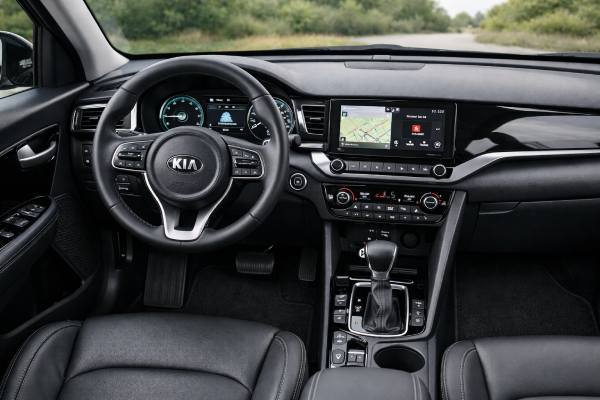
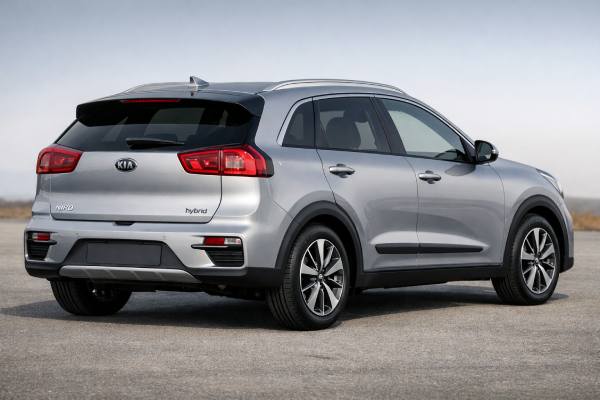
The facelifted 2019–2022 Kia Niro Hybrid (DE) is one of the more “engineering-honest” hybrids of its era: a small 1.6-liter gasoline engine paired with an electric motor and a 6-speed dual-clutch transmission (DCT), packaged into a compact crossover that still prioritizes usable space. On the road, it behaves less like a rubber-band CVT hybrid and more like a conventional car—just smoother at low speeds and notably more efficient in stop-and-go driving.
For ownership, the big themes are simple: keep up with routine fluids, understand the DCT’s driving style (it has clutches, not a torque converter), and treat the cooling system and 12 V battery as “hybrid essentials,” not afterthoughts. Done right, it’s a low-stress daily car with realistic fuel savings and a strong safety baseline.
Quick Specs and Notes
- Strong city efficiency with smooth low-speed electric assist and predictable hybrid transitions.
- Practical interior packaging for the class, with a useful cargo area and good rear-seat usability.
- More natural “car-like” feel than many hybrids thanks to the 6-speed DCT behavior.
- Caveat: avoid repeated clutch slip at very low speeds; it can worsen DCT shudder over time.
- Typical interval: engine oil and filter every 15,000 km or 12 months.
Jump to sections
- Kia Niro Hybrid DE facelift overview
- Kia Niro Hybrid DE facelift specs
- Kia Niro Hybrid DE facelift trims and ADAS
- Common issues, recalls, and service actions
- Maintenance and used-buyer guide
- Driving feel and real economy
- How it stacks up against rivals
Kia Niro Hybrid DE facelift overview
The facelift Niro Hybrid is best understood as a “conventional car that happens to be hybrid.” That sounds simple, but it’s a meaningful difference from many hybrids that rely on an eCVT. The Niro’s hybrid system uses a gasoline engine and an electric motor with a 6-speed dual-clutch transmission. You still get the advantages of electrification—instant low-speed torque, engine-off coasting, and brake energy recovery—but the driving rhythm feels familiar: there are real gear changes, and throttle response has a more direct relationship to road speed.
In everyday use, the hybrid system works hardest where you want it to: pulling away from a stop, creeping in traffic, and smoothing short acceleration bursts. The electric motor can fill gaps in torque when the engine would otherwise feel flat, and it also lets the engine operate more efficiently by reducing the need for high throttle openings at low rpm. When everything is healthy, the engine-to-electric handoff is subtle enough that most drivers stop thinking about it after a week.
The facelift years also brought a more modern cabin and updated driver assistance availability in many markets. From an ownership standpoint, those updates matter because they change what “good used condition” looks like: you’re not only checking the engine and gearbox behavior, but also radar/camera health, infotainment stability, and whether the car’s software updates and service actions were done on schedule.
If you’re choosing between the earlier Niro Hybrid and the facelift, the practical difference is less about raw power and more about refinement and equipment. The facelift tends to feel better integrated: quieter at steady speed, more polished in ergonomics, and often stronger in driver assistance depending on trim.
Where the Niro Hybrid asks for a bit of respect is the DCT. A dual-clutch gearbox can be smooth and efficient, but it doesn’t like being forced to “slip” like a torque-converter automatic in long parking-lot crawls. That doesn’t mean it’s fragile—it means the best ownership experience comes from smooth inputs and avoiding habits that create extra heat in the clutches.
Who it fits best:
- Drivers who do mixed city and suburban driving and want fuel savings without charging.
- Owners who want a hybrid that feels more “normal” than an eCVT car.
- Families who need crossover practicality but don’t want a heavy, high-consumption SUV.
Kia Niro Hybrid DE facelift specs
Powertrain and efficiency (Kappa II G1.6 HEV)
| Item | Specification |
|---|---|
| Powertrain code | Kappa II G1.6 Hybrid |
| Engine layout and cylinders | I-4, DOHC, 4 valves/cyl |
| Displacement | 1.6 L (1,580 cc) |
| Bore × stroke | 72.0 × 97.0 mm (2.83 × 3.82 in) |
| Induction | Naturally aspirated |
| Fuel system | Gasoline direct injection (GDI) |
| Compression ratio | 13.0:1 |
| Electric motor | PMSM, single motor, front axle |
| Hybrid battery | Lithium-ion polymer |
| System voltage | ~240 V |
| Hybrid battery capacity | ~1.56 kWh |
| System max power | 139 hp (102 kW) |
| System max torque | 265 Nm (195 lb-ft) |
| Timing drive | Chain |
| Rated efficiency (typical) | 4.4–5.0 L/100 km (53–47 mpg US / 64–56 mpg UK) |
| Real-world highway @ 120 km/h | 6.0–6.6 L/100 km (39–36 mpg US / 47–43 mpg UK) |
Transmission and driveline
| Item | Specification |
|---|---|
| Transmission | 6-speed DCT (dual-clutch automatic) |
| Drive type | FWD |
| Differential | Open (brake-based traction control) |
Chassis and dimensions
| Item | Specification |
|---|---|
| Suspension (front / rear) | MacPherson strut / multi-link |
| Steering | Electric power steering (EPS) |
| Brakes (front / rear) | Ventilated disc / disc |
| Typical brake sizes | ~305 mm front / ~284 mm rear |
| Popular wheel and tyre sizes | 205/60 R16; 225/45 R18 |
| Ground clearance | ~160 mm (6.3 in) |
| Length / width / height | ~4,355 / 1,805 / 1,545–1,560 mm (171.5 / 71.1 / 60.8–61.4 in) |
| Wheelbase | 2,700 mm (106.3 in) |
| Turning circle | ~10.6 m (34.8 ft) |
| Kerb (curb) weight | ~1,425–1,520 kg (3,142–3,351 lb) |
| GVWR | ~1,930–2,050 kg (4,255–4,520 lb) |
| Fuel tank | ~45 L (11.9 US gal / 9.9 UK gal) |
| Cargo volume | ~427 L seats up / ~1,425 L seats down (VDA) |
Performance and capability
| Item | Specification |
|---|---|
| 0–100 km/h (0–62 mph) | ~11.0–11.5 s |
| Top speed | ~162–170 km/h (101–106 mph) |
| Braking distance 100–0 km/h | ~37–40 m |
| Towing capacity (where approved) | up to ~1,300 kg (2,866 lb) braked |
| Payload (typical) | ~400–500 kg (882–1,102 lb) |
Fluids, service capacities, and key torque values
| Item | Specification |
|---|---|
| Engine oil | 0W-20 (typical) |
| Engine oil capacity | ~3.8–4.0 L (4.0–4.2 US qt) |
| Coolant | Long-life ethylene glycol coolant, 50:50 mix (typical) |
| Coolant capacity | ~6.0–6.5 L (6.3–6.9 US qt) |
| Brake fluid | DOT 4 |
| A/C refrigerant | R-1234yf (typical) |
| Wheel nuts | ~88–108 Nm (65–80 lb-ft) |
Safety and driver assistance (baseline)
| Item | Specification |
|---|---|
| Euro NCAP | 5 stars |
| Adult / child | 91% / 80% |
| Vulnerable road users | ~66–70% |
| Safety assist | ~81% |
| Core safety systems | ABS, ESC, traction control, multi-airbag layout |
| Typical ADAS availability | AEB, lane support, ACC (by trim/pack) |
Kia Niro Hybrid DE facelift trims and ADAS
Trim naming in Germany and wider Europe often differs by importer, but the facelift Niro Hybrid usually follows a recognizable pattern: a well-equipped base that covers fundamentals, a comfort-oriented middle trim, and a higher trim that adds the most meaningful technology. When shopping used, it’s less important to memorize trim labels and more important to spot the options that change daily life.
Trims and options that matter most in practice
1) Wheel and tyre packages
The Niro’s ride and noise levels depend heavily on wheel size. The popular 16-inch setup usually rides more softly and tends to be quieter on rough asphalt. Larger wheels can sharpen steering response, but they often increase road noise and can slightly hurt real-world economy on motorway speeds. When you test drive, pay attention to:
- Low-speed thumps and sharp-edge impacts
- Highway road roar on coarse pavement
- Whether the car tracks straight without constant micro-corrections
2) Infotainment and cockpit updates
The facelift brought a more modern interior and, in many versions, improved screen layout and connectivity. What matters on a used car is stability:
- No frozen screens or repeated reboots
- Bluetooth that reconnects consistently
- A reverse camera that loads quickly and stays clear
3) Heating and comfort equipment
Hybrids live in all seasons, and the Niro’s comfort equipment changes the ownership feel more than many buyers expect:
- Heated seats and steering wheel make winter driving more pleasant without running the HVAC aggressively.
- Automatic climate control is a quality-of-life improvement if you do many short trips.
Safety ratings and what they mean on a facelift car
The Niro platform’s crash-test performance is a strong baseline, but your “real safety outcome” is also shaped by equipment, tyres, and maintenance. A facelift car with modern ADAS can reduce fatigue and help avoid certain crash types, but only if the sensors are healthy and properly calibrated.
ADAS and calibration considerations
Depending on trim and packages, you may see:
- AEB (automatic emergency braking): typically includes vehicle detection; some versions add pedestrian and cyclist detection.
- Lane departure warning and lane keeping support: useful on motorways but sensitive to tyre alignment and windshield/camera condition.
- Adaptive cruise control (ACC): one of the best “long-drive” features when it’s set up correctly.
- Blind-spot monitoring and rear cross-traffic alert: valuable in a quiet hybrid that can sneak up on pedestrians in parking lots.
A practical used-car tip: if the vehicle has radar/camera features, ask about prior windshield replacement and front-end repairs. Even minor bumper work can affect sensor alignment. During your test drive, look for:
- No “sensor blocked” warnings in normal weather
- Smooth ACC braking (not jumpy or late)
- Lane support that doesn’t ping-pong between lane markings
Quick identifiers when shopping
- Steering wheel buttons and cluster menus often reveal ACC and lane functions.
- Parking sensors and camera presence can indicate higher equipment lines.
- Headlight type (halogen vs LED) is often tied to trim tiers and can be a meaningful safety upgrade for rural night driving.
The best “value” used Niro Hybrid is usually a mid-to-high trim with the safety package you actually want, on the smallest wheel size you’re happy with, and a clean service record that proves routine maintenance was done on schedule.
Common issues, recalls, and service actions
The facelift Niro Hybrid is generally robust, but it has a few repeat themes that are worth understanding before you buy. With hybrids, the cost risk isn’t usually “constant small repairs”—it’s a smaller number of components that become expensive if ignored. The smartest approach is to map issues by prevalence and severity, then learn the symptoms that help you catch them early.
Common (higher prevalence, usually low to medium cost)
DCT low-speed shudder or hesitation
- Symptoms: mild judder when creeping, hesitation when switching from a crawl to gentle acceleration, or an inconsistent take-up feel.
- Likely causes: clutch adaptation drift, driving habits that create excess heat (extended creeping), or worn clutch-related components over high mileage.
- Remedy: ensure software is current, confirm correct adaptation procedures after service, and drive with smooth throttle inputs. If the shudder is pronounced or worsening, get a proper diagnosis rather than hoping it “drives itself out.”
12 V battery weakness
- Symptoms: warning messages that appear and disappear, slow start-up, infotainment resets, or intermittent electronics behavior.
- Likely causes: aging 12 V battery and frequent short trips.
- Remedy: load-test the 12 V battery and replace proactively if marginal. It’s one of the cheapest ways to prevent weird hybrid behavior.
Brake hardware corrosion from light use
- Symptoms: scraping noise after rain, rough brake feel at low speeds, or visible rust that doesn’t clean up.
- Likely causes: regen reduces friction-brake use.
- Remedy: periodic firm braking (when safe), routine caliper slide cleaning, and timely pad/rotor service.
Occasional (medium cost, higher inconvenience)
Cooling system seepage or component wear
- Symptoms: coolant smell, low coolant level over time, or inconsistent cabin heat.
- Likely causes: hose aging, water pump/thermostat wear, or minor leaks that grow slowly.
- Remedy: pressure test and fix early. Cooling health matters more on a hybrid than many owners expect because stable temperatures support consistent efficiency and longevity.
GDI intake deposit build-up (long-term pattern)
- Symptoms: rough idle, slight hesitation, or reduced smoothness under light throttle at higher mileage.
- Likely causes: direct injection can allow deposits on intake valves over time, especially with lots of short trips and cold operation.
- Remedy: avoid constant short-trip use where possible, keep oil changes on time, and address misfires promptly (plugs and coils first, not guesses).
Rare (low prevalence, higher cost)
Hybrid system warnings or inverter-related faults
- Symptoms: “hybrid system warning,” reduced performance, or repeated fault messages after battery disconnects or repairs.
- Likely causes: sensor faults, wiring/connectors, or control module issues.
- Remedy: insist on a proper scan and targeted diagnostics. Hybrids do not reward “parts cannon” repair strategies.
Recalls, TSBs, and extended coverage: how to handle it sensibly
Rather than chasing rumor lists, focus on verification:
- Check recall completion by VIN using official channels and dealer records.
- Ask for invoices showing software updates or service actions.
- Confirm drivability with a cold start and a warm drive—many issues show up only in one condition.
High-value pre-purchase checks
- Full test drive that includes creeping, stop-and-go, and a motorway section.
- Smooth DCT take-up with no strong judder or repeated hesitation.
- A clean scan for stored codes (not only “no warning lights right now”).
- Evidence of consistent oil service and basic consumables (filters, brake fluid).
If the car passes these checks, the Niro Hybrid tends to be a straightforward long-term daily driver. The models that disappoint owners usually share the same story: incomplete service records, ignored DCT symptoms, and “minor” warning lights that were never properly diagnosed.
Maintenance and used-buyer guide
A hybrid’s best trait—doing a lot of work with a small engine—also means maintenance discipline matters. The facelift Niro Hybrid is not high-maintenance, but it responds poorly to neglect. The aim is to protect three systems at once: the gasoline engine, the dual-clutch gearbox behavior, and the electrified cooling and electrical system that keeps the hybrid stable.
Practical maintenance schedule (normal use)
Every 15,000 km or 12 months
- Engine oil and filter (use the correct oil spec and don’t stretch intervals if you drive short trips).
- Cabin air filter inspection and replacement as needed (often yearly if you drive in cities).
- Multi-point inspection: coolant level, hoses, brake condition, tyre wear, and underbody checks.
- Brake inspection: pad thickness, rotor condition, and slider pin lubrication.
Every 30,000–45,000 km (or ~24–36 months)
- Engine air filter replacement.
- Brake fluid replacement (many schedules are time-based; two years is a common benchmark).
- Alignment check if tyre wear shows feathering or shoulder wear.
Every 90,000–105,000 km
- Spark plug replacement (high-quality plugs matter for smooth hybrid operation).
- Cooling system inspection with a focus on seepage and hose condition.
Longer intervals (but don’t ignore time)
- Long-life coolant often has an extended interval, but time and mileage both matter. If your car does lots of short trips, treat cooling maintenance as more important, not less.
Fluids and parts choices that influence longevity
- Use the correct engine oil viscosity and specification. Hybrids start and stop the engine often; good oil matters for timing chain and valvetrain longevity.
- Replace filters with quality parts. A clogged cabin filter can reduce demist performance and increase HVAC strain on short winter trips.
- Keep tyres matched and properly inflated. Hybrids are sensitive to rolling resistance changes; mismatched tyres can also confuse stability systems.
Buyer’s guide: what to inspect on a used facelift Niro Hybrid
Engine and hybrid behavior
- Cold start: smooth idle, no persistent ticking, and no “hunting” rpm.
- Transition smoothness: the engine should start and stop without harsh vibration.
- Check for repeated warning lights during the drive cycle.
DCT drivability
- Low-speed crawl: it should feel controlled, not like it’s slipping constantly.
- Hill starts: smooth take-up without a strong shudder.
- Avoid cars that “feel confused” in stop-and-go traffic; that’s where small issues become owner complaints.
Cooling system and leaks
- Check coolant level and inspect around hoses and pump areas.
- Look for dried coolant residue and smell after a warm drive.
Brakes and underbody
- Inspect rotors for heavy rust lips and uneven pad wear.
- Check underbody for damage: a hybrid relies on intact covers for aero and protection.
Electronics and convenience
- Test every switch, sensor, and camera you care about. A “cheap” used car becomes expensive when you start chasing intermittent electronic faults.
Recommended specs to seek (and what to avoid)
Seek:
- Documented regular oil services and brake fluid history
- A trim level with the safety features you actually want
- Smaller wheels if comfort and road noise matter to you
Avoid:
- Cars with vague explanations for DCT shudder
- Incomplete service history, especially on oil and brake fluid
- Repeated warning messages that “come and go”
Long-term durability outlook: with regular oil changes and sensible driving habits, the engine and hybrid system can age well. The most common long-run annoyances tend to be DCT feel in heavy traffic and neglected consumables—both of which are manageable with proper care.
Driving feel and real economy
The facelift Niro Hybrid drives like a conventional compact crossover—just quieter at low speed and more relaxed in city traffic. The steering is typically light and easy, the suspension is tuned for comfort, and the car feels stable at motorway speeds. Most owners notice two things right away: the calmness when pulling away from a stop (thanks to electric torque) and the “normal” sensation of gear changes (thanks to the DCT).
Ride, handling, and noise
At urban speeds, the car feels composed and easy to place, helped by good visibility and predictable steering response. On the motorway, it tracks straight with minimal correction, and crosswinds are usually manageable for the class. Tyres and wheel size remain the biggest variables:
- 16-inch wheels often deliver the best ride and the least road noise.
- Larger wheels can sharpen turn-in slightly but tend to increase harshness and roar on coarse asphalt.
Cabin noise is mostly wind and tyres rather than engine, because the hybrid system tries to avoid high-rpm operation during gentle cruising. Under hard acceleration, you’ll hear the 1.6-liter engine more clearly, but it doesn’t usually feel strained unless the car is heavily loaded or climbing steep grades at speed.
Powertrain character and hybrid transitions
The electric motor mainly improves response at low rpm and during short acceleration bursts. In practice:
- Throttle response is strongest from a stop through city speeds.
- Passing power is adequate rather than fast; the hybrid prioritizes efficiency.
- Engine starts and stops should feel subtle. If you feel a harsh shudder, it’s worth checking mounts, software status, and service history.
The DCT is a defining trait. Unlike a torque converter automatic, it uses clutches. That’s why it rewards a smooth driving style:
- In crawling traffic, avoid constant micro-throttle inputs that make the clutches slip.
- On hills, use steady throttle and let the car engage cleanly rather than “hovering” at the bite point.
Real-world economy in daily use
Owners tend to see the best results in mixed driving with frequent slowdowns and gentle acceleration:
- City: roughly 4.5–5.2 L/100 km (52–45 mpg US / 63–54 mpg UK)
- Mixed: roughly 5.0–5.6 L/100 km (47–42 mpg US / 56–50 mpg UK)
- Highway at 120 km/h: roughly 6.0–6.6 L/100 km (39–36 mpg US / 47–43 mpg UK)
Cold weather can add a noticeable penalty because the engine runs more often to provide heat and the battery is less efficient. A realistic winter delta is +0.5 to +1.0 L/100 km depending on trip length, tyre choice, and temperature.
What makes it feel “good” long-term
- Regular maintenance that keeps the engine smooth and the brakes free of corrosion.
- Tyres that match the car’s efficiency intent (and are rotated regularly).
- A driver who uses steady inputs in stop-and-go traffic to keep the DCT happy.
If you drive it with that mindset, the Niro Hybrid delivers the kind of quiet, low-effort commuting that many owners want—without requiring charging habits or range planning.
How it stacks up against rivals
The facelift Niro Hybrid sits in a competitive space: compact crossovers and hatchbacks that promise low running costs and easy daily use. The best comparison comes down to transmission feel, real-world economy patterns, interior practicality, and how much you trust the long-run complexity.
Against eCVT hybrids (the “smooth and simple” camp)
Many mainstream hybrids use an eCVT-style power split system. Compared with those cars, the Niro Hybrid’s advantages are:
- A more conventional driving sensation at steady speeds
- Distinct, familiar gear changes instead of continuous “engine flare” behavior
- Often a direct-feeling connection between throttle and speed
Trade-offs:
- The DCT can feel less happy in heavy crawling traffic than a true eCVT system.
- Low-speed finesse depends more on calibration and driver input.
If you spend hours each week in stop-and-go congestion, an eCVT-type hybrid can feel smoother and more tolerant. If your driving is mixed and you prefer a normal-car rhythm, the Niro can be more satisfying.
Against mild hybrids (the “small savings, simple hardware” camp)
Mild hybrids often deliver modest efficiency gains with fewer high-voltage components. Compared with those, the Niro Hybrid typically offers:
- Stronger low-speed assistance and better city economy
- More frequent engine-off behavior
- More consistent efficiency benefits in mixed driving
Trade-offs:
- More electrified components and software dependency than a mild hybrid
- More systems to keep healthy over the long term (though not necessarily more routine maintenance)
Cabin and cargo practicality
This is a quiet strength for the Niro. Many rivals in this class compromise either rear-seat usability or cargo shape. The Niro’s packaging generally works well for:
- Rear-seat adults on medium trips
- Child seats and daily family tasks
- A cargo area that’s more usable than “coupe-crossover” styled alternatives
If you regularly carry bulky items, the shape and access of the boot can matter more than the headline liters.
Which buyer should choose the Niro Hybrid facelift?
Choose it if you want:
- A hybrid that feels like a normal car in daily driving
- Good real-world economy without learning charging routines
- Practical space without stepping up to a larger SUV
Consider a rival instead if:
- Your driving is dominated by very slow traffic and you want maximum low-speed smoothness
- You strongly prefer a simple, low-feature trim with minimal electronic systems
- You value sporty handling over comfort and efficiency
The Niro Hybrid facelift is best when you treat it as a balanced tool: efficient, practical, and comfortable, with a DCT that rewards smooth driving and proper maintenance rather than neglect.
References
- Official Kia Niro 2016 safety rating 2016 (Safety Rating)
- Safety Recall Report 20V488 2020 (Recall Database)
- Owner Manuals 2026 (Owner’s Manual)
- Find and Compare Cars 2026 (Official Efficiency Database)
Disclaimer
This article is for informational purposes only and is not a substitute for professional inspection, diagnosis, or repair. Specifications, torque values, service intervals, and procedures can vary by VIN, market, model year, and equipment. Always verify details using official manufacturer documentation and qualified service support for your exact vehicle.
If you found this guide useful, please share it on Facebook, X (Twitter), or your preferred community to support our work.