
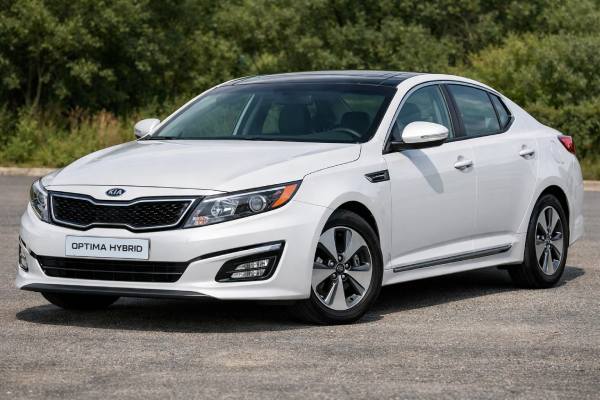
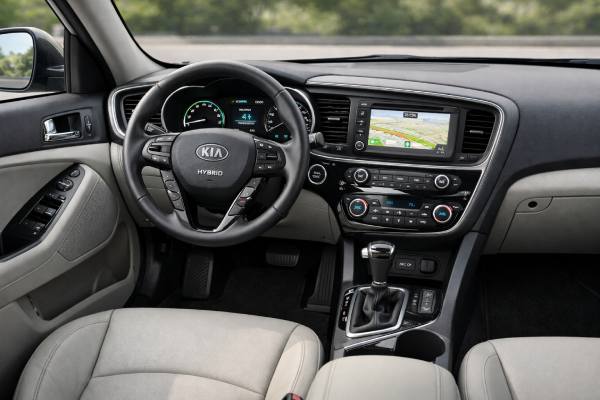

The facelift-era Kia Optima Hybrid (TF, 2014–2015) is best understood as a conventional midsize sedan that happens to be very good at hybrid work. Instead of a “CVT feel,” it uses a 6-speed automatic and blends electric assist into normal driving with a more familiar rhythm. The 2.4-liter Atkinson-cycle four-cylinder prioritizes efficiency, while the hybrid motor fills in low-speed torque and smooths stop-start transitions. In ownership terms, this Optima Hybrid rewards steady maintenance and careful cooling-system health more than constant tinkering—most expensive hybrid components are durable when kept within their temperature and voltage comfort zones. The key is to buy one with documented servicing, confirm recall/updates are complete, and test both the high-voltage (traction) battery and the smaller 12 V battery before you commit.
Quick Specs and Notes
- Strong highway comfort and a “regular automatic” driving feel compared with many hybrids.
- Useful real-world efficiency gains in city traffic thanks to EV assist and regenerative braking.
- Good equipment value on higher trims (heated seats, upgraded audio, driver aids depending on market).
- Ownership caveat: cooling-system condition and hybrid software updates matter; ignored faults get expensive.
- Typical interval: engine oil and filter every 12,000 km / 12 months (sooner under severe use).
Jump to sections
- Optima TF Hybrid facelift explained
- Optima TF Hybrid specs and dimensions
- Optima TF Hybrid trims and safety equipment
- Reliability and common hybrid faults
- Maintenance plan and buyer’s checklist
- Driving feel and real-world efficiency
- How the Optima Hybrid stacks up
Optima TF Hybrid facelift explained
The 2014–2015 facelift Optima Hybrid is a “parallel hybrid,” meaning the gas engine and electric motor can both push the car forward. In practice, it behaves like a normal sedan most of the time—quiet when you’re creeping or coasting, then smoothly bringing the engine online when you ask for more power. If you’re coming from a conventional automatic, this layout often feels more natural than hybrids that rely on a continuously variable transmission (CVT).
The centerpiece is the 2.4-liter Atkinson-cycle four-cylinder. “Atkinson” here doesn’t mean a different engine family so much as a valve-timing strategy that trades peak torque for higher thermal efficiency. That’s why the engine can feel unhurried on its own, yet the car still steps off cleanly: the electric motor fills the gap at low rpm and during gear changes. Together, the system output is rated around 199 hp for this facelift-era version, which is enough for everyday merging and passing without making efficiency your enemy.
The facelift matters for ownership because it’s when many TF cars received refinements to cabin materials, infotainment, and driver-assist availability (market-dependent), plus calibration updates that improve hybrid “blending” between regen braking and friction brakes. It’s also the period when you should pay attention to how the car has been serviced: a well-kept Optima Hybrid can feel surprisingly modern, while a neglected one can show warning lights, odd charging behavior, or rough transitions as the control modules compensate for aging sensors or weak 12 V power.
What owners tend to like most is the balance: mid-size ride comfort, a quiet cabin at speed, and fuel savings that show up most clearly in stop-and-go traffic. What owners need to respect is that this isn’t just an engine and transmission—there’s a high-voltage battery, inverter electronics, cooling loops, and software logic that must all stay healthy for the car to remain “invisible” in daily use.
Optima TF Hybrid specs and dimensions
Below are the most relevant specifications for the facelift Optima Hybrid (TF, 2014–2015). Exact figures can vary by market, wheel size, and test standard, so use these as a practical baseline and confirm against your VIN-specific documentation.
Powertrain and efficiency
| Item | Specification |
|---|---|
| Powertrain type | Full hybrid (HEV), parallel hybrid |
| Engine | 2.4 L inline-4, DOHC, 4 valves/cyl (Atkinson-cycle calibration) |
| Displacement | 2.4 L (≈ 2,359 cc) |
| Bore × stroke | 88.0 × 97.0 mm (3.46 × 3.82 in) |
| Induction | Naturally aspirated |
| Fuel system | MPI (multi-port injection) |
| Timing drive | Chain |
| Hybrid motor | Single traction motor integrated with transmission (front axle) |
| Battery | Lithium-polymer (traction battery), air-cooled/ducted packaging (market-dependent layout) |
| System output | 199 hp (≈ 148 kW) combined |
| Rated efficiency | Commonly around 6.0–6.7 L/100 km combined depending on rating method/market |
| Real-world highway @ 120 km/h | Often ~6.5–7.5 L/100 km with healthy tyres and alignment |
Transmission and driveline
| Item | Specification |
|---|---|
| Transmission | 6-speed automatic (hybrid-integrated) |
| Drive type | FWD |
| Differential | Open |
Chassis and dimensions (typical facelift TF sedan)
| Item | Specification |
|---|---|
| Suspension (front / rear) | MacPherson strut / multi-link |
| Steering | Electric power steering (EPS) |
| Brakes | 4-wheel discs; ABS + ESC standard |
| Popular tyre sizes | Often 215/55 R17 or 225/45 R18 (varies by trim/market) |
| Length / width / height | ~4,845 / 1,830 / 1,455 mm (190.7 / 72.0 / 57.3 in) |
| Wheelbase | ~2,795 mm (110.0 in) |
| Turning circle | ~11.0 m (≈ 36 ft) |
| Kerb weight | Commonly ~1,580–1,650 kg (3,480–3,640 lb) depending on equipment |
| Fuel tank | ~60 L (15.9 US gal / 13.2 UK gal) |
| Cargo volume | Reduced vs non-hybrid due to battery packaging (market-dependent measurement) |
Performance and capability (typical expectations)
| Item | Specification |
|---|---|
| 0–100 km/h (0–62 mph) | ~9.5–10.5 s (wheel/tyre and test method matter) |
| Top speed | ~190–200 km/h (118–124 mph) |
| Towing capacity | Often not recommended or very limited for hybrids; check your market manual |
| Payload | Check door-jamb label (varies widely with trim) |
Fluids and service capacities (high-level guidance)
Because hybrids can have VIN-specific differences, treat capacities as “confirm and fill,” not universal constants.
| Item | Typical guidance |
|---|---|
| Engine oil | 5W-20 (many markets) or 5W-30 (some climates); verify spec and approval |
| Coolant | Long-life coolant; verify type and mix (typically 50/50) |
| Transmission/ATF | Use the exact OEM ATF spec for the hybrid 6-speed unit |
| A/C refrigerant | R-134a in most TF applications; confirm under-hood label |
Safety and driver assistance (overview)
| Item | Notes |
|---|---|
| Crash ratings | Commonly strong results for the Optima body structure; confirm by model year and test body |
| ADAS | Lane and forward-collision features were limited vs modern cars; availability varies heavily by market/trim |
| Key safety tech | ESC, ABS, traction control, multiple airbags; ISOFIX/LATCH provisions typical |
Optima TF Hybrid trims and safety equipment
Trim naming varies by region, but most facelift Optima Hybrids follow a simple pattern: a base hybrid trim focused on value, and one or two higher trims that add comfort and tech. When shopping, don’t get stuck on badges alone—two cars with the same exterior label can have very different equipment depending on the market or original option packages.
Trims and options that change ownership
The most meaningful differences tend to fall into four buckets:
- Wheel and tyre package (17 vs 18 inch): Larger wheels can sharpen steering response but often cost a little efficiency and ride comfort. If your roads are rough, 17s are usually the sweet spot for this generation.
- Infotainment and camera systems: Upgraded head units, navigation, and parking cameras are nice, but they also introduce more age-related issues (screen wear, camera moisture ingress, older Bluetooth modules).
- Seat and climate features: Heated and ventilated seats, dual-zone climate, and better sound insulation are common “daily quality” upgrades that age well if maintained.
- Driver aids (where offered): Some markets offered forward-collision warning, blind-spot monitoring, rear cross-traffic alert, and parking sensors. These systems rely on sensors and modules that can be costly if damaged or poorly repaired after an accident.
Quick identifiers that help in-person:
- Wheels: Factory 17-inch aero-style wheels often signal efficiency-oriented trims.
- Interior: Leather seat surfaces, larger displays, and premium audio badging usually cluster on higher trims.
- External sensors: Look for parking sensors and radar/bumper sensor panels that hint at added driver aids.
Safety ratings and what they really mean
Safety results for the Optima platform are generally positive, but it’s important to match the rating to the test year and configuration. A “Top Safety Pick” (if applicable in your market/year) can depend on headlight performance and specific crash-test updates introduced mid-cycle. Likewise, European star ratings are tied to the exact test protocol in place at the time, and can’t be directly compared to newer tests without context.
Safety systems and service implications
Most facelift TF Optima Hybrids include:
- Front, side, and curtain airbags (count can vary by market)
- ABS, electronic stability control, traction control
- ISOFIX/LATCH child-seat anchors
After repairs, pay attention to:
- Alignment and steering-angle calibration (affects stability control behavior)
- Brake service quality (blending between regen and friction braking depends on consistent brake hardware condition)
- Sensor alignment if the car has blind-spot or forward-collision systems (bumper and mirror work matters)
If you’re buying used, an accident-repaired car can be perfectly fine, but only if the repair included correct sensor mounting and proper post-repair calibration—especially on a hybrid where drivability complaints can be misdiagnosed as “hybrid problems.”
Reliability and common hybrid faults
A well-maintained facelift Optima Hybrid is usually dependable, but it has more systems that must agree with each other: engine management, hybrid control, battery management, and transmission logic. The good news is that many issues start as small symptoms—if you act early, you can often avoid the expensive version of the same problem.
Common vs occasional vs rare issues
Common (usually low–medium cost):
- Weak 12 V battery (often 4–6 years): causes odd warnings, no-start events, or “hybrid system” messages that disappear after replacement.
- Brake vibration or uneven wear: hybrids use regen braking, so friction brakes may see light use and can develop corrosion or uneven pad deposits if the car sits.
- Cooling system maintenance neglect: old coolant, clogged radiator fins, or a tired water pump can push temperatures up—hybrids are less tolerant of marginal cooling.
Occasional (medium cost):
- Inverter/electronics cooling issues: poor coolant flow or trapped air can trigger warnings and reduced power.
- ABS/ESC sensor faults: wheel-speed sensors or tone rings can fail with age, affecting traction and stability functions.
- A/C performance decline: leaks and compressor wear are normal aging problems; the key is correct refrigerant charge and oil.
Rare (high cost):
- Traction battery degradation or module imbalance: often shows as reduced EV assist, more frequent engine running, and fault codes. Many packs last a long time, but replacement is the big-ticket risk.
- Inverter or power control module failure: uncommon, but expensive when it happens—sometimes linked to cooling neglect or water intrusion.
Symptom → likely cause → recommended remedy
- Intermittent warning lights, random glitches, or no-start:
Likely cause: weak 12 V battery, poor grounds, or charging control issues.
Remedy: load-test the 12 V battery, inspect terminals/grounds, then scan for stored codes. - Shudder or inconsistent braking feel at low speed:
Likely cause: uneven front brake hardware, surface corrosion, or poor pad bedding (regen masks early symptoms).
Remedy: inspect pads/rotors, service slide pins, refresh brake fluid; verify regen blending after service. - Runs hotter than expected, fans loud, reduced power:
Likely cause: cooling system restriction, radiator blockage, thermostat/water pump aging, or air in cooling loop.
Remedy: pressure test, verify coolant level/condition, bleed correctly, clean radiator stack. - Hybrid performance feels “flat,” EV assist reduced:
Likely cause: battery aging, temperature management issues, or outdated calibration.
Remedy: scan hybrid codes, check battery state-of-health (SOH), verify cooling ducts, request dealer software update history.
Recalls, TSBs, and how to verify
Use a VIN-based check and service records. Don’t rely on a seller saying “it’s all done.” The best pre-purchase approach is:
- Run an official VIN recall lookup.
- Ask for dealer printouts showing completion dates.
- Scan for stored codes even if the dash is clear—some sellers clear lights right before sale.
Maintenance plan and buyer’s checklist
A hybrid Optima doesn’t need exotic maintenance, but it benefits from consistency. The goal is to keep lubrication clean, cooling strong, and electrical health stable so the hybrid control system doesn’t spend its life compensating for weak inputs.
Practical maintenance schedule (baseline)
Use this as a real-world plan, then adjust to your driving:
- Engine oil and filter: every 12,000 km / 12 months (or 8,000 km / 6 months for severe use: short trips, heavy traffic, extreme heat/cold). Use the correct viscosity and spec for your market.
- Cabin air filter: 15,000–20,000 km or yearly; more often in dusty cities.
- Engine air filter: 30,000–45,000 km, sooner in dusty conditions.
- Coolant: commonly 160,000 km / 10 years first change, then 50,000–60,000 km / 3–4 years (confirm your manual; hybrid cooling needs correct type and bleeding).
- Spark plugs: often 160,000 km / 100,000 miles if iridium (confirm engine spec).
- Brake fluid: every 2 years, regardless of mileage.
- Brake pads/rotors inspection: every 15,000–20,000 km; hybrids can hide brake wear until it becomes uneven.
- Transmission fluid: check service guidance carefully; many owners do a preventative drain-and-fill around 80,000–120,000 km if allowed by the OEM procedure/spec.
- Tyre rotation: every 10,000–12,000 km; keep pressures correct for both efficiency and stability.
- 12 V battery test: annually after year 3; proactive replacement around 4–6 years reduces “mystery” electrical faults.
- Hybrid health check: at least annually—scan for codes and review battery temperature and balance data if your shop can read it.
Fluid specs and decision-making notes
- Use only the OEM-specified ATF for the hybrid 6-speed. “Close enough” fluids can create shift feel problems or long-term wear.
- For coolant, type matters (and mixing types is a common mistake). If the car has ever had cooling work, confirm what was used.
- If the car has stop-start and hybrid electronics, a healthy 12 V battery is not optional—many drivability complaints begin there.
Buyer’s checklist for 2014–2015 Optima Hybrid
Before you drive:
- Cold-start behavior: listen for abnormal rattles, belt noise, or rough idle.
- Check coolant condition and level (engine cold), and look for crusty residue at hose junctions.
- Verify the 12 V battery age and test it.
During the drive:
- Smooth engine-to-EV transitions (no harsh jolts).
- Brake feel: consistent pedal response in the last 10 km/h (6 mph).
- Highway tracking: no steering corrections needed on a flat road (alignment/tyres).
After the drive:
- Scan for codes (engine, ABS, hybrid, and body modules).
- Inspect for water intrusion in trunk/spare area (important because hybrids often place components and ducts in the rear).
- Review service history for coolant, brake fluid, and any hybrid updates.
If you can only choose one “extra” check, choose a hybrid-capable scan that reports battery temperatures and balance. It’s the fastest way to separate a healthy system from a future project.
Driving feel and real-world efficiency
The facelift Optima Hybrid’s biggest advantage is how normal it feels. The 6-speed automatic gives familiar step changes under acceleration, while the motor quietly fills torque gaps that would otherwise make a 2.4 Atkinson engine feel sleepy. In daily driving, the system encourages smoothness: gentle throttle and early lift-off let the car glide and recapture energy through regenerative braking.
Ride, handling, and NVH
- Ride comfort: tuned for midsize-sedan comfort. On 17-inch wheels it typically rides with more compliance over broken pavement; 18-inch packages can feel sharper but more brittle.
- Steering: light to moderate effort with typical EPS feedback for the era—precise enough, not sporty.
- Cabin noise: wind and road noise are usually well-controlled at motorway speeds for its generation, though worn tyres can make it noticeably louder.
Powertrain character and transitions
- Low-speed response: strong initial step-off thanks to electric torque.
- Midrange passing: adequate rather than punchy; the hybrid helps, but this is not the turbo model.
- Engine start/stop: should feel smooth. A noticeable shudder can indicate mounts, tune issues, or battery/charging management compensations.
- Transmission behavior: generally predictable. Harsh shifts can point to fluid condition, software updates, or driveline wear.
Real-world efficiency (what owners usually see)
Your results depend most on speed and temperature:
- City driving: where the Optima Hybrid shines—frequent regen opportunities and EV creep reduce fuel use.
- Highway (100–120 km/h): efficiency gains remain, but aerodynamic drag dominates; expect the hybrid advantage to narrow compared with city.
- Cold weather: consumption typically rises because the engine runs more to provide cabin heat and keep components in temperature range. Short trips amplify this effect.
Practical tips that make a measurable difference:
- Keep tyres at the correct pressure and stay on low-rolling-resistance tyres when possible.
- Fix alignment drift—hybrids hide it by “still getting decent mpg,” but it costs fuel and tyres.
- Use “normal” driving mode unless you specifically need a sharper throttle map.
For most drivers, the best real-world outcome is a car that feels like a conventional midsize sedan but uses less fuel in the conditions where sedans usually perform worst: urban congestion.
How the Optima Hybrid stacks up
In the used market, the facelift Optima Hybrid competes less on novelty and more on the total ownership package: comfort, equipment, and how expensive it is to keep everything happy as the car ages.
Strengths versus typical rivals
Compared with common midsize hybrids, the Optima Hybrid often stands out for:
- Conventional driving feel: the 6-speed automatic can be more intuitive than an eCVT for drivers who dislike “rubber-band” acceleration.
- Value per feature: depending on trim, you can get high-end comfort features for less money than more famous hybrid badges.
- Highway comfort: solid stability and a quiet cabin make it a good long-distance commuter.
Where rivals can be better
Depending on what you prioritize, competitors may offer:
- Higher peak efficiency: some rivals are simply more fuel-frugal in mixed use.
- Broader hybrid service familiarity: certain models have more independent shop experience and more used parts availability.
- Newer safety tech in the same price band: if you’re shopping at the top of your budget, a slightly newer non-hybrid sedan may offer more modern driver aids.
Who should buy the Optima Hybrid (and who shouldn’t)
A facelift Optima Hybrid is a good fit if you:
- Want a comfortable midsize sedan with meaningful city fuel savings
- Prefer a familiar automatic feel over an eCVT
- Can verify maintenance records and confirm hybrid health with a proper scan
You should be cautious if you:
- Can’t verify recall/software history
- Notice inconsistent braking feel, cooling issues, or repeated warning lights
- Need towing capability (most hybrids are not ideal tow vehicles)
If you find a clean, well-documented example, this Optima Hybrid can be a quietly smart buy—especially for drivers who rack up urban commuting miles and want comfort without stepping into more complex plug-in systems.
References
- 2015 Optima Hybrid – Overview 2015 (Manufacturer Press Info)
- 2015 Optima Hybrid Specifications 2015 (Manufacturer Specifications)
- 2015 Kia Optima 4-door sedan 2015 (Safety Rating)
- Recalls 2026 (Recall Database)
Disclaimer
This article is for informational purposes only and is not a substitute for professional diagnosis, inspection, or repair. Specifications, torque values, service intervals, and procedures vary by VIN, market, model year, and equipment. Always verify details using your vehicle’s official service documentation and labels, and consult a qualified technician for safety-critical work.
If this guide helped, please consider sharing it on Facebook, X (Twitter), or your favorite forum to support our work.