
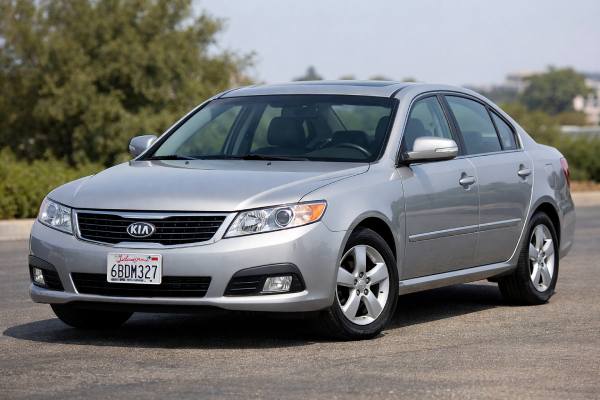
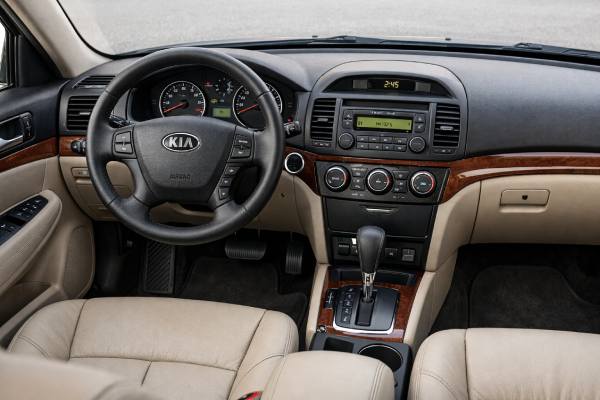
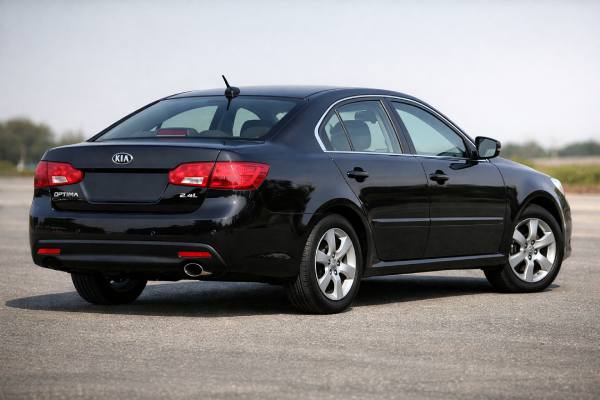
The facelifted 2009–2010 Kia Optima (MG) with the 2.7-liter G6EA V6 is the “quiet competence” version of this generation: smooth torque, simple naturally aspirated fueling, and a conventional drivetrain that most general repair shops understand. It is not a sporty sedan, but it can cover long highway days with low stress thanks to strong mid-range pull and a relaxed engine note. The trade-off is fuel use and under-hood access—this V6 is tighter to service than the four-cylinder models.
Ownership success comes down to two habits: staying ahead of cooling-system health and keeping up with the timing-belt interval. Do those, and the MG V6 tends to reward you with steady drivability, predictable running costs, and fewer “mystery” electronic issues than many newer cars.
Owner Snapshot
- Smooth V6 torque and calm cruising manners suit mixed city–highway driving and long trips.
- Conventional FWD layout and mainstream parts availability keep most repairs straightforward.
- Fuel economy is the main compromise; expect noticeably higher consumption than 2.0/2.4 models.
- Timing belt service is non-negotiable; plan replacement about every 90,000 km (60,000 mi) or 5–6 years (market-dependent).
- Replace brake fluid every 2 years to protect ABS components and maintain pedal feel.
Quick navigation
- Optima MG facelift overview
- Optima MG 2.7 V6 specs
- Optima MG equipment and safety
- Reliability issues and actions
- Maintenance and buyer’s checklist
- Driving and real-world performance
- Optima MG vs rivals
Optima MG facelift overview
The 2009–2010 facelift of the MG-generation Optima kept the same core platform but sharpened the car’s day-to-day usability. In V6 form (G6EA 2.7), it focuses on smoothness and “always available” power rather than peak output. Around town, the advantage is immediate: you rely less on high revs, and the car feels less strained when loaded with passengers or climbing grades. On the highway, the V6 typically runs at lower throttle openings for a given speed, which can make it feel calmer than smaller engines even if it does not always use less fuel.
This Optima’s strengths are practical. The chassis is tuned for comfort first—stable in a straight line, predictable in quick lane changes, and generally forgiving on uneven pavement. Steering is usually light-to-moderate, with limited feedback compared with sportier sedans, but it places the car accurately. Braking performance is adequate when the system is healthy, though owners who neglect fluid changes often describe a softer pedal over time.
For 2009–2010, most markets paired the V6 with a conventional automatic transmission and front-wheel drive. That combination is easy to live with and easy to diagnose, but it also means traction depends heavily on tire quality. If you drive in snow or heavy rain, good tires and correct alignment matter more here than chasing suspension modifications.
Where the MG V6 needs respect is heat management and scheduled service. The V6 bay is tight, and deferred cooling maintenance (old coolant, tired hoses, weak radiator cap, sluggish fans) can turn into overheating risk. The other “make or break” item is the timing belt: a missed belt interval is the kind of gamble that can end the engine in one event. If you approach the car as a comfortable, conventional sedan—and maintain it like one—the facelifted Optima V6 can be a satisfying long-term value.
Optima MG 2.7 V6 specs
Below are practical, commonly cited specifications for the 2009–2010 Optima (MG facelift) with the G6EA 2.7-liter V6. Numbers can vary by market, emissions calibration, and transmission, so treat them as a tight reference range and confirm against your VIN data and local service literature.
Powertrain and efficiency
| Item | Specification |
|---|---|
| Code | G6EA |
| Engine layout and cylinders | V6, 6 cylinders, DOHC, 24 valves (4 valves/cyl) |
| Bore × stroke | 86.7 × 75.0 mm (3.41 × 2.95 in) |
| Displacement | 2.7 L (2,656 cc) |
| Induction | Naturally aspirated |
| Fuel system | MPFI (multi-point fuel injection) |
| Compression ratio | ~10.4:1 |
| Max power | 185 hp (138 kW) @ ~6,000 rpm* |
| Max torque | ~241 Nm (178 lb-ft) @ ~4,000 rpm* |
| Timing drive | Belt |
| Rated efficiency (typical) | ~10.0–10.8 L/100 km (23–28 mpg US / 26–33 mpg UK)** |
| Real-world highway @ 120 km/h | ~8.8–9.6 L/100 km (25–27 mpg US / 30–32 mpg UK)** |
*Exact rpm points vary by market calibration.
**Fuel economy varies strongly with transmission, tire size, temperature, and traffic.
Transmission and driveline
| Item | Specification |
|---|---|
| Transmission (common) | 5-speed automatic (market-dependent code) |
| Transmission (some markets) | 5-speed manual (rarer on V6) |
| Drive type | FWD |
| Differential | Open (traction relies on tires and stability control tuning) |
Chassis and dimensions
| Item | Specification |
|---|---|
| Suspension (front/rear) | MacPherson strut / independent multi-link (market-dependent) |
| Steering | Rack-and-pinion, hydraulic or electric assist by market |
| Brakes | 4-wheel discs (vented front) |
| Wheels/tyres (popular fitment) | 215/55 R17 (17 in rim) |
| Ground clearance (typical) | ~150 mm (5.9 in) |
| Length / width / height | ~4,745 / 1,805 / 1,480 mm (186.8 / 71.1 / 58.3 in) |
| Wheelbase | ~2,720 mm (107.1 in) |
| Turning circle (kerb-to-kerb) | ~10.8–11.0 m (35–36 ft) |
| Kerb (curb) weight (typical V6) | ~1,520–1,600 kg (3,350–3,530 lb) |
| Fuel tank | ~62 L (16.4 US gal / 13.6 UK gal) |
| Cargo volume (trunk) | ~425 L (15.0 ft³), method varies (often SAE) |
Performance and capability (typical)
| Metric | Typical result |
|---|---|
| 0–100 km/h (0–62 mph) | ~9.5–10.3 s |
| Top speed | ~210–220 km/h (130–137 mph) |
| Braking 100–0 km/h | ~38–41 m (est., tires and pads matter) |
| Towing capacity | Market-rated; often ~1,200–1,500 kg braked / ~600–750 kg unbraked (verify locally) |
| Payload | Market-rated; often ~450–550 kg (verify locally) |
Fluids and service capacities (use VIN-specific confirmation)
| Item | Typical specification |
|---|---|
| Engine oil | API SM/SN class equivalent; 5W-30 or 5W-40 (climate dependent); ~4.3–4.6 L (4.5–4.9 US qt) |
| Coolant | Ethylene glycol long-life; 50/50 mix; ~7–8 L (7.4–8.5 US qt) |
| Automatic transmission/ATF | SP-III compatible (common for era); capacity varies with drain vs overhaul |
| A/C refrigerant | R-134a; charge varies by market and condenser |
| Key torque specs (typical) | Wheel nuts ~90–110 Nm (66–81 lb-ft); spark plugs ~18–22 Nm (13–16 lb-ft); drain plug varies |
If you want a single “owner truth” from the tables: this car lives or dies on scheduled belt service and temperature control. Everything else tends to be incremental.
Optima MG equipment and safety
Trim naming varies by country, but the facelift Optima (MG) generally followed a familiar ladder: a comfort-focused base trim, a mid-trim with the most popular convenience features, and an upper trim that bundled premium audio, leather, and larger wheels. The V6 often appeared in higher trims or as an option package because it carried higher tax and fuel costs in many markets.
Trims and options that change ownership
Look for these equipment differences because they affect ride comfort, tire cost, and long-term maintenance:
- Wheel and tire size: 16-inch wheels ride softer and cost less to tire; 17-inch setups look better and turn in a bit sharper, but they are more sensitive to alignment and pothole impacts.
- Climate system: automatic climate control tends to keep cabin comfort steady but adds blend-door actuators and more sensors. When it works, it is excellent; when neglected, it can hide weak A/C performance until summer.
- Audio and infotainment tier: higher trims may add an amplifier and more speakers. These can introduce parasitic drain or intermittent sound if water gets into door wiring or the trunk area.
- Seat materials: leather can crack if not conditioned and can hide broken seat heaters. Cloth is often more durable but stains easier.
Quick identifiers can help when shopping:
- V6 cars often carry V6 badging (not universal), and the engine cover is a clear giveaway when you open the hood.
- Upper trims commonly pair fog lights, chrome exterior accents, and steering-wheel audio controls.
- If available, check the build plate and VIN option codes to confirm engine family and restraint equipment.
Safety ratings and what they mean in practice
For this era, safety is less about driver assistance and more about structure, airbags, and how well the restraint system fits real people. The V6 does not inherently change crash structure, but trim content can matter because airbag fitment can vary by market.
From IIHS testing for the 2010 Optima sedan, the published ratings include:
- Moderate overlap front: Good
- Side: Acceptable
- Roof strength: Marginal
- Head restraints and seats: Good
That pattern suggests solid frontal protection and good seat/head restraint geometry, with roof strength being a weaker area by modern standards. For owners, the practical takeaway is to keep seat and head-restraint adjustments correct: a “Good” head restraint rating helps only if it is positioned properly relative to the back of the head.
Driver assistance and safety systems (typical for 2009–2010)
Expect a conventional suite:
- Front airbags plus side torso and side curtain airbags (availability varies by market/trim).
- ABS and ESC (electronic stability control) often standard or common on higher trims.
- ISOFIX/LATCH anchors for child seats (usually present, but confirm).
- No modern AEB or lane-keeping systems—this is a “driver does the driving” generation.
If the car has stability control, a weak battery or poor wheel-speed sensor signals can cause warning lights and reduced assistance. When shopping, make sure the dashboard is clean of ABS/ESC faults and that the car stops straight under firm braking.
Reliability issues and actions
The G6EA-powered Optima (MG facelift) can be dependable, but it has a few known stress points. Think of ownership in three tiers: “common nuisances,” “occasional but costly,” and “rare but serious.”
Common issues (usually low–medium cost)
- Valve cover gasket seepage (age-related)
- Symptoms: oil smell, damp edges around covers, minor smoke near exhaust heat.
- Likely cause: hardened rubber gaskets.
- Remedy: replace gaskets; inspect PCV valve (a stuck PCV can worsen leaks).
- Ignition coils and spark plugs (mileage-related)
- Symptoms: misfire under load, flashing MIL, rough idle.
- Likely cause: coil breakdown or worn plugs (heat is higher in tight V6 bays).
- Remedy: replace plugs on schedule; use correct heat range; replace coils as needed.
- Front suspension wear (bushings, links, sometimes ball joints)
- Symptoms: clunks over bumps, vague steering, uneven tire wear.
- Likely cause: rubber aging plus potholes.
- Remedy: replace links/bushings; align afterward.
Occasional issues (medium–high cost)
- Cooling system weakness (age + neglected coolant)
- Symptoms: temperature creep in traffic, heater output changes, coolant smell, fans running often.
- Likely cause: tired radiator, weak cap, sticky thermostat, degraded hoses, partially clogged core.
- Remedy: refresh cooling components proactively; pressure-test system; do not keep driving when overheating begins.
- Automatic transmission shift quality (fluid-condition sensitive)
- Symptoms: harsh 2–3 shift, flare, delayed engagement, shudder.
- Likely cause: old ATF, adaptation issues, worn solenoids.
- Remedy: correct fluid spec and level first; then diagnose solenoids and mounts; avoid “universal” fluids.
- Alternator and battery stress
- Symptoms: dim lights, slow crank, battery warning, intermittent modules acting up.
- Likely cause: heat plus aging regulator; battery sulfation.
- Remedy: load-test battery, check charging voltage, inspect grounds.
Rare but serious (high cost if ignored)
- Timing belt and tensioner failure
- Symptoms: often none before failure; sometimes squeal, chirp, or visible cracking on inspection.
- Likely cause: overdue belt, aged tensioner/idlers, oil contamination.
- Remedy: replace belt kit (belt, tensioner, idlers) at the interval; many owners also do the water pump “while in there.”
- Overheating leading to head gasket or warping risk
- Symptoms: persistent overheating, bubbling reservoir, coolant loss, white exhaust steam.
- Likely cause: continued driving while hot.
- Remedy: stop and diagnose immediately; repeated overheating events are what turn a simple repair into an engine rebuild.
Recalls, TSBs, and service actions
Because campaigns vary by market, treat this as a process:
- Run an official VIN check and confirm all open recalls are closed.
- Ask for proof of any ECU/TCU updates that address drivability complaints.
- Confirm the airbag system is fault-free and the SRS light works correctly (lights that never illuminate can be tampered with).
A well-documented car with belt history, cooling maintenance, and stable transmission behavior is usually a safe bet. A car without those basics can quickly erase any purchase “deal.”
Maintenance and buyer’s checklist
If you maintain this V6 Optima like a schedule-driven machine rather than a “fix it when it breaks” car, it typically behaves. Use the plan below as a baseline, then adapt it to your climate and driving pattern (short trips, heavy traffic, mountains).
Practical maintenance schedule (distance/time)
- Engine oil and filter: every 8,000–10,000 km (5,000–6,000 mi) or 12 months.
- Short trips and hot climates: lean toward the shorter interval.
- Engine air filter: inspect every oil change; replace every 20,000–30,000 km (12,000–18,000 mi).
- Cabin air filter: every 12 months (or sooner in dusty cities).
- Coolant: every 4–5 years (or per your market long-life spec).
- Refresh hoses and radiator cap if they feel soft, swollen, or original.
- Spark plugs: typically 60,000–100,000 km (37,000–62,000 mi) depending on plug type; V6 access makes it worth doing on time.
- Timing belt kit: commonly 90,000 km (60,000 mi) or 5–6 years.
- Strongly consider water pump replacement at the same time.
- Accessory/serpentine belts: inspect annually; replace at signs of cracking or noise.
- Automatic transmission fluid: every 50,000–80,000 km (30,000–50,000 mi) (drain/fill or service method per transmission design and local guidance).
- Brake fluid: every 2 years regardless of mileage.
- Brake pads/rotors: inspect every tire rotation; replace based on thickness and vibration.
- Tire rotation and alignment: rotate every 10,000–12,000 km (6,000–7,500 mi); align if wear is uneven or after suspension work.
- 12 V battery test: annually after year 3; many batteries last 4–6 years depending on climate.
Fluids and specs: what matters most
- Oil viscosity: 5W-30 suits many climates; 5W-40 can be appropriate in hotter regions or higher-mile engines if approved locally.
- Coolant type: use the correct long-life coolant standard (mixing chemistries can shorten service life).
- ATF: do not gamble with “universal” fluids—shift quality and clutch life depend on the right friction modifiers.
Pre-purchase inspection checklist (V6-specific)
- Timing belt proof: invoice with date and mileage, not just a verbal claim.
- Cold start behavior: listen for abnormal belt noise, misfires, or hunting idle.
- Cooling system test: check for stable temperature in traffic; inspect for dried coolant residue around hoses and radiator end tanks.
- Transmission engagement: from cold, select Drive and Reverse—engagement should be prompt and smooth.
- Oil leaks: inspect valve covers and front of engine; check for oil on the timing cover area.
- Suspension and tires: uneven inner-edge wear suggests alignment or worn bushings; a test drive over rough pavement should not sound like a toolbox.
- Electrical sanity: verify windows, locks, HVAC modes, and that ABS/ESC/SRS lights illuminate at key-on and go out after startup.
Long-term durability outlook
A cared-for MG V6 can be a long-lived sedan. The durability ceiling is mainly about preventing “one big event”—overheat episodes or timing-belt neglect. If you buy one, budget early for baseline service (fluids, belt history confirmation, cooling refresh) and you will usually end up with a comfortable, predictable car rather than a project.
Driving and real-world performance
In real use, the G6EA V6 changes the Optima’s personality more than the spec sheet suggests. The car feels less busy because it does not need to rev hard to move smartly, and that reduces both cabin noise and driver effort.
Ride, handling, and NVH
The MG chassis is tuned for stability and comfort. Over broken pavement, it tends to absorb small impacts well, especially on 16-inch wheels. With 17-inch tires, you gain some steering precision but you also notice sharper edges from potholes and expansion joints. Body roll is present in faster corners, yet it is controlled and predictable. On the highway, the Optima tracks straight and feels “settled,” which is one reason owners often keep them for commuting.
Cabin noise is typically more wind and tire-related than engine-related. The V6 has a smoother tone than the four-cylinder options and is less prone to vibration through the pedals and steering wheel. If you hear a droning hum at speed, suspect tires or a wheel bearing before blaming the engine.
Powertrain character and transmission behavior
The V6’s main benefit is mid-range torque. Passing from 80–120 km/h (50–75 mph) usually needs less downshifting than smaller engines, and the car feels more confident when loaded. Throttle response is generally linear, though older cars may feel lazy if the throttle body is dirty or if the transmission adapts to gentle driving.
Automatic transmissions of this era prefer smooth inputs. If you “stab” the throttle, you can trigger a kickdown that feels abrupt. A well-maintained unit shifts cleanly and holds gears sensibly on grades. If it hunts between gears on slight hills, check fluid condition and engine mounts—mount wear can make normal shifts feel harsh.
Real-world efficiency (what owners actually see)
A 2.7 V6 sedan is rarely a fuel-saver, but it can be consistent:
- City: often ~12.0–13.5 L/100 km (17–20 mpg US / 21–24 mpg UK), depending on traffic and temperature.
- Highway (100–120 km/h): often ~8.8–9.6 L/100 km (25–27 mpg US / 30–32 mpg UK).
- Mixed: commonly ~10.5–11.8 L/100 km (20–22 mpg US / 24–27 mpg UK).
Cold weather can add roughly 10–20% consumption in short-trip use because the engine spends more time warming up and the cabin heater demands heat.
Performance metrics that matter
The Optima MG V6 is “quick enough” rather than quick:
- 0–100 km/h in the high 9s to low 10s is typical for a healthy car.
- Braking feel depends heavily on fluid age and pad quality; fresh fluid and good pads make the pedal more confident and reduce fade.
- Tire choice has an outsized effect: good tires improve acceleration traction, emergency braking, and wet stability more than most mechanical tweaks.
If your priority is calm, easy speed with mainstream mechanicals, the V6 delivers. If your priority is low running cost, the four-cylinder versions generally win.
Optima MG vs rivals
Cross-shopping is where the facelift Optima MG V6 makes the most sense: it is often priced below the “default picks,” and that discount can fund the preventive maintenance that keeps it strong.
Against Toyota rivals like the Toyota Camry
A comparable V6 Toyota Camry usually feels more refined in cabin materials and may have a stronger resale market. The Optima counters with value and a simpler ownership story when bought carefully. If you want the easiest parts pipeline and broadest mechanic familiarity, the Camry tends to edge ahead; if purchase price matters more and you can verify belt history, the Kia can be the smarter buy.
Against Honda Accord
The Honda Accord often offers sharper steering feel and a more “connected” driving experience. The Optima feels softer and more comfort-oriented. Reliability can be excellent on both, but each depends on maintenance quality. In many markets, the Accord commands higher prices; that can erase its advantage if you end up buying a neglected example.
Against Mazda6 and Ford Mondeo
These are frequently the driver’s picks. Mazda6 (especially) can feel lighter and more agile, while Ford Mondeo often offers a planted chassis and good highway composure. The Optima’s advantage is usually cost-to-own: parts prices, straightforward driveline, and less complexity in driver-assist systems. If you prioritize ride comfort and smooth V6 torque over cornering finesse, the Optima fits well.
Against Hyundai Sonata (platform cousin)
Depending on market, the Hyundai Sonata can be a close mechanical relative. Cross-shop on condition, documentation, and rust/corrosion status rather than brand badge. In this comparison, the best-maintained example wins.
Who should choose the Optima MG V6?
Choose it if:
- You want a conventional, comfortable sedan with smooth power.
- You are willing to budget for timing belt service and cooling-system baseline checks.
- You prefer predictable mechanics over modern driver aids.
Avoid it if:
- Fuel cost is your top priority.
- You cannot verify belt history or the car shows any overheating hints.
- You want modern active safety tech (AEB, lane centering, adaptive cruise), which this generation generally lacks.
When priced right and maintained on schedule, the facelift Optima MG V6 can be a quietly excellent “workhorse sedan”—the kind you drive for years because it does its job without drama.
References
- 2010 Kia Optima 4-door sedan 2010 (Safety Rating)
- Vehicle Detail Search – 2010 KIA OPTIMA 4 DR FWD | NHTSA 2010 (Recall Database)
- Gas Mileage of 2010 Kia Optima 2010 (Fuel Economy Database)
- Manuals 2026 (Owner’s Manual)
Disclaimer
This article is for informational purposes only and is not a substitute for professional diagnosis, inspection, or repair. Specifications, torque values, fluid types, service intervals, and procedures can vary by VIN, market, drivetrain, and installed equipment. Always verify details using official service documentation for your exact vehicle and confirm recall status through official VIN records.
If this guide helped you, please consider sharing it on Facebook, X (Twitter), or your preferred platform—your support helps us keep creating practical, experience-based ownership resources.