

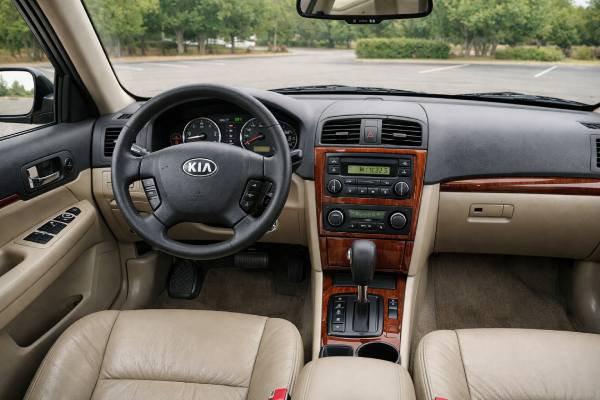
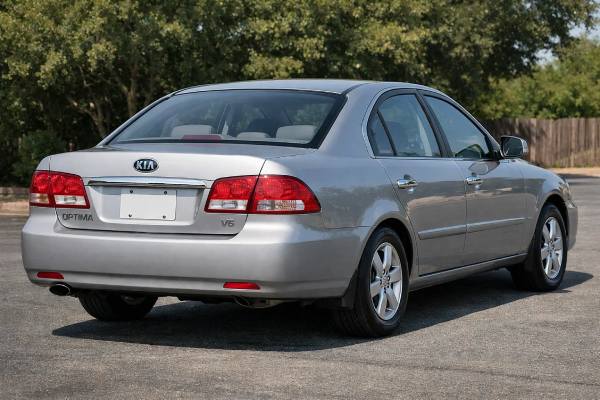
The facelifted 2003–2005 Kia Optima (MS) with the 2.4-liter G4JS inline-four is a straightforward midsize sedan built around proven Hyundai-Kia hardware. In daily use, it tends to reward owners who value simplicity: a conventional multi-point fuel injected (MPI) engine, an easy-to-service timing-belt layout, and suspension geometry that favors comfort over sharpness. The 138 hp tune is not fast by modern standards, but it delivers calm, predictable acceleration, especially at city speeds where torque arrives early.
Where this Optima still makes sense is ownership math. Parts availability is generally good, labor times are reasonable, and the car is mechanically honest—when something is wrong, it usually shows symptoms you can diagnose without chasing complex electronics. The key is maintenance discipline, especially timing-belt service, cooling system care, and corrosion checks as the body ages.
Quick Specs and Notes
- Comfortable ride and stable highway manners for a budget midsize sedan.
- Simple 2.4 MPI engine layout with generally approachable maintenance and parts pricing.
- Good value if you can verify timing-belt history and cooling-system health.
- Watch for age-related rubber and gasket leaks, plus suspension wear in front.
- Plan timing belt and water pump service about every 96,000 km (60,000 mi) or 6 years.
Quick navigation
- Kia Optima MS facelift in depth
- Kia Optima MS G4JS specs and measurements
- Kia Optima MS trims, options, and safety
- Reliability hotspots and recall checks
- Maintenance routine and buying advice
- Driving feel and real-world economy
- How it stacks up against rivals
Kia Optima MS facelift in depth
The 2003–2005 facelift version of the Optima (MS) sits in an interesting spot: modern enough to feel like a “real” midsize sedan, but old enough that nearly every example now reflects years of usage, climate, and maintenance habits. The G4JS 2.4-liter engine is the centerpiece. It’s a naturally aspirated inline-four with a conventional intake and fuel system, and it generally behaves like you expect: smooth idle when healthy, steady pull through the midrange, and no turbo-related surprises.
From an ownership perspective, the Optima’s strengths are mostly structural and practical. Cabin space is adult-friendly, the trunk is usable for everyday hauling, and the suspension tune prioritizes compliance. On rough city pavement, the car’s softer approach can actually be an advantage compared with sportier rivals—fewer harsh impacts, less constant correction at the wheel, and calmer long trips.
The flip side is that age is now the dominant factor. Rubber seals, hoses, and suspension bushings don’t care that a design was “reliable” in 2004; they care about heat cycles and time. This is why the best Optima MS examples are the ones with boring paperwork: regular oil changes, documented timing-belt service, and cooling system work done before overheating ever occurred. If you are shopping, think less about the badge and more about the condition of the fundamentals—engine temperature stability, transmission shift quality, brake feel, and underbody corrosion.
A final note on expectations: 138 hp is adequate, not exciting. Treat this Optima as a comfortable commuter that can do highway duty without drama, and you’ll likely appreciate it. Expect it to feel like a modern performance sedan, and it will disappoint.
Kia Optima MS G4JS specs and measurements
Below are practical specs for the facelift 2003–2005 Optima MS with the 2.4 G4JS. Exact values can vary by market, transmission, and trim, so treat these as typical figures for the 2.4-liter configuration and verify by VIN when precision matters (especially for fluids and brake hardware).
Powertrain and efficiency (2.4 G4JS)
| Item | Specification |
|---|---|
| Code | G4JS |
| Engine layout and cylinders | Inline-4, DOHC, 16 valves (4 valves/cyl) |
| Bore × stroke | 86.5 × 100.0 mm (3.41 × 3.94 in) |
| Displacement | 2.4 L (2351 cc) |
| Induction | Naturally aspirated |
| Fuel system | MPI (multi-point fuel injection) |
| Compression ratio | ~10.0:1 (typical; market-dependent) |
| Max power | 138 hp (103 kW) @ ~5500 rpm |
| Max torque | 147 lb-ft (199 Nm) @ ~3000 rpm |
| Timing drive | Timing belt |
| Rated efficiency (EPA, 2005 reference) | Auto 4-spd: 10.7 L/100 km (22 mpg US) combined; Manual 5-spd: 10.2 L/100 km (23 mpg US) combined |
| Real-world highway @ 120 km/h (75 mph) | Typically ~8.5–9.8 L/100 km (24–28 mpg US), depending on tires, wind, and A/C use |
Transmission and driveline
| Item | Specification |
|---|---|
| Transmission (common) | 4-speed automatic or 5-speed manual (market/trim dependent) |
| Drive type | FWD |
| Differential | Open |
Chassis and dimensions (typical midsize sedan values)
| Item | Specification |
|---|---|
| Suspension (front/rear) | Front: MacPherson strut; Rear: multi-link (typical MS platform layout) |
| Steering | Hydraulic power steering (ratio varies by market) |
| Brakes | Front ventilated discs; rear discs or drums depending on trim/market |
| Common tire size | 205/60 R15 (popular base); 205/55 R16 (common upgrade) |
| Ground clearance | ~150–165 mm (~5.9–6.5 in) typical |
| Length / width / height | ~4725–4750 / 1815–1820 / 1415–1430 mm (186.0–187.0 / 71.5–71.7 / 55.7–56.3 in) |
| Wheelbase | ~2700 mm (~106.3 in) |
| Turning circle | ~10.6–11.0 m (~34.8–36.1 ft) typical |
| Curb weight | ~1450–1550 kg (3197–3417 lb) depending on trim and transmission |
| Fuel tank | ~60–65 L (15.9–17.2 US gal / 13.2–14.3 UK gal) |
| Cargo volume | ~385 L (~13.6 ft³), method varies by region |
Performance and capability (typical)
| Item | Specification |
|---|---|
| 0–100 km/h (0–62 mph) | ~10.0–11.5 s (trim, transmission, and conditions dependent) |
| Top speed | ~190–205 km/h (118–127 mph), gearing dependent |
| Braking 100–0 km/h | ~40–44 m (131–144 ft) on good tires |
| Towing capacity | Often not officially rated in many markets; treat as “not recommended” unless your region provides a rating |
| Payload | Varies by market; check door jamb label |
Fluids and service capacities (decision-useful, verify by VIN)
| Item | Specification |
|---|---|
| Engine oil | 5W-30 (common), API SL/SJ era spec; capacity ~4.0–4.5 L (4.2–4.8 US qt) with filter |
| Coolant | Ethylene glycol, typically Asian phosphate-based; 50/50 mix; total ~6.5–7.5 L (6.9–7.9 US qt) |
| Automatic transmission fluid | SP-III type (common for Hyundai/Kia 4-speed era); drain/fill often ~3–4 L, total higher |
| Manual transmission fluid | Gear oil/MTF as specified for your gearbox (varies by market) |
| A/C refrigerant | R-134a; charge varies by system (check under-hood label) |
Key torque specs (typical ranges—verify for your fasteners)
| Fastener | Torque |
|---|---|
| Wheel lug nuts | ~88–108 Nm (65–80 lb-ft) |
| Engine oil drain plug | ~35–45 Nm (26–33 lb-ft) |
| Spark plugs | ~18–25 Nm (13–18 lb-ft) |
| Front caliper bracket bolts | ~80–100 Nm (59–74 lb-ft) |
| Front axle nut | ~180–220 Nm (133–162 lb-ft) |
Kia Optima MS trims, options, and safety
Trim naming varies by country, but the 2003–2005 facelift Optima typically follows a familiar pattern: a value-oriented base model, a better-equipped mid trim, and a top trim that adds comfort features. For the 2.4 G4JS specifically, the main mechanical differences you’ll see are transmission choice (4-speed automatic vs 5-speed manual where offered), wheel/tire size packages, and brake hardware (rear discs on some trims/markets, drums on others). The engine itself is generally consistent—same architecture and character—so your buying decision often comes down to equipment condition rather than chasing a rare “better” 2.4.
Trims and options (what matters today)
Look for options that still improve ownership in 2026:
- ABS presence and function: If equipped, confirm it actually works (no warning lamp, no stored codes if you scan it).
- Airbag configuration: Many cars of this era offer front airbags as standard and add side airbags on higher trims or later years. If side airbags are present, check seat condition and that the airbag light behaves normally.
- HVAC performance: A strong A/C system is not a luxury; it’s a sign the cooling fan control, condenser, and compressor are healthy.
- Seat and interior wear tells: Excessive bolster wear, sagging driver seat base, or broken recliner mechanisms often correlate with generally deferred maintenance.
Quick identifiers can help when listings are vague. Wheel size is an easy clue: 15-inch steel wheels usually point to base trims; 16-inch alloys often indicate a step up. A factory sunroof, steering wheel audio controls, or upgraded audio head unit (where original) can also signal higher trim levels, though many cars have been modified over time.
Safety ratings (what the tests say)
Formal crash-test coverage for this generation is best represented by IIHS. The Optima of this era is generally associated with:
- Moderate overlap frontal (original test): “Acceptable” overall for many configurations in this platform family.
- Side impact (original test): Often “Poor,” especially in configurations without strong torso protection.
- Head restraints and seats: Often “Poor” due to geometry and performance in whiplash-style evaluation.
This matters in practical terms: you want the best seat/head restraint setup available, and if side airbags exist on your specific car, they are a meaningful upgrade.
Safety systems and driver assistance
Don’t expect modern ADAS. The practical safety feature list is more basic:
- Airbags: Front airbags are typical; side airbags may be optional depending on year/trim/market.
- Seatbelts: Check retractors and pretensioner function (warning lights, belt condition, and smooth pull-out).
- Brakes and stability: ABS may be present; electronic stability control is not common in early-2000s midsize sedans, so tire quality and brake condition become even more important.
- Child-seat provisions: Many cars provide ISOFIX/LATCH anchors, but verify anchors are intact and not corroded or damaged.
If you prioritize safety, the best approach is to buy the cleanest, best-maintained example you can, then put real money into tires and braking—those upgrades change stopping distances and stability far more than cosmetic features.
Reliability hotspots and recall checks
At this age, “reliability” is less about design and more about what has already been repaired—and what is about to fail next. The G4JS 2.4 is generally durable when kept cool and properly lubricated. Most expensive failures are not mysterious; they come from timing-belt neglect, overheating, or long-term fluid decay.
Below is a practical map of common issues, organized by prevalence and cost impact.
Common (high prevalence)
- Timing belt and related components (medium to high cost if ignored):
Symptoms: chirping at idle, belt cracking on inspection, coolant seep near water pump, sudden no-start.
Likely root cause: belt age, tensioner wear, water pump bearing or seal deterioration.
Remedy: replace timing belt, tensioner(s), idler(s), and water pump as a set. Consider front crank/cam seals if seepage is visible. - Valve cover gasket seepage (low to medium cost):
Symptoms: oil smell, wetness around cover perimeter, oil in spark plug wells (on some engines).
Root cause: hardened gasket and grommets.
Remedy: gasket replacement, clean PCV system, and re-check for leaks after a few heat cycles. - Cooling system aging (medium cost, high risk):
Symptoms: temperature creep in traffic, coolant smell, radiator fans not cycling correctly, crusty residue on radiator end tanks.
Root cause: old coolant, radiator plastic aging, fan relay/control faults, thermostat wear.
Remedy: pressure test, replace weak components proactively, keep coolant fresh, verify fan operation. - Front suspension wear (low to medium cost):
Symptoms: clunks over bumps, vague steering, uneven tire wear.
Root cause: control arm bushings, ball joints, sway bar links, strut mounts.
Remedy: replace worn joints/bushings, align after repairs, inspect tires.
Occasional (moderate prevalence)
- Crankshaft/camshaft position sensors (medium cost):
Symptoms: intermittent stalling, random no-start, tach signal drop, stored sensor codes.
Remedy: replace sensor(s), inspect wiring near heat sources. - Ignition and fueling wear items (low to medium cost):
Symptoms: misfire under load, rough idle, poor fuel economy.
Root cause: aged plugs, wires/coil components (depending on ignition design), clogged injectors, vacuum leaks.
Remedy: tune-up with correct plugs, address vacuum leaks, verify fuel pressure. - Automatic transmission shift quality (medium to high cost if severe):
Symptoms: delayed engagement, flare between gears, harsh downshifts.
Root cause: aged ATF, neglected service, internal wear.
Remedy: service fluid with correct spec, avoid “power flush” on unknown-history units, diagnose before it becomes mechanical.
Rare (lower prevalence, but important)
- Structural corrosion (high severity in salty climates):
Symptoms: rust scale on subframes, brake/fuel line corrosion, soft jacking points, alignment that won’t hold.
Remedy: thorough underbody inspection. Walk away from advanced structural corrosion; it escalates quickly and is rarely cost-effective.
Recalls, TSBs, and extended coverage
Because campaign coverage varies by market and VIN range, treat recalls as a mandatory pre-purchase step:
- Run an official VIN recall check in your region.
- Request dealer service history printouts if possible.
- Confirm completion with documentation, not just “the owner says it was done.”
Also remember that “service actions” for older cars sometimes show up as updated parts rather than software reflashes. If your Optima has persistent idle or shift behavior issues, confirm the basics (vacuum leaks, sensors, fluids) before assuming a computer update will fix it.
Maintenance routine and buying advice
A clean Optima MS can be a sensible daily driver if you treat maintenance as a schedule, not a reaction. The car’s systems are conventional, which is good news: preventative work is usually cheaper than the failure it prevents.
Practical maintenance schedule (use both distance and time)
Every 7,500–10,000 km (5,000–6,000 mi) or 6–12 months
- Engine oil and filter (shorter interval for heavy city use or hot climates)
- Inspect coolant level and condition
- Inspect tires, brakes, and all exterior lights
Every 15,000 km (10,000 mi) or 12 months
- Rotate tires; inspect alignment wear patterns
- Replace cabin air filter (if fitted) and inspect engine air filter
- Inspect belts, hoses, and oil leaks
Every 30,000–40,000 km (20,000–25,000 mi) or 2 years
- Brake fluid flush (DOT 3/4)
- Inspect suspension bushings and ball joints closely
- Clean throttle body and check PCV function if idle quality is drifting
Every 60,000 km (37,000 mi) or 4 years
- Coolant service (do not mix incompatible coolant chemistries)
- Inspect spark plugs; replace if wear, misfire, or unknown age
- Manual transmission fluid (if applicable) if shifts feel notchy or history is unknown
Every 96,000 km (60,000 mi) or 6 years (critical)
- Timing belt, tensioner(s), idler(s), and water pump
- Inspect front crank and cam seals; replace if seepage is present
- Refresh accessory/serpentine belt as needed
Automatic transmission service guidance (4-speed)
- If history is known and clean: drain/fill with correct spec fluid every ~40,000–60,000 km (25,000–37,000 mi).
- If history is unknown: start with a gentle drain/fill, then reassess shift quality. Avoid aggressive flushes on a worn unit.
Fluid specifications and “don’t guess” rules
- Engine oil: a quality 5W-30 is a safe baseline for many climates; match viscosity to temperature and engine wear.
- Coolant: choose an Asian-vehicle compatible coolant chemistry and keep it consistent. Mixing types often creates sludge or accelerates corrosion.
- ATF: use the correct spec for your transmission family; wrong fluid can cause shudder and premature wear.
Buyer’s guide: what to inspect before you pay
Bring a flashlight, a basic OBD scanner (if supported in your market), and enough time to do a cold start.
Under the hood
- Cold start behavior: stable idle, no timing-belt squeal, no heavy smoke
- Cooling system: fans cycle, no bubbling in reservoir, no coolant smell after warming
- Oil condition: avoid glittery oil or thick sludge under cap
- Leaks: valve cover, front engine area (seals), power steering pump/lines
Underbody
- Subframe and rocker corrosion (probe gently—don’t just look)
- Brake lines and fuel lines condition
- Exhaust leaks at flex section and hangers
Road test
- Automatic: smooth engagement, consistent upshifts, no flare on kickdown
- Braking: straight stops, no pulsing, no long pedal travel
- Steering: no wandering, minimal clunk over bumps
- Temperature: needle stays steady after a long idle and a highway run
Best “sweet spot” configuration
For most buyers, the best Optima MS is not the fanciest; it’s the one with:
- Verified timing-belt service history
- Dry cooling system and stable temperature control
- Clean underbody and intact suspension bushings
- Quality tires (matched set) and healthy brakes
If you find a car that is cosmetically average but mechanically documented, that’s usually the smarter buy than a shiny car with missing service records.
Driving feel and real-world economy
The facelift Optima MS is tuned to feel reassuring rather than sporty. On the move, the steering is typically light-to-medium with a calm on-center feel, and the chassis settles quickly after bumps. This is a midsize sedan that prioritizes reduced fatigue: it tracks straight on highways, it doesn’t demand constant correction, and it generally isolates sharp impacts better than many compact cars from the same era.
Ride, handling, and NVH (noise, vibration, harshness)
- Ride: compliant, especially on taller sidewall tires (15-inch packages). If the ride feels harsh, suspect worn struts, overinflated tires, or cheap low-profile replacements.
- Handling balance: mild understeer is the default. It’s predictable, and stability is largely tire-dependent.
- Braking feel: when properly maintained, pedal feel is straightforward. A spongy pedal often points to old brake fluid, caliper slide issues, or air in the system.
- Cabin noise: expect noticeable wind and tire noise compared with modern sedans. A sudden increase often means worn door seals, uneven tire wear, or a failing wheel bearing.
Powertrain character (what it feels like)
The 2.4 G4JS makes its best impression in the midrange. Torque arrives early enough that city driving doesn’t require constant revving, and it will hold speed on modest grades without drama. The 4-speed automatic is the limiting factor: it’s geared for comfort and can feel reluctant to downshift quickly, especially with the A/C on or with a full load. If you want the liveliest response, the manual transmission (where available) typically makes the car feel more awake and reduces the “hunt” behavior that older automatics can develop.
Real-world efficiency
Using the official EPA figures as a baseline:
- 4-speed automatic (2.4): about 10.7 L/100 km (22 mpg US) combined, 12.4 L/100 km (19 mpg US) city, 8.4 L/100 km (28 mpg US) highway.
- 5-speed manual (2.4): about 10.2 L/100 km (23 mpg US) combined, 11.8 L/100 km (20 mpg US) city, 8.7 L/100 km (27 mpg US) highway.
In real use at 120 km/h (75 mph), many drivers see roughly 8.5–9.8 L/100 km (24–28 mpg US) in good conditions. Cold weather, short trips, and underinflated tires can push consumption up quickly—this is where basic maintenance (thermostat health, tire pressure, alignment, fresh plugs) pays off.
A few “performance-per-euro” upgrades
If you want the car to feel better without chasing modifications:
- Tires first: a quality touring tire transforms braking and stability.
- Brake fluid and pads: fresh fluid improves pedal consistency; quality pads reduce fade.
- Suspension refresh: struts, mounts, and sway links bring back composure.
- Transmission fluid (correct spec): often improves shift smoothness if the unit is healthy.
The Optima won’t become a sports sedan, but it can become a much more confidence-inspiring daily driver.
How it stacks up against rivals
The facelift Optima MS competed in one of the toughest midsize segments. Today, the comparison is less about showroom features and more about survivability: which cars age gracefully, which ones are easiest to keep safe and tight, and which ones punish neglect.
Versus the usual Japanese benchmarks
Against a Toyota Camry-era equivalent (and similarly aged Honda Accord), the Optima often feels a half-step behind in interior materials and long-term squeak resistance. Those rivals tend to hold together better when maintenance is only “okay.” However, the Optima can win on purchase price and parts affordability, and its simpler trim configurations sometimes mean fewer expensive gadgets to fail.
If you find an Optima with excellent maintenance history, it can be a smarter buy than a neglected Camry or Accord with a reputation doing the selling.
Versus Hyundai Sonata of the same era
This is the closest cousin in many ways. The driving feel and ownership patterns are similar: comfortable ride, conventional powertrains, and age-related issues that cluster around cooling systems, suspension wear, and rubber seals. The best choice between them usually comes down to which specific car has the better service history and cleaner underbody.
Versus Nissan Altima and Mazda6
An older Altima can feel lighter on its feet, but some owners report more sensitivity to deferred maintenance and higher odds of “nickel-and-dime” sensor and wear-item issues depending on year and powertrain. The Mazda6 often drives better, with more steering feel and control, but can be less forgiving of corrosion in certain climates and sometimes demands more suspension work to feel tight as it ages.
Where the Optima MS still makes sense
Choose the Optima MS 2.4 if you want:
- A comfortable commuter with simple mechanicals
- Predictable service needs you can budget for
- A midsize cabin and trunk without midsize purchase prices
Skip it (or be extremely picky) if you see:
- No proof of timing-belt service
- Temperature instability or any sign of past overheating
- Serious underbody corrosion or “fresh undercoating” hiding rust
- Harsh transmission behavior that doesn’t improve with correct fluid service
In other words: the Optima is not the “best midsize sedan ever made,” but a good example can be one of the best values—because it rewards careful selection and disciplined maintenance more than brand reputation.
References
- 2004 Kia Optima 4-door sedan 2026 (Safety Rating)
- Gas Mileage of 2005 Kia Optima 2025 (Official Fuel Economy)
- Vehicle Detail Search – 2005 KIA OPTIMA 4 DR 2026 (Recall Database)
- Owners Manual Download | Kia Owners | Kia Australia 2026 (Owner’s Manual Portal)
Disclaimer
This article is for informational purposes only and is not a substitute for professional inspection, diagnosis, or repair. Specifications, torque values, service intervals, and procedures can vary by VIN, market, production date, and installed equipment; always confirm details using your official service documentation and labels on the vehicle.
If this guide helped, please consider sharing it on Facebook or X/Twitter to support our work.