
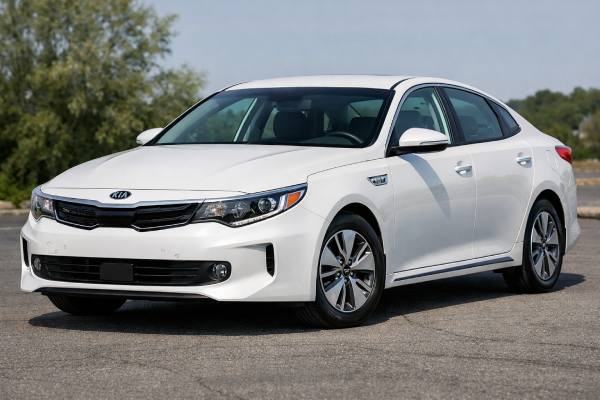
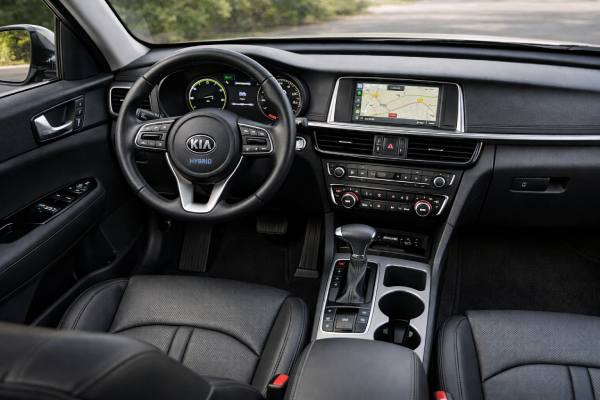

The 2017–2018 Kia Optima Hybrid (JF) is an efficient midsize sedan that keeps a traditional driving feel. Unlike many hybrids that use an eCVT, the Optima Hybrid pairs a 2.0-liter GDI gasoline engine with an electric motor inside a 6-speed automatic, so acceleration and highway cruising feel familiar. The hybrid system is tuned for smooth, low-RPM torque and quiet city operation, while the battery is small enough that it doesn’t dominate the car’s packaging or repair complexity.
Ownership is mostly “normal sedan” work—oil, filters, brakes—plus a few hybrid-specific checks like cooling airflow, 12 V battery health, and careful attention to warning lights and software updates. If you want strong fuel economy without switching to a hatchback or a plug-in routine, this Optima Hybrid sits in the sweet spot.
Quick Specs and Notes
- Strong real-world economy on mixed driving, with especially good city efficiency for a midsize sedan
- Conventional 6-speed automatic feel (no eCVT drone), with smooth electric assist at low speeds
- Good highway comfort and cabin refinement for long trips
- Caveat: keep up with oil-change intervals and confirm recall/TSB work by VIN—hybrid and GDI systems are sensitive to neglect
- Typical interval: engine oil and filter every 10,000 km (6,000 mi) or 12 months (use shorter intervals for heavy city or short trips)
Contents and shortcuts
- Optima Hybrid JF in-depth look
- Optima Hybrid JF specs table
- Optima Hybrid JF trims and safety
- Hybrid system reliability notes
- Maintenance plan and buyer tips
- Driving feel and efficiency
- Rivals versus the Optima HEV
Optima Hybrid JF in-depth look
The Optima Hybrid (JF) is built around a simple idea: deliver hybrid fuel savings without changing how a midsize sedan behaves. The 2.0-liter GDI engine runs a high-efficiency tune and works with an electric motor integrated into a conventional 6-speed automatic. In daily driving, that matters. You get familiar shift steps, predictable throttle response, and a “normal car” feel at 110–130 km/h—yet the hybrid system can still glide quietly at low load and fill torque gaps when the engine is below its sweet spot.
This layout also shapes maintenance and durability priorities. The hybrid battery is relatively small, so it cycles frequently. That’s good for efficiency, but it makes cooling airflow, clean electrical connections, and software health more important than many owners expect. The Optima Hybrid’s best ownership outcomes come from treating it like a well-engineered system rather than a simple engine swap: keep the oil fresh, ensure the cooling system is healthy, and do not ignore warning lights that suggest inverter, DC–DC, or battery management issues.
Packaging is a mild compromise. Trunk space is reduced versus non-hybrid Optimas, and curb weight is higher. Still, the car keeps the comfort-first mission: compliant suspension, solid straight-line stability, and a calm cabin. For most buyers, the Optima Hybrid is less about “performance hybrid” and more about quietly lowering fuel spend and emissions while keeping the driving experience conventional.
Who is it best for? Commuters with a mix of traffic and highway, families who want a roomy sedan, and drivers who dislike eCVT behavior but still want hybrid economy. Who should think twice? Owners who do mostly short trips in cold weather (where hybrids can run the engine often for heat), and shoppers who can’t verify service history and recall completion.
Optima Hybrid JF specs table
Below are the key specifications for the 2017–2018 Optima Hybrid (JF) with the 2.0 GDI hybrid system rated at 192 hp (system output). Markets and trims can vary slightly, so treat these as the common configuration and verify by VIN when ordering parts or fluids.
Powertrain and efficiency
| Item | Specification |
|---|---|
| Powertrain code | Hybrid 2.0 GDI HEV (2.0 GDI + electric motor) |
| Engine layout and cylinders | Inline-4 (I-4), DOHC, 16 valves (4 valves/cyl) |
| Bore × stroke | 81.0 × 97.0 mm (3.19 × 3.82 in) |
| Displacement | 2.0 L (1,999 cc) |
| Induction | Naturally aspirated |
| Fuel system | GDI (direct injection) |
| Compression ratio | 13.5:1 |
| Max power (system) | 192 hp (143 kW) @ 6,000 rpm (system) |
| Engine power (approx.) | 154 hp (115 kW) @ 6,000 rpm |
| Motor output (approx.) | 50 hp (38 kW) @ 1,770–2,125 rpm |
| Engine torque | 190 Nm (140 lb-ft) @ 5,000 rpm |
| Motor torque | 205 Nm (151 lb-ft) @ 0–1,770 rpm |
| System torque | 367 Nm (271 lb-ft) @ 1,770 rpm |
| Timing drive | Chain (typical for this family) |
| Rated efficiency (EPA) | 5.6 L/100 km combined (42 mpg US); 6.0 city (39 mpg US); 5.1 highway (46 mpg US) |
| Real-world highway @ 120 km/h | Typically ~6.2–7.0 L/100 km (38–34 mpg US), depending on temperature, tires, and wind |
Hybrid electrical system
| Item | Specification |
|---|---|
| Traction motor type | Single motor integrated into transmission |
| System voltage | ~270 V |
| Battery | Lithium polymer |
| Battery energy | ~1.62–1.76 kWh (by market/trim) |
Transmission and driveline
| Item | Specification |
|---|---|
| Transmission | 6-speed automatic (hybrid-integrated) |
| Drive type | FWD |
| Differential | Open |
Chassis and dimensions
| Item | Specification |
|---|---|
| Suspension (front/rear) | MacPherson strut / multi-link |
| Steering | Electric power steering (rack assist) |
| Brakes (front/rear) | Ventilated disc 305 mm (12.0 in) / disc 284 mm (11.2 in) |
| Wheels/tires (common) | 205/65 R16 (popular efficiency-focused fitment) |
| Ground clearance | 130 mm (5.1 in) |
| Length / width / height | 4,855 mm (191.1 in) / 1,860 mm (73.2 in) / 1,461 mm (57.5 in) |
| Wheelbase | 2,805 mm (110.4 in) |
| Turning circle (kerb-to-kerb) | 10.9 m (35.8 ft) |
| Kerb weight | ~1,581–1,604 kg (3,486–3,538 lb) |
| Fuel tank | 60.0 L (15.85 US gal / 13.2 UK gal) |
| Cargo volume | 380 L (13.4 ft³) — seats up (method varies by market) |
Performance and capability (typical)
| Item | Typical value |
|---|---|
| 0–100 km/h (0–62 mph) | ~9.5–10.5 s (trim, tires, conditions vary) |
| Top speed | ~185–195 km/h (115–121 mph) |
| Braking distance 100–0 km/h | ~37–41 m (121–135 ft), tire-dependent |
| Towing capacity | Not typically rated for towing in many markets (verify local rating) |
| Payload | Varies by GVWR and trim (check door sticker) |
Fluids and service capacities (common guidance)
| Item | Specification |
|---|---|
| Engine oil | API SN / ILSAC GF-5 (or newer equivalent); 0W-20 commonly specified |
| Engine oil capacity | ~4.5 L (4.8 US qt) (verify by engine/VIN) |
| Coolant | Long-life ethylene glycol coolant, 50/50 mix typical |
| Transmission fluid | ATF specification per Kia (use exact spec listed for your VIN) |
| A/C refrigerant | R-134a (many markets) |
| Key torque specs | Use service manual for critical fasteners (wheel lugs, brake carrier bolts, drain plugs) |
Safety and driver assistance (headline)
| Item | Notes |
|---|---|
| IIHS crashworthiness | Good ratings across major crashworthiness tests (varies by test version) |
| Headlight rating (IIHS) | Varies by trim and build; best ratings tied to specific headlight packages |
| ADAS availability | AEB/front crash prevention and lane features typically optional, depending on trim/package and build date |
Optima Hybrid JF trims and safety
Most 2017–2018 Optima Hybrid lineups are straightforward: an efficiency-focused base trim and a better-equipped trim with tech and comfort packages. The mechanical core—2.0 GDI hybrid system, FWD, 6-speed automatic—stays consistent. The differences that matter are usually in headlights, driver assistance features, and cabin equipment.
Trims and options: what changes in practice
Common equipment separators include:
- Headlights and driver assistance: Higher trims or technology packages often add LED projector headlights and front crash prevention (automatic emergency braking). This matters for both safety and night driving confidence.
- Wheels and tires: 16-inch wheels with taller tires typically ride softer and return the best economy. Larger wheels can look better but may cost you a small, steady fuel penalty and higher tire prices.
- Comfort and infotainment: Look for heated/ventilated seats, upgraded audio, navigation, and higher-resolution infotainment screens on upper trims. These are easy to spot at a glance and help resale value.
Quick identifiers when shopping used
- Steering wheel buttons: More driver-assist and cruise functions often indicate higher trim or tech package.
- Windshield camera housing: A larger housing around the rear-view mirror can hint at lane support or forward camera-based systems (varies by market).
- Headlight design: LED projector units and distinctive DRL shapes usually track with better IIHS headlight ratings and tech packages.
Safety ratings: what to pay attention to
For 2017 Optima models, IIHS results show strong crashworthiness performance, and Top Safety Pick + recognition is tied to optional front crash prevention and specific headlights on vehicles built after a certain point in the model year. In other words: the car’s structure can be strong, but your real-world safety outcome can improve further when the car has the right lighting and the right active safety package.
ANCAP’s rating coverage for the Optima helps confirm that the underlying platform performs well in modern crash tests, but always check which test protocol and year apply to the exact vehicle configuration in your market.
Safety systems and ADAS: what’s typically included
- Passive safety: Multi-airbag layouts, reinforced passenger cell design, and modern seat belt pretensioners are normal for this class and era.
- Core stability systems: ABS, stability control, traction control, brake assist, and tire-pressure monitoring are standard expectations.
- ADAS (often optional): AEB/front crash prevention, blind-spot detection, rear cross-traffic alert, lane departure warning, and (on some packages) lane keeping support. If the car has camera/radar systems, plan for calibration after windshield replacement, front-end repairs, or wheel alignment changes that affect sensor aim.
Hybrid system reliability notes
The Optima Hybrid’s reliability story is best understood as two overlapping systems: a modern GDI gasoline engine and a hybrid-electric layer that adds an inverter, motor, battery, and high-voltage controls. Most owners see years of dependable service when maintenance is consistent. Problems tend to cluster when oil changes stretch too far, cooling systems get ignored, or warning lights are dismissed.
Common issues (by prevalence and cost tier)
Common (low to medium cost):
- 12 V battery weakness (symptoms: intermittent no-start, random warning lights, infotainment resets) → often aging 12 V battery or charging/maintenance habits → test battery and charging voltage, replace with correct spec battery.
- Brake feel changes (symptoms: slightly grabby or inconsistent pedal) → blend between regenerative and friction braking, pad glazing, or old brake fluid → flush brake fluid on schedule and inspect pads/rotors; expect different feel than non-hybrid.
- GDI-related deposits (symptoms: rough idle, hesitation, lower mpg) → intake valve carbon build-up over time → use high-quality fuel, keep PCV system healthy, consider intake cleaning if drivability worsens.
Occasional (medium cost):
- Cooling system leaks or weak radiator cap/thermostat behavior (symptoms: rising temps, heater inconsistency) → coolant loss or thermostat issues → pressure test and repair early; hybrids can be less tolerant of overheating.
- Transmission/drive unit fluid neglect (symptoms: harsher shifts, shudder) → ATF aged beyond its working life → service with correct fluid, confirm level procedure.
Rare (higher cost):
- Hybrid warning lights (inverter/motor/battery management) (symptoms: “hybrid system” warnings, reduced power, charging faults) → sensor faults, wiring/connectors, cooling issues, or control module problems → scan with hybrid-capable diagnostics, confirm software updates, and address root cause before parts swapping.
- High-voltage battery degradation (symptoms: reduced EV assist, engine runs more often, mpg drop) → normal aging accelerated by high heat and heavy cycling → confirm cooling airflow and check for diagnostic codes; evaluate battery state-of-health where tools allow.
Service actions, recalls, and software updates
For any Optima Hybrid, recall status matters. Some campaigns are hardware fixes; others are software updates that adjust detection thresholds or drivability. Treat software as part of the car’s mechanical health: a calibration update can prevent nuisance faults, improve hybrid transition smoothness, or address known patterns.
Best practice:
- Run an official VIN recall check.
- Ask for dealer printouts showing completed recall/field service actions.
- Confirm that any warning lights were diagnosed with hybrid-capable tools—not a generic code reader.
Pre-purchase checks to request
- Full service history with oil intervals (time and distance).
- Evidence of coolant services and brake fluid flushes.
- Scan for stored codes, not just current warning lights.
- Test drive with multiple restarts; confirm smooth engine start/stop transitions and predictable braking.
Maintenance plan and buyer tips
A practical maintenance plan for the Optima Hybrid focuses on three goals: keep the GDI engine clean and well-lubricated, keep fluids fresh, and keep the hybrid system’s electrical and cooling support healthy. The good news is that most tasks are standard sedan work, and the hybrid-specific items are mainly inspection and diagnostic discipline.
Maintenance schedule (distance/time)
Use this as a sensible baseline; shorten intervals for frequent short trips, heavy city use, extreme heat/cold, or dusty conditions.
- Engine oil and filter: every 10,000 km (6,000 mi) or 12 months; consider 7,500 km (5,000 mi) for heavy city/short-trip use.
- Cabin air filter: every 15,000–20,000 km (9,000–12,000 mi) or annually if allergies/dust are an issue.
- Engine air filter: inspect every 20,000 km, replace by condition (often 30,000–40,000 km).
- Coolant: replace per long-life coolant schedule (often 5 years/100,000 km initial, then shorter thereafter—verify your market spec).
- Spark plugs: typically long-life iridium; plan around 160,000 km (100,000 mi), but verify exact plug type and interval for your VIN.
- Brake fluid: every 2 years, regardless of mileage (important for consistent braking feel and corrosion control).
- ATF (6-speed automatic): conservative owners often service around 60,000–90,000 km (40,000–60,000 mi) depending on driving conditions; always use the exact specified fluid and fill procedure.
- Tire rotation and alignment: rotate every 10,000–12,000 km; align when you see uneven wear or after suspension work.
- 12 V battery test: annually after year 3; many owners replace around 4–6 years, climate-dependent.
Hybrid-specific care
- Cooling airflow: keep vents and passages unobstructed; dust and lint can reduce cooling efficiency over time.
- Diagnostic discipline: if a hybrid warning appears, scan promptly. Continuing to drive with a reduced-power strategy can create secondary issues.
- Brake service approach: because regen does some braking, pads can last longer, but rotors can corrode if the car is driven gently all the time. Periodic firm stops (when safe) help keep rotors clean.
Buyer’s guide: what to inspect on a used example
Bring a checklist and be picky:
- Service history quality: regular oil changes and documented fluid services are worth more than low mileage alone.
- Cooling system condition: look for stains, smell of coolant, or inconsistent cabin heat.
- Hybrid transition smoothness: during a test drive, you want smooth engine start/stop events and no harsh engagement or repeated surging.
- Braking behavior: expect a slightly different pedal feel than a non-hybrid, but it should be consistent and predictable.
- Tires: mismatched brands or odd sizes can hurt efficiency and stability; budget for a proper matched set if needed.
Long-term outlook: a well-maintained Optima Hybrid can be a durable, cost-effective commuter sedan. The biggest risk factor is not the hybrid concept—it’s deferred maintenance and unresolved warning lights.
Driving feel and efficiency
The Optima Hybrid’s personality is calm and grown-up. It prioritizes smoothness over sportiness, but it avoids the “rubber-band” sensation many people associate with eCVT hybrids. The 6-speed automatic gives you clear shift points, and the electric motor fills in torque at low speed so the car feels responsive when pulling away from a stop or rolling through traffic.
Ride, handling, and NVH
- Ride comfort: tuned for compliance. Sharp bumps are muted well on the common 16-inch tire package.
- Highway stability: steady and relaxed; it tracks straight without constant corrections.
- Steering feel: light-to-moderate effort with a modern EPS character—accurate enough, not especially chatty.
- Cabin noise: low at cruise. Around-town, EV assist and low-RPM engine operation can make the car feel quieter than a comparable non-hybrid, especially in stop-and-go driving.
Powertrain character
- Takeoff and low-speed: electric torque helps, so it feels more eager than the engine’s displacement suggests.
- Passing and merging: it’s competent rather than fast. Expect a measured buildup of speed, with the hybrid system supporting the engine when you request more power.
- Transmission behavior: generally smooth. On hills, it may downshift sooner than you expect to keep the engine in an efficient range, especially with a cold powertrain or full cabin heat demand.
Real-world efficiency
EPA-rated economy is strong for a midsize sedan, and many owners see their best results in urban and suburban traffic where regenerative braking and EV assist shine.
- City driving: often the best case. Gentle acceleration and anticipating stops can push economy above rating.
- Highway (100–120 km/h): still good, but aerodynamics dominate. Expect a noticeable drop versus city numbers, especially in winter.
- Cold weather: hybrids often lose more efficiency than non-hybrids because the engine may run to provide cabin heat and maintain catalyst temperature. Short trips can be the toughest scenario.
Tip that actually works: use moderate acceleration to reach cruising speed efficiently, then hold steady throttle. “Creeping” slowly up to speed can keep the engine running longer and reduce hybrid benefits.
Rivals versus the Optima HEV
In the midsize hybrid sedan space, the Optima Hybrid competes on comfort and conventional drivability. Your best choice depends on whether you value maximum mpg, the simplest long-term service story, or the best tech suite.
Where the Optima Hybrid shines
- Traditional driving feel: If you dislike eCVT behavior, the Optima’s 6-speed automatic is a real advantage.
- Comfort-first tuning: It’s a relaxed long-distance car with a quiet cabin and stable highway manners.
- Value in the used market: In many regions, it can cost less than the most famous hybrid nameplates while still delivering strong economy.
Where rivals may be stronger
- Peak fuel economy: Some competitors prioritize absolute mpg and may beat the Optima Hybrid in city efficiency.
- Cargo packaging: Certain hybrids preserve more trunk space or offer liftback practicality.
- Safety tech standardization: Depending on market and trim, rivals may include more driver assistance as standard rather than optional.
How to choose quickly
Pick the Optima Hybrid if you want:
- A midsize sedan that drives like a normal automatic,
- Strong economy without plug-in habits,
- A comfort-oriented ride.
Consider alternatives if you want:
- The highest possible mpg above all else,
- Maximum cargo flexibility,
- The newest ADAS features standard on every trim.
The smartest move is to test drive with your real use case: a cold start, a few stoplights, a short highway stint, and a couple of medium-hard stops. The Optima Hybrid’s strengths—smooth transitions, calm ride, and easy efficiency—show up immediately in that routine.
References
- 2017 Kia Optima Hybrid Specifications 2017 (Manufacturer Specifications)
- 2017 Kia Optima Hybrid 2017 (Official Fuel Economy Data)
- 2017 Kia Optima 2017 (Safety Rating)
- Full Vehicle Detail Search for 2018 KIA OPTIMA%252520HYBRID 4 DR FWD 2018 (Recall Database)
- Kia Optima | Safety Rating & Report | ANCAP 2015 (Safety Rating)
Disclaimer
This article is for informational purposes only and is not a substitute for professional diagnosis, inspection, or repair. Specifications, torque values, fluid types, service intervals, and procedures can vary by VIN, market, model year, and installed equipment. Always confirm details using your vehicle’s official owner’s literature and service documentation, and follow approved safety procedures when working on high-voltage hybrid systems.
If you found this guide useful, please consider sharing it on Facebook, X (Twitter), or your favorite forum to support our work.