
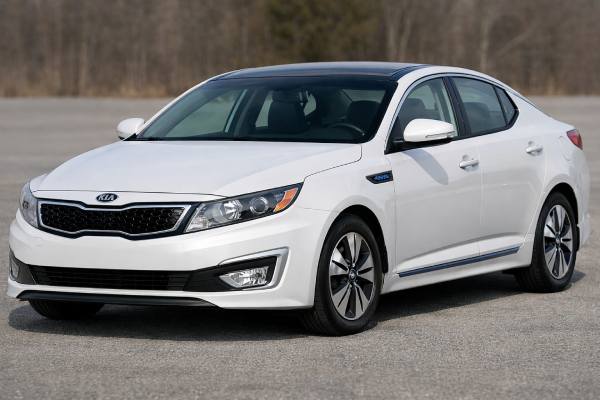
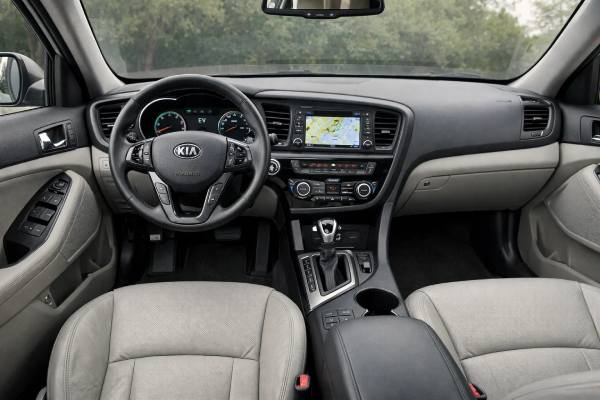
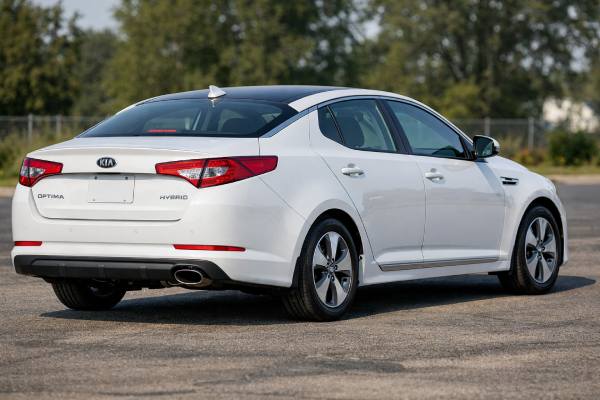
The 2011–2013 Kia Optima Hybrid (TF) is an early “mainstream hybrid sedan” that still feels like a conventional midsize car. Instead of a CVT-only driving style, it pairs an Atkinson-cycle 2.4L gasoline engine with an electric motor and a traditional 6-speed automatic transmission. The result is a calm, familiar throttle and shift feel, plus the ability to cruise on electric power in light-load situations.
For owners today, the Optima Hybrid’s story is about balance: strong highway comfort, respectable real-world fuel economy, and a straightforward layout—mixed with the reality that you’re maintaining both a hybrid system and a Theta-based 2.4L engine family. A good example with documented servicing can be a satisfying long-distance daily. A neglected one can become expensive quickly, especially if hybrid cooling airflow, 12V health, or engine oil discipline has been ignored.
Owner Snapshot
- Smooth, “normal-car” power delivery thanks to a 6-speed automatic instead of a CVT-only feel
- Very efficient at steady speeds; often strong highway economy for a midsize sedan
- Air-cooled hybrid battery means cabin-side vents must stay clean and unblocked
- Plan for proactive fluid service (especially engine oil and ATF) to reduce long-term risk
- Inspect and clean hybrid battery intake area about every 20,000 km (12,000 mi) or sooner in dusty use
What’s inside
- Kia Optima Hybrid TF explained
- Kia Optima Hybrid TF data
- Kia Optima Hybrid TF trims and safety tech
- Common HEV faults and fixes
- Service schedule and purchase checks
- Hybrid driving feel and mpg
- Competitors and smarter picks
Kia Optima Hybrid TF explained
Kia’s first-generation Optima Hybrid for the TF body is a full parallel hybrid: both the gasoline engine and the electric motor can drive the front wheels. That matters because it behaves more like a standard sedan than many hybrids of its era. In gentle driving, the car can move on electric power alone, then blend the gasoline engine in when torque demand rises or when the battery state-of-charge needs support.
A key design choice is the wet clutch that connects and disconnects the gasoline engine from the driveline. When the system decides to run in EV mode, the clutch opens and the engine can shut down while the electric motor keeps the car moving. When you ask for more power, the clutch closes and the engine restarts and synchronizes. If you’ve ever driven a hybrid that feels “rubber-banded,” this Optima can feel refreshingly direct because it uses a conventional stepped automatic transmission.
The hybrid battery is air-cooled (instead of liquid-cooled on many later hybrids). That simplifies hardware but makes airflow management important: the cabin-side intake and ducting must stay clear of lint, pet hair, and dust. A clogged intake can raise battery temperatures, reduce hybrid assist, and increase fan noise—small details that matter a lot in real ownership.
Aerodynamics and hybrid-specific features also define the TF Hybrid. Many cars include an active grille air flap strategy and underbody smoothing to reduce drag, plus hybrid-only exterior cues (badging, wheel designs, and subtle body tweaks). Some markets also used a low-speed external warning sound to improve pedestrian awareness during quiet EV operation.
In today’s used market, the Optima Hybrid is best viewed as a comfortable, efficient sedan that rewards careful buying. The smartest ownership approach is simple: prioritize service records, check hybrid system behavior on a long test drive, and treat 12V and maintenance fundamentals as non-negotiable.
Kia Optima Hybrid TF data
The exact specification set varies by market and model year, so the most useful approach is to focus on the core technical package and the dimensions that don’t change much. The tables below reflect typical TF Optima Hybrid equipment and widely published public specs; always confirm VIN-specific details in official documentation for your region.
Powertrain and efficiency
| Item | Specification |
|---|---|
| Powertrain type | Full parallel hybrid (engine + motor can drive wheels) |
| Engine code/family | 2.4L Atkinson-cycle I-4 (Theta-based hybrid application) |
| Engine layout | I-4, DOHC, 4 valves/cyl (typical for this family) |
| Displacement | 2.4 L (2,359 cc) |
| Induction | Naturally aspirated |
| Fuel system | Gasoline injection (market-dependent implementation) |
| Engine output (typical) | ~166 hp (engine-only figure often published for early TF Hybrid) |
| Electric motor | IPM-type synchronous motor (parallel hybrid motor) |
| Motor output (typical) | ~40 hp (30 kW class), torque assist at low rpm |
| System output (combined) | Commonly listed as 206 hp (early years); some later listings show ~199 hp depending on year/market calibration |
| Battery | Lithium-polymer, ~270 V, air-cooled |
| Drive type | FWD |
| Transmission | 6-speed automatic |
Rated fuel economy and real-world expectation
| Measure | Typical figure |
|---|---|
| Rated combined | ~6.4 L/100 km (about 37 mpg US) |
| Rated city / highway | ~6.7 / 6.2 L/100 km (about 35 / 38 mpg US) |
| Real-world highway @ 120 km/h | Often ~6.5–7.8 L/100 km depending on wind, temperature, tyres, and load |
Chassis, dimensions, and weights (typical TF Hybrid)
| Item | Value |
|---|---|
| Suspension (front/rear) | MacPherson strut / multi-link (typical for TF platform) |
| Steering | Electric assist (typical), tuned for light effort |
| Brakes (front/rear) | Disc / disc; approx. 300 mm (11.8 in) front, 284 mm (11.2 in) rear |
| Wheels/tyres (common) | 16-inch alloy wheels (hybrid-focused low rolling resistance tyres) |
| Ground clearance | 130 mm (5.1 in) |
| Length | 4,844 mm (190.7 in) |
| Width | 1,831 mm (72.1 in) |
| Height | 1,450 mm (57.1 in) |
| Wheelbase | 2,794 mm (110.0 in) |
| Turning circle (kerb-to-kerb) | ~10.9 m (35.8 ft) |
| Kerb weight | ~1,586–1,643 kg (3,496–3,622 lb) (trim-dependent) |
| Fuel tank | ~65 L (17.2 US gal / 14.3 UK gal) |
| Cargo volume | ~305 L (10.8 ft³) (hybrid battery packaging reduces trunk space) |
Performance and capability (typical)
| Metric | Typical expectation |
|---|---|
| 0–100 km/h (0–62 mph) | ~8.8–10.0 s (depends on tyre, battery state-of-charge, and trim weight) |
| Top speed | ~185–195 km/h (115–121 mph) typical for the segment |
| Towing capacity | Often not rated or very limited for hybrids; verify market rules |
| Payload | Trim- and market-dependent; check door-jamb label |
Fluids and service capacities (check your VIN)
Because published public specs rarely include full capacities for this generation, use these as planning guidance only.
| Fluid | Typical note |
|---|---|
| Engine oil | 5W-20 / 5W-30 depending on climate and approval; capacity often in the ~4.5–5.0 L range |
| Coolant | Long-life coolant; capacity varies with radiator and heater core configuration |
| ATF | Hyundai/Kia-spec ATF for 6-speed automatic; service strategy depends on “normal vs severe” use |
| Brake fluid | DOT 3 / DOT 4 depending on market specification |
| A/C refrigerant | R-134a typical for the era; charge varies by label |
Safety and driver assistance (era-appropriate)
Driver assistance on 2011–2013 TF hybrids is largely stability and traction control, not modern camera/radar ADAS. Typical equipment includes ABS, ESC, traction control, and multiple airbags. In safety testing, this generation is well known for strong structural performance in several IIHS categories for many trims/years, though outcomes depend on exact test year and equipment.
Kia Optima Hybrid TF trims and safety tech
Most TF Optima Hybrids were sold in a small set of trims that mirrored the normal Optima lineup but with hybrid-specific content. The easiest way to think about trims is “base hybrid” vs “premium hybrid” rather than chasing badge names that differ by country.
Trims and options that matter
Common trim differences usually fall into these buckets:
- Wheels and tyres: Many cars ship on 16-inch alloys with low rolling resistance tyres. Upsized wheels can look better but may raise consumption and road noise.
- Interior comfort: Cloth vs leather seating, power seat functions, heated seats (often front, sometimes rear depending on market).
- Infotainment: Basic audio vs upgraded systems, navigation availability, Bluetooth and USB integration. On older units, screen condition and button wear can tell you how hard a car was used.
- Lighting: Some trims add fog lights, projector headlamps, or LED accents. Headlamp condition matters for night safety and inspection compliance.
- Convenience packages: Smart key, push-button start, auto climate control, and parking sensors appear more often on higher trims.
Quick identifiers when viewing a used car:
- Hybrid-specific badging and instrument cluster graphics
- Underfloor trunk packaging changes (less depth than non-hybrid)
- Hybrid battery intake vent location (often near the rear seat area)
- A “hybrid” display page showing energy flow and battery state
Year-to-year changes (2011–2013)
While the TF Hybrid’s overall concept stays consistent, year-to-year changes can include:
- Powertrain calibration updates (some listings show different combined output figures by year/market)
- Minor equipment reshuffles (standard features moved between trims)
- Infotainment revisions (software, maps, or button layouts)
For buyers, the practical takeaway is to shop by condition and maintenance first, then treat trim as the bonus.
Safety ratings and structure
Many TF Optima models performed strongly in well-known crash-test programs for their time, but the rating details depend on the exact test year, body configuration, and sometimes headlight setup. When you research a specific car:
- Match the model year and body style exactly.
- Confirm whether the rating applies to the same structural variant (hybrid vs non-hybrid is often similar structurally, but equipment can differ).
- Verify airbag and seatbelt pretensioner presence and function during inspection.
Safety systems and what’s actually on the car
Expect a robust set of “classic safety tech”:
- Front airbags, side airbags, and curtain airbags (count and coverage vary by market)
- ABS and ESC (these should be standard in most regions by this era)
- ISOFIX/LATCH child-seat anchors
- Tire pressure monitoring (common in many markets)
You generally will not find modern AEB (automatic emergency braking), adaptive cruise control, or lane-centering on most 2011–2013 TF hybrids. If a seller claims it has these, verify carefully—many listings confuse trim features across generations.
Common HEV faults and fixes
A TF Optima Hybrid can be reliable, but it’s not forgiving of deferred maintenance. The most helpful way to plan is to separate issues into hybrid-specific, engine/transmission, and chassis/electrical concerns. Below are common patterns, with prevalence and cost tier as a guide.
Hybrid system: what to watch
Common (low to medium cost): battery airflow restriction
- Symptoms: Loud battery fan, reduced EV operation, “hybrid system” warnings in hot weather, fuel economy drop.
- Likely cause: Dust/lint clogging intake grille, ducting, or fan.
- Fix: Clean intake area and fan path; keep rear-seat and trunk area free of debris; replace any cabin-side filters/screens if equipped.
Occasional (medium cost): 12V battery weakness causing false hybrid faults
- Symptoms: Random warning lights, intermittent no-start, odd cluster behavior, frequent system resets.
- Cause: Aging 12V battery or poor charging behavior with short trips.
- Fix: Load-test the 12V battery; verify charging voltage; replace proactively if older than ~4–6 years.
Occasional (medium to high cost): hybrid clutch engagement harshness
- Symptoms: Shudder on takeoff, bump when engine restarts, inconsistent blending.
- Cause: Calibration sensitivity, worn clutch surfaces, contaminated ATF, or driveline mounts.
- Fix: Verify correct ATF type and service history; inspect mounts; scan for hybrid/TCU codes; update calibrations where available.
Rare (high cost): HV battery degradation
- Symptoms: EV mode becomes brief, battery state-of-charge swings quickly, more engine-on operation, warning lights.
- Cause: Age/heat history; repeated high-temperature operation with restricted airflow.
- Fix: Confirm with proper diagnostic scan and battery health data; replacement is expensive, so buy based on hybrid health.
Engine and transmission concerns
The 2.4L hybrid application is typically durable when oil is kept clean, but risk rises with long oil intervals and low oil level.
Common (low to medium): oil seepage and gasket aging
- Symptoms: Oil smell, damp timing cover area, drips on undertray.
- Fix: Address leaks early; keep oil level correct to protect bearings and timing components.
Occasional (high): internal engine wear from neglect
- Symptoms: Metallic knock, oil consumption, loss of power, persistent misfire.
- Fix: Walk away from a noisy engine unless priced for replacement; verify oil-change history and cold-start behavior.
Occasional (medium): automatic transmission shift quality issues
- Symptoms: Flare, delayed engagement, harsh 2–3 or 3–4 shifts.
- Fix: Confirm ATF service and correct fluid spec; scan for transmission codes; test under light and moderate throttle.
Chassis and electrical aging
Common (low to medium): suspension bushings and links
- Symptoms: Clunks over bumps, vague steering, uneven tyre wear.
- Fix: Inspect front control arm bushings, stabilizer links, and rear multi-link bushings; align after repairs.
Occasional (low): brake feel complaints
- Symptoms: Grabby initial bite or inconsistent pedal feel.
- Cause: Brake blending between regen and friction braking, plus pad/rotor condition.
- Fix: Use quality pads/rotors; bleed brake fluid on schedule; confirm no ABS/ESC faults.
Service schedule and purchase checks
A practical maintenance plan for the Optima Hybrid TF should reduce risk in three areas: engine oil discipline, transmission care, and hybrid airflow and 12V health. Below is a conservative schedule that suits mixed driving and aging components. Adjust for your climate and duty cycle.
Practical maintenance schedule (distance/time)
- Engine oil and filter: every 8,000–10,000 km (5,000–6,000 mi) or 12 months, whichever comes first. If you do frequent short trips, reduce the interval.
- Engine air filter: inspect every 15,000 km (9,000 mi); replace as needed.
- Cabin air filter: every 15,000–20,000 km (9,000–12,000 mi); more often in dusty cities.
- Hybrid battery intake area: inspect and clean every 20,000 km (12,000 mi); sooner with pets or dust.
- Coolant: follow the correct long-life interval for your market; many owners plan 5 years / 100,000 km as a cautious baseline, then shorter thereafter.
- Spark plugs: often long-life iridium; plan 120,000–160,000 km (75,000–100,000 mi) depending on specification.
- Automatic transmission fluid (ATF):
- Normal use: consider 90,000–120,000 km (55,000–75,000 mi)
- Severe use (heat, hills, city): consider 60,000 km (37,000 mi)
Always use the correct Hyundai/Kia-approved fluid. - Brake fluid: every 2 years, regardless of mileage.
- Brake pads/rotors: inspect at every tyre rotation; hybrids can hide wear because regen does some work.
- Tyre rotation and alignment: rotate every 10,000–12,000 km; align annually or after suspension work.
- 12V battery test: yearly after year 3; replace proactively around 4–6 years if reliability matters.
Buyer’s guide: what to inspect before purchase
Paperwork checks
- Confirm consistent oil change history (invoices beat stamps).
- Verify that hybrid system service notes exist (even basic “no codes, system checked” is better than silence).
- Check that recalls and service campaigns were completed in your region.
On-car inspection
- Look for oil leaks and coolant staining.
- Inspect tyres for uneven wear (alignment and bushing clues).
- Check trunk packaging: water intrusion and corrosion around seams is a red flag.
- Ensure the hybrid battery intake vent area is clean and unobstructed.
Test drive routine (do not skip this)
- Start cold: listen for knocks, rattles, or timing noise.
- Drive gently first: confirm smooth EV-to-engine transitions and no takeoff shudder.
- Highway run: verify stable tracking, no vibration, and consistent braking feel.
- Park and restart after full warm-up: confirm consistent behavior and no warning lights.
Long-term durability outlook
A TF Optima Hybrid that has had regular oil service, periodic ATF changes, and clean hybrid airflow can age well. The cars that become money pits are usually the ones with a weak 12V system, unknown hybrid behavior, or signs of engine neglect. Buying the best-maintained example you can find is far cheaper than “catching up” later.
Hybrid driving feel and mpg
On the road, the Optima Hybrid TF aims for normalcy. The steering is typically light, the chassis is tuned for comfort, and the cabin is quiet at steady speeds—especially when the hybrid system can keep engine rpm low. Compared with some CVT-based hybrids, the 6-speed automatic gives it a familiar rhythm: you feel real shifts under acceleration, and the car doesn’t hang at high rpm the way some older hybrids can.
Ride, handling, and NVH
- Ride: Composed over long highway miles, with a slightly firmer edge on larger wheels or low-profile tyres.
- Handling: Predictable front-drive balance. It’s not a sports sedan, but it’s stable and easy to place.
- Noise: Wind and tyre noise dominate at speed; drivetrain noise is generally subdued unless the engine is working hard or mounts are tired.
- Braking feel: The blend between regenerative braking and friction braking can feel different from a non-hybrid—sometimes a little “grabby” at low speed. Good pads, rotors, and fresh brake fluid help.
Powertrain character
In light throttle, the car may move on electric power briefly, then start the engine smoothly. Under moderate acceleration, the system blends motor torque to fill low-rpm gaps and reduce the feeling of a heavy midsize sedan. If the hybrid clutch or mounts are worn, transitions can feel abrupt—so pay attention to “engine restart” moments in stop-and-go traffic.
Real-world economy: what owners actually see
Rated figures vary slightly by year and market, but the common benchmark is about 37 mpg US combined (~6.4 L/100 km), with city around 35 mpg and highway around 38 mpg in typical published data.
In real driving:
- City: Short trips and cold weather reduce efficiency; expect higher consumption until the drivetrain warms up.
- Highway (100–120 km/h): Often the Optima Hybrid’s best scenario. At 120 km/h, many drivers see roughly 6.5–7.8 L/100 km, depending on conditions.
- Winter: Battery and engine warm-up demands can push consumption up by 10–25% in harsh climates.
Load and towing
Most owners should treat this generation as a passenger sedan, not a tow vehicle. If towing is even an option in your market, keep loads light and watch temperatures. For long-term health, it’s better to plan the Optima Hybrid for commuting and travel rather than heavy hauling.
Competitors and smarter picks
The TF Optima Hybrid sits in a competitive set of early-2010s midsize hybrids. Your best alternative depends on what you value most: lowest risk, best real-world economy, or the most “normal” driving feel.
Versus Toyota Camry Hybrid (same era)
Why buyers choose the Camry Hybrid
- Strong long-term reputation and broad service familiarity
- Efficient, calm drivetrain behavior in daily use
Why the Optima Hybrid can win
- More conventional shifting feel (if you prefer a stepped automatic experience)
- Often strong value on the used market for the equipment level
What to decide
If you want the lowest-drama ownership path, the Camry Hybrid is hard to ignore. If price and features matter most and you’re willing to buy carefully, the Optima Hybrid can be the better deal.
Versus Hyundai Sonata Hybrid (platform cousin)
These cars share many concepts and are often close in feel. In practice:
- Shop by condition and documentation, not badges.
- Choose the one with the cleaner service history, better tyres, and smoother hybrid transitions.
Versus Ford Fusion Hybrid
The Fusion Hybrid often offers a refined hybrid driving experience and good economy. The trade-off is that parts pricing and service familiarity vary by region. In areas where Ford hybrid service is common, it’s a strong alternative.
The best pick for different buyers
- Value-focused commuter: Optima Hybrid TF with full records, clean hybrid airflow, and a smooth test drive
- Lowest-risk long keeper: Camry Hybrid with excellent maintenance history
- Feature hunter: Compare Optima Hybrid higher trims vs Fusion Hybrid equipment, then buy the cleanest example
The Optima Hybrid’s biggest advantage is that it can feel like a regular midsize sedan while still delivering real savings at the pump. The key is buying the right one—and maintaining it like a hybrid, not just a regular Optima.
References
- 2013 Optima Hybrid Specifications 2013 (Specifications)
- 2012 Kia Optima Hybrid Overview 2012 (Manufacturer Overview)
- Fuel Economy of the 2013 Kia Optima Hybrid 2013 (EPA Fuel Economy)
- 2012 Kia Optima 4-door sedan 2012 (Safety Rating)
Disclaimer
This article is for informational purposes only and is not a substitute for professional diagnosis, inspection, or repair. Specifications, torque values, service intervals, fluids, and procedures can vary by VIN, market, model year, and equipment. Always verify details using official owner’s literature and service documentation for your exact vehicle.
If you found this guide useful, please consider sharing it on Facebook, X (Twitter), or your favorite forum to support our work.