
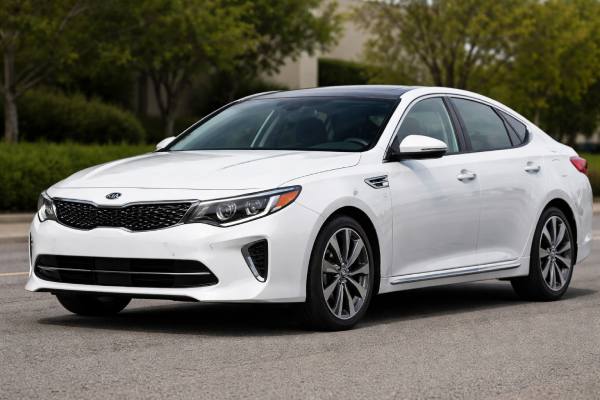


The 2016–2018 Kia Optima JF with the 2.0-liter G4NC (Nu) engine is one of those cars that rewards owners who like “quiet competence.” It is not a hot-rod midsize sedan, but it is a well-engineered daily driver: stable at highway speed, roomy for five, and designed around predictable, low-drama operation. The G4NC’s naturally aspirated layout keeps power delivery linear and helps avoid many turbo-related long-term costs, while the chassis tuning leans more comfort than razor-sharp sport.
Where this Optima shines is in the blend: modern crash structure, a long wheelbase that smooths rough roads, and simple driveline choices (front-wheel drive, 6-speed manual or automatic depending on market). Buy it with realistic performance expectations, maintain it on time, and it tends to be an easy car to live with.
What to Know
- Smooth, linear power and relaxed cruising; the 2.0 CVVL setup avoids turbo complexity.
- Strong space efficiency: long wheelbase, wide cabin, and a useful 510 L trunk (VDA).
- Efficient for its size when driven steadily; highway economy can be noticeably better than city use.
- Biggest ownership risk is neglect: old oil, overdue ATF, and ignored cooling issues cost more later.
- Plan on engine-oil service about every 10,000–12,000 km (6,000–7,500 mi) or 12 months for typical use.
Navigate this guide
- Kia Optima JF 2016–2018 ownership profile
- Kia Optima JF 2.0 G4NC specs and dimensions
- Kia Optima JF trims, options, and safety tech
- Reliability patterns, issues, and recalls
- Maintenance plan and smart buying checks
- Real-world driving and efficiency
- How it stacks up against rivals
Kia Optima JF 2016–2018 ownership profile
This Optima configuration is best understood as a comfort-first midsize sedan with a straightforward powertrain. The G4NC 2.0-liter is naturally aspirated, so it makes its power the “old-fashioned” way: it likes revs, responds predictably to throttle input, and does not rely on boost pressure to feel awake. That matters for long-term ownership because many high-cost turbo failure modes (wastegate issues, charge-pipe leaks, intercooler contamination, turbo oil-feed problems) simply do not exist here.
The JF platform itself is built around a long wheelbase and a wide track, which helps it feel planted on the highway. Owners usually notice two things quickly: (1) it tracks straight and stays calm over expansion joints, and (2) it is a genuinely spacious cabin for the class, especially for shoulder room. The trunk is also a practical strength—large enough for family travel without needing to fold seats for normal luggage.
The flip side is performance expectation management. At 163 hp, the 2.0 CVVL Optima is “adequate plus,” not quick. It will merge cleanly, but full-load passing at higher speeds takes planning—especially with a full cabin and the automatic transmission. If your driving is mostly highway commuting and you value low noise and stability, the power level makes sense. If you regularly drive steep grades, carry heavy loads, or like strong midrange punch, the 1.7 CRDi (in some regions) or 2.0 turbo variants suit that better.
From an engineering viewpoint, this trim tends to reward routine care more than heroic repairs. Keep fluids fresh, prevent cooling system surprises, and address small drivability symptoms early (misfires, vibration, slow cranking). Do that, and the car’s ownership experience is usually defined by comfort and predictability rather than constant troubleshooting.
Kia Optima JF 2.0 G4NC specs and dimensions
Below are Europe-market technical specifications for the 2.0 CVVL (G4NC family) configuration. Numbers can vary by market, wheel size, emissions calibration, and transmission type, so treat these as a well-grounded baseline and verify against VIN-specific documentation when ordering parts or fluids.
Powertrain and efficiency (2.0 CVVL / G4NC family)
| Item | Spec |
|---|---|
| Code | G4NC family (Nu 2.0 CVVL) |
| Engine layout and cylinders | Inline-4, naturally aspirated; 16 valves (4/cyl) |
| Displacement | 2.0 L (1,999 cc) |
| Bore × stroke | 81.0 × 97.0 mm (3.19 × 3.82 in) |
| Compression ratio | 10.3:1 |
| Induction | Naturally aspirated |
| Fuel system | CVVL-equipped gasoline engine (market-specific injection strategy) |
| Max power | 163 hp / 120 kW @ 6,500 rpm |
| Max torque | 196 Nm (145 lb-ft) @ 4,800 rpm |
| Timing drive | Chain |
| Rated efficiency (combined) | 7.4 L/100 km (MT) / 7.5 L/100 km (AT) |
| Real-world highway @ 120 km/h (75 mph) | Typically ~6.8–8.0 L/100 km (varies with wind, tyres, load) |
Transmission and driveline
| Item | Spec |
|---|---|
| Transmission | 6-speed manual or 6-speed automatic (market dependent) |
| Drive type | FWD |
| Differential | Open (traction control manages wheel slip) |
Gear ratios (2.0 CVVL, EU data)
| Gear | 6MT | 6AT |
|---|---|---|
| 1 | 3.615 | 4.400 |
| 2 | 2.080 | 2.726 |
| 3 | 1.387 | 1.834 |
| 4 | 1.079 | 1.392 |
| 5 | 0.884 | 1.000 |
| 6 | 0.744 | 0.774 |
| Reverse | 3.000 | 3.440 |
| Final drive | 4.533 | 3.383 |
Chassis, brakes, wheels, and dimensions
| Item | Spec |
|---|---|
| Suspension (front/rear) | MacPherson struts / double wishbones (independent) |
| Steering | Electric rack-and-pinion; ratio 14.34:1 (2.0 CVVL) |
| Turning circle | 10.9 m (35.8 ft) kerb-to-kerb (EU data shows 5.45 m radius) |
| Brakes (front/rear) | 280–300 mm vented discs / 262 mm solid discs |
| Most common tyre size | 215/60 R16 (optional 215/55 R17; 235/45 R18) |
| Ground clearance | 135 mm (5.31 in) |
| Length / width / height | 4,855 / 1,860 / 1,465 mm (191.14 / 73.23 / 57.68 in) |
| Wheelbase | 2,805 mm (110.43 in) |
| Kerb weight | 1,455 kg MT / 1,470 kg AT (3,208 / 3,241 lb) |
| GVWR | 2,000 kg MT / 2,020 kg AT (4,409 / 4,453 lb) |
| Fuel tank | 70 L (18.49 US gal / 15.40 UK gal) |
| Cargo volume | 510 L (18.0 ft³) seats up (VDA method) |
Performance and capability
| Item | Spec |
|---|---|
| 0–100 km/h (0–62 mph) | 9.4 s (MT) / 10.5 s (AT) |
| Top speed | 210 km/h (130.5 mph) MT / 208 km/h (129.2 mph) AT |
| Braking distance (100–0 km/h) | Typically ~36–41 m on good tyres (test-dependent) |
| Towing capacity | Up to 1,700 kg braked (MT) / 1,300 kg braked (AT); 650–750 kg unbraked (market rules apply) |
| Payload | Use door-jamb label; varies by trim and homologation |
Fluids and service capacities (practical guidance)
Because capacities and specifications can differ by transmission code, cooling package, and market, use these as decision-making guidance, not final authority:
| Fluid | What to use | Typical capacity guidance |
|---|---|---|
| Engine oil | Quality synthetic meeting the correct ACEA/API spec for your market; common viscosities include 5W-30 | Often ~4.0–4.5 L (with filter), verify by dipstick after refill |
| Coolant | OEM-compatible long-life coolant; correct mix ratio (commonly 50/50) | Often ~6 L total system (varies) |
| Automatic transmission fluid | OEM-spec ATF for the specific 6AT code | Drain-and-fill is typically far less than total fill; verify procedure |
| Brake fluid | DOT 4 (common for this class) | Flush by volume until clean (typ. ~1 L used in service) |
| A/C refrigerant | Market-dependent (often R-134a for these years) | Charge weight varies; use under-hood label |
Common critical torque ranges (verify by service manual): wheel lug nuts often ~90–110 Nm; engine oil drain plug commonly ~30–40 Nm on many Kia/Hyundai applications.
Safety and driver assistance (ratings snapshot)
| Rating body | Result highlights |
|---|---|
| Euro NCAP (Optima, test-era) | 5-star class result; strong adult and child occupant scores for the generation |
| ANCAP | Adult 88%, Child 86%, Pedestrian 67%, Safety Assist 74% (variant coverage depends on market) |
| IIHS (US-market 2016 model-year) | Top Safety Pick+ possible with optional front crash prevention; headlight ratings vary and can be a limiting factor |
Kia Optima JF trims, options, and safety tech
Trim structure depends heavily on region, but the ownership-relevant point is consistent: the mechanical base is similar, while equipment level determines comfort features and (most importantly) how much active safety you actually get. When shopping, focus less on the badge on the trunk and more on these three categories: transmission, wheel/tyre package, and driver-assistance suite.
Trims and options that change the experience
Common differences you will see across markets:
- Transmission choice (6MT vs 6AT):
The manual version is usually the quicker one on paper (and often the more efficient in mixed driving). The automatic is easier in traffic but can feel more relaxed than urgent—especially in kickdown from 80–120 km/h. - Wheel size (16 vs 17 vs 18 inches):
This matters more than many buyers expect. The 16-inch package typically gives the best ride comfort and the least road noise. Moving to 18s improves steering response but can increase impact harshness and tyre replacement cost. If your roads are rough, 16s are often the “smart long-term” choice. - Comfort and cabin tiers:
Leather vs cloth, seat ventilation, memory seats, upgraded audio, and larger infotainment screens change daily satisfaction and resale value. They also add more electronics—important for pre-purchase checks.
Quick identifiers when viewing a used one
- Tyre sidewall as a trim clue: 215/60 R16 usually suggests a comfort-oriented configuration; 235/45 R18 often indicates a higher equipment grade.
- Sensor “tells” for ADAS: cars with AEB/ACC typically have a radar unit behind the grille emblem or lower grille area, plus a camera module near the rear-view mirror.
- Instrument cluster prompts: cars with lane systems often show lane-line graphics and steering-wheel icons in the cluster menus.
Safety structure and passive systems
This generation Optima was engineered around a stronger body shell with more high-strength steel usage than prior versions, and it typically includes a full modern set of passive restraints: front airbags, side airbags, curtains, and commonly a driver knee airbag (market dependent). Child-seat mounting is usually straightforward, with ISOFIX/LATCH points and clear anchor access. Still, check the rear seat condition: damaged lower cushions and missing plastic guides can make child-seat installation harder than it should be.
Driver assistance: what’s standard vs optional
Expect three “tiers” across the used market:
- Core stability and braking electronics: ABS, ESC, traction control, brake assist—nearly universal.
- Awareness aids: parking sensors, rear camera, blind-spot monitoring, rear cross-traffic alert—often trim/package dependent.
- Collision avoidance and lane support: AEB, adaptive cruise control, lane keeping assist—commonly optional in many markets.
A practical note: if the car has AEB/ACC/lane camera features, budget for proper calibration after windshield replacement, front-end repairs, or certain alignment and suspension work. A car can drive “fine” while the system quietly disables itself due to a misaligned sensor.
Reliability patterns, issues, and recalls
The 2.0 G4NC Optima is generally an “average-to-good” reliability bet when maintained, with most problems clustering into ignition, cooling, rubber wear items, and electronics aging rather than catastrophic internal engine failures. Below is a practical map by prevalence and cost severity, written for owners and used-car shoppers.
Common (more likely) and usually low-to-medium cost
- Ignition coil or plug wear
Symptoms: rough idle, misfire under load, flashing MIL, fuel smell, poor fuel economy.
Likely cause: aged coils, incorrect plugs, or long intervals with city driving.
Remedy: scan for misfire codes, replace plugs with correct heat range and gap, replace coils as needed (often best in pairs or set if mileage is high). - PCV system and oil seepage
Symptoms: light oil consumption, oily residue near intake, valve cover seep, idle irregularity.
Likely cause: PCV valve sticking over time and normal gasket aging.
Remedy: replace PCV valve at sensible intervals; address valve cover gasket seep early to prevent oil dripping onto hot components. - Suspension links and bushings
Symptoms: clunks over bumps, vague steering feel, uneven tyre wear.
Likely cause: stabilizer links and control-arm bushings wearing with mileage and rough roads.
Remedy: inspect with wheels unloaded; replace worn links/bushings; align afterwards.
Occasional (some cars) and can become higher cost if ignored
- Cooling system leaks (thermostat housing, hoses, radiator end tanks)
Symptoms: coolant smell, low reservoir level, overheating in traffic, slow warm-up or temperature swings.
Likely cause: plastic components and seals aging, clamp tension loss.
Remedy: pressure test; replace leaking component(s); refill with correct coolant mix and bleed properly. - Automatic transmission shift quality decline
Symptoms: delayed engagement, flare on upshift, harsh downshifts, shudder on light throttle.
Likely cause: old ATF, adaptation drift, or mount wear amplifying driveline feel.
Remedy: diagnose mounts first; consider a drain-and-fill service cycle; avoid “flush” methods that ignore filter and pan condition unless the procedure is explicitly approved for the unit. - Steering feel changes and alignment sensitivity
Symptoms: pulling, steering off-center, tramlining with wide tyres.
Likely cause: alignment, tyre wear, or impact damage.
Remedy: measure alignment, inspect tyres for belt issues, check for bent components.
Rare (less common) but worth knowing
- Timing chain noise or correlation faults
Symptoms: cold-start rattle that persists, cam/crank correlation codes, poor running.
Likely cause: tensioner wear or guide wear (usually after high mileage or poor oil history).
Remedy: do not ignore correlation codes; confirm with scan data and mechanical inspection; repair before the chain can jump timing.
Recalls, TSBs, and software actions: how to approach it safely
Rather than memorizing a long recall list that varies by country and engine variant, use a consistent method:
- Run a VIN recall check (official database and dealer record).
- Ask for proof of completion (invoice or dealer printout).
- Confirm software updates for powertrain control and any ADAS modules if equipped.
Even within the same model years, the recall landscape can differ significantly by engine family and market (for example, some regions have more fuel system or brake-hydraulic campaigns, while others do not). The safest buyer behavior is VIN-based confirmation—especially because recall completion, not just recall existence, is what protects you.
Maintenance plan and smart buying checks
If you want this Optima to stay inexpensive, the strategy is simple: shorten fluid intervals slightly, inspect rubber and cooling parts regularly, and avoid “mystery maintenance.” The car is not unusually fragile, but it responds poorly to neglect because small issues (old oil, low coolant, worn tyres) can cascade into bigger bills.
Practical maintenance schedule (balanced for longevity)
Use this as a real-world plan; adjust for severe service (short trips, extreme heat/cold, heavy traffic).
| Item | Typical interval (normal use) | Severe-use suggestion |
|---|---|---|
| Engine oil and filter | 10,000–12,000 km (6,000–7,500 mi) or 12 months | 7,500–9,000 km (4,500–5,500 mi) or 6–9 months |
| Engine air filter | 20,000–30,000 km | Inspect every oil change; replace as needed |
| Cabin air filter | 15,000–20,000 km or yearly | 10,000–15,000 km in dusty/pollen-heavy areas |
| Spark plugs | 60,000–100,000 km (depends on plug type) | Stay closer to 60,000–80,000 km |
| Coolant | 5 years then every 3–5 years | Shorten if heat cycling is severe or coolant quality is unknown |
| Brake fluid | Every 2 years | Every 2 years (do not stretch) |
| Automatic transmission fluid | 60,000–90,000 km (drain-and-fill approach) | 50,000–60,000 km if mostly city driving |
| Manual gearbox oil | 80,000–120,000 km (if serviceable per market guidance) | 80,000–100,000 km |
| Tyre rotation | 10,000–12,000 km | 8,000–10,000 km |
| Alignment check | Yearly or with tyre replacement | With any abnormal wear or impact event |
| 12 V battery test | Yearly after year 3 | Replace proactively around 4–6 years if weak |
Fluids: what matters most for decision-making
- Engine oil: prioritize correct specification for your market over chasing a “magic viscosity.” Many owners do well with a quality 5W-30 where recommended, but always follow the cap/manual guidance for your exact engine calibration and climate.
- ATF: avoid guessing. If you cannot verify the exact transmission and fluid spec, do not top off with a universal fluid “because it’s close.”
- Coolant: mixing types can create sludge or corrosion risk over time. If history is unknown, a correct full service (drain, flush if needed, refill) is often safer than repeated topping-off.
Buyer’s guide: inspection checklist that actually saves money
Engine and drivability
- Cold start: listen for persistent rattles; brief startup noise is less concerning than noise that continues.
- Idle quality: stable idle and smooth off-idle response matter more than how “quiet” it is.
- Check for misfire history with a scan tool and review fuel trims if possible.
Cooling system
- Look for dried coolant traces at hose joints and around the radiator and thermostat housing.
- Verify the cabin heater gets hot quickly; weak heat can indicate air in the system or a thermostat issue.
Transmission
- Automatic: check for clean engagement, consistent shifts, and no shudder at light throttle.
- Manual: check for clutch take-up smoothness and no grinding on quick 2–3 shifts.
Chassis
- Uneven tyre wear often points to alignment or worn bushings—budget accordingly.
- Test for braking stability: no steering wheel shake under moderate braking.
Electronics
- Confirm every camera and sensor works (rear camera, parking sensors, blind-spot lights).
- If equipped with AEB/ACC/lane features, verify no warning lights and that the system initializes normally after startup.
Long-term durability outlook
With routine fluids and prompt attention to misfires and cooling leaks, this configuration typically ages well. The expensive surprises usually come from deferred maintenance (especially ATF and coolant) or from buying a poorly repaired accident car where alignment and sensor calibration were never restored correctly.
Real-world driving and efficiency
On the road, the 2.0 CVVL Optima’s personality is defined by smoothness and stability rather than punch. The engine pulls cleanly and predictably, but it does its best work when you let it rev. Around town, that means it feels relaxed—sometimes even subdued—until you ask for more throttle. For drivers coming from turbocharged midsize sedans, the initial response can feel softer. The upside is that it’s easier to modulate smoothly in traffic and less likely to deliver sudden torque spikes that stress tyres and driveline mounts.
Ride, handling, and NVH (noise, vibration, harshness)
The long wheelbase pays off on highways. Straight-line stability is a strong point, and the cabin generally feels calm at steady speed. Over broken pavement, the Optima usually filters sharp impacts well on 16-inch tyres; on 18s, you can feel more edge in potholes and expansion joints. Steering is light-to-medium in effort with an easy on-center feel, tuned for confidence rather than detailed road texture. Braking feel is typically consistent, with enough pedal confidence for everyday use, though ultimate stopping distance is highly tyre-dependent.
Powertrain character and transmission behavior
- Manual: the manual setup tends to feel more direct and can make the car feel quicker because you control the rev range.
- Automatic: the automatic is smooth and generally well-matched to comfort driving, but passing maneuvers often require a deeper pedal press and a downshift. If you want the best response, avoid “lugging” the engine—let it downshift and work in the midrange.
Real-world fuel economy
Factory combined ratings for the EU configuration sit around 7.4–7.5 L/100 km, and many owners land near that in mixed driving when tyres are properly inflated and driving is steady. The pattern is usually:
- City-heavy: ~8.5–10.5 L/100 km depending on congestion and trip length
- Highway 100–120 km/h: often ~6.8–8.0 L/100 km
- Mixed: commonly ~7.5–9.0 L/100 km
Cold weather and short trips matter because warm-up time, enrichment, and cabin heat load all push consumption higher. If you do mostly short urban runs, the simplest improvement is maintenance plus driving rhythm: clean filters, correct tyre pressure, and fewer hard accelerations from low speed.
Key performance numbers that shape expectations
The official 0–100 km/h figures (about 9.4 s manual and 10.5 s automatic) translate to a car that feels confident merging but not urgent when already rolling fast. If your driving includes frequent high-speed passing, the best “driving upgrade” is often not an engine mod—it is choosing the right tyres (good wet grip), keeping the engine in its stronger rpm band, and ensuring the automatic’s fluid and mounts are in good shape.
How it stacks up against rivals
The Optima JF 2.0 CVVL competes in a crowded midsize field, and its value depends on what you prioritize: comfort, equipment, and predictable ownership versus sporty driving or maximum resale.
Versus Toyota Camry / Avensis (market-dependent)
- Optima advantages: often more features for the money (especially comfort and infotainment), planted highway feel, and a modern safety structure for the generation.
- Toyota advantages: reputation for low drama with minimal attention, strong parts availability in many regions, and typically stronger resale.
- Who should pick the Optima: buyers who want a nicer cabin experience at used-car prices and are willing to follow a disciplined maintenance routine.
Versus Mazda6
- Optima advantages: quieter cruising and a more relaxed ride, especially on smaller wheels; often a better “long trip” car for passengers.
- Mazda6 advantages: more engaging steering and body control; tends to feel lighter and more responsive.
- Decision point: if you enjoy driving dynamics daily, the Mazda6 usually wins; if you want calm comfort, the Optima makes sense.
Versus Volkswagen Passat / Skoda Superb
- Optima advantages: simpler naturally aspirated setup (in this configuration) and often fewer powertrain complexity worries than some turbo-heavy lineups.
- VW-group advantages: excellent cabin packaging, strong highway refinement, and often better drivetrain torque in turbo trims.
- Ownership tradeoff: Passat/Superb can be excellent, but parts and diagnostic complexity can raise ownership cost depending on region and engine.
Versus Ford Mondeo
- Optima advantages: straightforward drivetrain and typically good feature value.
- Mondeo advantages: some trims offer strong handling balance and torque-rich engines.
- What to watch: Mondeo ownership cost can swing widely based on engine/transmission combination; the Optima 2.0 is usually more predictable.
Versus Hyundai Sonata (platform cousin)
- Optima advantages: often a different feature mix and pricing; sometimes better value in the used market depending on region.
- Sonata advantages: similar mechanical fundamentals; choice often comes down to availability, condition, and service history.
- Best practice: buy the better-maintained example, not the badge.
Bottom line: the Optima JF 2.0 CVVL is a strong choice when you want a comfortable midsize sedan with honest, linear power and you can verify service history. It may not beat every rival in sportiness or resale, but it competes well on day-to-day livability and long-distance comfort.
References
- Microsoft Word – Kia Optima (Europe) JF PETD – Final – 30 Oct.doc 2015 (Technical Specifications) ([Kia Press][1])
- Five-star safety ratings for all-new Kia Optima and Sportage 2015 (Safety Rating) ([Kia Press][2])
- Kia Optima | Safety Rating & Report | ANCAP 2015 (Safety Rating) ([ancap.com.au][3])
- 2016 Kia Optima 2016 (Safety Rating) ([IIHS Crash Testing][4])
- Check for Recalls: Vehicle, Car Seat, Tire, Equipment | NHTSA 2026 (Recall Database) ([NHTSA][5])
Disclaimer
This article is for informational purposes only and is not a substitute for professional diagnosis, inspection, or repair. Specifications, torque values, fluid capacities, service intervals, and procedures can vary by VIN, market, engine/transmission code, and equipment; always verify details using your official owner’s manual and service documentation for your specific vehicle.
If you found this guide useful, please consider sharing it on Facebook, X (Twitter), or your favorite forum to support our work.