
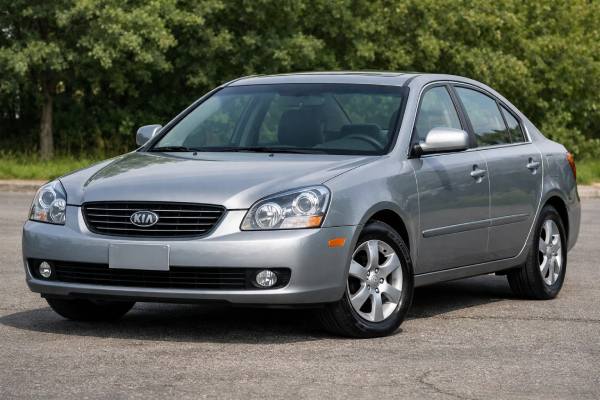
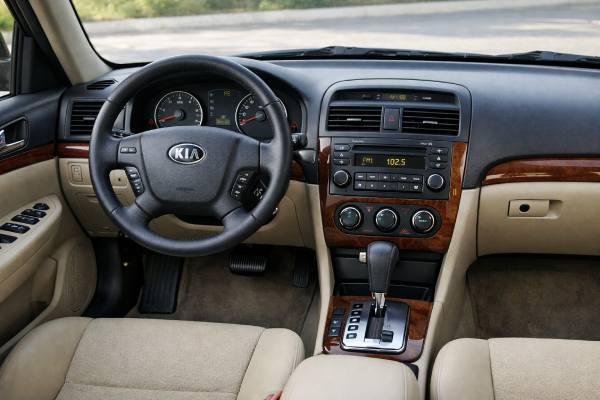
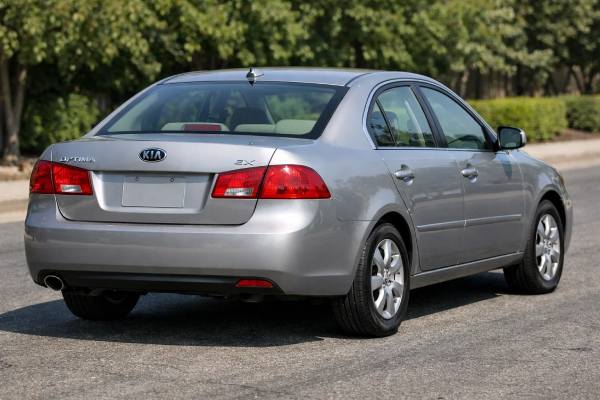
The 2006–2008 Kia Optima (MG) with the G6EA 2.7-liter V6 sits in a useful sweet spot: a midsize sedan with simple, durable mechanicals, strong everyday torque, and widely available parts. This version matters because the V6 changes the ownership profile—more relaxed highway passing and smoother power delivery than the four-cylinder, but with higher heat load under the hood and a timing-belt service you must plan for. The MG generation also brought a stiffer body and improved crash structure compared with earlier Optimas, which shows up in real safety performance. If you’re shopping one today, the key is separating “cheap used car” from “good used car”: service history, cooling-system condition, transmission behavior, and recall completion decide whether it’s a bargain or a project.
Owner Snapshot
- Smooth, flexible V6 that suits long highway runs and frequent overtakes better than the base engine.
- Straightforward FWD layout with conventional suspension and brakes—typically inexpensive to keep roadworthy.
- Cabin space and ride comfort hold up well as a daily driver if the suspension has been refreshed.
- Plan around timing-belt service and cooling-system upkeep; skipping either tends to get expensive later.
- Sensible baseline interval: engine oil and filter every 8,000–10,000 km (5,000–6,000 mi) or 12 months, whichever comes first.
What’s inside
- Kia Optima MG V6 essentials
- Kia Optima MG 2.7 V6 specs and measurements
- Kia Optima MG equipment, safety, and driver aids
- Reliability patterns, known faults, and recalls
- Maintenance plan and pre-purchase checks
- Road feel, power delivery, and real fuel use
- Rivals, value picks, and ownership tradeoffs
Kia Optima MG V6 essentials
Think of the 2006–2008 Optima MG V6 as a traditional midsize sedan done the simple way: a naturally aspirated V6 up front, a conventional automatic, and front-wheel drive. That formula is not exciting on paper, but it is predictable in the real world—especially for owners who prioritize “starts every morning” over chasing modern tech.
The G6EA 2.7 V6’s main advantage is how it delivers torque. You do not need to rev it hard to get useful acceleration, and that makes the car feel calmer in everyday driving—pulling away from junctions, climbing grades, and passing slower traffic. Compared with the four-cylinder Optima, the V6 version typically feels less strained at highway speeds, and it’s usually quieter under moderate throttle because it spends less time near its upper rpm range.
Chassis tuning on these cars aims for comfort first. The steering is light, the suspension isolates rough surfaces reasonably well for the class, and the wheelbase helps the Optima settle down on long trips. That said, most examples on the road now are old enough that bushings, struts, and engine mounts often dominate the driving experience. A “floaty” ride, clunks over bumps, or vibration at idle is often more about worn rubber and dampers than anything inherently wrong with the design.
From an ownership perspective, the V6 Optima is easiest to live with when you treat it like an appliance with a schedule. The core decision points are:
- Timing belt planning: it’s not optional maintenance; it’s a calendar and mileage item.
- Cooling-system health: a V6 running hot is a fast path to leaks, misfires, and head-gasket anxiety.
- Transmission behavior: the 5-speed automatic is usually durable, but it does not like neglected fluid.
- Electrical age issues: sensors and connectors tend to fail one at a time; diagnosis matters more than guessing parts.
If you buy one that has been maintained, the MG V6 can be a comfortable, low-drama daily. If you buy the cheapest one you can find, expect to “pay the difference” in deferred service within the first year.
Kia Optima MG 2.7 V6 specs and measurements
Specs for older cars vary by market and trim, but the 2006–2008 Optima MG with the 2.7 V6 and automatic has a fairly consistent mechanical package. The tables below focus on the G6EA/5AT FWD configuration because that’s the ownership reality for most buyers.
Powertrain and efficiency
| Item | Specification |
|---|---|
| Engine code | G6EA |
| Layout | V6, transverse |
| Valvetrain | DOHC, 24-valve (4 valves/cyl) |
| Bore × stroke | 86.7 × 75.0 mm (3.41 × 2.95 in) |
| Displacement | 2.7 L (2,656 cc) |
| Induction | Naturally aspirated |
| Fuel system | MPFI (port injection) |
| Compression ratio | ~10.0:1 (market-dependent) |
| Max power | 185 hp (138 kW) @ ~6,000 rpm |
| Max torque | ~250 Nm (184 lb-ft) @ ~4,000 rpm |
| Timing drive | Belt |
| Rated efficiency (EPA) | 10.2 L/100 km combined (23 mpg US / 28 mpg UK equivalent varies by conversion) |
| Real-world highway @ 120 km/h | ~9.0–10.5 L/100 km (varies with tyres, wind, load, and A/C use) |
Transmission and driveline
| Item | Specification |
|---|---|
| Transmission | 5-speed automatic (conventional torque-converter) |
| Drive type | FWD |
| Differential | Open |
Chassis and dimensions (typical)
| Item | Specification |
|---|---|
| Suspension (front/rear) | MacPherson strut / multi-link (market-dependent variants exist) |
| Steering | Hydraulic power steering (typical for the era) |
| Brakes | 4-wheel discs; ABS common/standard depending on trim |
| Popular tyre size | 205/60 R16 or 215/50 R17 (trim-dependent) |
| Ground clearance | ~150 mm (5.9 in) (varies by market) |
| Length / width / height | ~4,735 / 1,805 / 1,480 mm (186.4 / 71.1 / 58.3 in) |
| Wheelbase | ~2,720 mm (107.1 in) |
| Turning circle | ~11.0 m (36.1 ft) (typical) |
| Curb weight | ~1,470–1,580 kg (3,240–3,480 lb) |
| Fuel tank | ~65–70 L (17.2–18.5 US gal / 14.3–15.4 UK gal) |
| Cargo volume | ~400 L (14 ft³) (sedan, method varies) |
Performance and capability (typical real-world)
| Item | Typical value |
|---|---|
| 0–100 km/h (0–62 mph) | ~8.8–9.8 s |
| Top speed | ~205–215 km/h (127–134 mph) |
| Braking 100–0 km/h | ~38–42 m (test-dependent) |
| Towing capacity | Often not officially rated in many markets; where rated, keep loads conservative and cooling perfect |
| Payload | Typically ~400–500 kg (trim-dependent) |
Fluids, service capacities, and key torque values (decision-useful)
| Item | Specification (typical) |
|---|---|
| Engine oil | API-grade equivalent; common viscosities: 5W-30 or 5W-40 (climate-dependent) |
| Oil capacity | ~4.3–4.8 L (4.5–5.1 US qt) incl. filter |
| Coolant | Ethylene glycol long-life; 50/50 mix typical |
| Coolant capacity | ~7.5–8.5 L (7.9–9.0 US qt) |
| Automatic transmission fluid | SP-III type fluid (common Hyundai/Kia spec for era) |
| ATF capacity | ~7–8 L total; ~3.5–4.5 L drain-and-fill (varies by pan and cooler) |
| A/C refrigerant | R-134a; charge varies by market |
| Wheel lug nuts | ~90–110 Nm (66–81 lb-ft) |
| Spark plugs | ~18–22 Nm (13–16 lb-ft) (verify plug type) |
| Oil drain plug | ~30–40 Nm (22–30 lb-ft) (verify pan/plug) |
Safety and driver assistance (period-correct)
| Item | Notes |
|---|---|
| Euro NCAP / IIHS / NHTSA | Ratings vary by region and test protocol; see Section 3 |
| ADAS | No modern AEB/ACC/LKA in this era; focus is airbags, ABS, and stability control where fitted |
These numbers are most useful as a “sanity check” when you inspect a car. If a seller claims unusually low fuel use, unusually high power, or a different transmission, verify by VIN, under-hood labels, and build plate.
Kia Optima MG equipment, safety, and driver aids
The 2006–2008 Optima MG lineup is usually straightforward: a value-oriented base trim and a better-equipped upper trim, with the V6 typically offered as an upgrade or packaged with higher equipment. Names vary by region, but you’ll commonly see LX and EX (or equivalents). For buyers, the important part is not the badge; it is the functional equipment you actually get.
Trims and option logic that matters
Common differences you’ll run into:
- Wheels and tyres: base models often wear 16-inch wheels; higher trims move to 17-inch. The larger wheel package can sharpen steering response, but it also raises tyre cost and can make rough roads feel busier.
- Brakes and stability systems: ABS is common, and many cars include traction control; stability control availability depends on market and year. If winter driving is part of your life, prioritize a car with stability control and good tyres over a “nicer” interior.
- Comfort equipment: leather, power seats, heated seats, and sunroof frequently show up on higher trims. Test every switch—seat motors and sunroofs can be expensive “annoyance repairs.”
- Infotainment: most examples are simple (radio/CD). If you see aftermarket head units, check that the wiring is tidy and that steering-wheel controls (if equipped) still work.
Quick identifiers when shopping
- V6 confirmation: the intake layout, V6 engine cover labeling, and the VIN/engine code sticker are more reliable than “it feels fast.”
- Curtain airbags: look for “SRS Curtain” tags on the headliner near the A- or B-pillars (exact placement varies). Presence matters for side-impact protection.
- TPMS: some markets made it standard; others did not. Confirm the warning light behavior at ignition-on.
Safety ratings and what they mean for this car
Testing bodies and results vary by region, but you can still use them intelligently:
- IIHS crashworthiness (US-focused): For the 2006–2010 Optima body structure covered by IIHS testing, the Optima earns a Good rating in the moderate overlap front test and Acceptable in the original side test. Roof strength is Marginal, and head restraints and seats are Good. These details matter: it suggests solid frontal protection for the era, decent side performance depending on build date and equipment, and a weaker roof-strength result compared with newer designs.
- NHTSA star ratings (US-focused): NHTSA testing for this generation is often quoted as strong for the time, with five-star outcomes commonly cited for frontal and side impact in many configurations. Use the vehicle’s exact configuration page or VIN lookup to confirm what applies to the car you are viewing.
Driver assistance: what exists, what does not
This is a pre-ADAS car. There is no factory automatic emergency braking, adaptive cruise control, or lane-keeping system in typical 2006–2008 trims. The safety toolkit is therefore “foundation hardware”:
- Airbags (front, side torso, and curtain where equipped)
- ABS
- Traction and stability control on many trims/markets
- Proper head restraints (important for whiplash reduction)
For modern driving, that puts more responsibility on tyres, brakes, and suspension condition. A well-maintained Optima on quality tyres is meaningfully safer in the real world than a neglected one with old rubber and tired dampers.
Reliability patterns, known faults, and recalls
A useful way to think about reliability on the Optima MG V6 is “mostly durable, but unforgiving of skipped basics.” Many failures are not exotic—they are age, heat, and maintenance related. Below is a practical map by prevalence and cost tier, followed by what to look for.
Common (expect to see) — usually low to medium cost
- Valve cover gasket seepage (medium/age-driven):
Symptoms: oil smell, light smoke near exhaust, oily plug wells.
Cause: gasket hardening from heat cycles.
Fix: replace gaskets; clean and inspect PCV system to reduce crankcase pressure. - Engine mounts softening (medium, comfort issue):
Symptoms: vibration at idle in Drive, clunks on throttle tip-in.
Cause: rubber degradation; V6 torque loads.
Fix: replace mounts as a set if multiple are tired; verify alignment afterward. - Ignition wear (coils/plugs) (low to medium):
Symptoms: misfire under load, rough idle, flashing MIL.
Cause: aged coils, incorrect plug type/gap, oil in plug wells.
Fix: correct plugs, address gasket leaks, replace weak coils. - Cooling-system aging (medium, can become high):
Symptoms: slow coolant loss, heater inconsistency, temperature creep in traffic.
Cause: radiator end-tank aging, hoses, thermostat, cap weakness.
Fix: pressure test; replace weak parts proactively—overheating is the real enemy.
Occasional (seen regularly) — cost depends on diagnosis quality
- Crankshaft/camshaft position sensors:
Symptoms: intermittent stalling, long crank, random misfire codes.
Fix: proper scan-data diagnosis before parts; heat-related failures can be misleading. - Automatic transmission shift quality degradation:
Symptoms: flare on 2–3, delayed engagement, torque-converter shudder at light cruise.
Cause: old ATF, solenoid wear, or converter clutch wear.
Fix: fluid service first (correct spec), then diagnosis; avoid “flush” if the unit is already slipping. - Power steering seepage or pump noise:
Symptoms: whining, heavy steering at parking speeds, wet lines.
Fix: verify fluid level/condition; repair leaks before replacing pumps.
Rare but high-impact (don’t ignore)
- Timing belt neglect:
Symptoms: there may be no warning—failure can cause major engine damage on many V6 designs.
Fix: treat belt service as mandatory. If history is unknown, assume it is due. - Overheating events:
Symptoms: past boil-over, “new radiator” with no explanation, stained overflow bottle.
Risk: warped components, long-term gasket issues.
Fix: walk away unless you can verify the repair quality and the engine’s current health.
Recalls and service actions that matter
A well-known campaign for this platform involves the steering column clock spring, which can affect the driver airbag circuit and airbag warning light behavior. Your practical takeaway:
- Ask for documentation showing recall completion, or verify via official VIN tools and dealer records.
- During inspection, confirm the airbag light illuminates at key-on and then goes out—then scan for stored SRS codes.
For a 2006–2008 Optima MG, the “best” car is usually the one with boring paperwork: belt service recorded, coolant replaced on schedule, and recall completion confirmed.
Maintenance plan and pre-purchase checks
With the G6EA V6 Optima, maintenance is less about doing more and more about doing the right items on time. Below is a practical schedule you can follow even if your local handbook intervals differ; always align final intervals with the correct service documentation for your VIN and market.
Practical maintenance schedule (distance/time)
| Item | Interval (recommended) | Notes |
|---|---|---|
| Engine oil and filter | 8,000–10,000 km (5,000–6,000 mi) or 12 months | Short trips, high heat, or heavy traffic: shorten interval |
| Engine air filter | 15,000–30,000 km (9,000–18,000 mi) | Inspect yearly; replace more often in dusty areas |
| Cabin filter | 15,000–20,000 km (9,000–12,000 mi) | Helps HVAC performance and window clearing |
| Spark plugs | 60,000–100,000 km (37,000–62,000 mi) | Depends on plug type; replace earlier if misfires begin |
| Coolant | 5 years or 100,000 km (62,000 mi) | Pressure-test system at each change |
| ATF (drain and fill) | 50,000–70,000 km (31,000–43,000 mi) | Correct spec matters; repeat service can be gentler than flush |
| Brake fluid | Every 2 years | Moisture absorption affects braking feel and corrosion risk |
| Brake pads/rotors inspection | Every 10,000–15,000 km | Caliper slide lubrication prevents uneven wear |
| Timing belt and related parts | ~90,000–120,000 km or 5–7 years | Include tensioner/idlers; consider water pump “while you’re there” |
| Serpentine belt and hoses | Inspect yearly; replace at cracking/glazing | Cheap prevention for breakdowns |
| Wheel alignment and tyre rotation | Rotate 10,000–12,000 km | Alignment saves tyres and improves stability |
| 12 V battery test | Annually after year 4 | Replace proactively if cold starts weaken |
Fluids and specs: what owners should get right
- Engine oil viscosity: choose based on climate and engine condition; thicker is not automatically better. If the engine is clean and tight, the manufacturer-recommended grade is usually the best starting point.
- ATF specification: the transmission’s shift feel depends heavily on correct fluid friction characteristics. If you don’t know what is in it, a drain-and-fill is safer than an aggressive flush on a high-mileage unit.
- Coolant mix: use the correct long-life coolant type and keep a consistent mix ratio (commonly 50/50). Mixing incompatible coolants is a quiet way to create sludge.
Pre-purchase checklist (what to request and what to test)
- Service history proof: timing belt record is the biggest value marker on a V6 Optima.
- Cold start test: listen for belt squeal, lifter noise, or unstable idle; confirm no misfire.
- Cooling-system inspection: look for staining around radiator end tanks, water pump area, and hose joints; verify steady temperature in traffic.
- Transmission road test: smooth engagement from Park to Drive, no flare on upshifts, no shudder at light throttle around 60–90 km/h.
- Suspension and steering: clunks over bumps often point to links/bushings; steering should be consistent and not “notchy.”
- SRS/ABS lights: key-on light check, then scan for stored codes—especially important for airbag-related campaigns.
- Rust and underbody: focus on subframe mounts, brake lines, and rocker seams (regional salt exposure matters).
A well-bought Optima MG V6 is typically not expensive to maintain—after you catch up on deferred items. Budget for a “baseline service” right after purchase and you will usually have a more reliable year one.
Road feel, power delivery, and real fuel use
On the road, the Optima MG V6 feels like a classic mid-2000s sedan: comfortable, stable, and tuned to be easy rather than sharp. The suspension generally soaks up broken pavement well when the struts and bushings are healthy, and the longer wheelbase helps the car track straight at speed. If you feel nervous wandering on the highway, suspect tyres, alignment, or worn rear suspension links before blaming the design.
Powertrain character
The G6EA V6 is at its best in the “real world band”—low to mid rpm. Throttle response is typically smooth rather than snappy, and the engine’s refinement is a noticeable step up from the four-cylinder, especially when merging or passing. The 5-speed automatic usually shifts unobtrusively when maintained, but it will show its age if the fluid has been ignored: delayed engagement, harsher shifts when cold, or a faint shudder under light load.
A useful driving tip for longevity: avoid repeated full-throttle kickdowns when the engine is hot and the cooling system is marginal. If the temperature gauge ever creeps upward in traffic, treat it as a warning, not a suggestion.
NVH and comfort
Cabin noise at city speeds is typically modest, but at highway speeds the biggest variables are tyre choice and door seals. Many cars now have cheap tyres fitted to save money; that can add a surprising amount of roar. Engine mounts also matter: a V6 with tired mounts can feel “rough,” even if the engine itself is healthy.
Fuel use: what to expect
EPA figures for the 2.7 V6 automatic configuration are commonly listed around 20 mpg city / 28 mpg highway / 23 mpg combined, which translates roughly to 11.8 / 8.4 / 10.2 L/100 km. In real driving:
- City-heavy commuting: often lands around 11–13 L/100 km, especially with short trips and cold starts.
- Steady highway cruising: can drop into the 8.5–10.5 L/100 km range depending on speed and wind.
- Fast motorway (around 120–130 km/h): expect consumption to climb noticeably; aerodynamics dominate.
If you want the V6 Optima specifically for relaxed highway travel, that fuel penalty often feels worth it. If your life is short city trips, the four-cylinder version is usually the more rational buy.
Rivals, value picks, and ownership tradeoffs
In the 2006–2008 midsize segment, the Optima MG V6 competes on value and simplicity more than brand prestige. Your best comparison depends on what you care about: lowest risk, lowest total cost, or best driving feel.
Where the Optima MG V6 tends to win
- Purchase price and parts availability: compared with a similarly aged Toyota Camry V6 or Honda Accord V6 (often priced higher in many markets), the Optima can deliver comparable comfort and usable power for less money up front.
- Straightforward mechanical layout: independent shops usually understand it well; diagnostics are conventional.
- Comfort-per-euro: a good seat, decent ride, and a quiet-ish cabin are common strengths when the car is maintained.
Where rivals can be a better bet
- Long-term durability reputation: the Camry and Accord often have stronger “set it and forget it” reputations, especially if you want to minimize surprises as mileage climbs.
- Refinement at age: some competitors maintain tighter interior quality over time. With Optimas, worn seat foam, tired door seals, and squeaks can show up if the car lived a hard life.
- Safety evolution: all cars from this era lack modern ADAS, but newer redesigns of rivals gained structural and restraint improvements earlier in some regions.
Smart cross-shops (same era, similar money)
- Hyundai Sonata V6: often similar mechanical philosophy and parts ecosystem; compare maintenance history and body condition more than badge.
- Mazda6: sometimes more engaging steering/handling; watch for rust in certain climates and check suspension wear carefully.
- Nissan Altima (non-CVT versions in some markets/years): can be competitive, but verify transmission type and condition.
Buying guidance: who should choose the Optima V6?
Choose the Optima MG V6 if you want a comfortable midsize sedan, you can verify timing-belt history (or you budget for it immediately), and you value smooth torque for highway use. Consider a rival if you want the absolute lowest effort ownership experience and you are willing to pay more for a cleaner example with stronger resale and broader service documentation.
A practical rule: the best car is usually the one with the best history, even if it is not the “best brand.” A documented Optima will outlast a neglected anything.
References
- Fuel Economy of the 2007 Kia Optima 2026 (EPA Fuel Economy Database)
- 2007 Kia Optima 2026 (Safety Rating)
- Vehicle Detail Search – 2007 KIA OPTIMA 4 DR FWD | NHTSA 2026 (Recall Database)
- Check for Recalls: Vehicle, Car Seat, Tire, Equipment | NHTSA 2026 (VIN Check)
- KIA OPTIMA EARNS FIVE STAR SAFETY RATING FROM U.S. GOVERNMENT 2006 (Press Release)
Disclaimer
This article is for informational purposes only and is not a substitute for professional inspection, diagnosis, or repair. Specifications, torque values, fluid types, service intervals, and procedures can vary by VIN, market, build date, and equipment. Always verify details using the correct owner’s manual and service documentation for your specific vehicle, and consult qualified technicians for safety-critical work.
If you found this guide useful, please consider sharing it on Facebook, X (Twitter), or your favorite forum to support our work.