
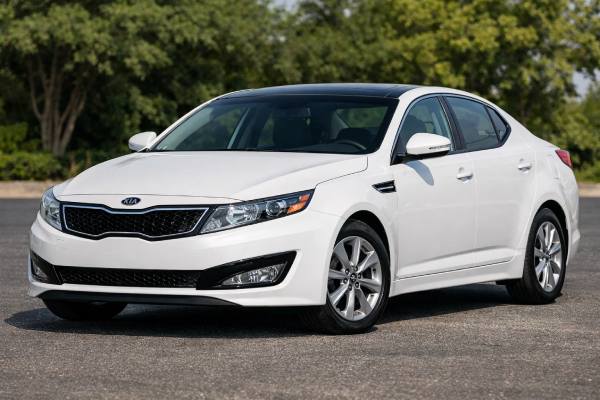

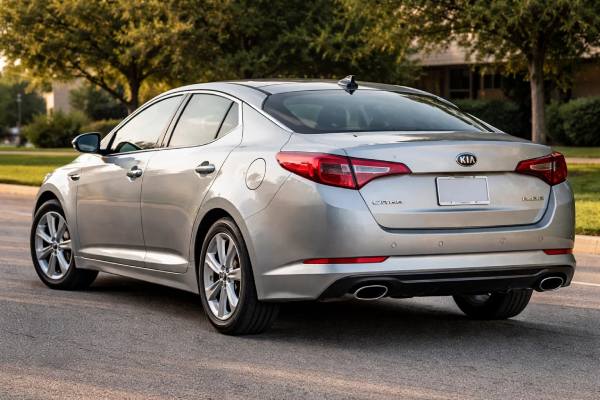
The 2011–2013 Kia Optima (TF) with the 1.7 CRDi diesel (engine code D4FD) targets the sweet spot for long-distance driving: strong mid-range torque, relaxed highway manners, and fuel economy that stays competitive even by modern standards when the car is in good tune. It’s also one of the more straightforward powertrains in the TF lineup—no high-output turbo drama, and fewer heat-soak issues than the hotter petrol engines—yet it still demands diesel-specific care.
Most ownership complaints come down to how the car is used. Short trips and stop-start driving can overload the DPF (diesel particulate filter) and EGR system, while neglected fuel filtration can shorten injector life. If your driving includes regular motorway time and you follow a conservative service routine, this Optima is typically a durable, comfortable, and cost-efficient midsize sedan with a surprisingly “big car” feel for the money.
Fast Facts
- Strong low- and mid-rpm pull suits highway commuting and loaded driving better than many small diesels.
- Long-wheelbase comfort and stable straight-line tracking make it an easy long-distance sedan.
- Generally simple FWD driveline: fewer costly hardware “surprises” than AWD rivals of the era.
- DPF and EGR health depends heavily on trip length; frequent short journeys can create recurring warning lights.
- Plan a sustained highway run of 20–30 minutes at least every 2–4 weeks (or ~400–600 km) if the car mostly does city miles.
Contents and shortcuts
- Kia Optima TF 1.7 CRDi at a glance
- Kia Optima TF D4FD specs and measurements
- Kia Optima TF diesel equipment and safety
- Reliability hotspots on the 1.7 CRDi
- Maintenance plan and smart buying tips
- Driving feel and real-world economy
- How this diesel Optima stacks up to rivals
Kia Optima TF 1.7 CRDi at a glance
This Optima variant pairs the TF platform’s roomy cabin and long wheelbase with a 1.7-liter common-rail turbo-diesel built for steady, efficient torque delivery. In most European markets the 1.7 CRDi sits below the 2.0 diesel options some rivals offered, but it compensates with lower running costs, simpler cooling demands, and a more relaxed character than high-strung small turbo petrol engines of the same era.
The D4FD is best understood as a “momentum” engine. It doesn’t encourage redline runs; instead, it rewards early upshifts and mid-range loading. On the highway, the Optima’s length and suspension tuning help it feel planted, with less busy body motion than many compact sedans. That calmness is a real advantage if you do 20,000–35,000 km per year, especially in mixed weather.
Where owners get into trouble is the mismatch between diesel emissions hardware and short-trip lifestyles. The DPF needs heat and time to complete regenerations, and the EGR system accumulates soot fastest when the engine rarely reaches full operating temperature. If the car is used mainly for 5–10 km hops, it can become an “ongoing warning light” vehicle unless the driver adapts habits and maintenance to suit.
For shoppers, the most important decision is condition over mileage. A well-serviced 250,000 km example with documented fuel filter changes and healthy DPF behavior can be a better bet than a low-mile car that has lived in city traffic. In regions that salt roads, underside corrosion checks matter just as much as engine checks, especially around rear suspension mounts and brake line routing.
Kia Optima TF D4FD specs and measurements
Specs vary by market, trim, and gearbox, so the tables below give the most typical ranges for the 2011–2013 1.7 CRDi sedan. Treat them as a practical reference, then verify against your VIN and local documentation.
Powertrain and efficiency
| Item | Typical spec (2011–2013 1.7 CRDi) |
|---|---|
| Code | D4FD |
| Engine layout and cylinders | Inline-4 turbo-diesel, DOHC, 16 valves (4 valves/cyl) |
| Bore × stroke | 77.2 × 90.0 mm (3.04 × 3.54 in) |
| Displacement | 1.7 L (1,685 cc) |
| Induction | Turbocharged, intercooled (variable-geometry turbo in many markets) |
| Fuel system | Common-rail direct injection (CRDi) |
| Compression ratio | ~17.0:1 (market dependent) |
| Max power | 134 hp (100 kW) @ ~4,000 rpm |
| Max torque | ~320 Nm (236 lb-ft) @ ~2,000–2,500 rpm (varies by calibration/gearbox) |
| Timing drive | Belt-driven cam system (verify by VIN/market) |
| Rated efficiency (combined) | ~5.0–5.6 L/100 km (56–47 mpg US / 65–50 mpg UK), test-cycle dependent |
| Real-world highway @ 120 km/h | ~6.2–6.8 L/100 km (38–35 mpg US / 46–42 mpg UK) |
Transmission and driveline
| Item | Typical spec |
|---|---|
| Transmission | 6-speed manual (common) or 6-speed automatic (market dependent) |
| Drive type | FWD |
| Differential | Open |
Chassis and dimensions
| Item | Typical spec |
|---|---|
| Suspension (front/rear) | MacPherson strut / multi-link |
| Steering | Electric power steering (EPS) |
| Brakes | 4-wheel discs (sizes vary by trim) |
| Wheels and tyres (common) | 215/55 R17 (popular), some trims 205/65 R16 or 225/45 R18 |
| Ground clearance | ~145 mm (5.7 in), varies with tyre and market |
| Length / width / height | ~4,845 / 1,830 / 1,455 mm (190.7 / 72.0 / 57.3 in) |
| Wheelbase | ~2,795 mm (110.0 in) |
| Turning circle (kerb-to-kerb) | ~11.0 m (36.1 ft) |
| Kerb weight | ~1,480–1,560 kg (3,263–3,439 lb) depending on gearbox/trim |
| Fuel tank | ~70 L (18.5 US gal / 15.4 UK gal) |
| Cargo volume | ~505 L (17.8 ft³) seats up (method varies by market) |
Performance and capability (typical)
| Metric | Typical range |
|---|---|
| 0–100 km/h (0–62 mph) | ~10.5–11.5 s |
| Top speed | ~195–205 km/h (121–127 mph) |
| Braking 100–0 km/h | Often ~38–41 m on good tyres (test dependent) |
| Towing | Commonly not class-leading for a midsize sedan; if rated, verify braked/unbraked by VIN/market |
| Payload | Varies widely; check door jamb plate for GVWR and axle ratings |
Fluids and service capacities (decision-useful estimates)
Use these as planning numbers, not as “fill-to” absolutes.
| Fluid | Typical specification guidance | Capacity (approx.) |
|---|---|---|
| Engine oil | ACEA C3 low-SAPS preferred for DPF; common grades 5W-30 or 5W-40 (climate dependent) | ~5.3 L (5.6 US qt) with filter |
| Coolant | Long-life ethylene glycol coolant; 50/50 mix typical | ~6.5–7.5 L (6.9–7.9 US qt) |
| Manual gearbox oil | MTF per Kia spec | ~2.0–2.3 L (2.1–2.4 US qt) |
| Automatic ATF | Kia/Hyundai-spec ATF | drain/refill often ~4–5 L; total higher |
| A/C refrigerant | R134a (most markets/years) | label-specific; verify under-hood sticker |
Key torque specs (common decision-makers)
| Fastener | Typical torque |
|---|---|
| Wheel nuts | ~88–108 Nm (65–80 lb-ft) |
| Engine oil drain plug | ~35–40 Nm (26–30 lb-ft) (verify sump type) |
| Front brake caliper bracket bolts | often ~90–110 Nm (66–81 lb-ft) (verify by caliper type) |
Kia Optima TF diesel equipment and safety
The 1.7 CRDi often arrived in trims that emphasized value: generous comfort equipment, sensible wheel sizes, and the core safety fundamentals buyers expected by the early 2010s. Exact naming varies by market (for example, base-to-premium ladders that might include mid and high grades), but the pattern is consistent: higher trims add convenience and cabin features more than they change the mechanical package.
Trims and options that matter in real ownership
Look for these items because they affect either running costs or long-term satisfaction:
- Transmission choice: The 6-speed manual is usually the simpler long-term bet if the clutch and dual-mass flywheel (DMF) are healthy. The automatic can be pleasant for commuting, but fluid condition and shift quality matter.
- Wheel size: 16–17 inch setups generally ride better and cost less in tyres while remaining stable. 18-inch packages can sharpen response but tend to increase road noise and tyre spend.
- Cold-weather equipment: Heated seats and mirrors are common in many regions and improve daily use; they also hint the car may have been specified for colder climates, where corrosion checks become more important.
- Infotainment generation: Early systems can feel dated and may suffer from screen, button, or Bluetooth aging. Functionality matters more than brand names here—test everything.
- Lighting: If your car has projector or HID-style setups, check lens haze and leveling function. Replacement can be pricier than halogen.
Quick identifiers that help when viewing a car:
- Diesel models usually have CRDi badging and may show a different instrument cluster redline (diesel lower).
- A genuine higher trim often has dual-zone climate controls, upgraded seat materials, and additional steering wheel buttons.
- VIN decoding and the build plate confirm engine and market; seller claims do not.
Safety ratings and what they mean for 2011–2013
This generation generally performs well in structural crash testing for its era, especially in the main frontal and side-impact categories when compared with older midsize sedans. The important nuance is that safety ratings are tied to test protocols of the time, not today’s stricter standards, and equipment like advanced automatic emergency braking was not common on this model in these years.
Safety systems and driver assistance (typical)
Most 2011–2013 TF Optimas include:
- Front, side, and curtain airbags (count varies; many cars have 6, some higher trims more)
- ABS and electronic stability control (ESC)
- Traction control and brake assist
- ISOFIX/LATCH outer rear seat child anchors (market dependent but common)
What you usually do not get in this period:
- Modern AEB, lane centering, and radar cruise systems. Some markets offered limited lane departure warnings later, but it’s not a defining feature of this specific diesel variant.
After repairs—especially suspension work or steering component replacement—confirm the car tracks straight, the steering wheel is centered, and the ESC/ABS lights prove out normally. Those “small” details often reveal bigger underlying issues like alignment drift, wheel speed sensor damage, or steering angle sensor recalibration needs.
Reliability hotspots on the 1.7 CRDi
Overall, the 1.7 CRDi Optima tends to be dependable when it sees regular highway temperature cycles and gets conservative servicing. Problems cluster around diesel emissions hardware, fuel system cleanliness, and the wear items that come with torque-heavy driving.
Below is a practical map of common issues by prevalence and cost tier. Mileage bands are approximate; age and usage patterns matter just as much.
Common (most likely)
- DPF loading and frequent regenerations (medium cost, high annoyance)
- Symptoms: DPF light, reduced power, rising fuel consumption, cooling fans running after shutdown, oil level creeping up (fuel dilution).
- Root cause: repeated short trips, interrupted regens, wrong oil (non–low-SAPS), or failing sensors (differential pressure, EGT).
- Remedy: confirm forced regen only after diagnosing sensors; adjust driving pattern; use correct oil; address boost leaks that raise soot output.
- EGR valve and intake soot buildup (medium cost)
- Symptoms: hesitation, rough idle, limp mode, smoke under load, recurring fault codes.
- Root cause: soot + oil vapor deposits, especially in urban use.
- Remedy: clean/replace EGR components, check charge-air hoses, and ensure thermostat reaches full operating temp.
- Dual-mass flywheel and clutch wear on manuals (medium to high cost)
- Symptoms: rattle at idle, vibration on take-off, slipping under load, shudder in higher gears.
- Root cause: torque spikes, towing (where applicable), stop-start commuting, aggressive launches.
- Remedy: replace clutch kit and DMF together when symptoms show; check engine mounts at the same time.
Occasional (depends on maintenance and environment)
- Injector wear or leak-off imbalance (medium to high cost)
- Symptoms: hard starting, uneven idle, diesel knock, smoke, rising correction values.
- Root cause: contaminated fuel, overdue fuel filter, water ingress.
- Remedy: fuel pressure and return-flow testing; replace filter housing seals if needed; address injectors based on test results, not guesswork.
- Turbo control issues (medium cost)
- Symptoms: inconsistent boost, limp mode, whistling, underboost codes.
- Root cause: sticky actuator, boost leaks, vacuum issues (where used), clogged charge-air cooler.
- Remedy: smoke test for leaks, verify actuator movement, check vacuum supply and solenoids.
- Cooling system aging (medium cost)
- Symptoms: slow warm-up, fluctuating temps, poor cabin heat, coolant smell.
- Root cause: thermostat drift, coolant neglect, hose aging.
- Remedy: restore correct warm-up behavior first; a diesel that runs cold soots up faster.
Rare (but expensive if ignored)
- Severe DPF blockage or melt-down (high cost)
- Symptoms: persistent limp mode, extreme backpressure, turbo stress, repeated regens failing.
- Root cause: long-term neglect, failed sensors, oil consumption, or repeated short-trip use without adaptation.
- Remedy: professional diagnosis; replacement or specialist cleaning depending on local rules and condition.
Service actions, recalls, and software updates
Campaigns vary by market, and a car can move across borders. The safest approach is process-based:
- Run an official VIN check through Kia dealer systems where possible.
- Ask for printouts or invoices showing completion.
- Confirm any ECU/TCU updates that address drivability or emissions warnings were actually installed.
If you shop outside the original market, also cross-check major safety actions using official databases such as NHTSA for U.S.-market vehicles, while recognizing that European diesel specifications can differ.
Maintenance plan and smart buying tips
A good maintenance plan for this diesel Optima is less about “minimum intervals” and more about protecting the systems that make modern diesels expensive when neglected: the DPF, EGR, turbo plumbing, and fuel system.
Practical maintenance schedule (distance or time, whichever comes first)
- Engine oil and filter: every 10,000–12,000 km or 12 months (short-trip use: lean to 10,000 km). Use low-SAPS oil suitable for DPF (often ACEA C3), and verify viscosity for your climate.
- Fuel filter: every 30,000–40,000 km (earlier if fuel quality is uncertain). This is a high-value service on common-rail diesels.
- Engine air filter: every 30,000 km; inspect sooner in dusty regions.
- Cabin filter: every 15,000–20,000 km or annually.
- Brake fluid: every 2 years regardless of mileage.
- Coolant: typically every 5 years, then every 3–5 years depending on coolant type and local guidance.
- Manual gearbox oil: inspect for leaks; change around 100,000–120,000 km if you plan long ownership.
- Automatic ATF (if equipped): service around 60,000–90,000 km for longevity, especially if the car does city work.
- Timing components: if belt-driven in your market, replace at the manufacturer interval (often 90,000–120,000 km or 5–6 years). Consider doing the water pump and tensioners together.
- Serpentine belt and pulleys: inspect every service; replace at the first signs of cracking or noise.
- Battery test: annually after year 4; many 12 V batteries last ~4–6 years depending on climate.
Diesel-specific habits that save money
- Support DPF regens: If you feel regen behavior (slightly higher idle, fans running, consumption uptick), avoid shutting down mid-cycle when possible.
- Add a “DPF health drive” if you do mostly short trips: 20–30 minutes steady speed at normal operating temp.
- Don’t ignore oil level rise: Fuel dilution from frequent regens can raise oil level; that’s a “fix the cause” warning, not an oil brand problem.
Buyer’s guide: what to check before purchase
Bring a checklist and treat warning lights as data, not drama.
Engine and emissions
- Cold start quality: quick fire, minimal smoke, no hunting idle.
- Evidence of repeated DPF issues: ask how often warning lights appear, and look for invoices showing sensor replacement or forced regenerations.
- Inspect boost hoses and intercooler connections for oil mist and splits.
Driveline
- Manual: listen for DMF rattle at idle and feel for clutch slip on a higher-gear pull from low rpm.
- Automatic: shifts should be clean and consistent; hesitation or flare suggests overdue fluid service or wear.
Chassis and brakes
- Uneven tyre wear hints alignment or worn bushings.
- Check rear caliper slider condition and parking brake behavior.
Body and corrosion
- Underbody inspection: look at rear suspension arms, subframe areas, brake lines, and wheel arch edges in salted-road regions.
Long-term durability outlook
If you match the car to the right duty cycle (regular warm runs) and keep filtration and fluids conservative, the 1.7 CRDi Optima can be a long-life sedan. Most “diesel horror stories” here trace back to short-trip usage without adaptation, poor oil choice, or skipping fuel filter changes.
Driving feel and real-world economy
On the road, the 1.7 CRDi Optima behaves like a classic midsize cruiser. The wheelbase gives it calm straight-line stability, and the suspension is typically tuned for comfort first. Around town it feels bigger than compact rivals, but the steering is usually light enough to manage easily, with predictable front-wheel-drive grip.
Powertrain character
The diesel’s best work happens in the mid-range. Expect the strongest pull in the 1,800–3,000 rpm band, where torque is thick and overtakes are easy without constant downshifts. Below that, it can feel a bit sleepy if you demand instant response, especially with a tall gear. If you drive it like a petrol engine—revving high for power—you’ll just add noise without much extra speed.
Manual gearboxes generally suit the engine well, though shift feel varies with mileage and linkage wear. The automatic (where fitted) is usually the “easy commute” choice; it should downshift smoothly for passing, but if it hunts between gears on gentle grades, it may need a fluid service or software update, or it may be masking a boost/DPF issue that reduces available torque.
Ride, handling, and NVH
- Ride: absorbs long-wave bumps well; sharper potholes depend heavily on tyre sidewall (16–17 inch wheels help).
- Handling: safe and stable rather than playful; the front end can push wide if you enter corners too fast on worn tyres.
- NVH: diesel clatter is most noticeable at cold start and under hard load; at steady highway speeds it settles into a low, distant hum.
Real-world efficiency expectations
Your results depend on route, tyres, and DPF health, but typical patterns look like this:
- City-heavy driving: ~6.5–8.0 L/100 km (36–29 mpg US / 43–35 mpg UK), with frequent regens pushing numbers higher.
- Highway 100–120 km/h: ~6.0–6.8 L/100 km (39–35 mpg US / 47–42 mpg UK).
- Mixed commuting: ~5.8–7.0 L/100 km (41–34 mpg US / 49–40 mpg UK).
Cold weather usually adds consumption because warm-up takes longer and the car may regen more often. If winter economy collapses beyond what temperature explains, check thermostat performance and DPF behavior.
Performance metrics that matter day-to-day
This Optima isn’t a drag-race sedan, but it’s effective:
- 0–100 km/h in roughly 10.5–11.5 seconds is enough for confident merging.
- In-gear passing is the real strength—especially from 80–120 km/h—because torque reduces the need for dramatic downshifts.
If you frequently carry passengers and luggage, the diesel’s torque advantage over small naturally aspirated petrol engines becomes obvious on grades and during overtakes.
How this diesel Optima stacks up to rivals
In the European midsize market of the early 2010s, the Optima 1.7 CRDi competed less on “best-in-class engineering” and more on the total ownership package: comfort, equipment value, and predictable drivability.
Versus Volkswagen Passat TDI (common 1.6/2.0 diesels)
Where the Optima can win
- Often better value per feature, especially on the used market.
- Comfortable ride and quiet highway demeanor.
Where the Passat can win
- Broader engine/gearbox variety and more specialist diesel support in some regions.
- Some configurations offer stronger towing and higher torque outputs.
Versus Ford Mondeo TDCi
Optima advantages
- Cabin ambience and long-distance comfort can feel more “premium for the price.”
- Straight-line stability and relaxed character.
Mondeo advantages
- Chassis balance and steering feel are often more engaging.
- Wider availability of workshop familiarity depending on country.
Versus Opel/Vauxhall Insignia CDTI
Optima advantages
- Simpler trim strategy and fewer “niche” configurations to decode.
- Often competitive fuel economy without chasing high output.
Insignia advantages
- Some versions offer higher power diesels and more performance headroom.
- More variation in suspension and equipment packages.
Versus Mazda6 diesel (where available)
Optima advantages
- Typically a softer, more comfort-first ride.
- Strong value proposition on used listings.
Mazda6 advantages
- Often more driver-focused dynamics.
- Depending on engine generation, can offer a different reliability profile—sometimes better, sometimes simply “different problems.”
Bottom line: who should choose the Optima 1.7 CRDi?
Choose this Optima if you want a comfortable, stable sedan for frequent motorway use, and you’re willing to maintain diesel emissions systems properly. Skip it if your driving is mostly short urban hops and you can’t commit to periodic long runs; in that use case, a petrol alternative (or a modern hybrid) will usually cost less in stress and surprise repairs over time.
References
- Vehicle Detail Search – 2012 KIA OPTIMA 4 DR FWD | NHTSA 2012 (Recall Database)
- 2013 Kia Optima 4-door sedan 2013 (Safety Rating)
- Instruktionsbok 2013 (Owner’s Manual)
- Car Safety Recalls | Kia UK 2026 (Recall and VIN Check)
Disclaimer
This article is for informational purposes only and is not a substitute for professional inspection, diagnosis, or repair. Specifications, torque values, service intervals, fluids, and procedures can vary by VIN, market, production date, and installed equipment. Always verify details against the official documentation for your specific vehicle and follow manufacturer-approved service guidance.
If you found this guide useful, consider sharing it on Facebook, X (Twitter), or your favorite forum to help others find reliable ownership information.