
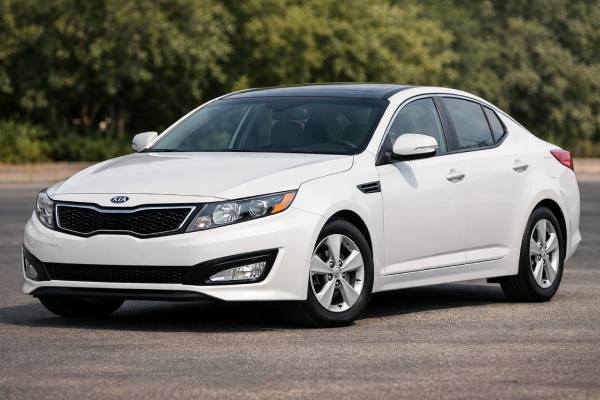

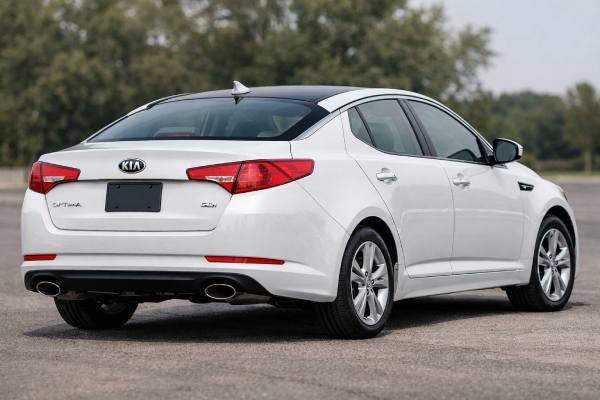
The 2011–2013 Kia Optima TF with the 2.4-liter G4KJ is one of those midsize sedans that can feel “newer” than its age suggests—quiet at a cruise, roomy in both rows, and stable at highway speeds. The headline engineering change for this generation was the move to a direct-injected (GDI) Theta II four-cylinder, giving strong midrange pull for daily driving while keeping the layout simple: naturally aspirated engine, front-wheel drive, and a conventional automatic in most markets. Ownership is mostly straightforward, but the powertrain rewards careful maintenance: clean oil at sensible intervals, a healthy cooling system, and attention to fuel quality and carbon build-up patterns typical of GDI engines. If you shop smart and verify service history, the Optima TF can still be a comfortable, value-focused sedan with a solid safety structure and a modern driving feel.
Quick Specs and Notes
- Strong everyday acceleration for a non-turbo midsize, especially from 40–100 km/h (25–62 mph)
- Comfortable ride with good high-speed stability and a quiet cabin on smooth asphalt
- GDI engine benefits from shorter oil intervals and regular intake-system attention over time
- Inspect brakes and suspension bushings every 20,000 km (12,500 mi) or 12 months
- Plan coolant service at 5 years / 100,000 km if history is unclear, even if long-life coolant is fitted
Navigate this guide
- Kia Optima TF 2011–2013 in depth
- Kia Optima TF 2.4 specs tables
- Kia Optima TF trims and safety tech
- Reliability and known weak points
- Maintenance plan and buying tips
- On-road feel and fuel use
- Rivals comparison and verdict
Kia Optima TF 2011–2013 in depth
The 2011–2013 Optima TF sits in the “do-it-all” part of the midsize sedan segment: family space, long-distance comfort, and running costs that can stay reasonable if the car has been treated well. With the G4KJ 2.4-liter (200 hp in your listed spec), the goal is not sports-sedan drama—it is easy torque delivery, predictable front-wheel-drive grip, and relaxed highway manners.
What owners notice first is the chassis balance. The suspension tuning typically favors composure over sharpness: it absorbs broken city pavement without constantly crashing into the cabin, yet it feels planted at 120–140 km/h. Steering is light to medium in effort and usually consistent, though feedback is limited compared with older hydraulic systems. In normal driving, the car tracks straight and resists crosswinds better than many smaller sedans.
The 2.4 GDI engine is the defining mechanical feature. Gasoline direct injection improves response and power density, but it also changes ownership realities: intake valves do not get “washed” by fuel, so deposits can build over time, especially with short trips and frequent cold starts. That does not mean the engine is automatically troublesome—it means the car likes longer drives, good oil, and a maintenance mindset that prevents small issues from growing into expensive ones.
Cabin and practicality are genuine strengths. Rear-seat legroom is typically competitive for the class, and the trunk is usable for travel bags or a weekly shop. Most examples have enough sound insulation to make long trips pleasant, which matters more than raw acceleration once the novelty wears off.
The best way to think about this Optima is as a comfortable, modern-feeling sedan that rewards verification. A clean service record, proof of oil changes at sensible intervals, and evidence that recalls and software updates were handled are worth more than a slightly lower purchase price.
Kia Optima TF 2.4 specs tables
Below are practical, ownership-focused specifications for the 2011–2013 Optima TF with the G4KJ 2.4 GDI. Exact figures can vary by market, emissions calibration, wheel size, and transmission, so treat the tables as a “what to expect” baseline and verify by VIN where possible.
Powertrain and efficiency
| Item | Specification |
|---|---|
| Code | G4KJ |
| Engine layout and cylinders | Inline-4 (I-4), DOHC, 4 valves/cyl (16V) |
| Bore × stroke | 88.0 × 97.0 mm (3.46 × 3.82 in) |
| Displacement | 2.4 L (2359 cc) |
| Induction | Naturally aspirated |
| Fuel system | GDI (direct injection) |
| Compression ratio | ~11.3:1 (market-dependent) |
| Max power | 200 hp (147 kW) @ ~6300 rpm (market-dependent) |
| Max torque | ~250 Nm (184 lb-ft) @ ~4250 rpm (market-dependent) |
| Timing drive | Chain |
| Rated efficiency | Typically ~7.8–9.5 L/100 km (30–24 mpg US / 36–29 mpg UK) depending on transmission and market test cycle |
| Real-world highway @ 120 km/h | Often ~6.8–7.8 L/100 km (35–30 mpg US / 42–36 mpg UK) with correct tyre pressures and steady cruising |
Transmission and driveline
| Item | Specification |
|---|---|
| Transmission | 6-speed automatic (common); 6-speed manual (some markets) |
| Drive type | FWD |
| Differential | Open |
Chassis and dimensions
| Item | Specification |
|---|---|
| Suspension (front/rear) | MacPherson strut / multi-link |
| Steering | Electric power steering (EPS); ratio varies by market/trim |
| Brakes | 4-wheel discs; diameters vary by trim (larger on sport trims) |
| Wheels/tyres (common sizes) | 215/55 R17 or 225/45 R18 (popular) |
| Ground clearance | ~150 mm (5.9 in) (approx., market/tyre dependent) |
| Length / width / height | ~4845 / 1830 / 1455 mm (190.7 / 72.0 / 57.3 in) |
| Wheelbase | ~2795 mm (110.0 in) |
| Turning circle (kerb-to-kerb) | ~10.9–11.2 m (35.8–36.7 ft) |
| Kerb (curb) weight | ~1460–1560 kg (3219–3439 lb), depending on transmission and equipment |
| GVWR | Market-dependent; verify door-jamb label |
| Fuel tank | ~70 L (18.5 US gal / 15.4 UK gal) (common) |
| Cargo volume | ~415 L (14.7 ft³), method varies by market |
Performance and capability
| Item | Typical figure |
|---|---|
| 0–100 km/h (0–62 mph) | ~8.5–9.5 s (transmission and traction dependent) |
| Top speed | ~205–215 km/h (127–134 mph), market dependent |
| Braking distance 100–0 km/h | Commonly ~37–40 m (approx.; tyres and test method matter) |
| Towing capacity | Often limited; many markets list no braked towing rating—verify local homologation |
| Payload | Market-dependent; verify door-jamb label |
Fluids and service capacities (common service values)
| Item | Specification (verify by VIN) |
|---|---|
| Engine oil | 5W-20 or 5W-30 meeting API/ILSAC specs; capacity ~4.8–5.0 L (5.1–5.3 US qt) with filter |
| Coolant | Long-life ethylene-glycol coolant; typical ~6.5–7.5 L (6.9–7.9 US qt) total system |
| Automatic transmission/ATF | SP-IV-type fluid (typical for Hyundai/Kia 6AT); total fill often ~7.0–7.5 L (7.4–7.9 US qt), drain/fill less |
| Manual transmission | MTF spec varies; verify service info |
| A/C refrigerant | R-134a; charge varies by market and condenser type (commonly ~500–650 g) |
| Key torque specs (common) | Wheel lug nuts ~90–110 Nm (66–81 lb-ft); spark plugs ~20–25 Nm (15–18 lb-ft); oil drain plug often ~35–40 Nm (26–30 lb-ft) |
Safety and driver assistance (period-correct)
| Item | Notes |
|---|---|
| Crash ratings | NHTSA: many 2011 Optima variants received a 5-star overall rating (verify by exact body/drive configuration). IIHS: strong performance in several crashworthiness categories for 2011–2015 applicability. Euro NCAP: a public four-pillar percentage page is not consistently available for this exact TF listing in the current database; use regional equivalents and official documentation where applicable. |
| Headlight rating (IIHS) | Depends on headlamp type and trim; check the exact configuration on the rating page |
| ADAS suite | For 2011–2013, most cars rely on ABS, ESC, traction control, and airbags; advanced AEB/ACC/LKA are generally not standard in this period |
Kia Optima TF trims and safety tech
Trims and equipment for the Optima TF vary widely by region, but the ownership approach stays the same: identify what the car actually has, then maintain the specific systems that come with that trim. In many markets you will see a base trim (often cloth seats and smaller wheels), a mid-trim with comfort upgrades (dual-zone climate, better audio, parking sensors or camera), and a sport-oriented trim with larger wheels and visual changes. The 2.4 GDI is common across trims, but gear ratios, wheel/tyre packages, and brake sizes can change how the car feels and what it costs to refresh.
Quick identifiers that help buyers
- Wheel size and brake feel: 18-inch packages usually sharpen steering response but can ride firmer and cost more in tyres. They may also come with larger front brakes, which is a plus for repeated high-speed stops.
- Interior clues: higher trims often have power seats (sometimes with memory), upgraded materials, and more steering-wheel buttons. If you see heated rear seats or ventilated front seats, you are usually looking at an upper trim.
- Tech packages: navigation-era head units often have different amplifiers and speaker layouts. When these fail, repair paths differ (simple head unit swap vs. amplifier diagnosis).
Year-to-year notes (2011–2013)
Within this window, changes are usually about infotainment revisions, small feature shuffles, and mid-cycle tweaks rather than major mechanical redesign. That matters because parts catalogs and wiring differ—especially for cameras, parking sensors, and steering-wheel controls. When you buy used, confirm that everything works: pairing Bluetooth, checking that the reverse camera is clear, and ensuring all window switches and seat motors operate smoothly.
Safety structure and restraint systems
For this generation, most trims include a strong baseline: front airbags, side torso airbags, and full-length curtain airbags are common, paired with ABS and ESC. Child-seat hardware is typically ISOFIX/LATCH-equipped, but the exact anchor locations and top-tether routing are worth verifying in person—especially if you plan to install a child seat frequently.
Driver assistance reality check
For 2011–2013, “driver assistance” usually means stability control and traction control doing the heavy lifting. If you are coming from a newer car with AEB and lane support, expect a more manual safety workload: you manage following distance and lane discipline without electronic back-up. That said, the Optima’s predictable handling and stable braking make it easy to drive smoothly, which is a practical safety advantage in daily traffic.
After service work—especially steering alignment, brake work, or airbag-related repairs—always confirm that warning lights are off and that the steering wheel is centered. These small checks catch problems early, before they become inspection failures or safety concerns.
Reliability and known weak points
A well-kept Optima TF can be dependable, but the GDI Theta II family has a reputation that makes it important to evaluate condition, service history, and update status rather than assuming all cars behave the same. Below is a practical map of common issues, what they feel like, and what typically fixes them.
Common (high prevalence)
- Oil consumption and oil-quality sensitivity (medium to high cost if ignored)
Symptoms: dipstick level drops between services, ticking on cold start, sluggish response, or oil smell near the exhaust.
Likely causes: extended oil intervals, ring deposits, PCV system issues, and general wear patterns that some GDI engines develop faster with short trips.
Remedy: shorten oil intervals, use the correct spec oil, confirm PCV function, and address leaks quickly. If consumption is severe, a proper diagnosis matters before buying. - Carbon build-up on intake valves (medium cost, mileage-dependent)
Symptoms: rough idle, hesitant acceleration, misfire codes, reduced fuel economy—often more noticeable after many short trips.
Likely cause: GDI design keeps fuel out of the intake tract, so deposits can accumulate.
Remedy: professional intake cleaning (methods vary), plus driving patterns that include longer fully-warmed trips. - Ignition coil and spark plug wear (low to medium cost)
Symptoms: misfires under load, check-engine light, rough running.
Likely causes: aged coils, incorrect plug type, or stretched intervals.
Remedy: replace with correct plug spec and quality coils; avoid bargain parts that fail early.
Occasional (moderate prevalence)
- High-pressure fuel system quirks (medium cost)
Symptoms: hard starts, stumble, fuel pressure codes, hesitation at higher load.
Likely causes: high-pressure pump wear, injector issues, or sensor faults.
Remedy: test fuel pressure properly; replace components only after confirmation because guesswork gets expensive fast on GDI. - Cooling system aging (low to medium cost, can become high)
Symptoms: slow coolant loss, sweet smell, temperature creep in traffic, weak heater performance.
Likely causes: hose aging, radiator seepage, thermostat sticking, or water pump wear.
Remedy: pressure test, fix small leaks early, and keep coolant service current.
Rare but serious (low prevalence, high severity)
- Bottom-end bearing failure risk on some Theta II applications (high cost)
Symptoms: metallic knocking, flashing oil light, sudden power loss, heavy vibration, or metal in oil.
Likely causes: multiple contributing factors reported across markets and model years; risk varies by production batch and maintenance history.
Remedy: verify recall campaigns and software updates, check for documented engine work, and avoid any car with unexplained noise or poor oil history.
Recalls, TSBs, and verification
Because recall status can change ownership outcomes, treat it as part of reliability, not paperwork. When you inspect a candidate car:
- Request full service history and proof of campaign completion.
- Verify by VIN through an official recall database and confirm with a dealer record where possible.
- Ask what oil interval was used in real life, not what the owner intended.
A strong Optima TF is usually one with boring evidence: regular oil services, cooling system kept healthy, no persistent warning lights, and a smooth idle when fully warm.
Maintenance plan and buying tips
A good maintenance rhythm is the difference between an Optima TF that feels smooth at 250,000 km and one that becomes a money pit at 160,000 km. The schedule below is intentionally practical: it assumes mixed driving and the realities of a GDI engine.
Practical maintenance schedule (distance/time)
| Item | Interval (typical) | Notes |
|---|---|---|
| Engine oil and filter | 8,000–10,000 km (5,000–6,000 mi) or 12 months | Shorter if mostly city, short trips, hot climates, or hard driving |
| Tyre rotation and pressure check | 10,000–12,000 km (6,000–7,500 mi) | Keeps handling consistent and reduces road noise |
| Engine air filter | 20,000–30,000 km (12,500–18,500 mi) | More often in dusty areas |
| Cabin air filter | 15,000–20,000 km (9,000–12,500 mi) | Helps HVAC performance and reduces blower strain |
| Brake inspection | Every 20,000 km (12,500 mi) | Include pad thickness, slider pins, and rotor condition |
| Brake fluid | Every 2 years | Moisture reduces braking performance under heat |
| Coolant | If unknown: now; otherwise 5 years / 100,000 km baseline | Long-life coolant can last longer, but history matters more than claims |
| Spark plugs | 100,000–160,000 km (62,000–100,000 mi) | Use correct heat range/type; GDI is sensitive to ignition quality |
| Automatic transmission fluid | 60,000–80,000 km (37,000–50,000 mi) | Drain-and-fill is common; avoid “lifetime” myths |
| Serpentine belt and hoses | Inspect at 60,000 km; replace by condition | Cracks, glazing, or noise are replacement triggers |
| Timing chain system | No fixed interval; inspect by symptoms | Rattle, correlation codes, or poor running warrant diagnosis |
| 12 V battery test | Annually after 4 years | Weak voltage causes false warning lights and sensor errors |
| Alignment check | Yearly or after tyre replacement | Reduces tyre wear and keeps steering stable |
Fluids, specs, and decision-making notes
Use oil that meets the correct standard, not just the right viscosity. A high-quality 5W-20 or 5W-30 is common depending on market and climate. For automatics, insist on the correct ATF spec (often SP-IV type for Hyundai/Kia 6-speed units). Mixing “close enough” fluids is a classic way to create shift shudder or accelerated wear.
For torque values, treat these as common reference ranges, not universal truth: wheel lug nuts around 90–110 Nm, spark plugs around 20–25 Nm, and oil drain plugs often in the 35–40 Nm range. If you do your own work, use the proper service manual for your VIN.
Buyer’s guide: what to check before purchase
- Cold start behavior: listen for rattles, harsh ticking, or uneven idle. A brief normal tick is different from deep knocking.
- Warm idle and smoothness: a healthy GDI engine should idle steadily once warmed up; stumbling can hint at deposits or ignition issues.
- Transmission quality: in a 6-speed automatic, shifts should be decisive and consistent. Flare, harsh bangs, or hesitation deserve diagnosis.
- Cooling system integrity: look for dried coolant residue, damp hose joints, or a low expansion tank with no explanation.
- Brakes and suspension: listen for clunks over bumps (bushings/links) and feel for brake pulsation (warped rotors or uneven pad deposits).
- Electrics and infotainment: test every window, mirror, seat motor, camera, and steering-wheel control—repairs can be time-consuming.
- Corrosion hotspots: check rear subframe areas, brake lines (region-dependent), and door/trunk seams.
Durability outlook: With consistent oil service, healthy cooling, and correct fluids, the Optima TF can age well. Without those basics, small issues stack up quickly—especially on a GDI engine.
On-road feel and fuel use
In real-world driving, the Optima TF 2.4 feels more confident than the spec sheet suggests. The engine’s character is smooth and willing: it does not need constant high rpm, but it also does not deliver diesel-like shove at very low rpm. The best performance is usually in the midrange—think passing from 60 to 120 km/h—where the GDI engine pulls cleanly if the transmission kicks down promptly.
Ride, handling, and NVH (noise, vibration, harshness)
- Ride: tuned for comfort first. On 17-inch wheels it typically feels more compliant; 18-inch packages sharpen response but can add impact harshness on potholes.
- Handling balance: predictable front-end grip with mild understeer when pushed. This is not a flaw—on public roads it is an easy, stable setup.
- Steering: light to moderate effort, accurate enough for highway placement, but not especially chatty.
- Braking feel: usually consistent if the caliper sliders are maintained and the brake fluid is kept fresh. A spongy pedal often points to old fluid or air in the system.
- Cabin noise: generally low at steady speed, though tyre choice can change the sound profile dramatically.
Powertrain behavior
The 6-speed automatic (where fitted) tends to favor efficiency in gentle driving, holding higher gears early. In stop-and-go traffic, a well-maintained unit should still feel smooth. If you feel repeated hunting between gears or shudder on light throttle, check fluid condition and software updates before assuming a major mechanical failure.
Real-world efficiency
For mixed driving, many owners see something like 8.5–9.5 L/100 km (28–25 mpg US / 33–30 mpg UK), with city-heavy use pushing higher and steady highway cruising improving results. At 120 km/h, a healthy car on appropriate tyres can often stay around 6.8–7.8 L/100 km (35–30 mpg US / 42–36 mpg UK). Winter conditions, short trips, and heavy HVAC use can add a noticeable penalty.
What changes the driving experience most
- Tyres: quality touring tyres reduce noise and improve wet grip more than many owners expect.
- Alignment: slight misalignment can make the car feel “busy” on the highway and chew tyres quickly.
- Engine health: a clean intake tract, fresh plugs, and stable fuel pressure keep throttle response crisp—small maintenance items that pay back every day.
If you want a sedan that is easy to live with rather than constantly “interesting,” the Optima TF’s calm road manners are a genuine advantage.
Rivals comparison and verdict
The Optima TF 2.4 competes with the mainstream midsize crowd, and its strengths make more sense when you compare ownership realities.
Against Toyota Camry (2.5 gasoline)
- Camry advantage: reputation for low drama, wide parts availability, and a conservative engine tune that often tolerates neglect better.
- Optima advantage: cabin design and “modern feel” for the money, with a stable highway personality.
- Ownership takeaway: if you prioritize minimum risk and maximum resale, the Camry often wins. If you want value and comfort and can verify maintenance, the Optima can be the better buy.
Against Honda Accord (2.4 gasoline)
- Accord advantage: typically sharp steering response and strong efficiency, with a long-standing reliability narrative.
- Optima advantage: often quieter at cruise and sometimes better-equipped at the same used price point.
- Ownership takeaway: choose the Accord if you want a more “connected” drive; choose the Optima if equipment and comfort per dollar matter most.
Against Hyundai Sonata (2.4 gasoline)
- Shared DNA: similar platform and engineering philosophy, often similar maintenance needs and similar strengths in comfort and packaging.
- Decision point: buy on condition, records, and equipment rather than brand preference. A well-kept example beats a neglected one every time.
Against Mazda6 (2.5 gasoline)
- Mazda advantage: often more engaging chassis feel and steering feedback.
- Optima advantage: typically softer ride and a more relaxed, quiet long-trip character.
- Ownership takeaway: if you want comfort and value, Optima; if you want driver engagement, Mazda6.
Verdict: who should buy the Optima TF 2.4?
Buy it if you want a comfortable midsize sedan that still feels contemporary, and you are willing to shop carefully. The smart play is to treat maintenance history as a feature: prioritize documented oil services, verify recall and update completion, and test for smooth idle and clean shifting. When those boxes are checked, the Optima TF can be an excellent “daily life” car—quiet, spacious, and satisfying without demanding constant attention.
References
- 2012 Kia Optima 2012 (Safety Rating)
- Vehicle Detail Search – 2011 KIA OPTIMA 4 DR FWD | NHTSA 2011 (Recall Database)
- Kia Optima | Safety Rating & Report | ANCAP 2011 (Safety Rating)
- 2011 KIA OPTIMA EARNS FIVE-STAR CRASH SAFETY RATING FROM U.S. GOVERNMENT 2011 (Manufacturer Publication)
Disclaimer
This article is for informational purposes only and is not a substitute for professional diagnosis or repair. Specifications, torque values, service intervals, and procedures vary by VIN, market, and equipment; always verify details against official service documentation for your exact vehicle and follow qualified technician guidance when safety-critical work is involved.
If you found this guide useful, please consider sharing it on Facebook, X (Twitter), or your favorite forum to support our work.