
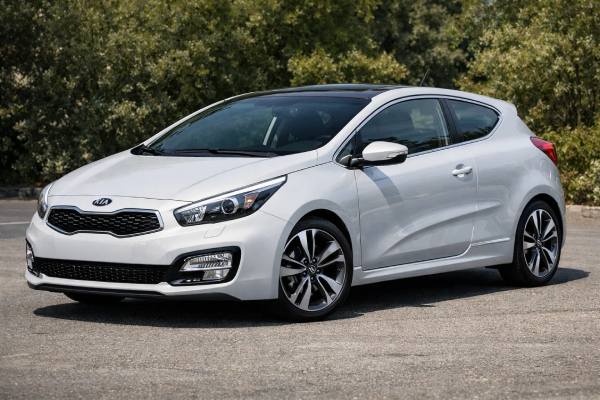
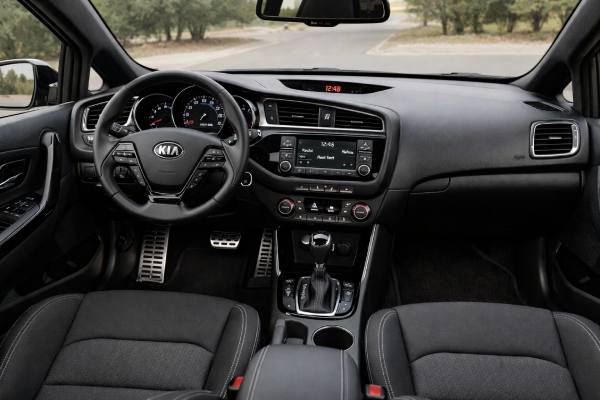
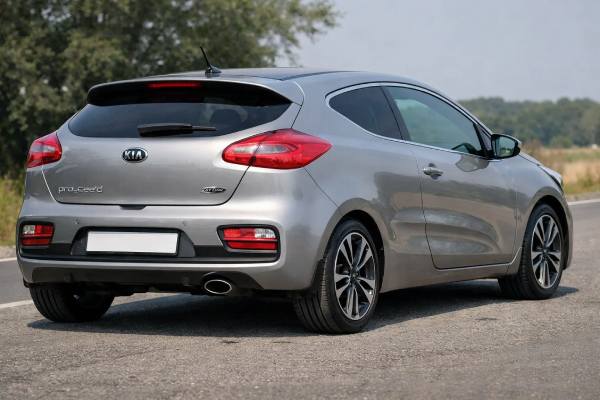
The 2015–2018 facelift Kia Pro Cee’d (JD) with the 1.4 Gamma MPi is the “simple petrol” choice in the range: naturally aspirated, multi-point injection, and tuned for everyday drivability rather than outright speed. That matters for ownership. With fewer turbo- and direct-injection-specific parts, this version tends to be easier to live with, easier to diagnose, and generally more tolerant of mixed driving—if you keep up with basic service items.
What you give up is effortless motorway punch and the strongest fuel economy in the lineup. What you get back is predictable throttle response, lower thermal stress, and a powertrain that usually rewards regular oil changes and good cooling-system care. If you’re shopping the facelift years, focusing on maintenance history and equipment level will typically matter more than chasing the lowest mileage.
What to Know
- Smooth, predictable power delivery suits city use and new drivers better than it suits fast motorway overtakes.
- Simple MPi fueling can mean fewer DI carbon-related headaches and less sensitivity to short-trip use.
- Expect best results on mid-grade tyres and fresh suspension bushes; worn rear bushes change the car’s balance quickly.
- Budget for ignition service: spark plugs are a key drivability item around 60,000–90,000 km (40,000–55,000 mi) depending on plug type and use.
- Keep oil-change discipline: 12 months or 10,000–15,000 km is a sensible target for mixed driving, even if your booklet allows longer.
Contents and shortcuts
- Pro Cee’d JD 1.4 MPi focus
- Pro Cee’d JD 1.4 MPi specifications
- Pro Cee’d JD trims and safety kit
- Reliability patterns and fixes
- Maintenance schedule and buying tips
- Driving feel and efficiency
- Rivals and value verdict
Pro Cee’d JD 1.4 MPi focus
If you want the facelifted Pro Cee’d shape but prefer the lowest-complexity petrol engine, the 1.4 Gamma MPi is the lineup’s “no drama” option. It’s a naturally aspirated inline-four with multi-point injection (MPi). That combination is usually friendlier to short trips than direct injection, and it avoids turbocharger heat and boost control hardware. In practical terms: fewer high-cost parts, fewer failure modes, and a driving feel that stays consistent as the car ages.
The trade-off is straightforward performance. With about 100 hp, the Pro Cee’d is happiest driven with momentum. It will cruise at motorway speeds without strain, but brisk overtakes need planning and a downshift. Owners who come from small turbo engines sometimes describe it as “quiet but not urgent”—because it doesn’t deliver that low-rpm surge. The upside is throttle predictability in the wet and snow, and generally smoother power delivery for new drivers.
The facelift years matter for two reasons. First, equipment and infotainment improved, and some markets bundled more safety features into option packs. Second, by this point most cars have well-established service histories—good and bad. On this engine, history is everything: clean oil, on-time coolant service, and evidence of ignition maintenance tend to correlate strongly with a smooth idle and stable fuel economy.
What should you expect to replace as the car reaches higher mileage? Not exotic parts—mostly normal wear: coil packs (occasionally), spark plugs, engine mounts, suspension links/bushings, and brake hardware. The Pro Cee’d’s longer doors also mean hinge wear and occasional trim rattles become more noticeable than on the five-door.
Who is it best for? City and suburban drivers, learners, and buyers who want a sporty-looking three-door hatch but prefer predictable running costs over maximum performance. If you commute long motorway stretches at high speed, tow frequently, or live for quick overtakes, you’ll likely prefer a stronger engine. But if you want a simple petrol C-segment hatch that you can maintain without surprises, the 1.4 MPi facelift Pro Cee’d is a sensible, ownership-first pick.
Pro Cee’d JD 1.4 MPi specifications
Below are practical, ownership-relevant specs for the facelift Pro Cee’d (JD) with the 1.4 Gamma MPi around 100 hp. Exact figures can vary slightly by market, gearbox, wheel size, and emissions calibration, so treat these as typical ranges and verify against the VIN-specific handbook for your car.
Powertrain and efficiency (typical)
| Item | Specification |
|---|---|
| Code | Gamma MPi (commonly G4FA in many markets) |
| Engine layout and cylinders | Inline-4 (I-4), DOHC, 16 valves (4 valves/cyl) |
| Displacement | 1.4 L (≈ 1,396 cc) |
| Bore × stroke | ≈ 77.0 × 74.1 mm (3.03 × 2.92 in) |
| Induction | Naturally aspirated (NA) |
| Fuel system | Multi-point injection (MPi) |
| Compression ratio | Typically ~10.5:1 (market dependent) |
| Max power | ≈ 100 hp (≈ 74 kW) @ ~5,500–6,000 rpm |
| Max torque | ≈ 134 Nm (≈ 99 lb-ft) @ ~4,000–4,200 rpm |
| Timing drive | Chain |
| Rated efficiency (combined) | ~5.8–6.5 L/100 km (≈ 40–49 mpg UK / 31–40 mpg US) |
| Real-world highway @ 120 km/h | ~6.4–7.4 L/100 km (≈ 38–44 mpg UK / 28–37 mpg US) |
Transmission and driveline
| Item | Specification |
|---|---|
| Transmission | Usually 6-speed manual (market dependent) |
| Drive type | FWD |
| Differential | Open |
Chassis and dimensions (Pro Cee’d body, typical)
| Item | Specification |
|---|---|
| Suspension (front/rear) | MacPherson strut / Multi-link (typical JD setup) |
| Steering | Electric power steering (EPS), rack-and-pinion |
| Brakes | Ventilated front discs / rear discs (sizes vary by trim) |
| Wheels and tyres (common) | 195/65 R15 or 205/55 R16 (market/trim dependent) |
| Ground clearance | ~140–150 mm (5.5–5.9 in) |
| Length / width / height | ~4,310 / 1,780 / 1,430 mm (170 / 70 / 56 in) |
| Wheelbase | ~2,650 mm (104.3 in) |
| Turning circle (kerb-to-kerb) | ~10.4–10.8 m (34–35 ft) |
| Kerb weight | ~1,200–1,320 kg (2,646–2,910 lb) |
| Fuel tank | ~53 L (14.0 US gal / 11.7 UK gal) |
| Cargo volume | Typically ~380 L seats up (VDA), less with space-saver/full-size spare |
Performance and capability (typical)
| Metric | Value |
|---|---|
| 0–100 km/h (0–62 mph) | ~12.5–13.5 s |
| Top speed | ~180–190 km/h (112–118 mph) |
| Braking 100–0 km/h | ~38–42 m (test and tyre dependent) |
| Towing capacity | Often modest; commonly ~1,200 kg braked / ~500–600 kg unbraked (verify by VIN plate) |
| Payload | Typically ~450–550 kg (trim dependent) |
Fluids and service capacities (decision-useful guidance)
| Fluid | Practical guidance |
|---|---|
| Engine oil | Use the handbook’s spec; many markets allow ACEA A5 with 5W-30 viscosity. Capacity is typically ~3.3–3.6 L (≈ 3.5–3.8 US qt) including filter, depending on sump/variant. |
| Coolant | Long-life OAT type is common; verify mix ratio and capacity in the handbook. |
| Manual gearbox oil | Usually a GL-4 spec oil; capacity varies by gearbox code. |
| A/C refrigerant | Often R-134a on these years (market dependent); charge amount is label-specific. |
Safety and driver assistance (typical equipment)
| Item | Notes |
|---|---|
| Crash ratings | Euro NCAP 5-star era for this generation; confirm year/protocol details for your market |
| Core systems | ABS, ESC, hill-start assist common; TPMS varies by market |
| ADAS | Often limited on lower trims; AEB/lane support may be absent or only in later option packs in some regions |
Pro Cee’d JD trims and safety kit
Trim naming varies widely by country, but the facelift Pro Cee’d range typically followed a familiar ladder: an entry trim focused on value, mid trims with comfort features, and top trims adding infotainment and appearance upgrades. With the 1.4 MPi, the key is not chasing badges—it’s confirming the equipment you care about and checking whether it’s factory-fitted or retrofit.
Trims and options that change ownership
Some options affect day-to-day costs more than you’d expect:
- Wheel size and tyre profile: 15–16 inch wheels usually ride better and cost less to maintain. Larger wheels can sharpen steering response but increase tyre spend and make the car more sensitive to potholes.
- Lighting packages: If your car has projector or LED elements, replacement costs can be higher. Confirm headlamp condition and whether the beam pattern is clean and even.
- Infotainment and navigation: Factory systems are integrated better than many aftermarket solutions, but they age in screen brightness and touch response. Check for Bluetooth stability and USB charging reliability.
- Climate control: Dual-zone setups add comfort and resale appeal but also add blend-door actuators and more sensors—still manageable, but worth testing.
Quick identifiers when viewing a used car
- Wheel and brake hardware: Larger brakes often accompany higher trims; look through the wheel spokes for rotor size and caliper design.
- Interior tells: Seat fabric/leather patterns, steering wheel controls, and the presence of a reversing camera are faster indicators than seller descriptions.
- VIN and build plate: Use these to confirm engine family and rated towing capacity rather than relying on the boot badge.
Safety ratings and what they mean
For this generation of C-segment hatchbacks, strong structural performance and standard stability control were a major selling point. A Euro NCAP “5-star” score from the era is reassuring, but remember two things:
- Protocols change. A five-star result from 2012–2015 is not directly comparable to a five-star result from today. Use it as a baseline, not a guarantee.
- Trim matters. Safety Assist points can depend on whether certain systems (like seatbelt reminders or speed assistance) are standard.
Safety systems and ADAS availability
Expect the core set on most cars:
- Front, side, and curtain airbags (count and placement vary by market)
- ABS and ESC (electronic stability control)
- ISOFIX/LATCH child-seat mounts (usually outer rear seats)
Advanced driver assistance (AEB, lane keeping, blind-spot monitoring) is often limited on the 1.4 MPi trims. If the car claims AEB or lane features, confirm with a physical check (camera/radar modules, correct steering wheel buttons, and menu settings). After windscreen replacement or front-end repair, calibration may be required for camera-based systems—so inspect the windscreen for non-OE markings and ask for invoices.
If safety is your primary goal, prioritize: tyres in good condition, straight braking, no warning lights, and evidence of quality repairs. On older cars, these fundamentals often matter more than a thin layer of optional driver aids.
Reliability patterns and fixes
The 1.4 Gamma MPi is generally a straightforward engine, but “simple” does not mean “ignore it.” Most problems on this model are either maintenance-related (fluids, ignition, cooling) or age-related (rubber, sensors, corrosion). The most useful way to judge a used example is to separate issues by prevalence and by cost.
Common issues (more likely)
- Ignition coils and plugs (low–medium cost):
Symptoms: misfire under load, rough idle, flashing engine light.
Likely causes: worn plugs, weak coil, oil contamination in plug wells (sometimes from a tired valve cover gasket).
Remedy: replace plugs with correct heat range; replace failing coil(s); inspect for oil leaks and repair the gasket if needed. - Intake and vacuum leaks (low cost, high annoyance):
Symptoms: unstable idle, lean-code faults, hesitation.
Likely causes: ageing hoses, intake boot cracks, PCV valve issues.
Remedy: smoke test, replace hoses/boots/PCV as needed. - Engine mounts (medium cost):
Symptoms: vibration at idle, clunks on take-up, harshness on gear changes.
Likely causes: collapsed rubber mounts with age.
Remedy: replace the worn mount(s), then check exhaust flex joint alignment.
Occasional issues (watch for them)
- Cooling system seepage (medium cost if caught early):
Symptoms: coolant smell, low level, dampness near radiator end tanks or hoses.
Likely causes: ageing hose clamps, radiator plastic tanks, thermostat housing seals.
Remedy: pressure test, replace weak components, and bleed the system correctly. - Oxygen sensors or catalyst efficiency faults (medium–high):
Symptoms: check engine light, higher fuel use, failed emissions test.
Likely causes: tired O2 sensor, exhaust leaks, ageing catalyst.
Remedy: diagnose with live data; fix leaks first; replace sensor/cat only when proven. - Manual gearbox wear (medium cost):
Symptoms: notchy shifts, reluctance into second when cold, clutch bite changes.
Likely causes: old gear oil, worn linkage bushings, clutch wear.
Remedy: refresh gearbox oil where allowed, inspect linkage, and evaluate clutch condition.
Rare but expensive (verify history)
- Timing chain noise/stretch (high if ignored):
Timing chains are “lifetime” only when oil quality is good.
Symptoms: rattling on cold start, correlation faults, rough running.
Remedy: confirm oil service history; if symptoms exist, measure stretch and replace chain/tensioner/guides as needed.
Software, calibrations, and service actions
Most cars won’t need frequent ECU updates, but drivability quirks (idle stability, throttle mapping, sensor plausibility) are sometimes improved by dealer software. If a seller mentions a reflash, ask what it fixed and whether it was part of a formal service action.
Recalls and how to verify completion
Rather than guessing from internet lists, verify by registration/VIN through an official recall checker and confirm with dealer service records. A completed recall should show a date and campaign code on an invoice or in the service history. If documentation is missing, treat it as incomplete until proven otherwise—especially for safety-related campaigns.
Maintenance schedule and buying tips
A good maintenance plan for the 1.4 MPi is not complicated—just consistent. The goal is to protect the timing chain, keep ignition strong, and prevent cooling problems before they become expensive. Use distance or time, whichever comes first.
Practical maintenance schedule (mixed driving)
- Engine oil and filter: every 10,000–15,000 km or 12 months.
If you do mostly short trips, lean toward the shorter end. Clean oil is the best insurance for chain tensioners and valvetrain wear. - Air filter (engine): inspect every 15,000 km, replace every 30,000 km (sooner in dusty areas).
- Cabin filter: every 15,000–30,000 km or 12 months if you value HVAC performance.
- Spark plugs: typically 60,000–90,000 km depending on plug type and usage.
If you feel hesitation or see rising fuel consumption, don’t wait for the maximum interval. - Brake fluid: every 2 years regardless of mileage.
- Coolant: commonly 5 years / 100,000 km for long-life coolant, then every 2–3 years afterward (verify by handbook and coolant type).
- Manual gearbox oil: not always listed as routine, but a 60,000–100,000 km change can improve shift feel and longevity (use only the correct spec).
- Tyres: rotate every 10,000–12,000 km; check alignment annually or after pothole hits.
- 12 V battery: test annually after year 4; many last 4–6 years depending on climate and use.
Fluids, specs, and a few torque values (decision-useful)
Because exact specs vary by market, use these as buying/ownership guidance, then confirm in your handbook:
- Oil viscosity: commonly 5W-30 where allowed; the handbook will specify the required performance standard (often ACEA/API categories).
- Oil capacity: typically ~3.3–3.6 L with filter; always verify after refill by checking the dipstick level after a short run and drain-back period.
- Wheel bolts: typically around 88–110 Nm (65–81 lb-ft) depending on wheel/hub spec—confirm for your vehicle before using a torque wrench.
Buyer’s guide checklist (what to inspect)
- Cold start behavior: listen for chain rattle, check idle stability, and confirm no warning lights.
- Service history proof: oil intervals, plug changes, coolant changes, and brake fluid receipts matter more than “only one owner.”
- Cooling system health: check coolant level and condition; look for crusty residue near hose joints and the radiator.
- Clutch and gearbox feel (manual): smooth take-up, no slipping in higher gears, no grinding into second.
- Suspension and tyres: uneven tyre wear suggests alignment or bush wear; listen for rear-link knocks over small bumps.
- Body and corrosion hotspots: inspect wheel arches, sills, and underbody seams; check that the long doors close cleanly without dropping.
Best-fit years and trims
For the facelift period, the “best” year is usually the one with the best documentation and the options you actually want. Mid trims often hit the sweet spot: enough equipment for comfort and resale without the highest wheel/tyre costs. If you prioritize long-term costs, choose smaller wheels, avoid heavily modified exhaust/intake setups, and prefer cars with evidence of careful warm-up habits and regular oil changes.
Driving feel and efficiency
The Pro Cee’d chassis is more “European hatchback” than many buyers expect from an affordability-focused brand. With the 1.4 MPi, that chassis character comes through clearly because the engine is linear and doesn’t mask the car’s dynamics with a turbo surge.
Ride, handling, and NVH
- Ride quality: On 15–16 inch wheels, the Pro Cee’d rides with a firm but controlled edge. It deals well with smooth motorway surfaces and doesn’t float, but sharp potholes can feel abrupt—especially on low-profile tyres.
- Handling balance: The rear multi-link setup helps the car feel planted mid-corner. Worn rear bushes, however, can make it feel nervous over bumps during cornering, so suspension condition matters.
- Steering: EPS steering is typically light at parking speeds and firmer at speed. Feedback is adequate rather than talkative, but the car tracks straight when alignment and tyres are correct.
- Cabin noise: Expect moderate road noise from the rear arches on coarse asphalt. Wind noise is usually well-controlled for the class, but door seals must be in good shape.
Powertrain character
The 1.4 MPi rewards a smooth, planned driving style:
- Throttle response: clean and predictable, especially in town.
- Low-rpm pull: modest; you’ll use the gearbox more than you would in a small turbo car.
- Overtaking: best done with a downshift and a clear gap; the engine is happier above mid-range rpm.
- Urban drivability: strong; it’s easy to meter power in traffic and on slippery surfaces.
Real-world fuel economy
Real-world results depend heavily on speed and traffic:
- City: commonly 7.0–8.5 L/100 km (≈ 33–40 mpg UK / 27–34 mpg US)
- Highway (100–120 km/h): commonly 6.4–7.4 L/100 km (≈ 38–44 mpg UK / 28–37 mpg US)
- Mixed: commonly 6.5–7.8 L/100 km (≈ 36–43 mpg UK / 30–36 mpg US)
Cold weather and short trips can add 10–20% consumption because the engine spends longer warming up. Tyre choice also matters: wider, stickier tyres can noticeably raise fuel use on motorway runs.
A few performance metrics that actually change the verdict
For most owners, the key number is not 0–100 km/h—it’s how the car feels from 60 to 100 km/h when joining traffic. In practice, keeping the engine in its stronger mid-to-upper range (with a downshift) is what makes the car feel confident. If you test drive one and it feels flat even with revs, suspect overdue plugs, a weak coil, or a restricted intake/exhaust rather than assuming “they all drive like that.”
Rivals and value verdict
The facelift Pro Cee’d 1.4 MPi sits in a crowded space: practical C-segment hatches where buyers want low running costs, safe handling, and reasonable comfort. Its strongest selling point is not being the fastest—it’s being predictable and generally easy to own.
How it compares to key rivals (ownership lens)
- Volkswagen Golf 1.4 (NA or small turbo, depending on year):
The Golf often feels more refined inside and may hold resale well, but repairs can be more expensive depending on engine and equipment. If you want a straightforward long-term commuter, compare service history quality rather than badge appeal. - Ford Focus 1.6 Ti-VCT (NA):
The Focus is usually a handling benchmark, with sharper steering feel. The Kia often counters with a strong equipment-to-price ratio and a calmer, less “busy” ride on the right wheels. - Opel/Vauxhall Astra 1.4 (NA):
Similar power-to-weight story. The Kia’s advantage is often simplicity and value, while the Astra may offer different comfort and seat ergonomics depending on trim. - Hyundai i30 1.4 MPi (closely related):
Often the closest match in mechanical layout. Choose based on the best example you can find: maintenance records, rust condition, and tyre/suspension wear matter more than brand differences.
Advantages that matter in daily use
- Simple fueling and linear response: MPi plus NA power makes the car forgiving and consistent.
- Chassis confidence: Good stability and predictable behavior, especially when the suspension is healthy.
- Value retention through condition: A clean, documented car often sells faster than a higher-spec car with vague history.
Where it falls short
- Performance headroom: Fully loaded motorway driving demands more downshifts than many modern engines.
- Economy sensitivity to speed: At 120–130 km/h, fuel use rises quickly compared with a small turbo in its torque band.
- Three-door practicality: The long doors are stylish but less convenient in tight parking and back-seat access.
Verdict
If you want the facelift Pro Cee’d look and a calm, low-complexity petrol engine, this version makes a strong case—provided the service history is solid. Buy on condition, not mileage alone. Prioritize a straight car with proof of oil changes, ignition maintenance, and recall completion. Do that, and the 1.4 MPi Pro Cee’d can be a reliable, sensible hatch that feels more grown-up than its power figure suggests.
References
- Kia Car Owners Manual | Kia UK 2026 (Owner’s Manual Portal)
- ICE and Hybrid Car Servicing 2026 (Service and Maintenance)
- Engine Oil Grades and Capacities 2016 (Service Document)
- Kia C’eed – Crash Test 2012 2012 (Safety Rating)
- Check if a vehicle, part or accessory has been recalled – GOV.UK 2018 (Recall Database)
Disclaimer
This article is for informational purposes only and is not a substitute for professional inspection, diagnosis, or repair. Specifications, torque values, fluids, and service intervals can vary by VIN, market, model year, and equipment. Always verify details against your vehicle’s official owner’s manual, service documentation, and identification plates.
If this guide helped, please consider sharing it on Facebook, X (Twitter), or your favorite forum to support our work.