
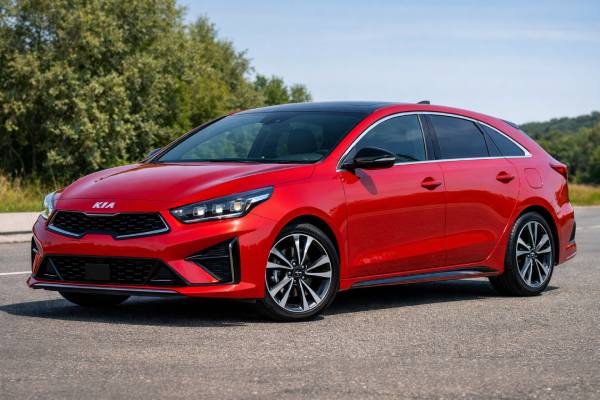
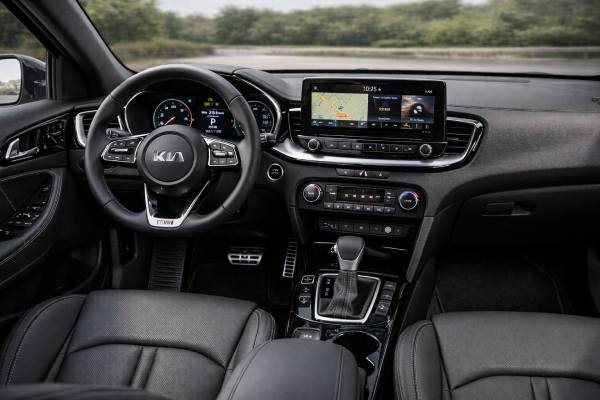

The facelifted Kia ProCeed (CD) with the 1.0 T-GDi is the “smart choice” configuration in this range: the same sleek shooting-brake body and long-roof practicality, paired with the lightest petrol engine in the lineup. In day-to-day use, that lower mass matters. It keeps steering effort natural, helps the front axle feel less loaded on broken pavement, and improves around-town fuel economy without forcing you into slow-car frustration—because the turbocharged three-cylinder makes its torque early.
For 2021–2024, the facelift also matters for ownership. You typically get updated lighting, fresher infotainment, and a more mature driver-assistance package than earlier cars. If you maintain it like a modern direct-injection turbo (clean oil, quality fuel, sensible warm-up and cooldown habits), this powertrain can be durable and inexpensive to run. The trick is choosing the right transmission and tire package for how you actually drive.
Essential Insights
- Strong everyday usability: big tailgate and long load floor, with city-friendly exterior footprint.
- Turbo torque arrives early, so it feels quicker than the power figure suggests in normal traffic.
- Facelift-era infotainment and driver assists are typically more complete than pre-2021 cars.
- Ownership caveat: direct-injection turbo engines dislike long oil intervals and constant short trips.
- Plan on engine oil and filter every 12 months or 10,000–15,000 km (6,000–9,000 mi), depending on use.
Start here
- Kia Proceed facelift 1.0 context
- Kia Proceed 1.0 spec tables
- Kia Proceed facelift trims and ADAS
- Common faults, recalls, and fixes
- Maintenance plan and buying tips
- Real driving, economy, comfort
- How it stacks up against rivals
Kia Proceed facelift 1.0 context
The ProCeed (CD) is a rare thing in today’s market: a compact wagon-shaped car that leans more “stylish grand tourer” than “utility box.” The 2021–2024 facelift keeps that core idea but tightens the details—most notably the lighting signatures, in-car tech, and the availability of newer driver-assistance features. For buyers who want the look and practicality of the ProCeed without the running costs or complexity of the higher-output engines, the 1.0 T-GDi is the rational entry point.
This engine is a turbocharged, direct-injection three-cylinder designed to deliver usable torque at low rpm. In daily commuting, that means fewer downshifts and less need to “chase revs” than you might expect from a 1.0-liter. It is not a hot-hatch setup—passing at highway speeds takes planning—but it stays composed when driven within its comfort zone. The bigger advantage is balance: the lighter engine typically makes the front end feel less heavy than the 1.5/1.6 variants, which can improve turn-in and reduce understeer on tighter roads.
Facelift-era cars also tend to be easier to live with: quicker infotainment responses, better phone integration, and more consistent lane and cruise behavior where those systems are fitted. On long trips, the ProCeed’s wheelbase and wagon proportions help stability, while the low roofline keeps aerodynamics and wind noise under control for the class.
The ownership profile is straightforward if you respect what this powertrain is: a small, boosted engine that rewards clean oil and sensible heat management. Short trips and neglected oil changes are the two patterns most likely to shorten turbo and timing-component life. If your driving is mostly urban, treat maintenance intervals as a maximum, not a suggestion. If your driving is mostly highway, the 1.0 can be surprisingly efficient and relaxed, especially on smaller wheels with higher-profile tires.
Who is it best for? Drivers who want the ProCeed shape for family life, hobbies, or work gear, but who value predictable costs over maximum performance. If you tow regularly, drive fully loaded in mountainous regions, or prioritize effortless high-speed passing, you will be happier with a larger engine. Otherwise, the 1.0 T-GDi facelift is a smart, modern daily that can stay inexpensive for years.
Kia Proceed 1.0 spec tables
Specs for the ProCeed (CD) vary by market, wheel size, and whether the car uses a mild-hybrid assist system in some regions. The tables below focus on the common 2021–2024 facelift-era 1.0 T-GDi configuration (118 hp / 120 ps), with ranges where equipment changes the numbers.
Powertrain and efficiency
| Item | Specification |
|---|---|
| Code | Kappa II T-GDi (market code varies) |
| Engine layout and cylinders | Inline-3, DOHC, 4 valves/cyl |
| Bore × stroke | ~71.0 × 84.0 mm (2.80 × 3.31 in) |
| Displacement | 1.0 L (998 cc) |
| Induction | Turbocharged (intercooled) |
| Fuel system | Gasoline direct injection (GDI) |
| Compression ratio | ~10.0:1 (varies by calibration) |
| Max power | 118 hp (88 kW) @ ~6,000 rpm (market dependent) |
| Max torque | ~172 Nm (127 lb-ft) @ ~1,500–4,000 rpm (typical) |
| Timing drive | Chain |
| Rated efficiency (combined) | ~5.7–6.3 L/100 km (41–37 mpg US / 50–45 mpg UK), wheel/gearbox dependent |
| Real-world highway @ 120 km/h | ~6.5–7.2 L/100 km (36–33 mpg US / 43–39 mpg UK) in mild weather |
Transmission and driveline
| Item | Specification |
|---|---|
| Transmission | 6-speed manual common; 7-speed DCT available in some markets/years |
| Drive type | FWD |
| Differential | Open (traction via brake-based stability control) |
Chassis and dimensions
| Item | Specification |
|---|---|
| Suspension (front/rear) | MacPherson strut / multi-link |
| Steering | Electric power steering; quick rack on sportier trims |
| Brakes (front/rear) | Ventilated discs / discs (diameters vary by trim) |
| Wheels/tyres (common) | 205/55 R16 or 225/45 R17; sport trims may use 235/40 R18 |
| Ground clearance | ~135–150 mm (5.3–5.9 in), market dependent |
| Length / width / height | ~4605 / 1800 / 1422 mm (181.3 / 70.9 / 56.0 in) |
| Wheelbase | ~2650 mm (104.3 in) |
| Turning circle | ~10.6 m (34.8 ft) |
| Kerb weight | ~1,280–1,380 kg (2,820–3,040 lb), trim/gearbox dependent |
| Fuel tank | ~50 L (13.2 US gal / 11.0 UK gal) |
| Cargo volume | ~594 L seats up; ~1,500+ L seats down (method and market vary) |
Performance and capability
| Item | Specification |
|---|---|
| 0–100 km/h (0–62 mph) | ~11.0–12.0 s (gearbox and wheels dependent) |
| Top speed | ~190–200 km/h (118–124 mph) |
| Braking 100–0 km/h | ~36–39 m (typical for class on good tyres) |
| Towing capacity | Market dependent; commonly up to ~1,200 kg braked (verify VIN plate) |
| Payload | Typically ~450–550 kg (varies by equipment) |
Fluids and service capacities (typical decision values)
Exact capacities depend on oil pan and gearbox variant; always verify by VIN and service literature.
| Item | Specification (typical) |
|---|---|
| Engine oil | 0W-20 or 5W-30 (market spec); ~3.5–4.0 L (3.7–4.2 US qt) |
| Coolant | Long-life OAT; ~5–7 L (5.3–7.4 US qt) |
| Manual gearbox oil | MTF (spec varies); ~1.8–2.0 L (1.9–2.1 US qt) |
| DCT fluid (if equipped) | DCTF per spec; capacity varies by unit and procedure |
| A/C refrigerant | R-1234yf (many markets) or R-134a (older/market specific); charge varies |
| Key torque specs (critical fasteners) | Wheel bolts commonly ~88–108 Nm (65–80 lb-ft); drain plug and spark plugs vary by engine variant |
Safety and driver assistance (high-level)
| Item | Specification |
|---|---|
| Crash ratings | Euro NCAP family rating published 2019; facelift reviewed later under validity rules (equipment dependent) |
| ADAS suite | AEB, lane support, ACC, blind-spot and rear cross-traffic where equipped; availability varies by trim and year |
Kia Proceed facelift trims and ADAS
Trim structures differ by country, but facelift-era ProCeed lineups usually follow a familiar pattern: a value-led trim (often with smaller wheels and simpler upholstery), a mid-grade with the best equipment-to-cost balance, and a sport-styled grade (GT-Line or similar) that adds appearance and chassis hardware. The 1.0 T-GDi is most commonly found in the mainstream trims rather than the full-performance models, which typically use larger engines.
How to spot trims quickly (useful on a test drive):
- Exterior cues: wheel size and design are the fastest tell. Base trims often wear 16-inch wheels, while higher trims move to 17s or 18s with lower-profile tyres.
- Lighting: facelift LED headlamps and DRL signatures may be standard higher up the range; base versions can differ.
- Cabin tells: larger infotainment screens, full-digital clusters, heated seats/wheel, and premium audio are usually tied to upper trims or option packs.
- Badging: GT-Line style badging is common; avoid assuming “sport badge = sport suspension” and confirm in the options list.
Mechanical and functional differences that matter:
- Tyres and ride: 16-inch wheels usually ride better and are cheaper to replace; 18-inch packages sharpen response but can increase road noise and impact harshness.
- Brakes: upper trims may use larger discs. This rarely changes normal stopping power dramatically, but it can improve fade resistance on long descents.
- Transmission pairing: in some markets/years, the 7-speed DCT is bundled with higher trims or specific option packs. If you spend hours in stop-and-go traffic, DCT convenience can be worth it—but it raises the importance of correct fluid service and smooth clutch behavior on the test drive.
Safety ratings and what they mean for 2021–2024:
The ProCeed shares its underlying structure with the Ceed family, and safety outcomes depend heavily on whether the tested vehicle had the relevant safety pack and which protocol year was used. In practical terms, facelift cars benefit most from:
- better camera/radar sensor performance in mixed traffic,
- more consistent lane-centering assistance (where fitted),
- improved speed-limit recognition and driver attention prompts on some markets.
ADAS coverage to confirm before you buy:
- AEB (Autonomous Emergency Braking): ask whether it covers pedestrians and cyclists, and whether it’s standard or part of a pack.
- ACC (Adaptive Cruise Control): some cars have standard cruise only; ACC is a big comfort upgrade if you drive highways often.
- Lane support: lane-keep assist (nudges) is common; lane-follow/lane-centering (more active) is higher-end.
- Blind-spot and rear cross-traffic alert: valuable in a shooting brake with a higher rear beltline; often optional.
- Parking aids: front sensors and a reversing camera reduce bumper rash risk—worth having on a longer-roof car.
Calibration and repair reality (important after windshield or bumper work):
Most ADAS features depend on camera and radar alignment. If a car has had a windshield replacement, front-end repair, or wheel alignment changes, confirm that the shop performed the required sensor calibrations. A car can “feel fine” yet have degraded AEB or lane performance if calibration was skipped.
Common faults, recalls, and fixes
The 1.0 T-GDi facelift ProCeed is generally not a high-drama vehicle, but it does have the typical weak points of a modern small turbo engine and a tech-heavy compact car. The key is to separate annoying issues from expensive ones, and to know the mileage bands where patterns show up.
Common (higher prevalence)
- Coil pack or spark plug wear (low to medium cost)
Symptoms: hesitation under load, misfire at idle, check-engine light.
Likely cause: plug gap growth, coil degradation, moisture intrusion.
Remedy: replace plugs to spec; swap coils as needed (often one fails first, but many owners replace as a set over time). - GDI intake valve deposits on short-trip cars (medium cost if severe)
Symptoms: rough cold start, reduced efficiency, occasional misfire, loss of crisp throttle response.
Likely cause: direct injection means fuel does not wash intake valves; frequent short trips increase deposits.
Remedy: improve driving pattern (occasional longer run), use quality fuel, service intake cleaning if performance degrades. Preventive work is usually not needed if the car sees regular full-temperature highway driving. - Brake corrosion and sticking slides (low to medium cost)
Symptoms: vibration, uneven pad wear, dragging feel after rain, reduced economy.
Likely cause: light usage and road salt; rear brakes are often the first to show it.
Remedy: clean/lube slides at service, replace pads/rotors if pitted or tapered.
Occasional (depends on use and climate)
- Turbo actuator or wastegate rattle (medium cost)
Symptoms: metallic rattle at specific rpm, sometimes reduced boost if actuator sticks.
Likely cause: linkage wear or carbon buildup over time.
Remedy: inspect actuator operation and boost control; repair varies from linkage service to turbo-related parts replacement. - Cooling system seepage (medium cost)
Symptoms: sweet smell, slow coolant loss, residue near hose joints.
Likely cause: clamp relaxation, small leaks at joints, aging plastic fittings.
Remedy: pressure test; replace suspect hose/clamp components early to avoid overheating events. - Infotainment glitches (low cost if software)
Symptoms: rebooting screen, Bluetooth dropouts, camera lag.
Likely cause: software bugs or weak 12 V battery performance.
Remedy: update software where applicable; test 12 V battery health and replace if marginal.
Rare but expensive (watch carefully)
- Timing chain system wear from poor oil care (high cost)
Symptoms: cold-start rattle, correlation/timing fault codes, degraded fuel economy, persistent check-engine light.
Likely cause: extended oil intervals, wrong oil spec, repeated cold starts with heavy load.
Remedy: measure chain stretch and inspect guides/tensioner; repair early if out of spec. - DCT clutch judder or shudder (high cost if severe, DCT only)
Symptoms: vibration pulling away, hesitation on gentle throttle, inconsistent engagement in traffic.
Likely cause: clutch wear, overheating in heavy stop-and-go, adaptation out of range.
Remedy: confirm correct fluid spec and service history; adaptation/reset may help; clutch work is the costly outcome.
Recalls, service actions, and how to verify
Because recall campaigns vary by country and production month, treat recall status as a VIN-specific check. Use official VIN recall lookups and request dealer printouts showing completion. If a seller cannot provide this, assume you will need to verify and possibly schedule corrective work.
Pre-purchase checks worth requesting
- Complete service history with oil interval evidence (dates and mileage).
- Evidence of software updates where applicable (infotainment and driver assistance).
- Smooth cold start and stable idle; no misfire counts.
- For DCT cars: repeated low-speed pullaways on a gentle incline—feel for shudder.
- Underside inspection for brake and suspension corrosion if the car lived in salty climates.
Maintenance plan and buying tips
A simple maintenance strategy is the difference between a cheap-to-own ProCeed and an annoying one. The 1.0 T-GDi is tolerant of normal use, but it is not tolerant of neglected oil or constant short-trip abuse. Treat the schedule below as a practical ownership plan, then align it with your market’s official service sheet.
Practical maintenance schedule (distance/time)
- Engine oil and filter: every 10,000–15,000 km (6,000–9,000 mi) or 12 months.
If you do mostly city driving, idle a lot, or drive in very hot/cold climates, stay near the shorter end. - Cabin air filter: 15,000–20,000 km (9,000–12,000 mi) or yearly; more often in dusty cities.
- Engine air filter: 30,000–40,000 km (18,000–25,000 mi); shorten for dusty regions.
- Spark plugs: commonly 60,000 km (37,000 mi) on small turbo GDI engines; confirm by engine code and market.
- Coolant: long-life coolant often 10 years or ~160,000 km (100,000 mi), then periodic changes; verify for your VIN.
- Brake fluid: every 2 years, regardless of mileage.
- Manual gearbox oil: inspect for leaks; change by 100,000–120,000 km (60,000–75,000 mi) if you want maximum shift quality and longevity.
- DCT service (if equipped): follow the exact DCT fluid spec and service interval used in your market. If the car is used in heavy traffic, early fluid service is cheap insurance.
- Tyre rotation and alignment: rotate every 10,000–12,000 km (6,000–7,500 mi); align if you see inner-edge wear (common on low-profile tyre packages).
- 12 V battery: test annually after year 3; many batteries show weakness in the 4–6 year window depending on climate and usage.
Fluid specifications and “decision” capacities
Because exact capacities vary, use these as planning values only:
- Engine oil viscosity: commonly 0W-20 or 5W-30 depending on climate and market requirements. The right spec matters more than the brand.
- Oil capacity: typically ~3.5–4.0 L with filter.
- Coolant: long-life OAT type is common; do not mix chemistries.
- A/C refrigerant: varies by market; use the under-hood label.
Essential torque values (typical ranges)
Always confirm in official service documentation, but these ranges help you sanity-check shop work:
- Wheel bolts: ~88–108 Nm (65–80 lb-ft)
- Spark plugs: often ~20–25 Nm (15–18 lb-ft) depending on plug and head
- Oil drain plug: commonly ~30–40 Nm (22–30 lb-ft)
Buyer’s guide: what to seek, what to avoid
Seek:
- Cars with documented oil changes at sensible intervals.
- 16- or 17-inch wheel setups if you value comfort and low tyre costs.
- A trim with the ADAS features you’ll actually use (ACC is the biggest daily-life upgrade if you commute).
Be cautious with:
- Any car that did mostly short trips and followed the longest possible oil interval.
- DCT cars that have lived in dense stop-and-go traffic and show shudder on pullaway.
- Cars with mismatched tyres across an axle (can upset stability and braking consistency).
Reconditioning items to budget for on a used example:
- Tyres (especially 18-inch performance sizes), brake refresh, battery, and a full fluid baseline if service history is incomplete.
Overall durability outlook is good when the car is maintained proactively. The most expensive outcomes usually trace back to heat and lubrication management—problems you can largely prevent with conservative oil intervals and calm warm-up habits.
Real driving, economy, comfort
On the road, the facelift ProCeed 1.0 T-GDi feels like a well-sorted compact with a practical body, not a clumsy wagon. The steering is typically light around town, with decent accuracy as speed rises. The benefit of the small engine is less mass over the nose, which helps it change direction cleanly on roundabouts and tighter bends. You still get front-wheel-drive limitations—power-on understeer if you rush corner exits—but the chassis is fundamentally composed.
Ride, handling, and NVH (noise and vibration)
- Ride quality: strongly tyre-dependent. 16-inch wheels usually deliver the best compliance. 18-inch packages look great but can thump over sharp edges and expose more road texture through the cabin.
- Highway stability: the long roof and wheelbase give it a planted feel for the class. Crosswind stability is generally good, though larger wheels can follow ruts more.
- Cabin noise: the three-cylinder has a mild off-beat tone under load. At steady speeds, tyre noise tends to dominate—again, wheel choice matters.
Powertrain character
This engine’s “secret” is torque availability at everyday rpm. In normal traffic, you rarely need to rev it hard; it responds best to a smooth, mid-throttle style. If you floor it from low rpm, you may feel a brief pause as boost builds, then steady pull rather than a strong surge.
- Manual gearbox: typically the most efficient and predictable. Choose it if you like direct control and want lower long-term complexity.
- 7-speed DCT (where offered): convenient and quick when healthy, but it can feel less smooth at creeping speeds because it uses clutches rather than a traditional torque converter. For city-only driving, test this carefully.
Drive modes (if equipped) usually change throttle mapping and steering weight more than they change true performance. “Sport” can feel sharper but may encourage higher fuel use without making the engine genuinely faster.
Real-world efficiency
Real numbers depend on climate, tyres, and speed, but typical patterns look like this:
- City: ~6.8–8.0 L/100 km (35–29 mpg US / 42–35 mpg UK) in heavy traffic; short trips push it higher.
- Highway (100–120 km/h / 60–75 mph): ~6.0–7.2 L/100 km (39–33 mpg US / 47–39 mpg UK).
- Mixed: ~6.2–7.0 L/100 km (38–34 mpg US / 46–40 mpg UK).
Cold weather can add roughly 10–20% consumption on short journeys because the engine spends more time warming up and the cabin heater load is higher.
Performance metrics that change the verdict
The ProCeed 1.0 is not slow in a dangerous way, but it is sensitive to load:
- With two people and light cargo, it keeps up easily.
- With four adults and luggage, passing requires planning and downshifts, especially on inclines.
If your typical driving includes steep grades or frequent high-speed overtakes, the 1.5 T-GDi class of engine will feel more relaxed. If your driving is mostly urban/suburban with occasional highway, the 1.0 is usually the better cost/benefit match.
How it stacks up against rivals
The ProCeed’s real competitors are not just other compact wagons; they are style-forward long-roof cars and “practical fastback” alternatives. The facelift 1.0 T-GDi version has a distinct advantage: it offers the same design-led body as higher trims without forcing higher running costs.
Where the ProCeed 1.0 wins
- Design plus practicality balance: many rivals make you choose between a stylish roofline and a useful tailgate. The ProCeed gives you both, with a long cargo area and a wide opening.
- Everyday torque and easy manners: the small turbo engine delivers usable low-rpm pull for city work, which can feel more effortless than a naturally aspirated competitor with similar power.
- Value in the used market: because enthusiasts chase the GT models, the 1.0 variants can be a sweet spot—especially if you find one with the right ADAS package and sensible wheels.
Where rivals may be stronger
- Rear-seat headroom: the ProCeed’s lower roofline can be tighter for tall rear passengers than boxier estates.
- High-speed passing and load tolerance: competitors with 1.5–2.0-liter engines (or strong hybrids) feel less strained with full loads.
- Traditional automatic smoothness: some rivals use torque-converter automatics that creep more smoothly than a DCT in traffic.
Rival shopping guidance (what to compare directly)
- Practical compact estates: compare cargo usability (seat-fold mechanisms, load floor length, underfloor storage) and tyre costs.
- Sporty fastbacks: compare rear visibility, hatch opening shape, and rear seat comfort on a 30-minute drive.
- Premium shooting brakes: compare total cost of ownership—tyres, brakes, insurance—because purchase price is only the start.
The decision shortcut
Choose the ProCeed facelift 1.0 T-GDi if you want:
- the shooting-brake look,
- real cargo usefulness,
- modern driver aids (depending on trim),
- and predictable running costs—provided you commit to sensible oil intervals.
Choose a larger-engine alternative if your driving is regularly:
- fully loaded,
- mountainous,
- or high-speed overtaking heavy.
References
- The new Kia ProCeed and Ceed GT 2019 (Press Kit)
- Kia Ceed range gets extensive design, tech and powertrain upgrades 2021 (Press Release)
- The Kia Ceed Family. 2023 (Brochure)
- Proceed Quick Reference Guide 2022 (Owner Information)
- Official Kia Cee’d 2019 safety rating 2019 (Safety Rating)
Disclaimer
This article is for informational purposes only and is not a substitute for professional inspection, diagnosis, or repair. Specifications, torque values, service intervals, and procedures vary by VIN, market, model year, and equipment; always verify details using official owner and service documentation for your exact vehicle.
If you found this guide useful, please consider sharing it on Facebook, X (Twitter), or your favorite forum to support our work.