

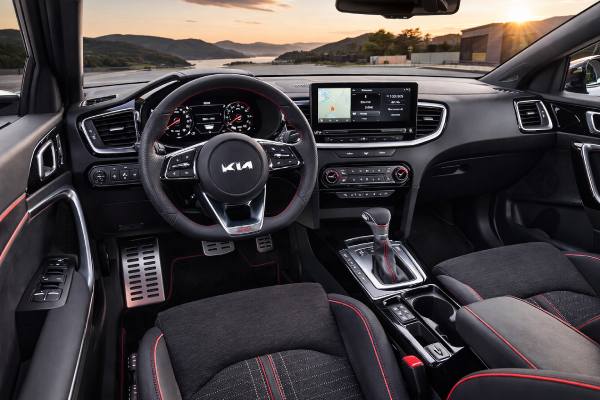

The facelift-era Kia ProCeed GT (CD) is a rare mix: a stylish shooting-brake body with genuinely quick performance, but still built around the practical Ceed platform. Its 1.6 T-GDi turbo petrol (Gamma II family) focuses on usable mid-range torque rather than high-rev drama, which suits real traffic and fast motorway driving. Most cars in this period pair the engine with a quick-shifting dual-clutch automatic, giving the GT an eager feel without the fuel thirst of larger hot hatches.
For owners, the headline is balance. You get strong standard equipment, mature chassis tuning, and a big cargo area for the class. The trade-offs are the usual ones for a modern turbo direct-injection engine and a dual-clutch transmission: oil quality matters, short trips are hard on the intake system, and smooth driving habits reduce wear. If you service it on time and buy carefully, the ProCeed GT is a very satisfying long-term daily.
What to Know
- Strong mid-range pull and confident motorway pace; feels quicker than the numbers suggest.
- Practical shooting-brake cargo space with a low load floor; easy to live with year-round.
- Well-equipped in most markets (LED lighting, heated features, and driver aids often standard).
- Caveat: turbo DI engines and dual-clutch gearboxes reward frequent fluid checks and gentle warm-up habits.
- Typical interval: change engine oil and filter every 10,000–15,000 km (6,000–9,000 mi) or 12 months (use the shorter interval for city use).
Guide contents
- Kia ProCeed GT CD ownership profile
- Kia ProCeed GT CD specs and capacities
- Kia ProCeed GT CD trims and safety tech
- Reliability and known weak points
- Maintenance plan and buying tips
- Road performance and economy
- Rivals and smart alternatives
Kia ProCeed GT CD ownership profile
The facelift 2021–2024 ProCeed GT sits in a small niche: it looks like a premium estate-coupe, but it drives like a warm-to-hot hatch. The GT badge is not just trim decoration. Compared with regular ProCeed versions, the GT typically brings firmer suspension tuning, stronger brakes, larger wheels and tyres, and sport seats that hold you in place on quick roads. In daily use, it still behaves like a Ceed-family car: easy visibility, sensible control layout, and a cabin that prioritizes function over flash.
Engineering highlights that matter to owners
- Turbo direct injection (DI) 1.6 petrol: The engine’s character is torque-first. You usually feel the strongest shove from low-to-mid rpm, which makes overtakes effortless and reduces the need to rev it out.
- Dual-clutch transmission (common pairing): A wet-clutch 7-speed DCT (market dependent) generally feels crisp when you accelerate, while still cruising quietly at motorway speed. Like any DCT, it dislikes repeated creeping on inclines, so driving technique matters.
- Platform balance: The Ceed CD platform tends to feel stable at speed. The ProCeed’s longer roof and rear structure do not make it “boaty”; it still changes direction neatly, especially in GT form.
Why this body style is a genuine advantage
The ProCeed’s shooting-brake shape is not only styling. You get a wide hatch opening, a long load floor, and a low liftover height that is friendly for strollers, luggage, and bulky shopping. The roofline is lower and sleeker than a typical estate, so rear headroom can be the main packaging compromise. For couples, small families, or anyone who carries gear more often than passengers, it’s a smart layout.
Who it fits best
- Drivers who want hot-hatch pace but also need cargo space.
- People who do frequent motorway miles and value high-speed stability.
- Buyers who want a sporty car without the harshness and attention of the most aggressive hatchbacks.
Who should think twice
- If your usage is mostly short, cold trips, the DI turbo setup can build deposits faster and the oil sees more moisture and fuel dilution. Shorter oil intervals help, but the usage pattern still matters.
- If you live in heavy stop-and-go traffic on steep hills, a DCT can run hotter and wear faster than a conventional torque-converter automatic.
Kia ProCeed GT CD specs and capacities
Specs vary by market, wheel size, emissions calibration, and gearbox choice, but the tables below reflect the typical facelift-era ProCeed GT 1.6 T-GDi (201 hp class) sold in Europe. Always confirm with your VIN build sheet if you need exact fluid quantities or torque values.
Powertrain and efficiency (typical)
| Item | Specification |
|---|---|
| Code | Gamma II 1.6 T-GDi (engine family; market codes vary) |
| Engine layout and cylinders | Inline-4, DOHC, 16-valve (4 valves/cyl) |
| Displacement | 1.6 L (≈1,591 cc) |
| Bore × stroke | ≈77.0 × 85.4 mm (≈3.03 × 3.36 in) |
| Induction | Turbocharged |
| Fuel system | Direct injection (DI) |
| Compression ratio | Typically around 10:1 (market calibration varies) |
| Max power | 201 hp (150 kW) @ ~6,000 rpm (often listed as 204 PS in EU) |
| Max torque | ~265 Nm (195 lb-ft) @ ~1,500–4,500 rpm |
| Timing drive | Chain (inspect for noise/correlation faults over time) |
| Rated efficiency | Commonly ~6.8–7.6 L/100 km (35–31 mpg US / 42–37 mpg UK), depending on wheels and gearbox |
| Real-world highway @ 120 km/h | Often ~7.2–8.2 L/100 km (33–29 mpg US / 39–34 mpg UK), depending on wind/tyres/load |
Transmission and driveline
| Item | Specification |
|---|---|
| Transmission | Typically 7-speed DCT (wet clutch), code varies by market |
| Drive type | FWD |
| Differential | Open (traction managed by brake-based systems) |
Chassis and dimensions (typical for ProCeed body)
| Item | Specification |
|---|---|
| Suspension (front/rear) | MacPherson strut / multi-link (GT tune differs from standard models) |
| Steering | Electric power steering; ratio varies by market |
| Brakes | 4-wheel discs (GT uses larger hardware than non-GT) |
| Wheels and tyres (common) | 225/40 R18 (rim 18 in) in many markets |
| Ground clearance | Not usually marketed; expect low-to-moderate for a sporty wagon |
| Length / width / height | Approx. 4,605 / 1,800 / 1,422 mm (181.3 / 70.9 / 56.0 in) |
| Wheelbase | Approx. 2,650 mm (104.3 in) |
| Turning circle (kerb-to-kerb) | Typically ~10.6–11.0 m (34.8–36.1 ft) |
| Kerb weight | Commonly ~1,400–1,500 kg (3,086–3,307 lb), depending on equipment |
| Fuel tank | Typically ~50 L (13.2 US gal / 11.0 UK gal) |
| Cargo volume | Often listed around ~594 L seats up (VDA) / ~1,545 L seats down (VDA), market-dependent |
Performance and capability (typical)
| Item | Specification |
|---|---|
| 0–100 km/h (0–62 mph) | Commonly ~7.2–7.7 s (gearbox and traction dependent) |
| Top speed | Often ~225 km/h (140 mph) |
| Braking distance 100–0 km/h | Typically in the mid-to-high 30 m range on good tyres (test-dependent) |
| Towing capacity | Market-dependent; often offered with braked towing ratings (confirm by VIN plate) |
| Payload | Depends on GVWR; check door jamb label |
Fluids and service capacities (decision-useful, verify by VIN)
| Item | Specification |
|---|---|
| Engine oil | ACEA C2/C3 class commonly specified in Europe; viscosity often 0W-30 or 5W-30 (market climate dependent) |
| Engine oil capacity | Typically ~4.5–5.0 L (4.8–5.3 US qt) with filter |
| Coolant | Ethylene glycol long-life coolant; mix commonly 50/50 (unless pre-mixed) |
| Coolant capacity | Often ~6–7 L (6.3–7.4 US qt), varies by radiator/engine bay |
| DCT fluid | Use only the exact OEM-spec DCT fluid for your transmission code |
| A/C refrigerant | R-1234yf in many facelift-era European cars; charge varies by system label |
Key torque specs (common service items, verify)
| Fastener | Typical torque |
|---|---|
| Wheel bolts | ~88–110 Nm (65–81 lb-ft), depending on wheel and market spec |
| Engine oil drain plug | Commonly ~25–35 Nm (18–26 lb-ft), depends on pan/plug design |
Safety and driver assistance (typical)
| Item | Notes |
|---|---|
| Crash ratings | Euro NCAP rating typically references the Ceed family platform and test year |
| ADAS suite | AEB, lane support, and ACC often available; exact standard vs optional depends on trim/year |
Kia ProCeed GT CD trims and safety tech
The ProCeed GT lineup is usually simpler than the broader Ceed range. In many markets, “GT” effectively means a high fixed specification with a short options list. That is good for used buyers: fewer confusing packages, more consistent equipment, and easier comparisons between listings.
Trims, options, and quick identifiers
Common identifiers of a real GT
- Exterior cues: GT bumpers, sporty exhaust finishers (market dependent), and GT badging.
- Wheels: 18-inch wheels are typical; verify tyre size matches the factory fitment on the door sticker.
- Interior: Sport seats (often suede-like inserts or leather mix), flat-bottom style steering wheel in some markets, and GT logos on seats or steering wheel.
Options that change ownership experience
- Adaptive cruise control (ACC) and lane centering features: Great for motorway commuters, but be aware that windshield replacement or front radar alignment can add cost after an accident.
- Panoramic roof: Adds light and appeal, but check for wind noise, drainage issues, and smooth operation.
- Premium audio: Nice upgrade, and it can be a helpful used-market differentiator when prices are close.
- Winter pack (heated seats/steering wheel): Highly recommended for cold climates; it improves daily comfort without mechanical downside.
Year-to-year changes that matter (facelift era)
Facelift updates typically focus on infotainment, lighting, and driver assistance availability. When comparing 2021 vs 2023 cars, pay attention to:
- Infotainment screen generation and navigation features
- Headlight type (full LED vs mixed systems)
- Availability of advanced AEB modes and highway assist features (names vary by market)
Safety ratings and what they really mean
For the ProCeed, published crash ratings usually reference the Ceed platform test rather than a separate ProCeed-specific run. That is normal industry practice when the body style shares the same underlying structure and restraint systems. Still, you should read the rating as a platform-level indicator, not a guarantee that every trim behaves identically. Wheel size, tyre type, and optional safety equipment can influence real-world outcomes.
Safety systems and ADAS practical notes
Core safety hardware you can expect
- Multiple airbags (front, side, and curtain), with exact count by market
- ABS, stability control, traction control, and brake assist
- ISOFIX child-seat mounts (rear outboard positions are common)
ADAS features to confirm on a used car
- AEB coverage: Some systems detect cars only; others also detect pedestrians and cyclists.
- Lane support level: Basic lane-keep assist can ping-pong more than lane-follow assist.
- Blind-spot monitoring and rear cross-traffic alert: Valuable in tight urban parking situations.
Calibration implications after repairs
Modern driver aids are not “set and forget.” If the car has had:
- A windshield replacement (camera area)
- Front bumper work (radar area)
- Suspension geometry changes (alignment)
…then ask for proof of correct calibration. A properly repaired car is fine, but a poorly calibrated system can create false warnings or reduced performance when you need it.
Reliability and known weak points
The facelift ProCeed GT’s overall reliability picture is generally solid for the class, but it is not maintenance-forgiving. Think of it as a performance daily: it rewards good habits and clear service records.
Below are common patterns seen on modern turbo DI engines and dual-clutch drivetrains, organized by prevalence and cost tier. Exact frequency varies by climate, trip length, and driving style.
Common (low to medium cost)
- Ignition coil or spark plug wear (misfires under load)
Symptoms: Hesitation, flashing MIL under hard acceleration, rough idle.
Likely cause: Plug wear, coil aging, or incorrect plug spec/heat range.
Remedy: Replace plugs at the correct interval; replace weak coils as needed. Use OE-spec plugs and correct gap. - PCV and intake contamination (DI deposit build-up)
Symptoms: Rough cold start, uneven idle, reduced response, occasional misfire codes.
Likely cause: Direct injection does not wash intake valves with fuel; short trips accelerate deposits.
Remedy: Shorten oil intervals, use quality fuel, and consider periodic intake cleaning if symptoms appear. - Cooling system seepage checks
Symptoms: Slow coolant loss, sweet smell, crusting around hose joints.
Likely cause: Hose clamps, plastic fittings, or radiator end tanks.
Remedy: Pressure test, replace weak clamps/hoses early to avoid overheating.
Occasional (medium cost)
- DCT low-speed shudder or harsh engagement
Symptoms: Judder in traffic, clunky take-up, hesitation when creeping.
Likely cause: Clutch adaptation out of range, fluid condition, or heat stress from creeping uphill.
Remedy: Ensure correct DCT fluid service (if specified), run adaptation procedures, and check for software updates. - Turbo control or boost-leak faults
Symptoms: Loss of power, whistle/hiss, underboost codes.
Likely cause: Loose charge pipe clamp, aging diverter valve, or boost sensor issues.
Remedy: Smoke test intake, reseat/replace hoses, verify actuator operation.
Rare but higher cost
- Turbocharger failure from oil starvation or poor oil practices
Symptoms: Blue smoke, loud whine, persistent underboost, oil consumption spike.
Likely cause: Extended oil intervals, wrong oil spec, repeated hot shutdowns after hard driving.
Remedy: Replace turbo and address root cause; strict oil spec and warm-up/cool-down habits reduce risk. - Timing chain noise or correlation faults (over long mileage)
Symptoms: Rattle on start-up, timing correlation codes, poor running.
Likely cause: Chain stretch or tensioner wear over high mileage with long oil intervals.
Remedy: Diagnose quickly; replace chain/tensioner/guides if out of spec.
Recalls, TSBs, and service actions
Because recall campaigns vary by market and VIN range, treat this as a process rather than a single list:
- Run an official VIN check (manufacturer recall portal or national authority database).
- Ask the seller for dealer invoices showing recall completion.
- Confirm software updates were applied when drivability or transmission behavior was a complaint.
If a seller cannot document this, it is not automatically a deal-breaker, but you should price the car assuming you will visit a dealer to verify and update it.
Maintenance plan and buying tips
A good maintenance routine for the ProCeed GT is not complicated, but it must be consistent. The goal is to protect three expensive areas: the turbocharger, the DI fuel system, and the DCT (if equipped).
Practical maintenance schedule (distance or time, whichever comes first)
Every 10,000–15,000 km (6,000–9,000 mi) or 12 months
- Engine oil and filter (use the exact ACEA/API spec listed for your market)
- Check coolant level and concentration
- Inspect belts, hoses, and any visible oil seepage
- Tyre rotation (if tyre wear pattern allows) and pressure check
Every 20,000–30,000 km (12,000–18,000 mi)
- Engine air filter (more often in dusty areas)
- Cabin air filter
- Brake inspection (pad thickness, rotor condition, slide pin freedom)
Every 40,000–60,000 km (25,000–37,000 mi)
- Brake fluid (commonly every 2 years regardless of mileage)
- Spark plugs (many turbo DI engines want shorter plug intervals than older port-injected engines)
- Alignment check (especially if you see inner-edge tyre wear on 18-inch tyres)
Every 60,000–120,000 km (37,000–75,000 mi)
- Coolant (interval varies widely by coolant type and market guidance)
- DCT fluid service (only if specified for your transmission; do not improvise fluid type)
- Inspect suspension bushings, ball joints, and wheel bearings (tyre noise is often the first clue)
Fluids and specs that matter most
- Engine oil: The correct spec is more important than brand. A turbo DI engine depends on oil to cool and lubricate the turbo bearings.
- Coolant: Use the correct long-life coolant type; mixing can reduce corrosion protection.
- DCT fluid: Use only the OEM-specified DCT fluid for the exact gearbox code.
Buyer’s guide: what to check before purchase
Service history
- Look for consistent oil changes, not “whenever the light came on.”
- Confirm spark plug replacement at an appropriate interval.
- Check if the car had any drivability updates (dealer notes can help).
Road test checklist
- Cold start: listen for chain rattle, rough idle, or persistent misfires.
- Low-speed crawl: note any DCT shudder, delayed engagement, or clunks.
- Full-throttle pull: power should be smooth and consistent; watch for underboost behavior.
- Braking: should be straight and stable, with no steering wheel shake.
Chassis and body
- Inspect front tyre inner edges for wear (alignment or bushings).
- Look for uneven paint texture around bumpers (radar/camera area repairs matter).
- Check hatch seals and rear water ingress signs (lift carpet, inspect spare well area if accessible).
Long-term durability outlook
With clean oil, sensible warm-up habits, and a careful buy (no hidden crash repairs, no neglected DCT behavior), the ProCeed GT can be a dependable fast daily. Most expensive failures in this category come from neglect, poor fluid choices, or repeated short-trip use without shortened service intervals.
Road performance and economy
The ProCeed GT’s driving experience is defined by two traits: easy torque and stable chassis tuning. It is not a razor-edged track toy, but it is quick enough to feel special on real roads.
Ride, handling, and NVH
Ride: The GT suspension is firmer than standard ProCeed variants, and the common 18-inch tyre package adds sharpness. Over broken city pavement, you will feel more impact than in a comfort-focused estate, but the payoff is cleaner control at speed.
Handling: The front end generally feels composed, with predictable grip and a rear that follows faithfully. You can push it on a curving road without surprise. Like most FWD performance cars, hard acceleration out of tight bends can tug at the steering slightly, especially on worn tyres.
Cabin noise (NVH):
- City speeds: tyre pattern and road surface dominate
- Motorway speeds: wind noise is usually reasonable for the shape, but crosswinds and roof accessories can add noise quickly
Powertrain character
Throttle response: The turbo setup gives strong mid-range thrust. There is usually a brief moment of turbo build at low rpm, but it is mild rather than annoying.
DCT behavior (if equipped):
- In normal driving, shifts are quick and efficient.
- In stop-and-go traffic, smoother inputs help. Avoid holding the car on the throttle on an incline; use the brake to reduce clutch heat.
- Kickdown is generally strong, but the gearbox may hesitate if it needs multiple downshifts. Sport mode often reduces that delay.
Real-world efficiency (what owners typically see)
Your fuel economy depends heavily on tyre choice and driving profile:
- City-heavy: often ~8.5–10.5 L/100 km (28–22 mpg US / 33–27 mpg UK)
- Steady highway (100–120 km/h): often ~7.2–8.2 L/100 km (33–29 mpg US / 39–34 mpg UK)
- Mixed driving: commonly ~7.8–9.0 L/100 km (30–26 mpg US / 36–31 mpg UK)
Cold weather can add a noticeable penalty because the engine runs richer during warm-up and cabin heat depends on engine temperature.
Key performance metrics that change the verdict
- 0–100 km/h: low-to-mid 7-second range in many tests, depending on tyres and gearbox
- Passing power: strong 80–120 km/h response is a real highlight; it feels confident in the exact speeds used for European overtakes
- Braking confidence: the GT’s stronger brake setup helps it feel calm during repeated fast-road use, assuming quality pads and healthy fluid
Load and long-distance use
Fully loaded with passengers and luggage, the ProCeed GT remains stable. Expect higher consumption and more frequent downshifts on long grades. If you plan to tow, verify the exact braked/unbraked rating for your VIN and market; towing capability can differ significantly between countries and homologation versions.
Rivals and smart alternatives
The ProCeed GT’s closest rivals depend on what you value most: performance, cargo shape, or cabin technology. Few cars combine all three as neatly in this price band, which is exactly why the GT has a loyal following.
If you want similar speed with more traditional practicality
- Volkswagen Golf GTI (hatch): Often sharper steering feel and broad aftermarket support, but less cargo flexibility than the ProCeed shooting-brake shape.
- Škoda Octavia vRS (estate in some markets): More rear space and a “big car” feel, typically with a slightly less playful personality unless pushed.
If you want premium badge vibes
- Audi A3 Sportback (higher output trims): Higher perceived cabin prestige, but option pricing can be steep and the practical advantage over the ProCeed is not guaranteed.
- BMW 1 Series (sport trims): Strong dynamics and brand appeal, but you usually sacrifice cargo shape and sometimes equipment per price.
If you want performance-per-euro
- Hyundai i30 N (hatch/fastback depending on market): More intense and track-capable; harsher ride and more attention-grabbing personality. Great if you want an event, less ideal if you want quiet long-distance comfort.
- Cupra Leon (estate variants in some markets): Strong performance and modern tech; check real-world running costs and tyre wear on higher-power versions.
The ProCeed GT advantage, summarized
- Best for: a driver who wants one car to do everything—fast commuting, weekend trips, and daily hauling—without moving to a larger, heavier wagon.
- Not best for: someone who wants the lightest, most aggressive hot hatch experience, or someone whose driving is mostly short cold trips in heavy traffic.
A smart shopping strategy is to compare a ProCeed GT against a slightly newer, slightly lower-trim rival at the same price. The GT often wins on standard equipment and cargo usefulness, while rivals can win on brand, rear space, or ultimate performance edge.
References
- Official Kia Cee’d 2019 safety rating 2019 (Safety Rating)
- Kia Ceed range gets extensive design, tech and powertrain upgrades 2021 (Manufacturer Publication)
- new-kia-proceed-gt-specification.pdf 2021 (Specification Sheet)
- Recall Campaigns 2026 (Recall Database)
- Check vehicle recalls 2026 (Recall Database)
Disclaimer
This article is for informational purposes only and is not a substitute for professional diagnosis, inspection, or repair. Specifications, torque values, fluid types, capacities, and service intervals can vary by VIN, market, production date, and installed equipment. Always verify details using official Kia service documentation for your specific vehicle and consult a qualified technician for safety-critical work.
If you found this guide useful, please consider sharing it on Facebook, X (Twitter), or your favorite forum to help others find accurate ownership information.