
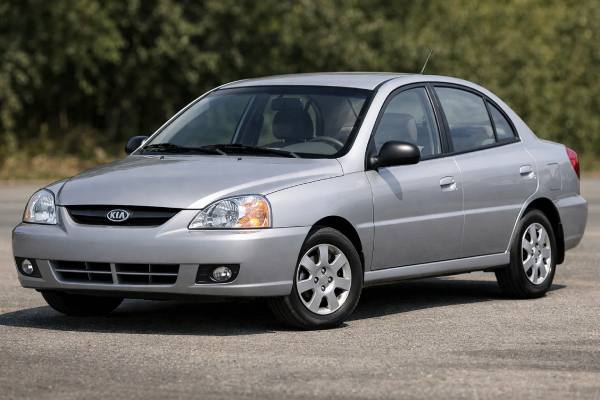
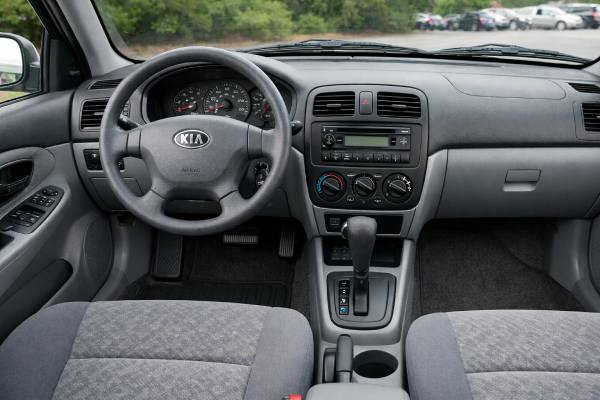
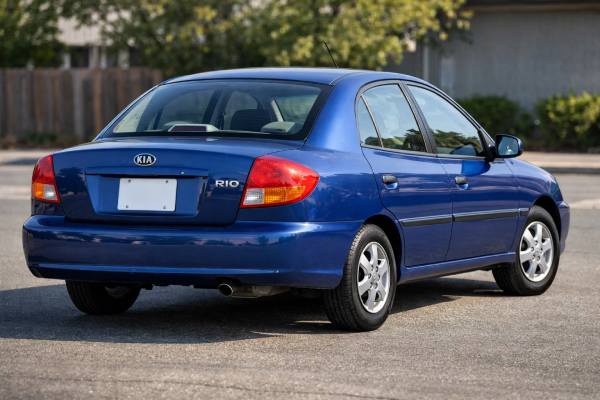
The 2001–2002 Kia Rio (DC) with the 1.5-liter B5-DE engine and the 96 hp calibration is one of those early-2000s cars that rewards owners who treat it like a simple machine: keep fluids fresh, stay ahead of timing-belt service, and fix small leaks before they become big ones. Under the hood, the DOHC 16-valve four-cylinder is straightforward and generally tolerant of daily use, but it is not “set-and-forget”—rubber parts, cooling components, and fuel-system sealing deserve attention as the car ages. On the road, this Rio is tuned more for steady commuting than speed, with modest passing power and a light chassis that feels nimble at city speeds. If you’re shopping today, the best examples are the ones with clear maintenance history, intact rust protection, and proof that recall and safety campaigns were completed.
Owner Snapshot
- Simple drivetrain and inexpensive parts make it budget-friendly when maintained on schedule.
- Compact size and tight turning circle suit city driving and easy parking.
- The 96 hp tune is adequate for commuting, but passing power is limited with passengers and A/C.
- Timing-belt neglect can turn a cheap car into an expensive repair—treat it as non-negotiable.
- Plan oil changes every 10,000 km (6,000 mi) or 6 months (shorten for short-trip use).
Navigate this guide
- Rio DC 1.5 96 hp snapshot
- Rio DC 1.5 96 hp technical tables
- Rio DC trim cues and safety kit
- Common failures and service bulletins
- Service routine and pre-purchase guide
- Road behavior and efficiency notes
- How it stacks up to rivals
Rio DC 1.5 96 hp snapshot
This 2001–2002 Kia Rio (DC) pairing—B5-DE 1.5 and the 96 hp output—sits in a sweet spot for owners who value simplicity over sophistication. The car’s layout is traditional for the era: transverse engine, front-wheel drive, and either a 5-speed manual or a 4-speed automatic. There’s nothing exotic here, which is exactly why many of these cars are still running: most issues can be diagnosed with basic tools, and repairs rarely require special equipment.
Where this version differs from higher-output calibrations is in how it delivers its performance. Expect a smooth, linear pull rather than a punchy midrange. Around town it feels willing, but on faster roads it asks you to plan—downshifts and longer gaps matter when merging or overtaking. The manual gearbox typically makes the most of the engine, while the automatic emphasizes ease and can feel sluggish if it’s overdue for fluid service.
Ownership satisfaction comes down to preventative care. At this age, condition matters more than mileage: a low-mile car with old coolant hoses and a forgotten timing belt can be riskier than a higher-mile example with documented maintenance. Rust protection and body integrity are equally important because corrosion repairs can exceed the car’s value.
This Rio’s strengths are easy to summarize: compact footprint, low running costs, and a drivetrain that responds well to routine service. Its limitations are just as clear: modest crash technology by modern standards, fewer comfort features than later subcompacts, and age-related wear in rubber, seals, and suspension joints. Buy it as a dependable commuter project—not as a car to ignore—and it can still deliver honest value.
Rio DC 1.5 96 hp technical tables
Below are practical, owner-focused specifications for the 2001–2002 Rio (DC) with the B5-DE 1.5-liter engine in 96 hp form. Exact figures can vary slightly by market (emissions calibration), body style (sedan vs wagon), and transmission.
Powertrain and efficiency
| Item | Spec (typical for 2001–2002 Rio DC 1.5) |
|---|---|
| Engine code | B5-DE |
| Layout / cylinders | Inline-4, transverse |
| Valvetrain | DOHC, 16 valves (4 valves/cyl) |
| Bore × stroke | 75.5 × 83.4 mm (2.97 × 3.28 in) |
| Displacement | 1.5 L (1493 cc) |
| Induction | Naturally aspirated |
| Fuel system | MPI (multi-point injection) |
| Compression ratio | Typically around 9.5:1 (market-dependent) |
| Max power | 96 hp (71 kW) @ ~5500–5800 rpm (calibration-dependent) |
| Max torque | ~132 Nm (97 lb-ft) @ ~4500 rpm (varies by market) |
| Timing drive | Timing belt |
| Fuel (typical) | Regular unleaded (follow local octane guidance) |
| Rated efficiency (EPA-style, reference) | Manual: 24/29 mpg US (city/hwy); Auto: 22/28 mpg US (city/hwy) |
| Real-world highway @ 120 km/h (75 mph) | ~7.0–8.5 L/100 km (33–28 mpg US), depending on wind, tyres, and A/C |
Transmission and driveline
| Item | Spec |
|---|---|
| Transmission | 5-speed manual or 4-speed automatic |
| Drive type | FWD |
| Differential | Open |
Chassis and dimensions (typical)
| Item | Spec (approximate range) |
|---|---|
| Front suspension | MacPherson strut with coil springs and anti-roll bar |
| Rear suspension | De Dion / torsion-beam style rear with coil springs (market-dependent descriptions) |
| Steering | Hydraulic power steering (typical); ratio varies |
| Brakes | Front discs; rear drums (most trims) |
| Popular tyre size | 175/65 R14 (common fitment) |
| Ground clearance | ~150 mm (6.0 in) (varies by tyres/market) |
| Length / width / height | ~4215–4240 / 1680 / 1420 mm (166.0–166.9 / 66.1 / 55.9 in) |
| Wheelbase | ~2410 mm (94.9 in) |
| Turning circle (kerb-to-kerb) | ~9.4 m (30.8 ft) |
| Kerb weight | ~1015–1055 kg (2240–2325 lb) |
| Fuel tank | ~45 L (11.9 US gal / 9.9 UK gal) |
| Cargo volume | Sedan ~260–330 L (9–12 ft³), method varies |
Performance and capability (typical expectations)
| Metric | Typical for 96 hp Rio DC 1.5 |
|---|---|
| 0–100 km/h (0–62 mph) | ~12.5–14.0 s (manual usually quicker than auto) |
| Top speed | ~165–175 km/h (103–109 mph) |
| Braking 100–0 km/h | Highly tyre- and brake-condition dependent; expect longer distances than modern cars |
| Towing | Often not rated / not recommended in many markets; treat as minimal |
| Payload | Typically modest; check door-jamb label for your car |
Fluids and service capacities (verify by VIN)
Because markets differ, treat these as decision-making ranges rather than exact fill-to-the-milliliter numbers.
| Fluid | Typical spec guidance | Typical capacity (approx.) |
|---|---|---|
| Engine oil | 5W-30 or 10W-30 (climate dependent), API SJ/SL class equivalents | ~3.3–3.6 L (3.5–3.8 US qt) with filter |
| Coolant | Ethylene glycol long-life coolant, ~50/50 mix | ~5.5–6.5 L (5.8–6.9 US qt) |
| Automatic transmission fluid | SP-III-type ATF commonly specified on many Kia/Hyundai 4AT units | Drain/fill often ~2.5–3.5 L; total fill higher |
| Manual gearbox oil | GL-4 75W-90 (typical) | ~2.0–2.5 L |
| Brake fluid | DOT 3 or DOT 4 (market dependent) | Fill to level; flush volume varies |
| A/C refrigerant | R134a | Commonly ~450–650 g (verify under-hood label) |
Key torque specs (common, verify before final tightening)
| Fastener | Typical torque range |
|---|---|
| Wheel lug nuts | 90–110 Nm (66–81 lb-ft) |
| Spark plugs | 18–25 Nm (13–18 lb-ft) |
| Engine oil drain plug | 30–40 Nm (22–30 lb-ft) |
| Front caliper bracket bolts | 80–110 Nm (59–81 lb-ft) |
Rio DC trim cues and safety kit
For 2001–2002, Rio (DC) equipment varies more by market than by engine. Some regions offered a very simple base model, while others packaged convenience items (power steering, A/C, power windows) into higher grades. The most useful way to understand trim on these cars today is to focus on functional differences—brakes, wheels, airbags, and comfort features—rather than the badge alone.
Trims and options: what actually changes
Common differences you’ll see when cross-shopping:
- Body style: sedan vs wagon (often called “Cinco” in some markets). Wagons can carry more but may have different rear trim and roof hardware.
- Transmission: the 5-speed manual is usually the enthusiast and economy choice; the 4-speed automatic is smoother in traffic but more sensitive to neglected fluid.
- Wheels and tyres: many cars came on 14-inch steel wheels with narrow tyres; alloys were often optional. Tyre choice has a big impact on braking feel and wet grip.
- Air conditioning: some base cars lack A/C. If present, confirm cold output and listen for compressor noise.
- Power accessories: power steering is common but not universal; power windows/locks vary.
- Interior identifiers: look for a tachometer (not always standard), seat fabric patterns, and the presence of rear head restraints.
Year-to-year changes between 2001 and 2002 are typically minor (package reshuffles, option availability), but you may see small differences in switchgear, upholstery, and standard equipment depending on the sales region.
Safety ratings: set expectations
Many early-2000s subcompacts have limited modern crash-test coverage that cleanly maps to today’s rating systems. Even when official testing exists, the protocol and scoring standards differ from current methods, so comparing star ratings across decades can be misleading.
A practical approach:
- Verify whether your exact body style and year were tested in your region (sedan vs wagon can matter).
- Prioritize structural condition (no prior major collision repairs, no corrosion in critical areas) because age and rust can reduce crash performance in real-world events.
- Treat the car as “basic safety tech” by modern standards, even if it was competitive for its time.
Safety systems and driver assistance (ADAS)
Driver assistance features as we define them today (AEB, adaptive cruise, lane centering) are not part of this generation. What you may have, depending on trim and market:
- Front airbags: often driver, sometimes passenger depending on market/year.
- Seat belts: pretensioners may be present; verify smooth retraction and buckle condition.
- ABS: available on some trims; not guaranteed on base cars.
- Stability control and traction control: uncommon for this era/segment; don’t assume it’s fitted.
- Child-seat provisions: you may see ISOFIX/LATCH in some later builds or markets, but many cars rely on belt-installation. Check rear seat anchoring points carefully.
If you’re buying as a family runabout, this is the section where realism matters most: the Rio (DC) can be dependable, but it is not a modern safety benchmark. The safest “upgrade” you can buy is a well-maintained car on good tyres with fully functioning brakes and seat belts.
Common failures and service bulletins
At 20+ years old, the Rio (DC) is mostly about age-related wear. The B5-DE engine itself is generally robust if serviced, but small problems can stack up when maintenance is sporadic. Below is a practical map of issues by prevalence and cost tier, with symptoms and remedies you can act on.
High priority (safety or high consequence)
- Fuel smell, dampness near fuel rail, or visible fuel seepage (Common / High):
Symptom: gasoline odor after parking, hard starts, wet spots around fuel lines, or fuel drips.
Likely cause: aging seals, cracking hoses, or known fuel-distributor and line issues on certain vehicles.
Remedy: stop driving until inspected; replace affected fuel distributor/lines/seals as required and confirm recall completion. - Overheating or coolant loss (Occasional / Medium–High):
Symptom: rising temperature gauge, heater blows cold, coolant smell, puddles.
Likely cause: tired radiator, hoses, thermostat, water pump seepage, or cap failure.
Remedy: pressure-test the system; replace weak components as a set. Overheating events can warp the head and turn into a high-cost repair. - Timing-belt neglect (Common as an ownership problem / High):
Symptom: unknown belt history, noisy idlers, or sudden no-start if the belt fails.
Likely cause: overdue belt, worn tensioner/idlers, oil contamination from a leaking seal.
Remedy: replace belt, tensioner, and idlers together; strongly consider water pump at the same time.
Medium priority (drivability, comfort, running cost)
- Rough idle, stalling, or hunting idle (Common / Low–Medium):
Likely causes: dirty throttle body, idle air control valve deposits, vacuum leaks, or tired ignition components.
Remedy: smoke-test for vacuum leaks, clean throttle body, and replace plugs/wires as needed. - Check-engine light for O2 sensor or catalyst efficiency (Occasional / Medium):
Symptom: CEL, sluggish response, higher fuel consumption.
Likely cause: aging oxygen sensor(s), exhaust leaks upstream, or a tired catalytic converter.
Remedy: fix exhaust leaks first; replace sensors with correct-spec parts; verify fuel trims. - Automatic transmission shift flare or delayed engagement (Occasional / Medium–High):
Symptom: revs rise between shifts, delayed “D” engagement, harsh shifting when cold.
Likely cause: old ATF, wrong fluid type, internal wear.
Remedy: verify correct fluid specification, service the fluid properly, and avoid “power flush” if the unit shows heavy wear.
Lower priority but common annoyances
- Suspension knocks and vague steering (Common / Medium):
Front strut mounts, drop links, control-arm bushings, and ball joints wear with age. Rear bushings can also degrade. A fresh set of quality bushings and alignment often transforms the car. - Wheel bearing hum (Occasional / Medium):
Symptom: speed-related roar that changes when you load/unload the car in a gentle turn.
Remedy: replace the affected bearing/hub before it damages adjacent parts. - Electrical aging (Common / Low–Medium):
Window regulator issues, tired alternators, weak grounds, and brittle connectors appear on older cars. Many “mystery” faults trace back to voltage drop or corrosion at grounds.
Recalls, TSBs, and how to verify completion
For any early-2000s Rio, the most important step is to confirm recall work was completed—especially for fuel-system-related campaigns. Practical verification steps:
- Run the VIN through the official recall database for your region.
- Ask a dealer to check campaign completion by VIN and provide a printout if possible.
- When inspecting the car, look for evidence of replaced fuel lines/components and compare it with service receipts.
Because this platform is simple, good records are disproportionately valuable. A Rio with proof of timing-belt service, cooling-system refresh, and recall completion is usually a safer buy than one with “low miles” and no paperwork.
Service routine and pre-purchase guide
If you maintain this Rio like a schedule—not like a reaction—you can keep costs predictable. The table below is an owner-friendly baseline that works well for the B5-DE 1.5. Always adjust for your use: short trips, extreme heat/cold, and heavy city traffic justify shorter intervals.
Practical maintenance schedule (distance or time, whichever comes first)
| Item | Interval | Notes |
|---|---|---|
| Engine oil and filter | 10,000 km (6,000 mi) or 6 months | Short trips: 7,500 km (4,500 mi) is kinder |
| Air filter (engine) | 15,000–20,000 km or 12 months | Replace sooner in dusty areas |
| Cabin filter (if equipped) | 15,000–20,000 km or 12 months | Some trims may not have one |
| Spark plugs | 30,000–40,000 km (copper) or per plug type | Inspect leads/wires at same time |
| Coolant | Every 2–3 years | Use correct coolant type and bleed air carefully |
| Brake fluid | Every 2 years | Moisture degrades braking and ABS components |
| Manual gearbox oil | 60,000–80,000 km | Use correct GL-4 grade (avoid GL-5 if not specified) |
| Automatic transmission fluid | 50,000–60,000 km or 3–4 years | Correct ATF spec matters; service gently |
| Timing belt + tensioner + idlers | 90,000–100,000 km or 5–6 years | Replace sooner if oil-contaminated or history unknown |
| Water pump | With timing belt (recommended) | Cheap insurance while access is open |
| Serpentine/aux belt | Inspect every oil change; replace at 60,000–100,000 km | Replace if cracked or glazed |
| Brake pads/rotors/drums | Inspect every 10,000–15,000 km | Clean and lubricate slide pins |
| Tyre rotation + alignment check | 10,000 km | Alignment saves tyres and improves stability |
| 12 V battery test | Annually | Replace proactively at 4–6 years typical |
Fluids, specs, and “don’t guess” items
- Oil viscosity: choose viscosity for climate (5W-30 for colder climates; 10W-30 can be acceptable in warm regions if allowed).
- ATF: the 4-speed automatic is sensitive to fluid type—wrong ATF can cause poor shifting and premature wear.
- Coolant mix: a 50/50 mix is a safe default for corrosion protection and freeze margin; bleeding air is critical after service.
Essential inspection checklist for buyers
Bring a flashlight and be systematic:
- Cold start: listen for belt squeal, lifter noise, and idle stability.
- Fuel smell check: sniff around the engine bay and under the rear seat area (where applicable). Any fuel odor is a stop sign.
- Cooling system: look for crusted coolant residue around hose joints, radiator end tanks, and water pump area.
- Oil leaks: inspect valve cover area and around crank seals (oil can shorten timing-belt life).
- Transmission behavior:
- Manual: check clutch bite point and for synchro crunch on fast 2–3 shifts.
- Auto: check for delayed engagement and harsh 2–3 shifts when warm.
- Suspension and steering: clunks over bumps suggest worn links or bushings; wandering suggests alignment or tyre issues.
- Rust hotspots: wheel arches, sills/rockers, rear suspension mounting points, and underbody seams.
- Electrics: verify windows, blower speeds, charging voltage, and all exterior lights.
Long-term durability outlook
A well-kept Rio (DC) can be a durable low-cost commuter, but it is unforgiving of neglect. Your best strategy is to buy the cleanest body you can find, then “baseline” the car: fluids, belts, filters, tyres, and brake service. Once those fundamentals are done, ongoing ownership is usually predictable and inexpensive.
Road behavior and efficiency notes
The 96 hp Rio (DC) feels light on its feet at urban speeds, and that’s where it makes the best impression. Steering is typically easy and quick enough for tight streets, and the compact dimensions make it unintimidating in traffic. Ride quality is simple rather than sophisticated: you’ll notice sharp bumps more than you would in a modern supermini, but the car generally stays composed if the dampers and bushings are healthy.
Powertrain character
- Throttle response: the naturally aspirated 1.5 responds cleanly, but it’s not torquey at very low rpm. Keeping it in the midrange matters on hills.
- Manual transmission: usually the better match for the engine. It helps the car feel more energetic, especially when merging and passing.
- Automatic transmission: prioritizes smoothness. With age, sluggish shifts often trace back to old fluid or incorrect ATF. A well-serviced automatic is fine for commuting, but it will never feel quick.
With A/C on and passengers aboard, you should expect noticeably slower acceleration. That’s normal for the class and era. The best “performance mod” is simply returning the engine to factory health: fresh plugs, clean throttle body, no vacuum leaks, and correct tyre pressures.
NVH (noise, vibration, harshness)
Compared with newer cars, the Rio is louder at highway speeds. Common contributors:
- Tyres: cheap, hard tyres increase roar dramatically.
- Worn engine mounts: create vibration at idle and during gear changes.
- Exhaust leaks: add drone and can trigger oxygen-sensor faults.
If you’re test-driving, hold a steady 100–120 km/h (60–75 mph) and listen for wheel bearing hum and wind noise around door seals. Those sounds are useful clues about total vehicle condition.
Real-world efficiency
In mixed use, many owners see economy that depends heavily on transmission choice and driving style:
- Manual: often returns better mpg in mixed driving if you shift early and keep speeds steady.
- Automatic: can match the manual on gentle routes, but city stop-and-go usually costs more fuel.
As a realistic guide, expect roughly 8.0–10.5 L/100 km (29–22 mpg US) depending on route, temperature, and tyre choice. Short trips and cold starts push consumption up quickly on any older, port-injected engine.
Braking feel and stability
Front discs and rear drums are adequate when maintained, but they require more frequent attention than modern disc/disc setups:
- Replace old brake fluid (every two years).
- Keep rear drums correctly adjusted (where applicable).
- Use quality tyres—grip limits braking more than hardware on this car.
High-speed stability is acceptable for the class, but crosswinds and worn suspension components can make it feel light. A proper alignment and fresh bushings do more for confidence than chasing power.
How it stacks up to rivals
Cross-shopping a 2001–2002 Rio today is less about brand loyalty and more about finding the best-preserved example among older subcompacts. Here’s how the Rio (DC) with the 1.5 96 hp tune generally compares to common rivals of its era.
Where the Rio tends to win
- Purchase price and parts cost: it’s often cheaper to buy and maintain than many Japanese rivals, especially if you’re doing basic work yourself.
- Mechanical simplicity: fewer complex systems means fewer “mystery” failures.
- City usability: compact size and easy steering make it a practical urban tool.
If you need an inexpensive commuter and you can verify maintenance, the Rio’s value proposition remains strong.
Where rivals may be better
- Build feel and refinement: cars like the Toyota Echo/Yaris (early generation) and Honda Civic of the era often feel tighter at high mileage, with less cabin noise and fewer rattles.
- Rust resistance: depending on climate and prior care, some competitors hold up better structurally.
- Automatic transmission behavior: certain rivals have smoother, more durable automatics—though condition is still the deciding factor.
Common rivals to consider
- Hyundai Accent (similar vintage): mechanically comparable and often similar in price. Choose the cleaner body and better records.
- Toyota Echo/Yaris (depending on market): frequently more efficient and refined, but usually costs more used.
- Honda Civic (late 1990s/early 2000s): strong durability reputation; theft risk and higher purchase price can be trade-offs.
- Ford Fiesta / Opel Corsa / VW Polo (Europe-focused comparisons): can offer a more mature chassis feel, but parts and repair costs vary widely by country and engine.
How to make the “best rival” decision
Instead of chasing the “best model,” rank candidates like this:
- Body and rust condition (most important).
- Proof of timing-belt service and cooling-system health.
- Recall completion (especially fuel-system-related campaigns).
- Tyres, brakes, and suspension condition (immediate safety and cost).
- Transmission behavior (particularly for automatics).
A Rio that scores well on those points can be a smarter buy than a theoretically “better” rival that needs rust repair, a timing belt, tyres, and brakes on day one. In this age bracket, the best car is the best-kept car.
References
- Gas Mileage of 2001 Kia Rio 2001 (Fuel Economy Data)
- Check for Recalls: Vehicle, Car Seat, Tire, Equipment | NHTSA 2026 (Recall Database)
- Vehicle Detail Search – 2002 KIA RIO 4-DR WAGON | NHTSA 2002 (Vehicle Record)
- Safety Recall: Rlo/Rio Cinco Fuel Distributor Replacement 2004 (Recall Document)
- 2002 Kia Rio Specs & Feature Comparisons | Kelley Blue Book 2002 (Specs Summary)
Disclaimer
This article is for informational purposes only and is not a substitute for professional diagnosis, inspection, or repair. Specifications, torque values, fluid types, service intervals, and procedures can vary by VIN, market, and equipment. Always verify details using official service documentation for your exact vehicle and consult a qualified technician when safety is involved.
If this guide helped you, please consider sharing it on Facebook, X (Twitter), or your favorite forum to support our work.