


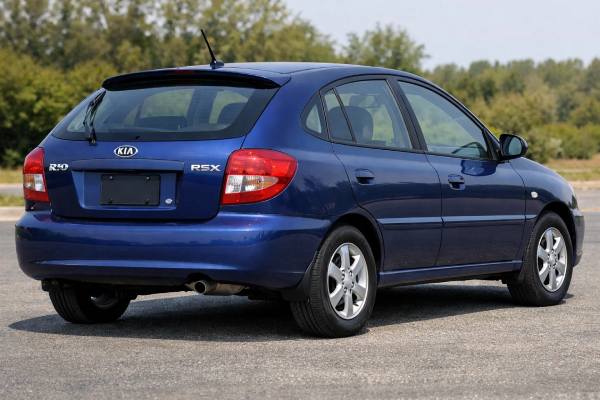
The facelifted 2002–2005 Kia Rio (DC) with the 1.5-liter B5-DE is the “sweet spot” of the first-generation Rio lineup: noticeably stronger than the smaller engine options, but still simple, light, and inexpensive to keep running. Its value today comes from straightforward mechanical systems, widely available service parts, and a compact footprint that’s easy to park and cheap to insure in many markets.
That said, this is an early-2000s budget car, so ownership success depends more on condition than on the badge. A good example is one with documented timing-belt service, a healthy cooling system, and suspension components that aren’t worn out. If you approach it with that mindset, the Rio can be a practical commuter or first car that rewards basic maintenance with predictable running costs.
Quick Specs and Notes
- Stronger everyday performance than 1.3 models, especially with passengers or hills.
- Simple drivetrain and chassis design keeps most repairs affordable.
- Parts availability is generally good, but trim and electrical niggles can add time.
- Budget for a timing-belt service if there’s no proof (typically every ~90,000 km / 60,000 mi or 5–6 years).
- Replace brake fluid about every 2 years to protect ABS components and calipers.
Jump to sections
- Kia Rio DC facelift at a glance
- Kia Rio DC 1.5 technical specs
- Kia Rio DC trims and safety
- Reliability issues and fixes
- Maintenance plan and buying tips
- Driving feel and fuel use
- Rivals worth cross-shopping
Kia Rio DC facelift at a glance
The 2002–2005 facelift Rio (DC) is built around a basic but proven small-car recipe: front-engine, front-wheel drive, a transverse inline-four, and a simple rear torsion-beam suspension. The facelift brought minor styling and equipment updates (market-dependent), but the core ownership story is the same: low mass, easy packaging, and mechanical accessibility.
With the 1.5-liter B5-DE rated around 98 hp, the car feels less strained than the smaller engines when merging or climbing. It won’t be quick by modern standards, but it’s typically “good enough” for daily traffic if the engine is healthy and the transmission shifts cleanly. The manual gearbox versions usually feel more responsive and economical, while the automatic versions prioritize ease of use—at the cost of slower acceleration and slightly higher fuel consumption.
The Rio’s main advantage today is that it’s still serviceable without specialized tools. Routine work—filters, plugs, belts, brakes, and most suspension parts—tends to be straightforward. The trade-off is refinement: noise insulation is modest, ride quality depends heavily on suspension condition, and cheap tires can make the car feel nervous on rough roads.
Ownership outcomes vary widely because many cars are now old enough that “deferred maintenance” becomes the real enemy. If the timing belt history is unknown, treat it as due. If the cooling system has been neglected, overheating risk becomes a serious engine threat. And if corrosion is present (especially in salty climates), it can turn a bargain into a project. A well-kept Rio can be a sensible commuter; a tired one can consume time in small but constant repairs.
Kia Rio DC 1.5 technical specs
Specifications for the facelift Rio vary by body style (sedan vs hatch/wagon in some markets), transmission, and local equipment. The tables below focus on the most common configurations for the B5-DE 1.5 with FWD.
Powertrain and efficiency
| Item | Spec (typical for 2002–2005 1.5) |
|---|---|
| Code | B5-DE |
| Engine layout and cylinders | Inline-4 (I-4), DOHC (market-dependent), 16-valve typical |
| Displacement | 1.5 L (≈1490 cc class) |
| Induction | Naturally aspirated |
| Fuel system | Multi-point fuel injection (MPFI) typical |
| Compression ratio | ~9.5–10.0:1 (varies by calibration) |
| Max power | 98 hp (73 kW) @ ~5,500 rpm (typical) |
| Max torque | ~130–135 Nm (96–100 lb-ft) @ ~3,000–4,000 rpm (typical) |
| Timing drive | Belt |
| Rated efficiency | ~6.5–8.5 L/100 km (28–36 mpg US / 33–43 mpg UK), depends on trans and body |
| Real-world highway @ 120 km/h (75 mph) | ~7.5–9.0 L/100 km (26–31 mpg US / 31–38 mpg UK), wind and tire choice matter |
Transmission and driveline
| Item | Spec |
|---|---|
| Transmission | 5-speed manual (common) or 4-speed automatic (common) |
| Drive type | FWD |
| Differential | Open |
Chassis and dimensions
Suspension and steering are conventional for the class, which helps parts cost and alignment work.
| Item | Spec (typical) |
|---|---|
| Suspension (front/rear) | MacPherson strut / torsion beam |
| Steering | Rack-and-pinion, hydraulic assist common |
| Brakes | Front disc / rear drum common; ABS optional/market-dependent |
| Wheels/tyres (popular size) | 175/70 R13 or 185/60 R14 (varies by trim) |
| Ground clearance | ~150–160 mm (5.9–6.3 in), market-dependent |
| Length / Width / Height | ~4,240 mm / ~1,680 mm / ~1,440 mm (167.0 / 66.1 / 56.7 in) typical |
| Wheelbase | ~2,410 mm (94.9 in) |
| Turning circle (kerb-to-kerb) | ~9.5–10.5 m (31–34 ft), depends on tires and steering stops |
| Kerb (curb) weight | ~970–1,120 kg (2,140–2,470 lb), depends on body and transmission |
| GVWR | ~1,400–1,500 kg (3,086–3,307 lb) typical |
| Fuel tank | ~45 L (11.9 US gal / 9.9 UK gal) typical |
| Cargo volume | Body-style dependent; expect ~320–350 L (11–12 ft³) seats up for hatch, larger trunk for sedan |
Performance and capability
| Item | Typical range |
|---|---|
| 0–100 km/h (0–62 mph) | ~11.5–13.5 s (manual faster, automatic slower) |
| Top speed | ~170–180 km/h (106–112 mph), conditions vary |
| Braking distance | 100–0 km/h ~42–47 m (62–0 mph ~138–154 ft), tire quality dominates |
| Towing capacity | Often not rated or very limited in many markets; check the VIN plate/manual |
| Payload | Commonly ~350–450 kg (772–992 lb), depends on GVWR and curb weight |
Fluids and service capacities
Capacities and specifications can vary by engine sub-version and market. Use these as planning numbers and verify for your exact VIN.
| Item | Typical spec |
|---|---|
| Engine oil | API SJ/SL-era equivalent; viscosity commonly 5W-30 or 10W-30; ~3.0–3.5 L (3.2–3.7 US qt) with filter |
| Coolant | Ethylene glycol long-life type; 50/50 mix typical; ~5–6 L (5.3–6.3 US qt) |
| Automatic transmission fluid (if equipped) | Kia/Hyundai-spec ATF for 4AT; capacity varies by service method (~5–7 L total) |
| Manual transmission oil (if equipped) | Gear oil per manual; often ~2 L class |
| A/C refrigerant | Usually R134a; charge amount varies by body and compressor |
| Key torque specs (critical fasteners) | Wheel nuts ~90–110 Nm (66–81 lb-ft); spark plugs ~18–25 Nm (13–18 lb-ft); oil drain plug often ~30–40 Nm (22–30 lb-ft) |
Safety and driver assistance
Early-2000s small cars usually have limited modern driver assistance. Expect basic safety hardware, with equipment varying sharply by trim and market.
| Item | Typical |
|---|---|
| Crash ratings | Often market-specific and may not exist for this exact configuration; verify by year and region |
| Airbags | Driver airbag common; passenger and side airbags vary |
| ABS / stability control | ABS may be optional; stability control is uncommon on this generation |
| ADAS | Generally none (no AEB/ACC/LKA on this era) |
Kia Rio DC trims and safety
Trim strategy for the facelift Rio is usually simple: a base model aimed at price, plus one or two higher trims that add comfort and safety equipment. Names differ by market (and sometimes by importer), so the most reliable approach is to identify the car by its physical cues and option content rather than the badge alone.
Common trim differences you’ll actually feel:
- Wheels and tires: Base trims often use smaller wheels with taller sidewalls. Those can ride better over broken pavement and cost less to replace. Higher trims may look nicer but can feel harsher if the suspension is worn.
- Air conditioning: Some base cars have simpler HVAC or no A/C in certain markets. If A/C matters to you, confirm it blows cold and that the compressor doesn’t cycle rapidly (a sign of low refrigerant or pressure issues).
- Power features: Power windows/locks and heated mirrors are typical “step-up” items. Failures are usually minor (switches, window regulators) but can be time-consuming.
- Audio and interior: Higher trims may add better head units or speakers, but many cars now have aftermarket radios. Check wiring quality—poor installs can cause parasitic battery drain.
Quick identifiers when shopping:
- ABS check: Turn the key to ON and confirm the ABS light illuminates briefly, then turns off after startup (if equipped). No light at all can mean the bulb is removed.
- Airbag clues: An “SRS” or airbag light should illuminate briefly at key-on and then go out. A permanently lit (or missing) light needs investigation.
- Seatbelt hardware and anchors: Look for ISOFIX/LATCH points (often labeled on the rear seat) if you plan to use child seats. In some variants, tether anchors exist but can be hidden under trim panels.
Safety equipment expectations (realistic for this era):
- Structure and restraint design are older-generation. The car can be safe when maintained (good tires, brakes, and functioning airbags), but it does not have the crash-avoidance technology common today.
- ABS, if present, is a meaningful upgrade for wet braking stability. If you drive in rain or snow, it’s worth prioritizing.
- Headlights are often adequate at best. Cloudy lenses and weak bulbs reduce visibility more than owners realize. Restoring lenses and using quality bulbs is a low-cost safety improvement.
After-service calibration considerations: There’s little in the way of camera/radar calibration on this platform, but basic sensor work still matters. If the car has ABS, keep wheel-speed sensors and tone rings clean and correctly routed after brake or hub work. A sloppy sensor harness repair can cause intermittent ABS faults that only appear in heavy rain or during tight steering angles.
Reliability issues and fixes
A well-maintained Rio can be dependable, but age-related failures are now the rule rather than the exception. Below are the issues owners most often encounter, grouped by how frequently they show up and how painful they are when they do.
Common (low to medium cost)
- Timing belt overdue (high consequence, medium cost):
Symptoms: Unknown service history, belt noise, or “it was done a long time ago.”
Likely cause: Time and mileage degrade the belt and tensioner.
Remedy: Replace timing belt kit (belt, tensioner, idlers). Many owners also do the water pump at the same time because labor overlaps. - Cooling system aging (medium consequence, low to medium cost):
Symptoms: Slow coolant loss, overheating in traffic, heater performance changes, crusty residue around hoses/radiator.
Likely cause: Old hoses, radiator end-tanks, thermostat sticking, weak cap.
Remedy: Pressure-test, replace weak components, and refresh coolant with the correct mix. Overheating is not something to “monitor.” - Idle quality and drivability niggles (low consequence, low cost):
Symptoms: Hunting idle, stalling when cold, hesitation.
Likely cause: Dirty throttle body, aging ignition components, vacuum leaks, tired oxygen sensor.
Remedy: Start with basics: air leaks, throttle cleaning, plugs/wires (or coils depending on version), and proper fuel trims diagnosis.
Occasional (medium cost)
- Automatic transmission shift quality (medium consequence, medium cost):
Symptoms: Harsh shifts, delayed engagement, or flare between gears.
Likely cause: Old ATF, solenoid wear, or internal clutch wear (especially with neglected fluid).
Remedy: Confirm fluid level/condition, service with correct ATF, and avoid “power flush” on a very dirty unit unless a specialist recommends it. - Front suspension wear (medium consequence, low to medium cost):
Symptoms: Clunks over bumps, wandering alignment, uneven tire wear.
Likely cause: Worn control-arm bushings, ball joints, strut mounts, tie-rod ends.
Remedy: Replace worn parts as a set when possible, then align. Cheap parts can cause repeat repairs.
Rare to less common (can be high cost)
- Rust and corrosion (high consequence, variable cost):
Symptoms: Soft jacking points, crusty brake lines, bubbling at arches or underbody seams.
Likely cause: Salt exposure plus age.
Remedy: If structural areas are compromised, walk away unless you’re buying it as a project.
Recalls, service actions, and verification
Because recall coverage varies by country, verification is always VIN-based. Ask for paperwork, then confirm through official recall lookup tools or dealer records. Pay special attention to fuel-system and safety-related actions, because those can be expensive if unresolved and risky if ignored. When in doubt, a dealer can check campaign completion by VIN and print the results.
Maintenance plan and buying tips
The Rio responds well to a “simple but strict” maintenance approach. The goal is not perfection—it’s preventing the few failure modes that can total the engine or make the car unreliable.
Practical maintenance schedule (distance/time)
Use distance or time, whichever comes first.
| Item | Interval (typical) | Notes |
|---|---|---|
| Engine oil and filter | 7,500–10,000 km (5,000–6,000 mi) or 6–12 months | Short trips and hot climates benefit from shorter intervals |
| Engine air filter | 15,000–20,000 km (10,000–12,000 mi) | Inspect more often in dusty areas |
| Cabin filter (if equipped) | 12 months | Not all trims have one |
| Coolant | 3–5 years | Replace sooner if unknown or contaminated |
| Spark plugs | 30,000–60,000 km (20,000–40,000 mi) | Depends on plug type and ignition system |
| Timing belt kit | ~90,000 km (60,000 mi) or 5–6 years | Replace earlier if oil contamination or noise is present |
| Accessory belts and hoses | Inspect every oil service | Replace at first cracking/glazing |
| Brake fluid | Every 2 years | Helps prevent internal corrosion and ABS issues |
| Brake pads/rotors | Inspect every 10,000–15,000 km | Replace based on thickness and vibration |
| Manual trans oil (if manual) | 60,000–100,000 km | Improves shift feel and bearing life |
| ATF (if automatic) | 40,000–60,000 km | Earlier if the car has city-only use |
| Tires rotation and alignment | Rotate 10,000 km; align as needed | Alignment matters more than most owners expect |
| 12 V battery test | Annually after year 3 | Weak batteries cause hard-start and charging complaints |
Fluids, specs, and “decision” torque values
For planning, the Rio typically uses common viscosities and standard service fluids for its era. The most important rule is correct specification first, brand second. Torque values matter most where over-tightening causes damage:
- Wheel nuts: keep within spec to avoid warped rotors and damaged studs.
- Spark plugs: overtightening can damage threads; undertightening can cause misfires.
- Oil drain plug: stripping the pan threads is an avoidable headache.
Buyer’s guide: what to check before you pay
Ask for proof or price it in:
- Timing belt kit replacement (with date and mileage).
- Cooling system service (coolant condition, thermostat/radiator work).
- Transmission fluid service (especially for automatics).
Inspect in person:
- Cold start: listen for belt noise, rattles, and unstable idle.
- Overheat signs: stained overflow tank, sweet smell, oily coolant, or pressure in hoses when cold.
- Rust hotspots: sills, rear arches, underbody seams, brake lines, and subframe mounting points.
- Test drive: straight-line tracking, brake vibration, and any harsh 1–2 shifts (automatic).
- Electrical basics: charging voltage, window regulators, central locking, and dash warning lights.
Best-fit buyer profile: This Rio makes sense for someone who values low purchase price and can stay disciplined on preventative maintenance. If you want modern crash-avoidance tech or “set and forget” reliability with zero attention, a newer supermini is the better answer.
Driving feel and fuel use
In real-world driving, the 98 hp 1.5 is the configuration that makes the Rio feel less like a “city-only” car. Throttle response is typically honest—no turbo lag, no complicated drive modes—just a straightforward cable/throttle-body era feel (market-dependent). The engine’s strength is midrange usability rather than top-end excitement. It pulls adequately from low rpm for normal traffic, and it doesn’t require constant downshifts the way smaller engines can.
Ride, handling, and NVH: The chassis is simple and predictable. With good suspension bushings and decent tires, it tracks straight and turns in without drama. The rear torsion beam keeps costs low but can make the car feel “busy” over broken pavement, especially if rear shocks are weak. Cabin noise is the main refinement gap versus newer rivals: wind noise around mirrors and road roar on coarse asphalt are common. Fresh door seals and correct tire pressures help, but the Rio will always feel like an early-2000s economy car.
Transmission character:
- Manual: Usually the better match for the 1.5’s power band. It improves responsiveness and often returns better fuel economy.
- Automatic: Smoothness depends heavily on fluid condition. A healthy unit shifts cleanly, but neglected ATF can lead to flare or harsh engagement.
Real-world efficiency (typical):
- City: ~7.5–9.5 L/100 km (25–31 mpg US / 30–38 mpg UK)
- Highway 100–120 km/h: ~6.5–9.0 L/100 km (26–36 mpg US / 31–43 mpg UK)
- Mixed: ~7.0–8.8 L/100 km (27–34 mpg US / 32–40 mpg UK)
Cold weather, short trips, and underinflated tires can easily add 0.5–1.0 L/100 km. If your Rio’s fuel use is far worse than expected, don’t assume “it’s old.” Check thermostat operation (engine running too cool), oxygen sensor function, dragging brakes, and alignment.
Performance metrics that actually matter: Expect 0–100 km/h in the low-to-mid 12s for many cars, with passing performance that is adequate if you plan your gaps. Braking feel is mostly a function of tire quality and front brake condition; a spongy pedal often points to old brake fluid or air in the system. If you want the Rio to feel safe at speed, spend money on tires first, brakes second, shocks third.
Rivals worth cross-shopping
The facelift Rio sits in a crowded used-car space, and it’s smart to compare it against a few “usual suspects.” The goal isn’t to find a perfect car—it’s to find the best match for your priorities and local parts/support.
If you want maximum durability:
- Toyota Yaris/Echo (same era): Often stronger long-term reliability and fewer electrical annoyances. You may pay more up front, but you can regain it in fewer small repairs.
- Honda Jazz/Fit (early years): Excellent packaging and practical space, typically stronger resale. Watch for rust and suspension wear like any older car.
If you want similar value with different trade-offs:
- Hyundai Accent (early 2000s): Close cousin in spirit—simple, cheap, easy to service. Choose based on the best-maintained example, not the badge.
- Ford Fiesta (older generations): Often better steering feel and chassis tuning, but parts and electrical complexity vary by market and year.
If you want a more “solid” highway feel:
- Volkswagen Polo / Opel (Vauxhall) Corsa / Renault Clio (depending on market): These can feel more refined, but they may cost more to repair if neglected, especially with aging electronics or higher parts pricing.
How the Rio 1.5 wins:
- Usually cheaper to buy than the Japanese leaders in the segment.
- Straightforward mechanical layout that independent shops understand.
- The 1.5 output is enough for everyday use without needing to drive it hard.
Where it loses:
- Less modern crash-avoidance tech and sometimes fewer airbags than newer rivals.
- More cabin noise and an “economy-grade” interior that may rattle with age.
- Condition sensitivity: a neglected Rio feels worn quickly, while a cared-for one feels honest and competent.
Best decision rule: Choose the Rio when you can verify major maintenance (timing belt, cooling system, fluids) and the body is structurally clean. Choose a rival when you need a quieter highway car, stronger safety equipment, or you prefer paying more upfront to reduce the odds of recurring small repairs.
References
- Gas Mileage of 2004 Kia Rio 2004 (Fuel Economy Data)
- Check for Recalls: Vehicle, Car Seat, Tire, Equipment | NHTSA 2026 (Recall Database)
- Safety Recall: Rlo/Rio Cinco Fuel Distributor Replacement 2004 (Recall Bulletin)
- Service Intervals 2016 (Service Intervals)
Disclaimer
This article is for informational purposes only and is not a substitute for professional inspection, diagnosis, or repair. Specifications, torque values, service intervals, and procedures can vary by VIN, market, body style, transmission, and installed equipment—always verify details using the correct official service documentation for your vehicle.
If this guide helped, consider sharing it on Facebook or X to support our work and help other owners make informed decisions.